
How Much Does It Cost to Case Openings and Add Craftsman Trim in Menifee in 2026?
Quick Answer
Holland & Sons Construction prices cased openings in Menifee and the Inland Empire at roughly $900 to $1,400 per standard opening when several are done together, $1,500 to $2,500 for a single opening on its own, and $3,500 to $5,500 for a main opening with a built-up Craftsman header and column bases. Most whole-house packages land between $5,000 and $15,000+. The number of openings, how many get a crowned header, the material (pine, poplar, or MDF), and whether paint is included drive most of the difference.
Key Takeaways
-
Standard cased opening, done in a group: $900 to $1,400. Single opening alone: $1,500 to $2,500. Feature opening with header and column bases: $3,500 to $5,500.
-
The biggest decision factor is not material. It is how many openings get the full Craftsman treatment. One crowned header adds $900 to $1,300; five of them adds five times that.
-
Online per-foot casing numbers assume a door jamb already exists. A drywall-wrapped tract-home opening has none, so the jamb has to be built first. That is most of the labor.
-
Holland & Sons backs doors and trim with a five-year workmanship warranty, and the paint is included in the number, not added later.
-
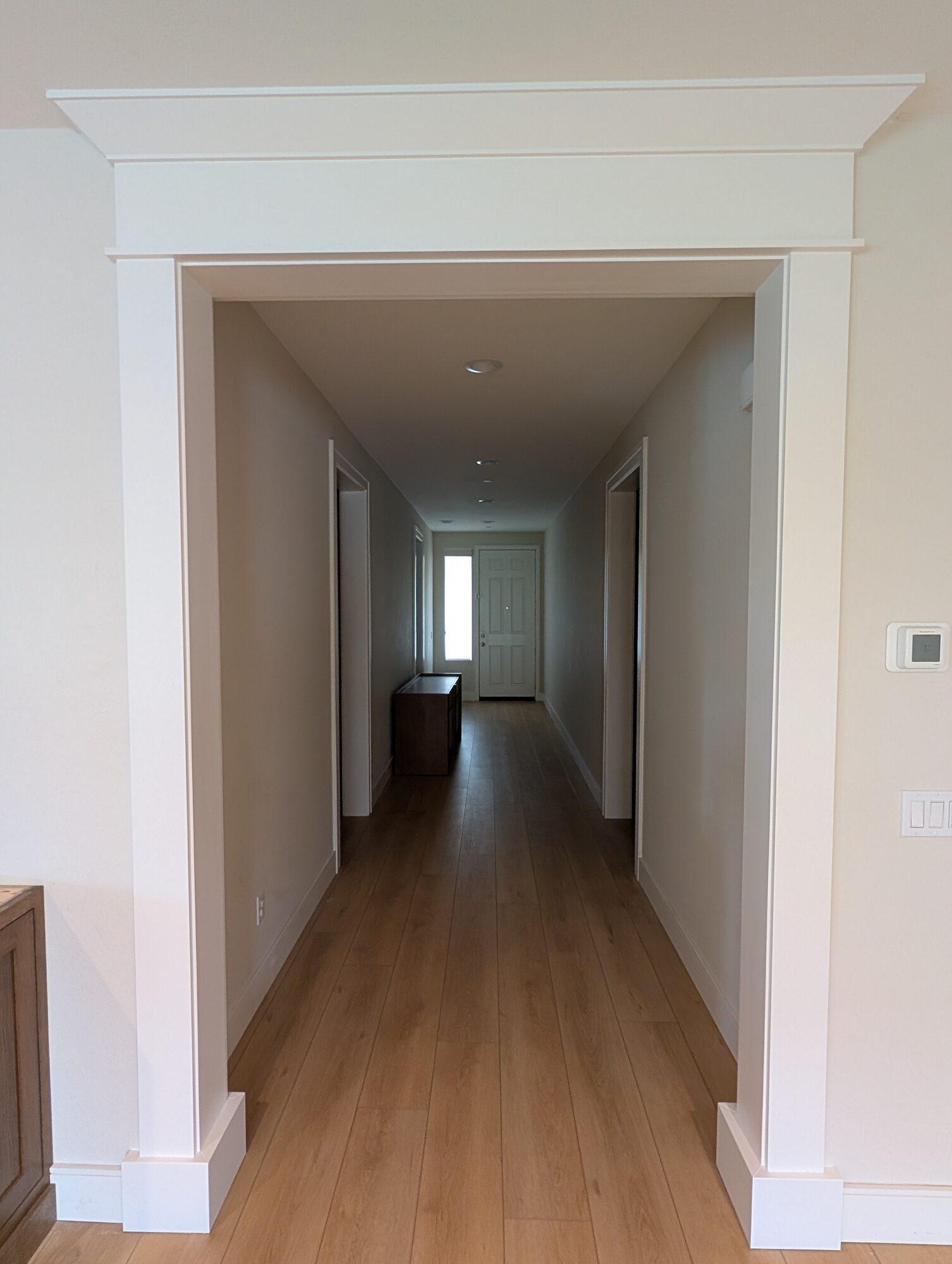
See this in action: the Painted Trail Trim project, five openings cased for $6,737 in Audie Murphy Ranch, Menifee: Painted Trail Cased Openings
You have probably already seen $8 to $12 per linear foot, or $150 to $250 per door. Those numbers are real. They are for a different job: nailing casing around a door that already has a jamb, the wood frame inside the opening that casing lands on. A drywall-wrapped opening in a Menifee tract home has no jamb. It is drywall folded around a framed hole.
What you are actually buying is a true, solid opening built out of the wall: jambs the full thickness of the wall, casing on both faces, and paint that turns all of it into one piece. Priced that way, a cased opening in Riverside County runs $900 to $2,500 depending on how many you do at once, and a feature opening with a Craftsman header runs $3,500 to $5,500. Here is where every one of those dollars goes.
The Direct Answer: What Cased Openings Cost in Menifee in 2026
Holland & Sons' cased opening projects in Menifee, Murrieta, Temecula, and the surrounding Inland Empire run from about $1,500 for a single standard opening to $15,000+ for a whole house with multiple crowned headers in poplar. Most families land in the middle, $5,000 to $9,000: four to six openings fully cased, one of them carrying the header and column bases.
Three things move the number. How many openings. How many get the full header instead of clean casing. And whether paint is included, because a cased opening without paint is half a job.
Room-by-Room Investment Table
| Opening Type | Typical Investment Range |
|---|---|
| Single standard opening, done alone (jambs, casing both faces, paint) | $1,500 – $2,500 |
| Each additional standard opening in the same visit | $900 – $1,400 |
| Main living-area opening with three-piece Craftsman header and column bases, done alone | $3,500 – $5,500 |
| Four to six openings with one feature opening (the Painted Trail project) | $5,000 – $9,000 |
| Whole house: every opening cased, multiple crowned headers, poplar or hardwood | $10,000 – $15,000+ |
| Widening or relocating an opening | Priced per job; involves the header framing above and usually a permit |
Ranges vary by opening width, ceiling height, material selection, and how far out of plumb the existing framing is. If your project is really a whole-home door and trim replacement rather than cased openings, that is a different number and we have written it up separately.
Cost Per Unit: Why This Job Is Priced Per Opening, Not Per Foot
| Unit | Typical Range | What It Describes |
|---|---|---|
| Per linear foot, casing on an existing jamb | $8 – $12 | Homewyse's May 2026 national figure for nailing casing to a door jamb. Includes "planing or sanding the jamb edge," so a jamb is assumed |
| Per standard cased opening, built from a drywall passage | $900 – $2,500 | Fur-out, jambs the full wall thickness, casing both faces, fill, caulk, two coats of trim enamel |
| Per feature opening with header and bases | $3,500 – $5,500 | Everything above plus a three-piece built-up header with crown and a pair of mitered column bases |
| Per crowned header added to an opening | +$900 – $1,300 | Head casing, projecting cap, crown, sized to the ceiling height |
| Per pair of column bases | +$250 – $400 | Mitered boxes at the foot of each pilaster, sized to clear the existing baseboard |
To apply this to your house: count the drywall-wrapped openings, price the main passage into the living area as a feature opening, and the rest as standard openings in the same visit. That gives you a realistic preliminary budget; the opening widths, the ceiling height, and how far out of plumb the framing is will move the final number.
What Drives the Investment
What adds to it:
-
More openings, or wider ones. A six-foot opening needs longer stock and a bigger header than a three-foot hall passage.
-
Crown or built-up headers on more than one opening. This is the single biggest lever in the whole project.
-
Poplar or hardwood in place of pine. Here is where each material belongs.
-
Taller ceilings. Ten feet and up means taller pilasters and a bigger header to keep the proportion right. Here is how we size baseboard, casing, and crown.
-
Openings badly out of plumb or square, which need heavier fur-out work before any jamb goes in.
-
Tying the new casing into new baseboard, wainscoting, or crown around the room.
What controls it:
-
Fewer openings, or crown on only the one that matters most.
-
Standard eight- or nine-foot ceilings.
-
MDF casing on openings nobody touches, pine where hands and furniture land.
-
Keeping the existing baseboard and wall paint. The Painted Trail project kept both.
What you can influence: the design decision. One crowned opening and four clean ones costs a fraction of five crowned openings, and it looks better. The hierarchy is the design, and it happens to be the budget too.
What Is Included vs. Not Included
Included in a Holland & Sons cased opening quote:
-
Fur-out framing in kiln-dried stock to true up the opening
-
Jambs ripped to the full wall thickness so no drywall shows inside the passage
-
Casing on both faces of every opening
-
Header build-up and column bases on the feature opening, if specified
-
All material, including factory-primed stock for the column bases
-
Nail-hole filling, caulking, and two coats of trim enamel on site
-
Daily cleanup and haul-away of cut-offs and dust
-
A hand-sketched layout and the on-site design meeting
-
A five-year workmanship warranty on doors and trim
Not included unless it is in the scope:
-
Interior doors, new or replaced
-
Baseboard replacement, if the existing base stays
-
Wall paint beyond the trim
-
Moving thermostats, switches, or outlets that sit next to an opening
-
Widening, raising, or relocating an opening, which touches the header framing and usually a permit
Contractor Quote Comparison Framework
Two quotes for the same five openings can be $2,000 apart and both be honest. The difference is in what each one is building. Run both quotes against this list. A fuller version of how to read trim quotes is here.
| Line Item | What Its Presence or Absence Tells You |
|---|---|
| Jambs, and their thickness | If the word "jamb" is missing, the quote is casing nailed to the drywall edge, and drywall will still show inside the passage. Jambs should be called out at full wall thickness. |
| Fur-out or backing | Tract openings are rarely plumb. Truing the opening first is what keeps the reveals from cracking later. |
| Material by species, by location | "Pine jambs and casing, MDF crown" is a specification. "Paint-grade trim" is not. |
| Header: number of pieces | One flat board is a head casing. Three stacked pieces (head, cap, crown) is a built-up header. Priced very differently, and they look it. |
| Column bases | Tells you whether the opening is being built as a composition or casing is being run to the floor. |
| Paint: product and coats | Named product, two coats, fill and caulk included. If paint is excluded, add $300 to $500 per opening before comparing. |
| Existing baseboard | Kept, replaced, or cut back? Each is fine. Silence is not. |
| Design or layout | A sketch means the proportions were decided before the saw started. |
| Warranty and cleanup | Workmanship warranty in writing with a term (Holland & Sons: five years on doors and trim), and daily cleanup with haul-away. |
Pricing Tiers for Cased Openings
| Build Level | Investment Range | What You Get |
|---|---|---|
| Entry | $3,500+ | One large opening dressed with casing and a built-up header, or several small openings with simple casing and no jambs. Holland & Sons will build the no-jamb version if a client asks for it, and will say up front that it is not the version we recommend: the rounded drywall corner stays, and it shows inside the passage. |
| Mid-Range | $5,000 – $9,000 | Four to six openings fully cased with solid pine jambs and wide casing, one feature opening with column bases and a Craftsman header, paint included. The Painted Trail project sits here at $6,737. |
| Full Custom | $10,000 – $15,000+ | Every opening in the house cased, multiple crowned headers, poplar or hardwood stock, paneled jamb returns, or wainscoting tied into the openings. |
A note on the two low numbers in this post. The $1,500 to $2,500 single standard opening in the room-by-room table sits below the Entry tier because Entry assumes a built-up header on one large opening. One plain hallway opening, cased with jambs and painted, is the smallest job on this list and lands under $3,500 on its own.
How to Choose the Right Tier
-
Count the openings you walk through every day. Those are the ones to case. A guest-bath passage nobody notices can wait.
-
Pick one opening to carry the emphasis, almost always the passage into the kitchen, dining, and family area. That one gets the header and bases.
-
Decide whether the casing needs to tie into anything else now (new baseboard, wainscoting). If yes, you are in the full-custom tier and should plan the whole room at once.
-
Check the ceiling height. Nine feet is standard here and the mid tier assumes it. Ten feet and up moves the header size and the number.
-
Read the quote against the framework above. If it is missing jambs or fur-out, read what goes wrong when those are skipped before you sign.
See This In Action: Painted Trail Trim
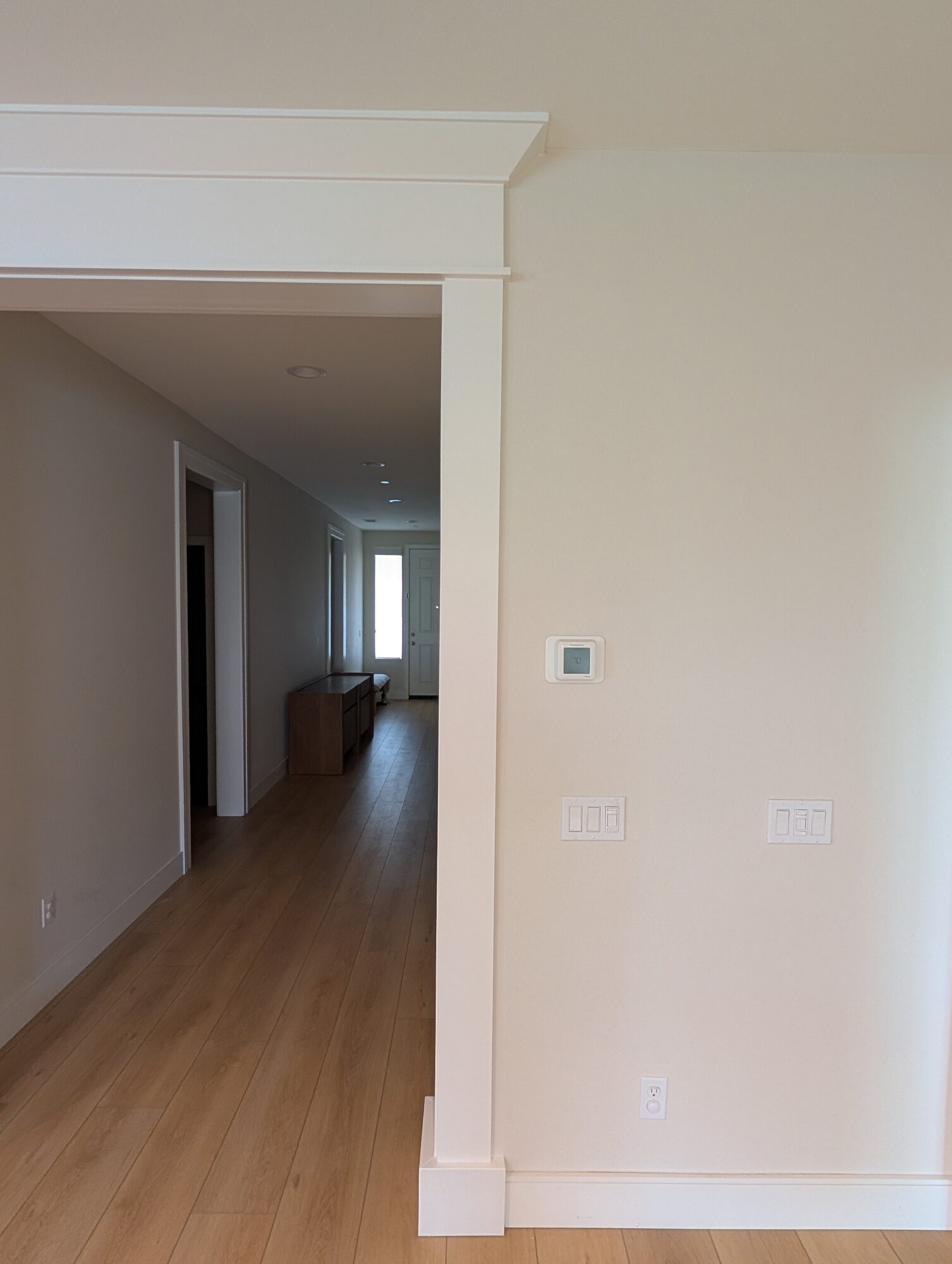
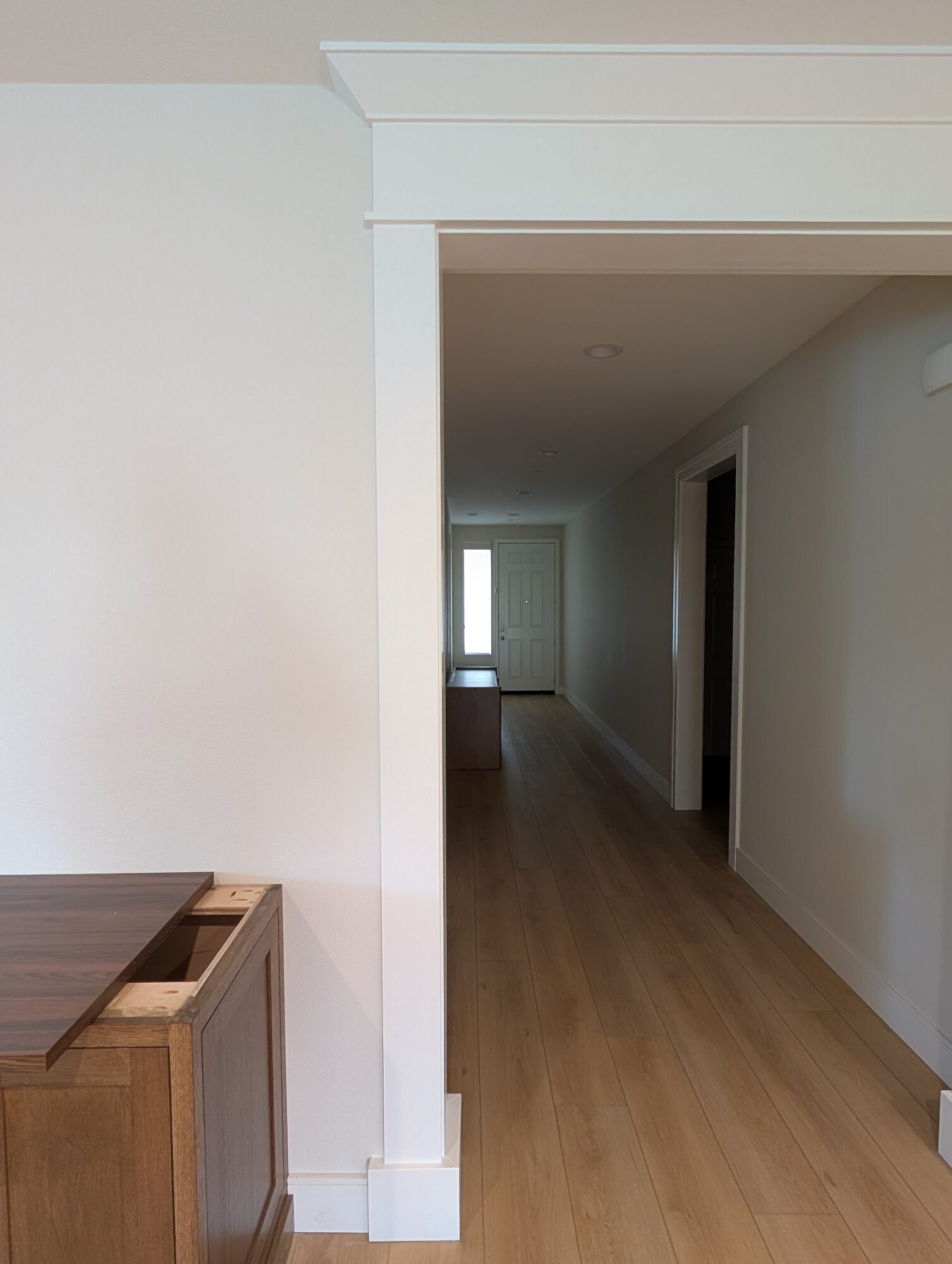
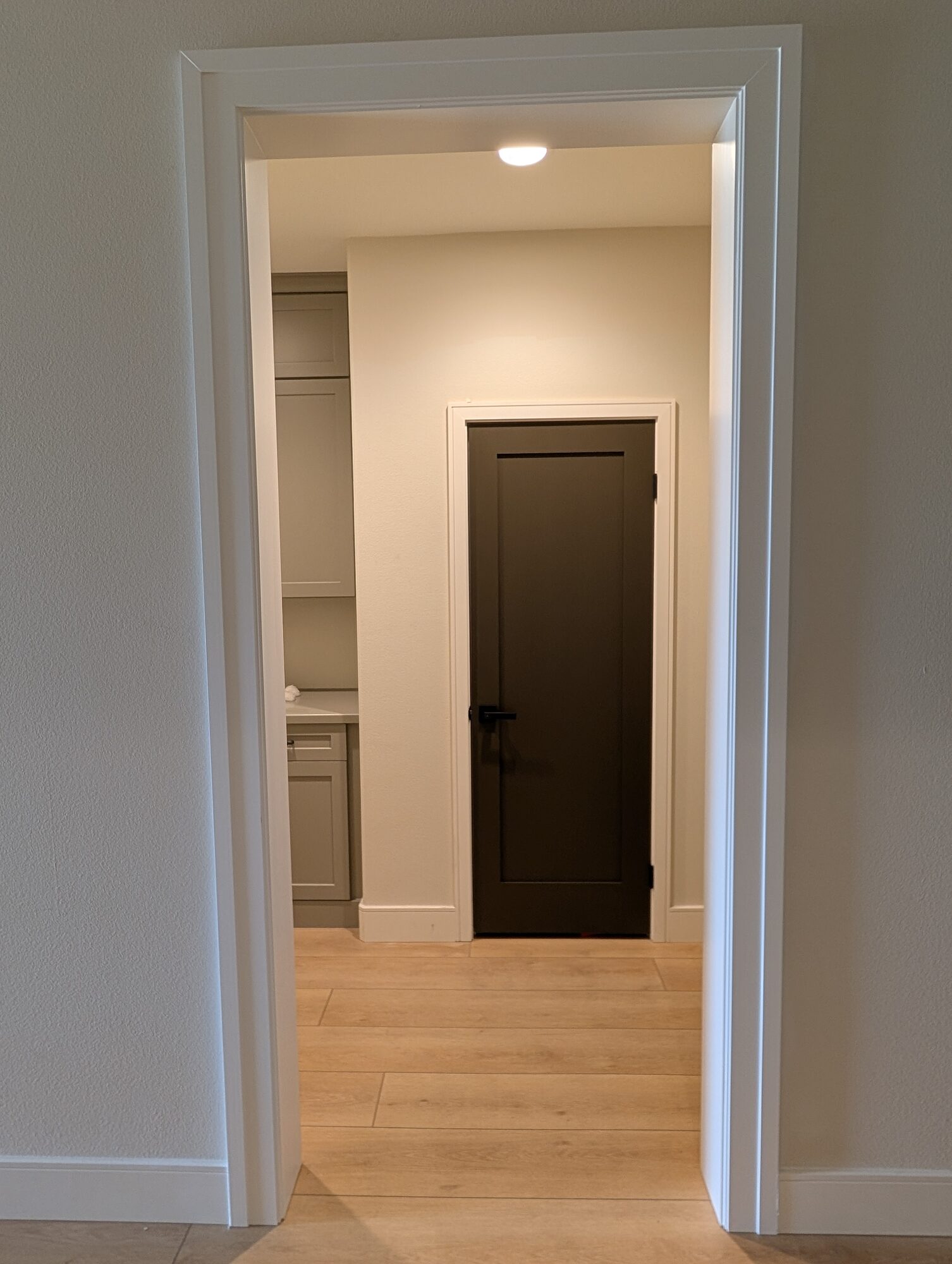
Five openings, four days, zero days in the shop: every piece on the Painted Trail Trim project was cut inside the house, two days of carpentry and two days of paint, for $6,737.
What we used on this project:
-
Solid pine 1x10 jambs ripped to full wall thickness, and solid pine casing and molding on all five openings
-
A three-piece built-up Craftsman header (head casing, projecting cap, MDF crown) on the main opening only
-
Column bases built as mitered boxes from WindsorONE kiln-dried, factory-primed fascia, sized to clear the existing baseboard
-
Kiln-dried fir fur-out built into the sides of every opening before the jambs went on
-
Two days of on-site paint in Sherwin-Williams Emerald Urethane Trim Enamel, Pure White SW 7005
The hub post has every photo, the line-item breakdown of the $6,737, the material-by-material reasoning, and the four-day timeline. Link: the full project story
Local Market Context: Menifee and Southwest Riverside County
Audie Murphy Ranch, Menifee Ranch, and the newer tracts in French Valley, Winchester, and Wildomar were built by national production builders (DR Horton, Lennar, Richmond American) on a model that finishes interior passageways in drywall. It is fast and it is normal. It is also why nearly every new home in Southwest Riverside County has the same openings, and why the tells of builder-grade trim show up in the first year of living there. In a tract where twelve houses share your floor plan, cased openings are a modest investment no other house on the street has. In Corona, Norco, Eastvale, and Riverside, with older housing mixed in, the question is usually matching new cased openings to existing trim, which moves profile decisions up front but does not change the per-opening math much.
Local ROI and Home Value
Homes in Menifee, Murrieta, Temecula, and Lake Elsinore compete against nearly identical tract homes when they sell, and buyers remember the one with real architectural detail long after the showing. A cased opening with a proper header is the kind of thing a buyer photographs on their phone without knowing why.
The national data points the same way. The National Association of Realtors' 2025 Remodeling Impact Report found that 64% of homeowners had a greater desire to be in their homes after a remodeling project, and 46% reported more enjoyment of their living space. Trim does not show up as its own line in that report; it shows up in how the whole house reads. Results vary by home, market, and project scope.
The Holland & Sons Angle
The Painted Trail number, $6,737 for five openings in four days with nothing built in the shop, is a useful one to study because nothing in it is padding. Materials were about $1,400. Two days of carpentry, two days of paint, a half-day of design and layout, and cleanup made up the rest. Pricing a job like this honestly means pricing the parts the homeowner never sees, the fur-out and the jambs, at what they actually take, and not hiding them inside a per-foot number that pretends they do not exist. Two days of carpentry is a tight number for five openings, and it held because the cuts were right the first time. Wyatt ran the majority of the saw work on this job, and the lesson he is in the middle of learning is the one that makes a quote hold: a carpenter who can cut it once is the reason the number on the contract is the number on the invoice.
Related Resources: Cased Openings and Craftsman Trim Guide
This post is one of six companion guides built around the Painted Trail Trim project in Menifee. Together they cover the whole decision, from what it costs to who should build it.
-
Cased Openings and Craftsman Trim in Menifee, CA: Five Openings, One Crown, and Knowing Where to Stop (Painted Trail Trim): the project itself, with photos, the full $6,737 breakdown, the four-day timeline, and every material decision
-
What Goes Wrong When You Add Trim to Drywall-Wrapped Openings in a Tract Home?: the failures you can see, the ones you can't yet, and how to check the work before paint hides it
-
MDF vs. Pine Trim: Which Is Right for Your Inland Empire Home?: where each paint-grade material belongs, with poplar and factory-primed stock in the mix
-
What Paint Finish Should You Use on Custom Interior Trim? A Finish Carpenter Compares the Options: what installed trim has to survive, and which finishes hold up to it
-
How to Hire a Trim Carpenter in Menifee: What Good Trim Work Looks Like Before You Sign: a scorecard, the questions that sort the carpenters from the guessers, and what a complete quote includes
-
Should Every Doorway Get the Same Trim? Where to Put the Crown and Where to Stop: how to decide which openings match, which coordinate, and which one gets the emphasis
Frequently Asked Questions
How much does it cost to case an opening in Menifee?
A single drywall-wrapped opening converted to a fully cased opening (jambs, casing, paint) usually runs $1,500 to $2,500 in Menifee and the Inland Empire when it is the only opening on the job, and $900 to $1,400 each when several are done in one visit. A main opening with a built-up Craftsman header and column bases runs $3,500 to $5,500 on its own. The Painted Trail Trim project in Audie Murphy Ranch cased five openings, including one feature opening, for $6,737.
Why is the online number for door casing so much lower than my quote?
Because the online number is for nailing casing to a door that already has a jamb. Homewyse's May 2026 figure of $7.92 to $12.14 per linear foot includes "planing or sanding the jamb edge," which tells you a jamb is assumed. A drywall-wrapped opening in a tract home has no jamb. The jamb has to be built first, on solid backing, and the opening has to be trued up before any casing goes on. That is most of the labor, and it is why per-foot casing numbers do not describe this job.
What is the labor cost to install door casing per opening?
Casing alone on an existing jamb typically runs $150 to $300 per side in labor across the Inland Empire. Building a cased opening from a drywall passage is a different task: fur-out, jambs, casing on both faces, filling, caulking, and paint. Figure $600 to $1,100 in labor per standard opening when several are done together, more for a single opening because of setup time, and more again for a header and column bases.
How much does a trim carpenter cost per hour in California?
A fully burdened rate for a top-level finish carpenter in Riverside County, meaning wages plus insurance, workers' comp, tools, truck, and overhead, runs around $170 an hour, and a junior carpenter around $120. Published online averages are lower because they usually quote bare wages. Holland & Sons quotes by the opening and by the scope, not by the hour, so the number you sign is the number you pay. An hourly rate only matters when the scope is open-ended, which is exactly what you want to avoid on trim work.
How much does Craftsman trim cost compared with plain casing?
On a cased opening, the Craftsman treatment adds roughly $900 to $1,300 for a three-piece built-up header with crown and $250 to $400 for a pair of column bases, over the same opening with flat casing run straight to the floor. The rest of the opening (jambs, fur-out, casing, paint) costs the same either way. That is why Holland & Sons usually recommends the full treatment on one opening and clean casing on the rest.
Is it worth it to upgrade the trim in a new tract home?
For most families, yes, because it is one of the few upgrades that changes how the house feels every single day for a number that fits inside a normal budget. The National Association of Realtors' 2025 Remodeling Impact Report found 64% of homeowners had a greater desire to be home after a remodeling project. Trim is also what buyers notice first in a neighborhood where every floor plan repeats. Results vary by home, market, and project scope.
Does casing openings include paint?
At Holland & Sons it does, and it should in any quote you accept. Paint is where a cased opening succeeds or fails: filling nail holes, caulking the reveals, and two coats of a hard trim enamel. The Painted Trail project carried two full days of on-site paint in Sherwin-Williams Emerald Urethane Trim Enamel inside its $6,737. If a quote excludes paint, add $300 to $500 per opening to compare it fairly.
Ready for a Real Number?
If your new build has drywall openings in every direction and you have been putting off the call because you had no idea what it costs, now you have a range. The next step is a visit, a tape measure, and a sketch, and the first meeting is usually the only one you need.
Start your project at hsconstruct.com/contact. Fill out the form, describe the project, and upload a photo or two of the openings or trim you are thinking about, plus any inspiration photos you have saved. Brian reads every one. Want to see this advice applied to a real project? Here's the full breakdown: the full project story. More finished work is on Facebook, Instagram, YouTube, and TikTok at hollandandsonsconstruction. We build in Menifee, Murrieta, Temecula, Wildomar, French Valley, Winchester, Canyon Lake, Lake Elsinore, Perris, Norco, Corona, Eastvale, and all across Riverside County and the Inland Empire.
951-338-8058 | brian@hsconstruct.com | hsconstruct.com | CSLB #1123738
More Than Just Cased Openings
Cased openings and Craftsman trim are one piece of what we do at Holland & Sons, and they are one chapter in a much longer story. Brian has been a finish carpenter since 1991, and his sons now build alongside him, which means every room in your home is fair game. If your space needs more than casing and a header, here's what else we build:
-
Kitchen and bathroom remodels: full custom cabinetry, tile work, and finish carpentry from demo to done
-
Custom and built-in cabinetry: designed for the room, built in the shop, installed to last
-
Media walls and entertainment walls: built-in TV walls with storage, lighting, and clean cable management
-
Fireplace walls: mantels, surrounds, and full-height paneling that make the fireplace the center of the room
-
Accent walls: paneling, slat walls, and feature walls that give one wall a job to do
-
Mudrooms: lockers, bench seating, cubbies, and hooks, built for the way your family comes through the door
-
Coffered ceilings: grid beam systems that add architectural depth to any room, sized and proportioned to the space
-
Wainscoting and wall paneling: classic raised panel, flat panel, board-and-batten, and shiplap applications
-
Reclaimed wood accents: feature walls, fireplace surrounds, and detail work using salvaged material with real character
-
Beam wraps: hollow wood wraps that give exposed beams the look of solid timber without the structural engineering
-
Crown molding, baseboards, and trim carpentry: the details that make a house feel finished, from a single room to a whole home
-
Cased openings and interior door replacements: clean transitions between spaces that most contractors overlook
Wood, proportion, and rooms that feel right. That's what we do. hsconstruct.com
About the Author
Brian Holland is the owner and lead carpenter of Holland & Sons Construction, a family-run finish carpentry and general contracting company serving Riverside County and the Inland Empire. He entered the trade at 17 in 1991, learned on the job, and has spent every year since building the kind of work that makes rooms feel right, often before a homeowner can articulate why. Many projects start at his vintage drafting table, where he sketches the layout by hand with pencil and paper using a Vemco drafting machine before anything gets built. His sons now apprentice alongside him on every project. Holland & Sons is based in Perris, CA and licensed by the CSLB (#1123738).
Memberships & Credentials: NAHB Member | CBIA Member | NARI Member | BBB A+ Rated | Tanya Holland, NAHB Certified Aging-in-Place Specialist (CAPS) | CSLB #1123738
This guide is part of our interior doors & trim series.
Learn more about Interior Doors & TrimHave a project in mind? Let's start a conversation.
Tell us what you are thinking about and we will give you a straight answer about scope, timeline, and investment.
Start a Conversation