MDF vs. Pine Trim: Which Is Right for Your Inland Empire Home?
Quick Answer
Holland & Sons Construction uses solid pine for jambs, casing, and anything at hand height on Inland Empire trim projects, and MDF for crown and long flat runs up high where nothing touches it. Poplar earns its higher material investment in high-traffic spots that need a harder edge: chair rail, mudroom wainscoting, stair parts. The question is not which material is better. It is which one belongs in each location, and in a Menifee tract home the answer changes between the floor and the ceiling.
Key Takeaways
-
Pine where hands, furniture, and mops land. MDF where nothing touches it. Poplar where hardness is worth paying for.
-
The deciding factor is location in the room, not a universal winner. Floor-level trim in rooms with water is where MDF gets its bad reputation, and that reputation is earned there and nowhere else.
-
Inland Empire heat dries trim fast. Solid pine shrinks a little as it dries; MDF swells if it ever gets wet and does not fully recover. Both are manageable if the material is in the right place.
-
Holland & Sons specifies material by location on every quote, and backs doors and trim with a five-year workmanship warranty.
-
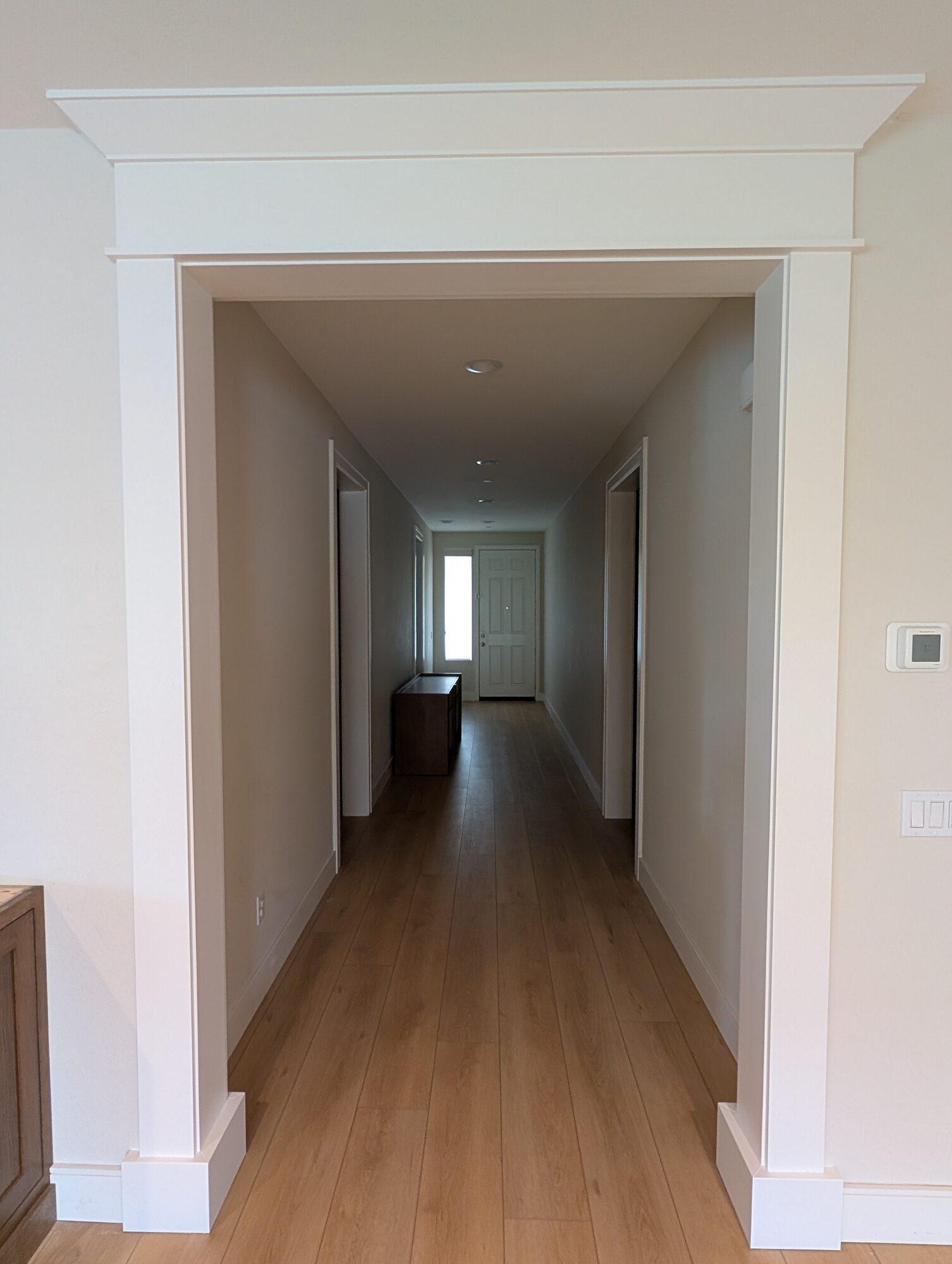
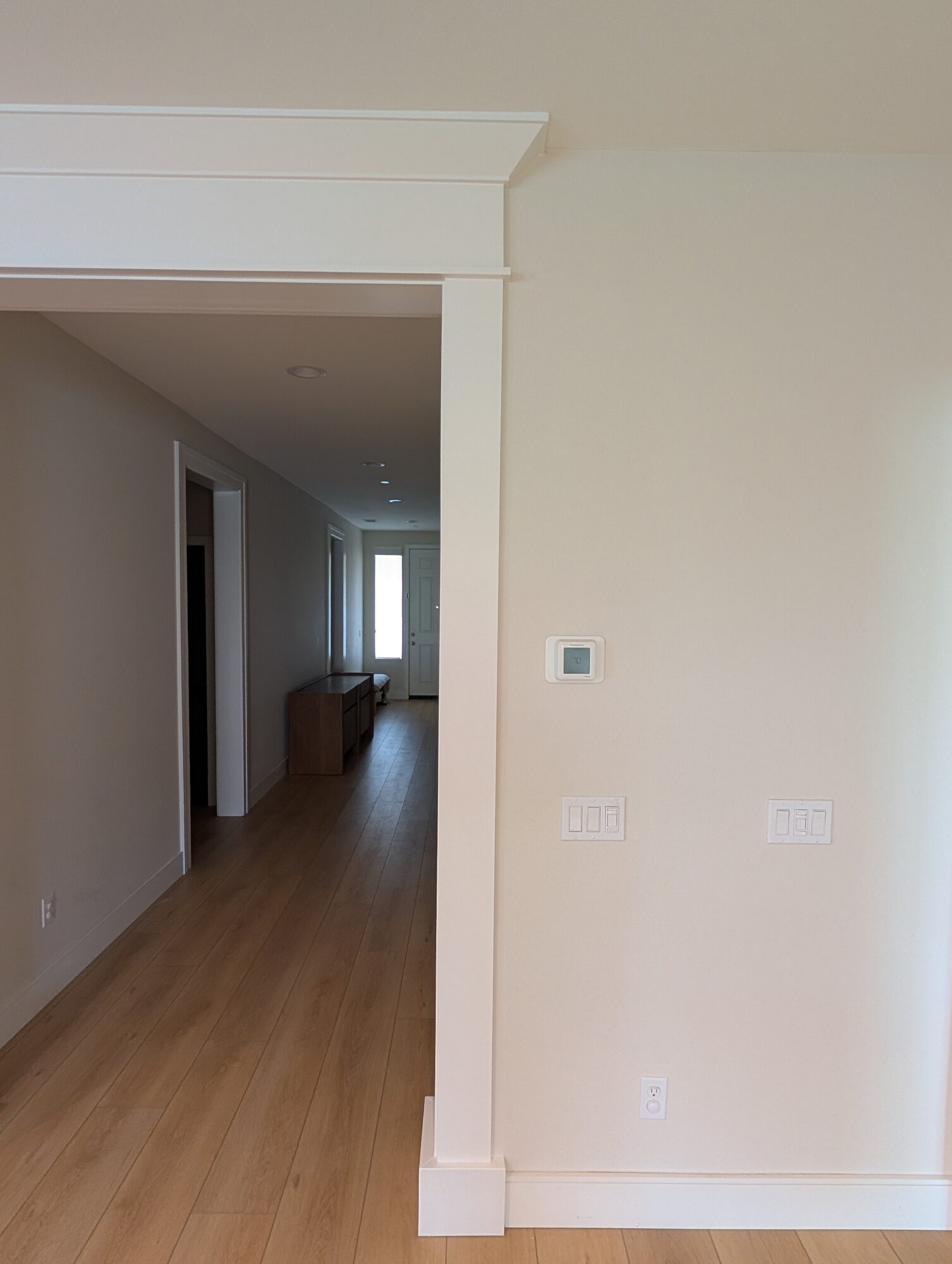
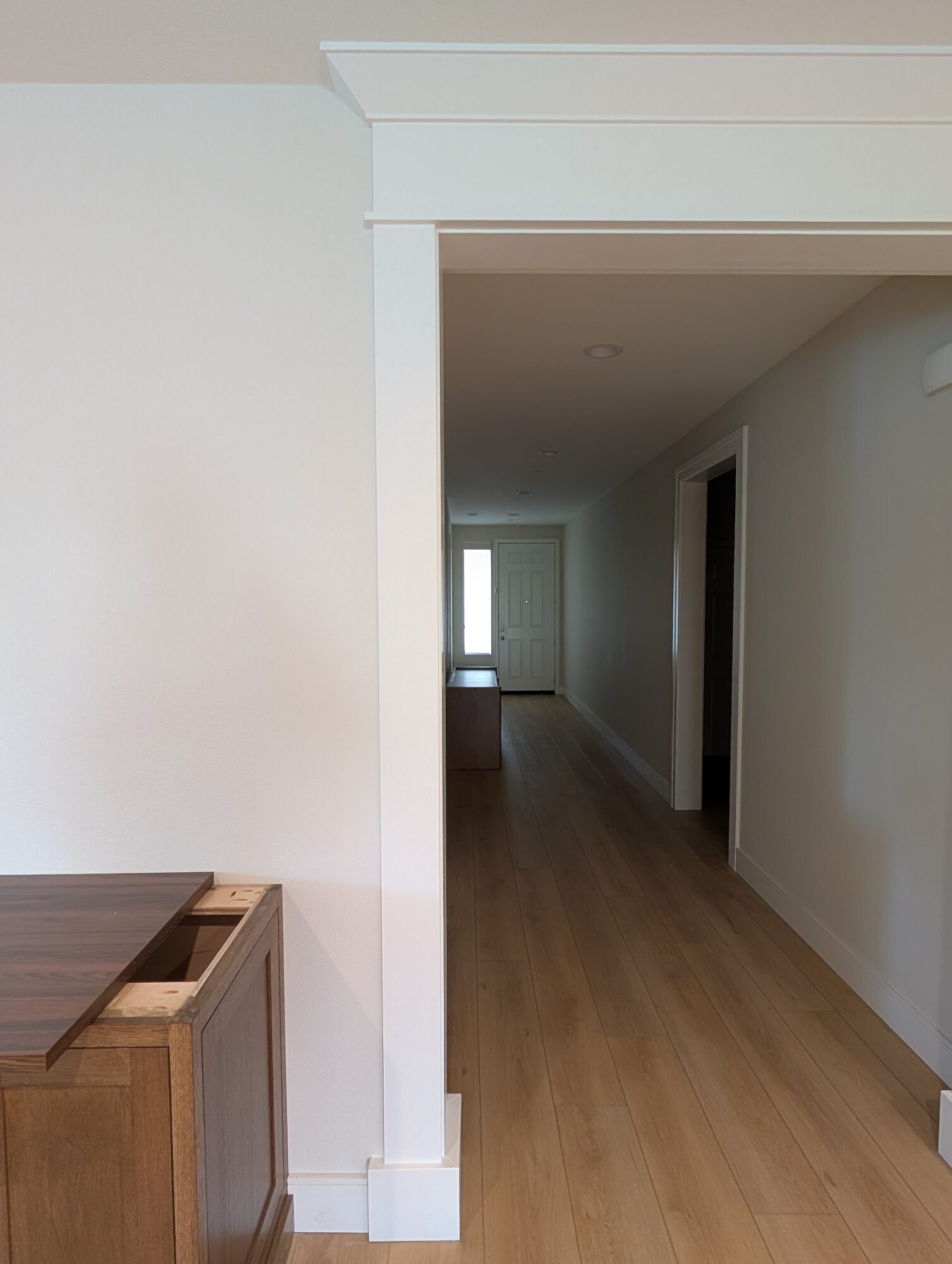
See this in action: pine jambs and casing, MDF crown, and factory-primed column bases on five openings in Menifee: Painted Trail Cased Openings
Ask this question in a forum and you get a fight. Half the answers say MDF is garbage and half say it paints better than wood ever will. Both camps are describing something real; they are just standing in different rooms. The person who hates MDF has a swollen baseboard in a bathroom. The person who loves it has a crown molding with no visible joints. Neither one is wrong about what they are looking at.
Holland & Sons has installed both materials, and poplar, in homes from Menifee to Norco, and the answer that holds up is boring: put each one where it performs. This post lays out where that is, with a side-by-side, a secondary table for poplar and factory-primed stock, and the regional reasons the answer is a little different in the Inland Empire than it is in a damp climate.
The Direct Answer: Pine at Hand Height, MDF Up High, Poplar Where It Earns It
For the most common Inland Empire situation, a tract home with nine-foot ceilings, drywall-wrapped openings, and a family that uses the house hard, Holland & Sons recommends solid pine for jambs, casing, and baseboard, and MDF for crown. Pine takes a hit and a nail, and a dent in it can be filled and painted. MDF stays straight over a long run, paints glass-smooth, and up on a crown it will never be touched by anything but a duster.
MDF is the right call for the whole package when every piece sits high and dry: a crown-only project, picture-frame molding on a dining room wall, a built-up header on an opening nobody brushes against. Poplar is the right call when the trim will be hit every day and the budget supports it: chair rail in a hallway full of kids, wainscoting in a mudroom, a stair skirt.
Side-by-Side: MDF vs. Solid Pine for Painted Trim
| Factor | MDF | Solid Pine |
|---|---|---|
| Investment range | Lowest material investment per foot for most profiles | Moderate; finger-jointed primed pine is close to MDF, clear pine is higher |
| Installation complexity | Cuts clean but makes fine dust; soft edges need care at miters; heavy in long lengths | Takes nails without splitting; mills clean on site; lighter to handle |
| Maintenance | Chips and dents at edges usually need the piece replaced; keep away from water | Dents fill and repaint; tolerates an occasional wet mop |
| Longevity | Indefinite up high and dry; short at a wet floor | Decades anywhere in the house with a sound paint film |
| Performance in dry inland climates | Very stable in dry air; the risk is the rare wet event, not the heat | Shrinks slightly as it dries out; dry, acclimated stock and glued joints keep that invisible |
| Best home style | Smooth, flat-profile styles: Craftsman headers, Shaker and modern casing, crown | Any style; takes a crisp milled profile and holds an edge where it is touched |
| Resale appeal | Reads as finished trim; no buyer can tell on a crown | Reads as solid under hand; buyers notice at casing and base |
| Best for | Crown, long flat runs, headers and caps up high, picture-frame molding | Jambs, casing, baseboard, window stools, anything at hand height |
Why This Comparison Matters
The question comes up because the material line on a trim quote can swing the number noticeably, and because MDF has a reputation that follows it into rooms where it does not apply. What each option actually costs on a cased opening is laid out here; on the Painted Trail project the difference between MDF casing with no jambs and solid pine jambs and casing was roughly $300 to $500 across five openings. That is not a large number against a $6,737 job, and it bought the family solid wood everywhere a laundry basket can hit.
Where generic advice goes wrong is in treating the house as one environment. It is not. A floor in a Menifee laundry room and a ceiling in a Menifee dining room are a few feet apart and have nothing in common as far as trim is concerned. One gets mopped and occasionally flooded. The other never gets touched. Specify by location and most of the argument disappears.
Secondary Options: Poplar and Factory-Primed Stock
| Option | What It Solves | Best For |
|---|---|---|
| Poplar | Hardest common paint-grade wood; holds a crisp profile and resists dents; usually the highest material investment of the three locally | High-traffic chair rail, mudroom wainscoting, stair parts, cabinet face frames |
| Finger-jointed primed pine | Solid wood, straight, comes primed and long; short pieces joined end to end so knots are gone | Casing and baseboard runs where paint is the finish and budget matters |
| Kiln-dried, factory-primed fascia and trim boards (WindsorONE, BodyGuard) | Dried and primed at the factory with three coats of primer; stable enough to miter into boxes that hold their joints; specialty product, order ahead | Column bases, thick built-up pieces, anything mitered that has to hold its joints through a dry summer |
| Standard framing lumber (2x stock) | Readily available and inexpensive; carries more moisture than trim stock and tends to shrink and open miters as it dries | Blocking and fur-out behind the trim, where movement is hidden; not for the finished face |
Poplar came up on the Gypsy Canyon wainscoting project in the same Audie Murphy Ranch neighborhood, and the reasoning there was the same as here: solid wood where the panels get touched, and a harder species where a chair back hits the rail.
The Questions Homeowners Ask About MDF and Pine
Is MDF trim junk? No. It is an engineered fiberboard that is very straight, very stable in dry air, and paints better than almost anything. It is a poor choice at a wet floor and a fine choice at a dry ceiling. People who call it junk are usually describing a baseboard in a bathroom, and they are right about that baseboard.
Does MDF expand and contract? It does, in a different way than wood. The Composite Panel Association's technical bulletin on dimensional stability notes that MDF and particleboard swell in thickness when they take on moisture, and that the swelling is not fully recovered when the material dries back out. Dry air is not the problem; a wet event is. Solid pine moves the other direction: the USDA Forest Products Laboratory's Wood Handbook describes how wood shrinks as it loses moisture, which is what a Menifee summer does to it. Both are manageable with dry stock, glued joints, and the right location.
Can I mix materials in the same opening? Yes, and you should. The Painted Trail header is pine head casing and cap with MDF crown on top, all painted the same color. Nobody can tell where one stops and the other starts, and each piece is doing the job it is good at.
What about PVC trim? It belongs outside and in showers, where water is constant. Inside a dry house it adds investment without adding anything a homeowner can feel, and it moves more with temperature than wood does.
Decision Framework: Which Material Goes Where
Use MDF when:
-
The piece is above shoulder height and nothing will touch it: crown, headers, caps, picture-frame molding.
-
The run is long and flat and straightness matters more than hardness.
-
The finish is paint, and the smoothest possible surface is the goal.
Use solid pine when:
-
The piece is at hand height or floor level: jambs, casing, baseboard, window stools.
-
The room has a water source: kitchen, bath, laundry, mudroom.
-
The piece will be nailed through on site and needs to take a fastener without the edge crumbling.
Use poplar when:
-
The trim will be hit every day and the dents in pine would bother you: chair rail, wainscoting cap, stair skirt.
-
The profile is fine and crisp and needs to hold its edge.
-
The budget supports the upgrade in the specific place it earns it, not the whole house.
Use factory-primed, kiln-dried stock for anything mitered into a box at the floor, like column bases, where a joint that opens will be seen every day. Whatever the material, the finish that goes over it decides how it wears.
See This In Action: Painted Trail Trim
Four materials on one opening: solid pine jambs and casing, pine head casing and cap, MDF crown, and kiln-dried, factory-primed fascia column bases, each one chosen for the spot it occupies on the Painted Trail Trim project in Menifee.
What we used on this project:
-
Solid pine 1x10 jambs and casing on all five openings, where hands and furniture land
-
MDF crown on the one built-up header, nine feet up, where it will never be touched
-
Column bases mitered from WindsorONE kiln-dried, factory-primed fascia instead of framing 2x10, so the boxes hold their miters far better; BodyGuard fascia does the same job
-
Kiln-dried fir for the fur-out behind everything, where movement is hidden
-
All of it under two coats of Sherwin-Williams Emerald Urethane Trim Enamel in Pure White SW 7005, so the material changes are invisible
The hub post has the full material table with every alternative considered, the photos, and the $6,737 breakdown. Link: the full project story
Regional Performance Note: Dry Heat, Big Swings, Tract Framing
Inland Empire summers run hot and dry, and a house in Menifee, Perris, or Hemet can see a wide swing between a July afternoon and a January morning. That pulls moisture out of solid pine, which is why acclimating stock in the house for a few days before installation matters here more than it does on the coast, and why glued joints on solid backing are not optional. MDF is comfortable in dry air; its risk is the one wet event, and that risk lives at the floor. Tract framing adds the last variable: an opening that is out of plumb puts stress on whatever trim is forced onto it, regardless of material. The most common mistakes that come from that are covered here.
The Holland & Sons Angle
The column bases on the Painted Trail job are the clearest material decision on the project, and the smallest. Standard 2x10 framing lumber would have been the easy pick for a box that size. It also would have been the wrong one: framing stock carries enough moisture that the mitered corners open up over the first winter, and a column base is at eye level every time someone bends to tie a shoe. Building them from WindsorONE kiln-dried, factory-primed fascia added a little to the material line and took that problem off the table. Buy it once. Wyatt built those bases, including the finished end on each one, on the bench before anything went on the wall, and the material was the first thing he had to get right: the miters hold only if the stock was dry and stable to begin with; no material promises zero movement, and the right one promises very little. That is the lesson underneath the whole material question, and he learned it with a saw in his hand instead of in a forum argument.
Related Resources: Cased Openings and Craftsman Trim Guide
This post is one of six companion guides built around the Painted Trail Trim project in Menifee. Together they cover the whole decision, from what it costs to who should build it.
-
Cased Openings and Craftsman Trim in Menifee, CA: Five Openings, One Crown, and Knowing Where to Stop (Painted Trail Trim): the project itself, with photos, the full $6,737 breakdown, the four-day timeline, and every material decision
-
How Much Does It Cost to Case Openings and Add Craftsman Trim in Menifee in 2026?: real ranges per opening, what moves the number, and how to read two quotes side by side
-
What Goes Wrong When You Add Trim to Drywall-Wrapped Openings in a Tract Home?: the failures you can see, the ones you can't yet, and how to check the work before paint hides it
-
What Paint Finish Should You Use on Custom Interior Trim? A Finish Carpenter Compares the Options: what installed trim has to survive, and which finishes hold up to it
-
How to Hire a Trim Carpenter in Menifee: What Good Trim Work Looks Like Before You Sign: a scorecard, the questions that sort the carpenters from the guessers, and what a complete quote includes
-
Should Every Doorway Get the Same Trim? Where to Put the Crown and Where to Stop: how to decide which openings match, which coordinate, and which one gets the emphasis
Frequently Asked Questions
Should I use MDF or wood for trim?
Use solid wood where hands, furniture, and mops land, and MDF where nothing touches it. In practice that means pine (or poplar) for jambs, casing, and baseboard, and MDF for crown and long flat runs up high. Holland & Sons builds most Inland Empire trim packages exactly that way. Picking one material for the whole house usually means overpaying for the crown or underbuilding the casing.
What are the disadvantages of MDF trim?
MDF has soft edges that dent and chip on impact, it swells if it gets wet and does not fully shrink back, it makes fine dust when cut, and it cannot be stained. The Composite Panel Association's technical bulletin on dimensional stability confirms that MDF's moisture swelling is greater than solid wood's and is not fully recovered on re-drying. None of that matters on a crown molding nine feet up. All of it matters on a baseboard behind a mop bucket.
Is it common to use MDF for baseboards?
Very common, especially in production homes, because it is straight, comes long, and paints smooth. It is a reasonable choice for baseboard in bedrooms and hallways on a dry floor. Holland & Sons tends to move to solid pine or poplar baseboard in kitchens, bathrooms, laundry rooms, and mudrooms, and anywhere a vacuum or a kid's shoe hits the base every day, because a dented wood base can be filled and repainted and a chipped MDF edge usually cannot.
Should I get MDF or pine baseboards?
Pine if the base takes abuse or ever sees water; MDF if it sits on a dry floor in a quiet room and the budget is tight. On a cased opening, the baseboard question is usually about what the new casing has to meet, and the Painted Trail Trim project in Menifee kept the builder's existing baseboard and sized the column bases to clear it. Which base material you have affects that detail, so mention it at the first meeting.
Which costs less, poplar or pine?
Pine, usually by a meaningful margin, and finger-jointed primed pine is often the least expensive solid-wood option because it comes ready for paint. Poplar is typically the most expensive of the three paint-grade materials locally. That difference is why Holland & Sons reserves poplar for the places its hardness earns the money: high-traffic chair rail, mudroom wainscoting, and stair parts.
Which wood is stronger, pine or poplar?
Poplar is harder and denser, so it resists dents better and holds a crisp milled edge longer. Pine is softer but takes a nail without splitting and is plenty durable for casing and jambs in a family home. Strength matters at hand height in high-traffic rooms; it does not matter on a header or a crown that nobody touches.
What type of wood is best for decorative trim like a built-up header?
For a painted built-up header, a mix: solid pine for the head casing and cap, where the pieces are thick and get handled during installation, and MDF for the crown, where straightness and a smooth paint surface matter more than hardness. For the column bases at the floor, Holland & Sons uses kiln-dried, factory-primed fascia rather than framing lumber, because the miters hold up far better as the house dries out through an Inland Empire summer. No wood assembly is immune to movement; this takes most of it off the table.
Is MDF trim okay in a bathroom or a mudroom?
Up high, yes. At the floor, no. MDF crown in a bathroom is fine because it never sees standing water. MDF baseboard in a bathroom, laundry room, or mudroom is where the swelling complaints come from: one overflow or one wet mop left against the wall and the bottom edge puffs and stays puffed. Use solid wood, or a moisture-resistant product, at the floor in any room with a water source.
Not Sure Which Material Your Trim Should Be?
The answer is almost never one material for the whole house. It is the right one in each spot, and that is a conversation best had standing in the room with a few sample pieces in hand.
Start your project at hsconstruct.com/contact. Fill out the form, describe the project, and upload a photo or two of the openings or trim you are thinking about, plus any inspiration photos you have saved. Brian reads every one. Want to see this advice applied to a real project? Here's the full breakdown: the full project story. More finished work is on Facebook, Instagram, YouTube, and TikTok at hollandandsonsconstruction. We build in Menifee, Murrieta, Temecula, Wildomar, Canyon Lake, Lake Elsinore, Perris, Hemet, Moreno Valley, Norco, Corona, Eastvale, and all across Riverside County and the Inland Empire.
951-338-8058 | brian@hsconstruct.com | hsconstruct.com | CSLB #1123738
More Than Just Trim Material
Choosing the right paint-grade material for each spot is one piece of what we do at Holland & Sons, and it is one chapter in a much longer story. Brian has been a finish carpenter since 1991, and his sons now build alongside him, which means every room in your home is fair game. If your space needs more than casing and crown, here's what else we build:
-
Kitchen and bathroom remodels: full custom cabinetry, tile work, and finish carpentry from demo to done
-
Custom and built-in cabinetry: designed for the room, built in the shop, installed to last
-
Media walls and entertainment walls: built-in TV walls with storage, lighting, and clean cable management
-
Fireplace walls: mantels, surrounds, and full-height paneling that make the fireplace the center of the room
-
Accent walls: paneling, slat walls, and feature walls that give one wall a job to do
-
Mudrooms: lockers, bench seating, cubbies, and hooks, built for the way your family comes through the door
-
Coffered ceilings: grid beam systems that add architectural depth to any room, sized and proportioned to the space
-
Wainscoting and wall paneling: classic raised panel, flat panel, board-and-batten, and shiplap applications
-
Reclaimed wood accents: feature walls, fireplace surrounds, and detail work using salvaged material with real character
-
Beam wraps: hollow wood wraps that give exposed beams the look of solid timber without the structural engineering
-
Crown molding, baseboards, and trim carpentry: the details that make a house feel finished, from a single room to a whole home
-
Cased openings and interior door replacements: clean transitions between spaces that most contractors overlook
Wood, proportion, and rooms that feel right. That's what we do. hsconstruct.com
About the Author
Brian Holland is the owner and lead carpenter of Holland & Sons Construction, a family-run finish carpentry and general contracting company serving Riverside County and the Inland Empire. He entered the trade at 17 in 1991, learned on the job, and has spent every year since building the kind of work that makes rooms feel right, often before a homeowner can articulate why. Many projects start at his vintage drafting table, where he sketches the layout by hand with pencil and paper using a Vemco drafting machine before anything gets built. His sons now apprentice alongside him on every project. Holland & Sons is based in Perris, CA and licensed by the CSLB (#1123738).
Memberships & Credentials: NAHB Member | CBIA Member | NARI Member | BBB A+ Rated | Tanya Holland, NAHB Certified Aging-in-Place Specialist (CAPS) | CSLB #1123738
This guide is part of our interior doors & trim series.
Learn more about Interior Doors & TrimHave a project in mind? Let's start a conversation.
Tell us what you are thinking about and we will give you a straight answer about scope, timeline, and investment.
Start a Conversation