
How to Tell If Stain-Grade Built-Ins Are Well Made: A White Oak Quality Checklist for Riverside County
Quick Answer
Well-made stain-grade built-ins show it up close: grain that runs in order across doors and drawer fronts, solid wood on every exposed edge instead of iron-on banding, no visible fasteners, and tight miters with the grain wrapping the corner. In Riverside County, ask to see finished stain-grade work in person and get the species, edge treatment, finish and repair terms in writing before you sign.
Key Takeaways
- Paint hides mistakes; stain-grade wood shows every joint, fastener and grain mismatch
- Look for solid wood edges, grain that flows across doors, hidden fasteners and grain-wrapped miters
- Ask to see finished stain-grade work in person and a finish sample on your actual wood
- Get repair responsibility in writing: who fixes it, at whose expense, if the finish misses
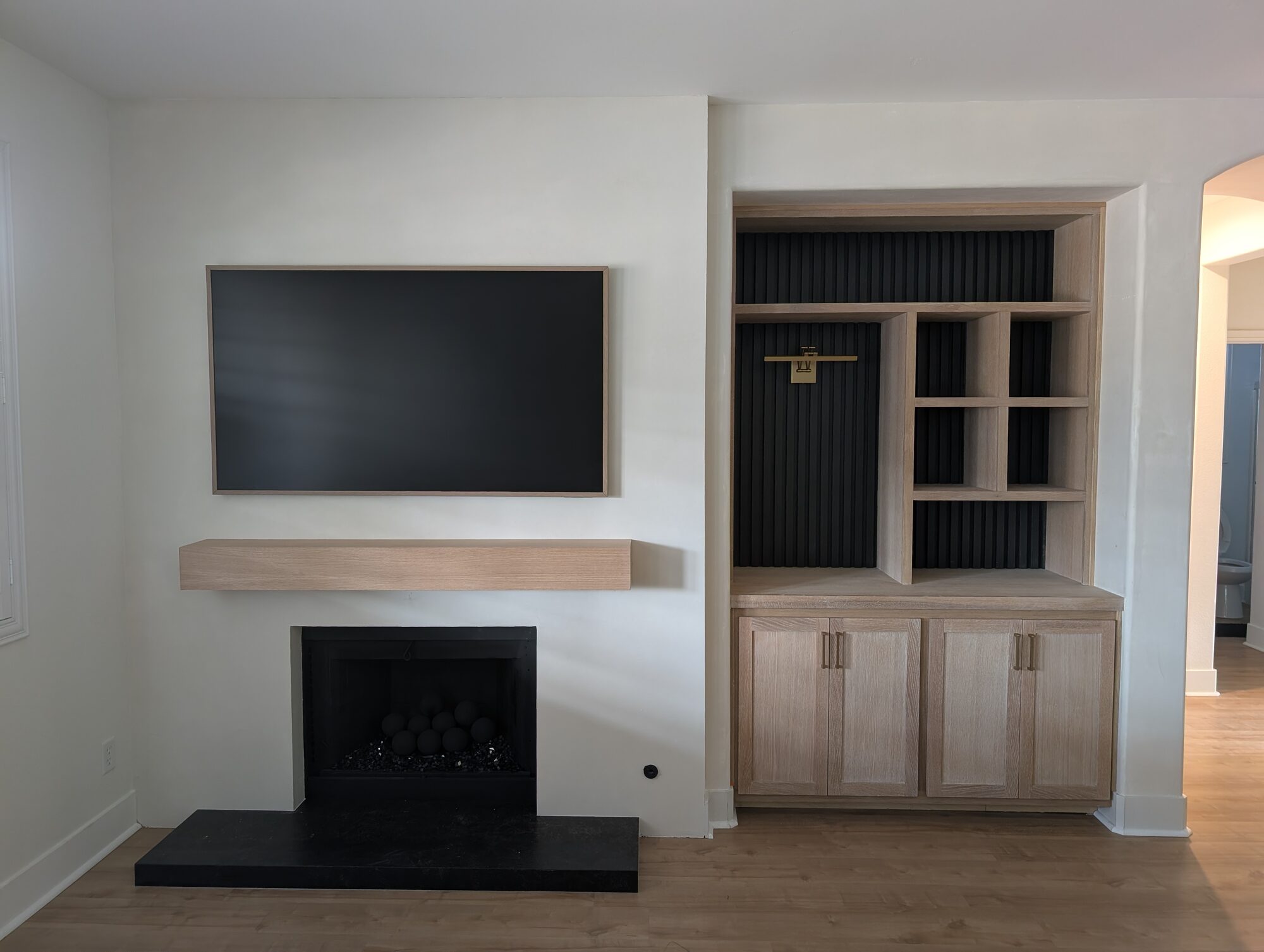
- See this in action: the Winchester fireplace wall project
Here’s the thing about stain-grade woodwork: there’s nowhere to hide. Paint covers a filled nail hole, a gap at a miter, a plywood edge with tape on it. Clear-finished white oak shows all of it. So the best way to judge a builder for this kind of work is to judge the work itself, up close, with a short list of things to look for.
We’ve already written general hiring guides for finish carpenters and built-in contractors. This one is narrower. It’s what to look at, what to ask and what to get in writing when the wood is going to be clear-finished and on display in your Riverside County home.
What Excellent Looks Like
- Grain in order. Door and drawer fronts cut so the grain flows from one to the next instead of jumping around. On rift-sawn white oak, the grain should read straight and even across the whole run.
- Solid wood on every exposed edge. Shelf fronts and panel edges capped with solid wood nosing (a strip of real hardwood glued to the edge), not thin iron-on edge banding.
- No visible fasteners. No filled nail holes in the faces of shelves, mantels or panels. Joinery and cleats do the holding.
- Miters that wrap. On a mantel or box, the grain continues around the corner as if it were one piece.
- Consistent color. The finish matches across doors, face frame, top and shelves, with no blotchy or darker boards.
- Clean reveals. Even gaps around doors (the small, deliberate space between a door and its frame), usually the thickness of a coin, the same all the way around.
- Built for the wall. Openings sized for what goes in them, scribed tight to uneven walls and floors.
The industry has a name for these levels. The Architectural Woodwork Institute’s standards, summarized by the American Hardwood Information Center, define Economy, Custom and Premium grades for appearance, fabrication, finishing and installation, with Premium reserved for focal points. A fireplace wall in your living room is a focal point.
What Adequate Looks Like, and Why It’s Not Enough
Adequate stain-grade work passes from across the room. Up close, you see edge banding peeling at the corners, a filled nail hole in the middle of a shelf, door grain that changes direction from one door to the next, and a miter that’s opened up a hair since install. None of it is a disaster. All of it is permanent, because unlike paint, you can’t just fill and recoat stain-grade wood and have it disappear.
The Stain-Grade Scorecard
Score each row 1 to 3: 3 for a good answer, 2 for a partial answer, 1 for a red flag.
| What to Evaluate | Ask This Directly | Good Answer vs. Red Flag |
|---|---|---|
| Finished stain-grade work | Can I see a stain-grade project you built, in person or in detailed close-up photos? | Good: yes, with close-ups of edges and joints. Red flag: only painted work, or only wide shots. |
| Species and cut | What species and cut will you use on visible parts? | Good: names it, like rift-sawn white oak. Red flag: "oak" or "hardwood" with no detail. |
| Edge treatment | Solid wood nosing or edge banding on shelf fronts? | Good: solid wood on exposed edges. Red flag: "banding, nobody can tell." |
| Grain matching | How do you lay out door and drawer fronts? | Good: cut in sequence from the same boards. Red flag: no answer. |
| Fasteners | Will I see any nail holes on visible faces? | Good: no, here’s how it’s held together. Red flag: "we’ll fill them." |
| Finish and samples | Which finish product and color, and can I see a sample on my wood? | Good: names the product and brings a sample. Red flag: "a clear coat." |
| Installation | Who installs: your crew, or someone else? | Good: the builder’s own crew. Red flag: unclear or a different company. |
| Repairs | If a finish or joint isn’t right, who fixes it and who pays? | Good: we redo it at our expense. Red flag: vague, or it’s on you. |
Scoring: 21 to 24 is a strong stain-grade builder. 15 to 20 means ask more questions and see more work. Under 15, keep looking.
Questions to Ask Before You Sign
- What species and cut will every visible part be, and what’s used where it doesn’t show?
- How thick are the shelves, and what’s on the front edge?
- How will the shelves and mantel be attached, and will I see any fasteners?
- Will you cut the door and drawer fronts in sequence so the grain flows?
- What finish product and color are you using, and will you sample it on my boards?
- How do you let the wood acclimate before building?
- Is the design drawn and dimensioned before fabrication, and do I approve it?
- If the finish or a joint isn’t up to standard, what happens?
What a Complete Quote Should Include
- Species, cut and grade for visible parts, plus material for hidden parts (like cabinet boxes)
- Shelf thickness and edge treatment
- Joinery and attachment method for shelves and mantel
- Finish product, color and number of coats
- Hardware brand and finish
- Who designs, who fabricates and who installs
- Electrical and permit responsibility, if lights or outlets are involved
- Timeline for design, shop work and on-site days
- Exclusions list
- Workmanship warranty and how repairs are handled
If any of these is missing, ask for it in writing before signing. And when you compare two quotes, line them up item by item; we laid that out in how to compare quotes accurately (Builder-Grade Fireplace Update Cost).
Red Flags
- Only painted work in the portfolio for a stain-grade job
- "Oak" or "hardwood" with no species, cut or grade
- Edge banding on shelf fronts described as "the same thing"
- No finish sample offered
- Install handed to a different crew than the one that built it
- No written answer on who fixes finish or workmanship problems
- No license number on the quote, or a license that doesn’t check out
- A down payment request over $1,000 or 10% of the contract, whichever is less, which CSLB says contractors cannot ask for
Many quality problems start before anyone picks up a tool. See the most common mistakes to watch for (Surround and TV Niche Removal) when the old surround comes off.
The Questions Homeowners Actually Ask
Is stain grade better than paint grade?
Neither is better across the board. Stain grade is the right call when you want real wood grain, especially to match wood elsewhere in the house. Paint grade is the right call for painted cabinetry, where smooth MDF and poplar take paint better and ask a smaller investment.
Do finish carpenters need a license?
In California, yes, for almost any built-in. Since January 1, 2025, California’s minor work exemption covers jobs under $1,000 in combined labor and materials, and only when no building permit is required and the person doesn’t employ anyone to help, according to the Center for Public Interest Law’s summary of AB 2622. Anything bigger needs a licensed contractor. Check any license on the CSLB’s license lookup.
See This In Action — Winchester Fireplace Wall
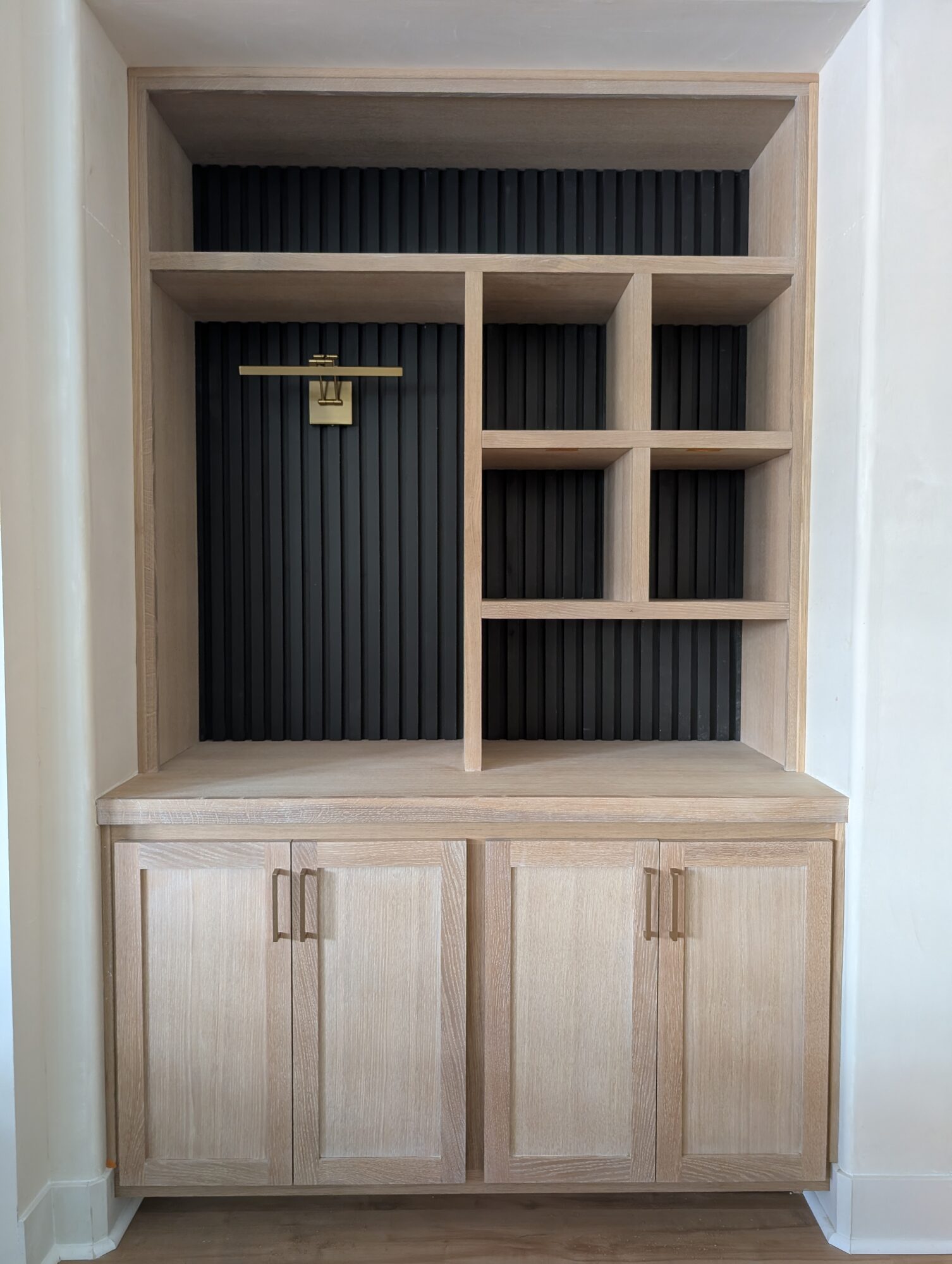
Every upper cubby on the Winchester built-in is 1-1/2 inches thick, made from two sheets of plywood laminated together, veneered in white oak and capped with solid oak nosing. The layout is open and stepped, so there was nowhere to hide a fastener, and you won’t find one.
What we used on this project:
- 1-1/2" laminated cubby panels with white oak veneer and solid white oak nosing
- Every shelf grooved into its neighbors (a channel cut so each piece seats into the next), then cleated with glue and pin nails
- Rift-sawn white oak face frame, shaker doors and top over domestic maple boxes
- Layout drawn by hand at the drafting table before anything went to the shop
The Holland & Sons Angle
The Winchester cubbies are the best test I know for stain-grade work: an open, stepped layout where every edge shows and every joint is in plain sight. We laminated the panels to 1-1/2 inches, nosed every front in solid oak and grooved each shelf into the next, because a filled nail hole in clear-finished oak is there for good. Thirty-five years in, I’d rather spend the hours in the shop than explain a shortcut in somebody’s living room. Wyatt says the thing he wants most is for customers to walk away happy with the work he did. On stain-grade work, that means getting it right the first time, because you can’t paint over it.
Related Resources — Winchester Fireplace Wall Guide
This post is one part of a set of guides built around a real fireplace wall Holland & Sons finished in Winchester. Start with the project, then go wherever your next question is.
-
Custom Fireplace Wall in Winchester, CA: White Oak Built-In with a Record-Player Cubby — The full project: photos, the complete $17,590 investment, timeline and construction details.
-
How Much Does It Cost to Update a Builder-Grade Fireplace in Winchester, Temecula and Murrieta? — Real investment ranges for a reface, a new surround and mantel, or a full fireplace wall, and what moves the number.
-
Can You Remove a Builder-Grade Fireplace Surround and TV Niche Without Replacing the Fireplace? — What comes off, what stays, mantel clearances over gas, and the permit questions to settle before demo.
-
Roman Clay vs. Paint on a Fireplace Wall: Is It Worth It in Inland Empire Homes? — A straight comparison of look, prep, durability and investment, with limewash and Venetian plaster in the mix.
-
Rubio Monocoat vs. Polyurethane for White Oak Built-Ins: Color, Protection and Maintenance — Which finish keeps white oak looking like white oak, and where polyurethane still wins.
-
How to Design a Built-In for Vinyl Records and a Turntable in Your Inland Empire Home — Shelf heights, depths, weight, power and placement for a listening corner that works.
Frequently Asked Questions
How can you tell if built-ins are good quality?
Good-quality built-ins show it in the details: solid wood on exposed edges, no visible fasteners, tight joints, even gaps around doors, and grain that flows across door fronts. Open a door and look at the box and hinges too. Ask to see finished work in person, not just wide photos.
Is stain grade better than paint grade?
Stain grade isn’t better than paint grade, it’s for a different look. Stain grade uses hardwood with clear or stained finishes to show the grain. Paint grade uses smooth materials like MDF and poplar that take paint well. Choose stain grade to match existing wood; choose paint grade for painted cabinetry.
Are paint grade or stain grade cabinets more expensive?
Stain grade cabinets usually require a larger investment than paint grade. Hardwood is a bigger material investment, and the work takes longer because every joint and edge shows. On a fireplace wall like our Winchester project, rift-sawn white oak on visible parts added roughly $1,500 to $2,500 over paint-grade poplar or MDF.
Which lasts longer, paint or stain?
A clear or stained finish on hardwood generally ages more gracefully than paint, because wear blends into the grain instead of showing as chips. Paint is easier to touch up completely. How long either lasts depends more on the finish product and the use than on the choice itself.
What is the difference between edge banding and solid wood edging?
Edge banding is a thin strip of veneer glued or ironed onto a plywood edge; solid wood edging is a real strip of hardwood glued on and shaped. Banding is thinner and can chip or peel at corners. Solid edging takes wear, can be eased or profiled, and reads as solid wood.
What are the three grades of cabinets?
Architectural woodwork is commonly graded Economy, Custom and Premium under the Architectural Woodwork Institute’s standards. Custom is the most common; Premium is for focal points and special projects; Economy is the minimum. Retail cabinet lines use their own grade names, so ask what a builder’s grade actually includes.
What are the disadvantages of built-ins?
Built-ins can’t move with you, they require a larger upfront investment than furniture, and they lock a room into one layout. Poorly made ones also age badly, which is why construction quality matters so much. For a focal wall you’ll keep, those trade-offs are usually worth it.
Do finish carpenters need a license in California?
Yes, in California a contractor’s license is required for almost any built-in project. The minor work exemption covers jobs under $1,000 in labor and materials combined, and only if no permit is required and the worker employs no one else. Verify any license on the CSLB website before signing.
Want to See Stain-Grade Work Up Close?
If you’re planning white oak or other stain-grade built-ins in Winchester, Menifee, Murrieta, Temecula, Perris, Riverside or anywhere in the Inland Empire, start at hsconstruct.com/contact. Fill out the form, tell us about the room, and upload photos plus any inspiration you’ve saved. Bring this checklist to the meeting. We’ll answer every row of it.
Follow Holland & Sons on our social channels to see what’s on the bench this week.
951-338-8058 | brian@hsconstruct.com | hsconstruct.com | CSLB #1123738
More Than Just Stain-Grade Built-Ins
Stain-grade built-ins are often where a room starts to come together, but they’re rarely the only thing a house needs. Brian has been a finish carpenter since 1991, and his sons now build alongside him, which means every room in your home is fair game.
If your space needs more than a built-in, here’s what else we build:
- Kitchen and bathroom remodels — full custom cabinetry, tile work, and finish carpentry from demo to done
- Coffered ceilings — grid beam systems that add architectural depth to any room, sized and proportioned to the space
- Wainscoting and wall paneling — classic raised panel, flat panel, board-and-batten, and shiplap applications
- Reclaimed wood accents — feature walls, fireplace surrounds, and detail work using salvaged material with real character
- Beam wraps — hollow wood wraps that give exposed beams the look of solid timber without the structural engineering
- Crown molding, baseboards, and trim carpentry — the details that make a house feel finished, from a single room to a whole home
- Cased openings and interior door replacements — clean transitions between spaces that most contractors overlook
- Custom built-in entertainment walls and bookshelves — designed by hand, built in the shop, installed to last
Wood, proportion, and rooms that feel right — that’s what we do.
hsconstruct.com
About the Author
Brian Holland is the owner and lead carpenter of Holland & Sons Construction, a family-run finish carpentry and general contracting company serving Riverside County and the Inland Empire. He entered the trade at 17 in 1991, learned on the job, and has spent 35 years building the kind of work that makes rooms feel right — often before a homeowner can articulate why. Every project starts at his vintage drafting table, where he sketches the layout by hand with pencil and paper using a Vemco drafting machine before anything gets built. His sons now apprentice alongside him on every project. Holland & Sons is based in Perris, CA and licensed by the CSLB (#1123738).
Related project
This guide is part of our custom built-ins & cabinetry series.
Learn more about Custom Built-Ins & CabinetryHave a project in mind? Let's start a conversation.
Tell us what you are thinking about and we will give you a straight answer about scope, timeline, and investment.
Start a Conversation