
How to Hire the Right Contractor for a Custom Built-In (A Temecula Homeowner’s Scorecard)
Quick Answer
To hire the right contractor for a custom built-in in Temecula or the Inland Empire, verify their CSLB license, ask how they design and measure before fabrication, require a quote that names materials and finishes line by line, and check that they handle site conditions in writing rather than as change-orders. The strongest signal is a contractor who can show you a real project — design sketch, materials, and finished result. Holland & Sons has been licensed and building in Riverside County since 1991 (CSLB #1123738).
Key Takeaways
-
Verify the CSLB license first — it’s public, free, and non-negotiable in California.
-
A complete quote names the cabinet box material, shelf species, finish system, and exclusions — vague quotes hide cut corners.
-
Use the scorecard below to compare contractors on the same criteria, not just on price.
-
Holland & Sons sketches every project to scale and specifies materials by name — the standard this guide describes.
See this in action: the Brewster Built-In project (Paseo Del Sol, Temecula)
The best way to hire the right contractor is to know what good work looks like before anyone gives you a number. That’s the whole secret. Once you can recognize a complete quote, a real design process, and a contractor who plans for the wall they’ll actually find behind your old unit, the decision mostly makes itself — and the contractors who were hoping you wouldn’t ask quietly fall away.
This guide gives you the framework: what excellent looks like in a built-in, what “adequate” quietly costs you, a scorecard you can score each contractor against, the questions that separate a craftsman from a guesser, and the red flags worth walking away from. None of it requires you to become an expert. It just requires you to ask.
One scope note: this post is about evaluating the contractor. What can go wrong with the project itself — proportion, sequencing, materials — is its own subject, covered in the problems guide linked below.
What Excellent Looks Like
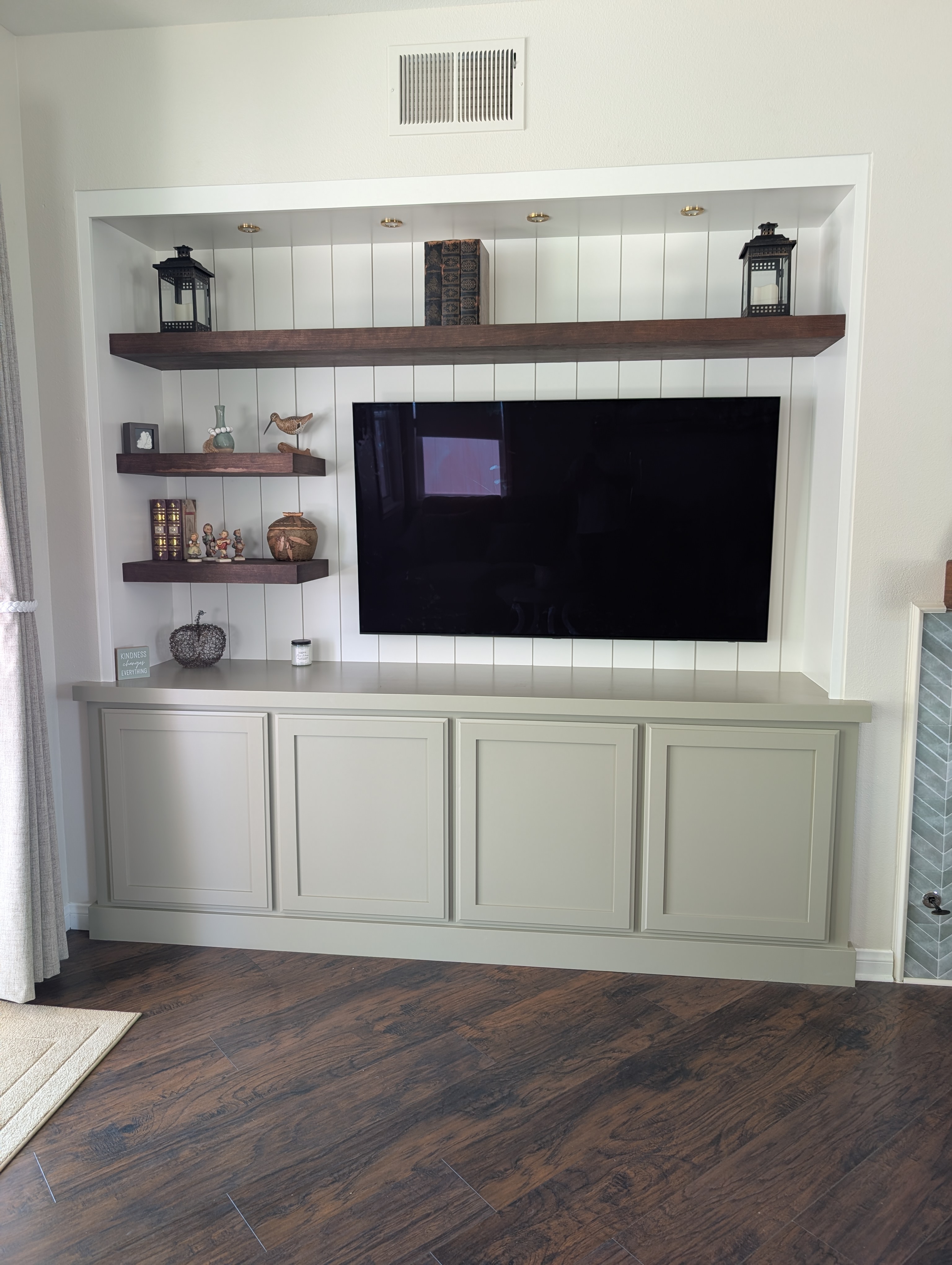
A truly well-executed custom built-in shares a handful of traits you can see and check. Use this as a checklist when you look at a contractor’s finished work:
-
A hand-built cabinet box in named plywood (e.g., 3/4” domestic maple), not ready-to-assemble components.
-
Floating shelves built so the grain wraps continuously around every visible edge — no exposed end grain, no visible seams from the front.
-
Consistent reveals (the deliberate gaps between parts) and surfaces that are plumb and square even where the wall isn’t.
-
A factory-smooth finish with no brush marks, drips, or grain telegraphing through the paint.
-
A unit that sits within its space in correct proportion — designed to the room, not jammed to fill the wall.
What Adequate Looks Like — and Why It’s Not Enough
Adequate is what you get when a contractor does the minimum. It looks fine in the first photo and reveals itself over the first year. Ready-to-assemble boxes that loosen at the joints. Paint-grade MDF shelves dressed to look like wood, with edges that chip. Latex paint on cabinet faces that scuffs and shows every cleaning. Reveals that wander because nothing was scribed to the wall. None of this is a scam — it’s just built to a price, and the long-term cost shows up as a unit that dates and wears faster than the one next door. Knowing the difference is consumer protection, not a sales pitch.
The Contractor Scorecard
Score each contractor 1 to 3 on every criterion (1 = red flag, 2 = acceptable, 3 = good). A perfect score is 21. Anything below about 15 means keep looking.
| What to Evaluate | Ask This Directly | Good Answer vs. Red Flag |
| License | What’s your CSLB license number? | Good: gives it freely, it verifies active. Red flag: hesitation or “we work under someone’s.” |
| Design process | How do you design and measure before building? | Good: a drawing to scale, measured on site. Red flag: “we’ll figure it out as we go.” |
| Box material | What is the cabinet box made of? | Good: names plywood and grade. Red flag: vague “cabinet-grade” or unsure. |
| Shelf construction | How are the floating shelves built? | Good: names species, describes grain-wrap. Red flag: “standard shelves.” |
| Finish system | What paint or finish, and how many coats? | Good: names a durable enamel/oil and coats. Red flag: “whatever’s on the truck.” |
| Site conditions | How do you handle out-of-square walls? | Good: scribe and fit on site, in writing. Red flag: silence, or “that’s extra.” |
| Proof of work | Can you show me a real project like mine? | Good: sketch, materials, photos. Red flag: stock images or none. |
Questions to Ask Before You Hire
Beyond the scorecard, these questions separate contractors who know built-ins from contractors who are guessing:
-
Who actually builds the unit — your own crew or a subcontractor?
-
Do you fabricate in a shop and install, or build entirely on site?
-
How do you protect my floors and keep the space livable during the work?
-
What happens if you find a surprise behind the old unit on demo day?
-
How do you match new doors or finishes to my existing kitchen or trim?
-
What’s your timeline, and what could change it?
-
What warranty do you stand behind, and what isn’t covered?
A contractor who answers these specifically — with their own crew, their own shop, their own process — is showing you the standard a good built-in requires.
What a Complete Quote Should Include
Before you sign, the quote should contain every item below. If any is missing, ask for it in writing first:
-
Cabinet box material and grade, named specifically
-
Door style and how it matches existing cabinetry
-
Floating shelf species and construction method
-
The finish system — paint or oil product and number of coats
-
Hardware (hinges, pulls) by type or brand
-
Demo, haul-away, and daily cleanup
-
A timeline with shop fabrication and on-site days
-
An exclusions list — what’s not included (TV, mount, electrical, flooring)
-
Warranty terms
For comparing the dollar figures across quotes accurately, see how to compare quotes accurately in the cost guide.
Red Flags to Watch For
-
No CSLB license number, or reluctance to share it.
-
A quote that’s a single lump sum with no material or finish detail.
-
Pressure to sign quickly or pay a large deposit upfront.
-
No drawing, no measuring visit — a price given off a phone photo.
-
Vague answers about who actually builds the work.
-
Stock photos instead of real projects they can speak to.
-
“We’ll deal with site conditions if they come up” — instead of having a plan for them.
That last one matters more than it sounds — see the most common mistakes to watch for in the problems guide for why an unplanned wall surprise becomes a change-order.
How to Verify a California License
In California this step is free and takes two minutes. Every legitimate contractor carries a CSLB (Contractors State License Board) license, and the board maintains a public lookup where you can confirm the license is active, in the right classification, and bonded. Ask for the number, check it before you sign, and treat any hesitation to provide it as the red flag it is. Holland & Sons holds CSLB #1123738 — and will hand you that number before you ask.
See This In Action — The Brewster Built-In
Every Holland & Sons project starts at a vintage Vemco drafting machine, where Brian sketches the full wall elevation by hand at 1” = 1’ scale. For the Brewster Built-In, that single drawing settled the asymmetrical shelf layout, the TV biased right, the nickel-gap backer annotated for its paint color, and the cabinet run — all on paper before a board was cut. That drawing is exactly what you should ask any contractor to show you. A real design process is the clearest evidence you’re hiring a craftsman and not a guesser.
What we used on this project:
-
A hand-drawn 1” = 1’ elevation with full material annotations before fabrication
-
Named materials throughout — maple plywood box, cherry veneer shelves, specified finishes
-
Shop fabrication followed by on-site installation, by Brian’s own crew
-
A CSLB-licensed (#1123738) contractor standing behind the work
You’ll find the design sketch, the full materials list, and before-and-after photos here: the Brewster Built-In.
The Holland & Sons Angle
The Brewster drawing is the whole argument for this post in one sheet of paper. Most built-ins get “designed” in a showroom or off a phone photo. This one was worked out at a drafting machine older than most of the homes in Paseo Del Sol — every shelf height, every reveal, the TV deliberately biased right, the colors annotated in the margins. That asymmetry wasn’t a default; it was a decision, made on paper, defendable before a dollar was spent. When you ask a contractor to show you their drawing, you’re really asking whether they make decisions or hope. Brian’s sons learn that at the drafting table before they ever touch a saw — on this project, his son sat in on the elevation as Brian talked through why equal halves were wrong for the room, watching a design get reasoned out rather than guessed.
Related Resources — Built-In Entertainment Wall Guide
This guide is part of a full cluster on planning, building, and getting a custom built-in entertainment wall right in the Inland Empire.
How Much Does a Custom Built-In Entertainment Wall Cost? — real line-item pricing, tiers, and how to compare quotes.
What Goes Wrong With Built-In Entertainment Walls — the project mistakes that derail a build, and how to avoid them.
Built-In Entertainment Wall vs. Freestanding Furniture — which one fits your home, and when furniture is the smarter call.
Best Wood for Floating Shelves: Cherry vs. Walnut vs. White Oak vs. Maple — a carpenter’s take on choosing the right species.
Built-In Entertainment Wall Materials Explained — the boxes, finishes, and hardware behind a built-to-last unit.
Frequently Asked Questions
How do I choose a contractor for a custom built-in?
Start by knowing what good work looks like, then evaluate each contractor against it. Verify the CSLB license, ask how they design and measure before building, require a quote that names materials and finishes line by line, and confirm they handle site conditions in writing. The strongest single signal is a contractor who can show you a real project — a design sketch, the materials used, and the finished result. Use a scorecard so you’re comparing contractors on the same criteria, not just on price.
What questions should I ask before hiring a contractor for a built-in?
Ask who actually builds the unit — their crew or a sub; whether they fabricate in a shop or build entirely on site; how they protect your floors and keep the space livable; what happens if they find a surprise behind the old unit; how they match new finishes to your existing cabinetry; their timeline and what could change it; and what warranty they stand behind. Specific, confident answers signal a contractor who knows built-ins. Vague answers signal guessing.
What should a built-in quote include?
A complete quote names the cabinet box material and grade, the door style and how it matches existing cabinetry, the floating shelf species and construction, the finish system and number of coats, the hardware, demo and cleanup, a timeline with shop and on-site days, an exclusions list, and warranty terms. If any of these is missing, ask for it in writing before signing. A single lump sum with no detail isn’t a better deal — it’s an incomplete description of the work.
How do I verify a contractor’s license in California?
Ask for the contractor’s CSLB license number and check it on the Contractors State License Board’s free public lookup before you sign anything. Confirm the license is active, in the correct classification for the work, and bonded. Every legitimate California contractor carries one and will share the number readily — Holland & Sons holds CSLB #1123738. Treat reluctance to provide a license number, or any claim of working “under someone else’s,” as a serious red flag.
How do I compare two contractor bids fairly?
Compare the line items, not just the totals. Two bids can differ by thousands and both be honest because they describe different work and materials. Line them up criterion by criterion: box material and grade, shelf species and construction, finish system and coats, and whether site conditions are addressed in writing. A lower bid that omits this detail is describing less work or lower-grade material. The cost guide in this cluster covers bid comparison in more depth.
What are the biggest red flags when hiring for a built-in?
The clearest red flags are no CSLB license or reluctance to share it, a lump-sum quote with no material or finish detail, pressure to sign fast or pay a large deposit upfront, a price given without a drawing or a measuring visit, vague answers about who builds the work, stock photos instead of real projects, and no plan for site conditions. Any one of these is reason to ask harder questions; several together is reason to keep looking.
Should a built-in contractor provide a drawing before building?
Yes. A scaled drawing of the full wall elevation, measured on site, is one of the clearest signs you’re hiring a craftsman rather than a guesser. The drawing settles proportions, shelf heights, the TV location, reveals, and colors before anything is cut — which prevents most of what goes wrong on a built-in. On the Brewster project, a single hand-drawn elevation at 1” = 1’ scale settled the entire design before fabrication. Ask any contractor to show you theirs.
Ready to Hire With Confidence?
If you’re evaluating contractors for a custom built-in in Temecula, Murrieta, Menifee, Perris, Riverside, or anywhere in the greater Inland Empire, hold every one of them — including us — to the standard in this guide. When you’re ready, visit hsconstruct.com/contact, fill out the form, describe your project, and upload a few inspiration photos. Brian will walk you through his process, show you real work, and give you his CSLB number before you have to ask.
Want to see this advice applied to a real project? Here’s the full breakdown: the Brewster Built-In.
You can also follow Holland & Sons on social media to watch projects come together from sketch to install.
951-338-8058 | brian@hsconstruct.com | hsconstruct.com | CSLB #1123738
More Than Just Hiring a Built-In Contractor
The standard you should hold a built-in contractor to is the standard we hold ourselves to on every kind of work. Brian and his sons have been finish carpenters since 1991, which means every room in your home is fair game.
If your space needs more than a built-in, here's what else we build:
-
Kitchen and bathroom remodels — full custom cabinetry, tile work, and finish carpentry from demo to done
-
Coffered ceilings — grid beam systems that add architectural depth to any room, sized and proportioned to the space
-
Wainscoting and wall paneling — classic raised panel, flat panel, board-and-batten, and shiplap applications
-
Reclaimed wood accents — feature walls, fireplace surrounds, and detail work using salvaged material with real character
-
Beam wraps — hollow wood wraps that give exposed beams the look of solid timber without the structural engineering
-
Crown molding, baseboards, and trim carpentry — the details that make a house feel finished, from a single room to a whole home
-
Cased openings and interior door replacements — clean transitions between spaces that most contractors overlook
-
Custom built-in entertainment walls and bookshelves — designed by hand, built in the shop, installed to last
Wood, proportion, and rooms that feel right — that’s what we do.
hsconstruct.com
About the Author
Brian Holland is the owner and lead carpenter of Holland & Sons Construction, a family-run finish carpentry and general contracting company serving Riverside County and the Inland Empire since 1991. He entered the trade at 17, learned on the job, and has spent 35 years building the kind of work that makes rooms feel right — often before a homeowner can articulate why. His sons now apprentice alongside him on every project. Holland & Sons is based in Perris, CA and licensed by the CSLB (#1123738).
Related project
This guide is part of our custom built-ins & cabinetry series.
Learn more about Custom Built-Ins & CabinetryHave a project in mind? Let's start a conversation.
Tell us what you are thinking about and we will give you a straight answer about scope, timeline, and investment.
Start a Conversation