Roman Clay vs. Paint on a Fireplace Wall: Is It Worth It in Inland Empire Homes?
Quick Answer
For a single fireplace or feature wall, Roman Clay is worth it: it gives a soft, hand-troweled depth that paint can’t, and on a wall like our Winchester project it added roughly $1,200 to $2,000 over standard paint, including the extra wall prep. For whole rooms, hallways and high-touch walls in Inland Empire homes, paint is still the better call.
Key Takeaways
- Roman Clay over paint added about $1,200 to $2,000 on a fireplace wall like Winchester’s, including prep
- Portola calls for smooth drywall, preferably a Level 5 finish; orange-peel and knockdown textures cause trouble
- Light colors should go on with plastic knives; steel can leave gray burnish marks
- Paint wins on whole rooms, high-traffic walls and anywhere you’ll touch up often
- See this in action: the Winchester fireplace wall project
If it’s one wall, and that wall sits next to real wood or stone, I’d pick Roman Clay. Paint next to rift-sawn white oak looks flat. Roman Clay has movement in it, a soft mottled surface that catches light from the side, and it makes the wood look warmer instead of competing with it.
If it’s every wall in the house, or a hallway the kids drag backpacks down, I’d pick paint. Paint is cheaper, faster, easier to touch up and far more forgiving of the textured walls most Inland Empire tract homes came with.
That’s the short version. The rest of this post is the honest comparison, including the part most Roman Clay articles skip: the wall has to be ready for it, and that’s where most of the extra investment goes.
The Direct Answer
Roman Clay is worth it on a focal wall, like a fireplace wall, where the texture is the point and you’ll mostly look at it rather than lean on it. Paint is the right call for large areas, high-traffic walls and anywhere you want a cheap, easy repair later.
Roman Clay vs. Paint, Side by Side
| Factor | Roman Clay | Standard Paint |
|---|---|---|
| Investment | About $1,200 to $2,000 more than paint on a fireplace wall like Winchester’s, including the smooth-coat prep | Baseline |
| Look | Soft, mottled, hand-troweled depth; matte | Uniform color; sheen you choose |
| Wall prep | Smooth drywall, preferably Level 5; stain-blocking primer recommended (Portola) | Works over most existing textures |
| Installation | Two hand-troweled coats with a putty knife or trowel; skill shows in the result | Roll and cut in; forgiving |
| Maintenance | Washable with mild soap once the optional topcoat is applied | Washable in satin or eggshell; easy touch-up |
| Repairs | Touch-ups can show; larger fixes may mean redoing a section | Simple spot repair |
| Inland Empire tract walls | Orange-peel or knockdown texture has to be smoothed first | Goes right over existing texture |
| Best home style | Modern, transitional, Spanish and Mediterranean; walls next to natural wood or stone | Everything |
| Resale appeal | Reads as custom on a single focal wall | Neutral; never a negative |
Roman Clay figures are Holland & Sons’ approximate upgrade range from the Winchester project. Product details are from Portola’s Roman Clay technical data sheet.
Why This Comparison Matters in Inland Empire Homes
Roman Clay is everywhere online right now, and most of what you’ll read is written by people showing off a finished wall, not by the people who prepped it. The step that gets skipped is the surface.
Portola’s own technical data sheet calls for smooth interior drywall, preferably a Level 5 finish (a thin skim coat over the entire wall so there’s no texture or seam showing). It says textured surfaces like orange peel or knockdown make application difficult, and that the product isn’t meant to fill imperfections. Most tract homes in Winchester, Menifee, Murrieta and Temecula came with orange-peel or knockdown texture on every wall. So on most homes here, Roman Clay starts with a skim coat. That’s real labor, and it’s why the honest number is bigger than the clay itself.
If you’re also deciding what goes on the surround itself, we compared stone veneer, tile and shiplap for fireplace surrounds in a separate post.
What About Limewash, Venetian Plaster and Faux Finishes?
| Option | What It Solves | What It Doesn’t Solve | Right For |
|---|---|---|---|
| Limewash | Soft, chalky, cloudy color; works on masonry and brick, inside or out | Less depth than a troweled finish; can rub or streak; not a smoothing product | Painted brick fireplaces, exterior walls, a lighter budget |
| Venetian plaster | Deep, polished, almost stone-like surface; very durable when done right | Higher investment and a true specialty trade; longer to apply | High-end focal walls where you want sheen and depth |
| Textured or faux paint techniques | Some variation in color for less money | Doesn’t have the troweled body or soft edges of clay | A quick refresh when budget is the deciding factor |
Livingetc’s Roman Clay guide makes the key split clearly: limewash can go outside, Roman Clay is for interiors.
The Questions Homeowners Actually Ask
Is Roman Clay better than limewash?
Better for a smooth interior feature wall, yes. Roman Clay gives a fuller, troweled surface; limewash gives a thinner, cloudier wash of color. Limewash wins on brick, on exteriors and when you want the lightest touch.
Do you need to prime before Roman Clay?
Portola recommends a stain-blocking primer on new drywall, and calls priming a previously painted wall best practice so old stains don’t come through. We prime every time.
What do you seal Roman Clay with?
Portola makes an optional Roman Clay topcoat, recommended for high-traffic areas. Once sealed, it can be cleaned with mild dish soap on a sponge. Portola doesn’t recommend it where it will be in constant contact with water, grease or harsh chemicals.
Can you put Roman Clay on textured walls?
Technically you can trowel over texture, but you’ll see it. The texture telegraphs through, and Portola’s guidance points you to smooth drywall. On the Winchester wall, we smooth-coated the whole thing before any clay went on.
Is Roman Clay okay for bathrooms?
Away from direct water, with the topcoat, it can work. Not in a shower and not where water sits on it.
How Roman Clay Actually Goes On
Knowing the process tells you where the hours go. Per Portola’s data sheet, it looks like this:
- Smooth the wall. Skim coat any texture until the drywall is smooth, ideally Level 5. On a tract home, this is often the biggest step.
- Prime. A stain-blocking primer, rolled on.
- Base coat. Troweled on with a putty knife or trowel, about 60 to 70% opaque. It dries in roughly 2 to 4 hours.
- Final coat. Troweled in sweeping passes. This is where the movement in the finish comes from, and where an inexperienced hand shows.
- Optional topcoat. At least 4 to 6 hours later, preferably the next day.
For a sense of scale, Portola lists coverage at roughly 100 to 125 square feet per 5-kilo container. On the Winchester wall, drywall prep and Roman Clay together took 3 working days on site, and the wall prep took as much care as the clay.
When to Choose Roman Clay, When to Choose Paint
- Choose Roman Clay for one focal wall, a fireplace wall or a wall beside stain-grade wood, where you want texture and soft movement and you’re willing to prep the wall right.
- Choose paint for whole rooms, hallways, kids’ spaces and anywhere you’ll want quick touch-ups.
- Choose limewash for painted brick, exteriors or a lighter budget.
- Choose Venetian plaster when you want a polished, stone-like finish and the budget to match.
Two other posts help you finish the decision: real investment examples for each option (Builder-Grade Fireplace Update Cost) and how the wood finish works next to a clay wall (Rubio Monocoat vs. Polyurethane).
See This In Action — Winchester Fireplace Wall
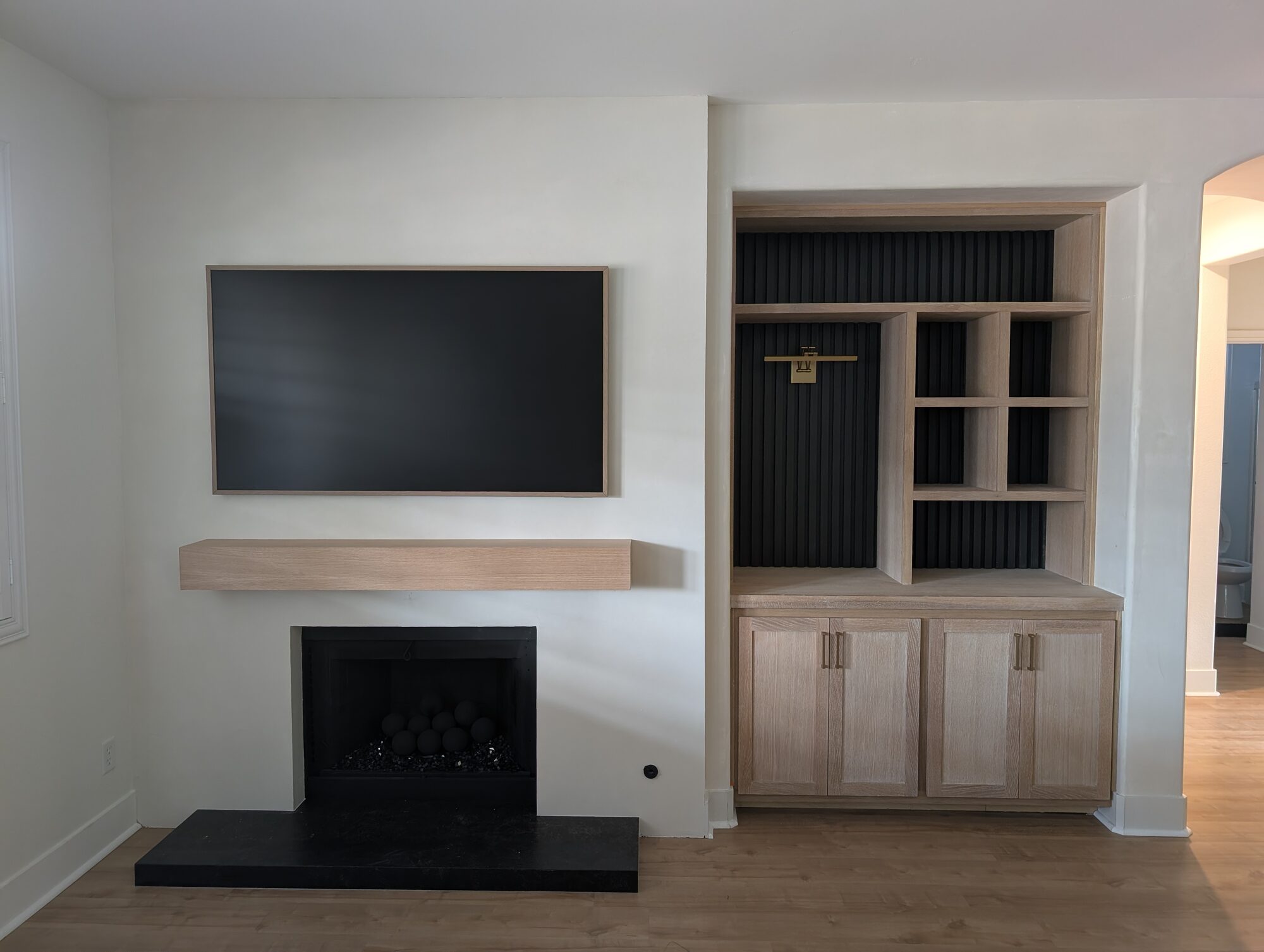
The Winchester wall is Portola Roman Clay in Mariposa, a light color, running edge to edge and around the return toward the staircase wall. Before any clay went on, the entire wall was smooth-coated so the texture couldn’t telegraph through.
What we used on this project:
- Portola Roman Clay in Mariposa across the full wall, including the return
- Drywall smooth-coated over the whole wall before the clay
- Plastic putty knives, per Portola’s guidance for light colors
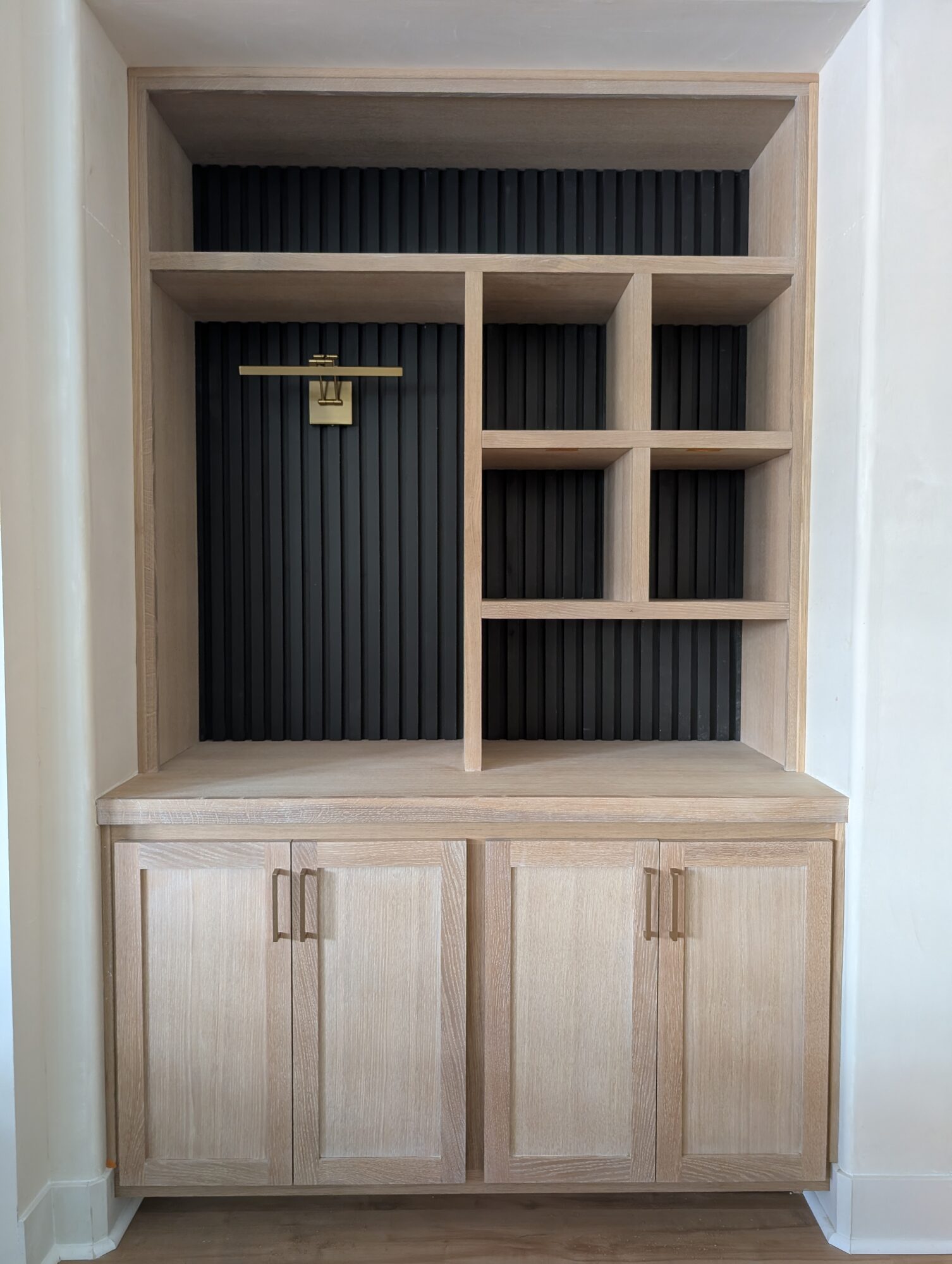
- Rift-sawn white oak in Rubio Monocoat Natural and black slats in Sherwin-Williams Tricorn Black set against the clay
How Roman Clay Holds Up in the Inland Empire
Two local realities matter most. First, texture: as covered above, most homes here need the wall smoothed before Roman Clay looks right. Second, dust and hands. Inland Empire living rooms see a lot of fine dust and a lot of traffic, and an unsealed clay wall will show hand marks. Near a fireplace or a TV wall that people reach across, we’d seal it.
Paint, by comparison, doesn’t care about either. That’s the honest trade: Roman Clay looks better on the right wall, and paint is easier everywhere else.
The Holland & Sons Angle
Mariposa is a light color, and light Roman Clay shows everything: the edge of a steel knife, a ridge in the drywall, a burnish mark from pressing too hard. That’s why the whole Winchester wall was smooth-coated, return and all, before the clay went on. Thirty-five years in, I’ll tell you the wall finish is only as good as the wall under it. Waylon likes to say carpentry looks complicated from the outside but isn’t once you’re doing it. Roman Clay is the opposite. It looks like you just smear it on, right up until you try it on a light color.
Related Resources — Winchester Fireplace Wall Guide
This post is one part of a set of guides built around a real fireplace wall Holland & Sons finished in Winchester. Start with the project, then go wherever your next question is.
- Custom Fireplace Wall in Winchester, CA: White Oak Built-In with a Record-Player Cubby — The full project: photos, the complete $17,590 investment, timeline and construction details.
- How Much Does It Cost to Update a Builder-Grade Fireplace in Winchester, Temecula and Murrieta? — Real investment ranges for a reface, a new surround and mantel, or a full fireplace wall, and what moves the number.
- Can You Remove a Builder-Grade Fireplace Surround and TV Niche Without Replacing the Fireplace? — What comes off, what stays, mantel clearances over gas, and the permit questions to settle before demo.
- Rubio Monocoat vs. Polyurethane for White Oak Built-Ins: Color, Protection and Maintenance — Which finish keeps white oak looking like white oak, and where polyurethane still wins.
- How to Tell If Stain-Grade Built-Ins Are Well Made: A White Oak Quality Checklist for Riverside County — What excellent stain-grade work looks like up close, the questions to ask, and what a complete quote includes.
- How to Design a Built-In for Vinyl Records and a Turntable in Your Inland Empire Home — Shelf heights, depths, weight, power and placement for a listening corner that works.
Frequently Asked Questions
What are the pros and cons of Roman Clay?
Roman Clay’s main pro is a soft, hand-troweled depth that paint can’t match; its main cons are prep, application skill and harder touch-ups. It needs smooth drywall and two troweled coats, and light colors can show burnish marks. It’s a great choice for one focal wall and a poor choice for every wall in a busy house.
How expensive is Roman Clay?
On a fireplace wall like our Winchester project, Roman Clay added roughly $1,200 to $2,000 over standard paint, including smoothing the wall first. Most of that difference is labor: skim-coating textured drywall and hand-troweling two coats. Large rooms scale up from there, which is why we usually recommend it for one feature wall.
Is Roman Clay better than limewash?
Roman Clay is better than limewash for a smooth interior feature wall, and limewash is better for brick, masonry and exteriors. Roman Clay gives a fuller troweled surface; limewash gives a thinner, cloudier wash. Livingetc notes limewash can go outside while Roman Clay is an interior product.
What do you seal Roman Clay with?
Roman Clay is sealed with Portola’s optional Roman Clay topcoat, recommended for high-traffic areas. Portola says to wait at least 4 to 6 hours after the final coat, preferably overnight, before applying it. Once sealed, the wall can be cleaned with mild dish soap on a sponge.
Do I need to prime before Roman Clay?
Yes, you should prime before Roman Clay. Portola recommends a stain-blocking primer on new drywall and calls priming previously painted walls best practice so old stains don’t bleed through. Priming also gives the clay a consistent surface to grab.
Can you put Roman Clay on textured walls?
Roman Clay goes best on smooth walls, and textured walls usually need to be skimmed first. Portola’s data sheet calls for smooth drywall, preferably a Level 5 finish, and says orange peel and knockdown make application difficult. Most Inland Empire tract homes have textured walls, so plan on prep.
Can you do Roman Clay yourself?
Yes, a patient homeowner can apply Roman Clay, but light colors and textured walls are where DIY goes wrong. Use plastic knives on light colors, since Portola notes steel can leave gray burnish marks. Practice on a sample board first, and get the wall smooth before you start. A bad first coat is hard to hide.
Is Roman Clay okay for bathrooms?
Roman Clay can work in a bathroom away from direct water if it’s sealed with the topcoat. Portola doesn’t recommend it for showers or surfaces in constant contact with water. A powder room wall is a reasonable spot; a tub surround is not.
Should Roman Clay be smooth or textured?
Roman Clay should go on a smooth wall and is meant to look softly mottled, not heavily textured. The movement comes from how it’s troweled, not from the wall underneath. If the wall has orange peel, the finished clay will look bumpy rather than soft.
Thinking About Roman Clay on Your Fireplace Wall?
If you’re in Winchester, Menifee, Murrieta, Temecula, Perris, Riverside or anywhere in the Inland Empire, start at hsconstruct.com/contact. Fill out the form, describe the wall, and upload photos plus any Roman Clay inspiration you’ve saved. We’ll come out, check the wall texture, and tell you straight whether clay or paint is the right call.
Follow Holland & Sons on our social channels to see what’s on the bench this week.
951-338-8058 | brian@hsconstruct.com | hsconstruct.com | CSLB #1123738
More Than Just Wall Finishes
A great wall finish is often where a room starts to come together, but it’s rarely the only thing a house needs. Brian has been a finish carpenter since 1991, and his sons now build alongside him, which means every room in your home is fair game.
If your space needs more than a new wall finish, here’s what else we build:
- Kitchen and bathroom remodels — full custom cabinetry, tile work, and finish carpentry from demo to done
- Coffered ceilings — grid beam systems that add architectural depth to any room, sized and proportioned to the space
- Wainscoting and wall paneling — classic raised panel, flat panel, board-and-batten, and shiplap applications
- Reclaimed wood accents — feature walls, fireplace surrounds, and detail work using salvaged material with real character
- Beam wraps — hollow wood wraps that give exposed beams the look of solid timber without the structural engineering
- Crown molding, baseboards, and trim carpentry — the details that make a house feel finished, from a single room to a whole home
- Cased openings and interior door replacements — clean transitions between spaces that most contractors overlook
- Custom built-in entertainment walls and bookshelves — designed by hand, built in the shop, installed to last
Wood, proportion, and rooms that feel right — that’s what we do.
hsconstruct.com
About the Author
Brian Holland is the owner and lead carpenter of Holland & Sons Construction, a family-run finish carpentry and general contracting company serving Riverside County and the Inland Empire. He entered the trade at 17 in 1991, learned on the job, and has spent 35 years building the kind of work that makes rooms feel right — often before a homeowner can articulate why. Every project starts at his vintage drafting table, where he sketches the layout by hand with pencil and paper using a Vemco drafting machine before anything gets built. His sons now apprentice alongside him on every project. Holland & Sons is based in Perris, CA and licensed by the CSLB (#1123738).
Related project
This guide is part of our custom fireplace walls series.
Learn more about Custom Fireplace WallsHave a project in mind? Let's start a conversation.
Tell us what you are thinking about and we will give you a straight answer about scope, timeline, and investment.
Start a Conversation