
How to Design a Built-In for Vinyl Records and a Turntable in Your Inland Empire Home
Quick Answer
Plan a vinyl built-in around the record, the turntable and the weight. Openings a little taller and deeper than a standard 12-3/8-inch LP jacket, dividers every few inches so records stand upright, and shelves sized for 35 to 45 pounds per foot will cover most collections. In Inland Empire homes, keep records out of direct sun and hot garages, and plan the turntable's power and light before the cabinet is built.
Key Takeaways
- A standard LP jacket is about 12-3/8 inches square; size openings around your actual records with a little room to spare
- The Library of Congress recommends storing LPs upright with dividers 4 to 6 inches apartLPs average 35 to 45 pounds per shelf-foot, so span and support matter as much as shelf thickness
- Plan turntable power, lid clearance, cables and lighting before fabrication, not after
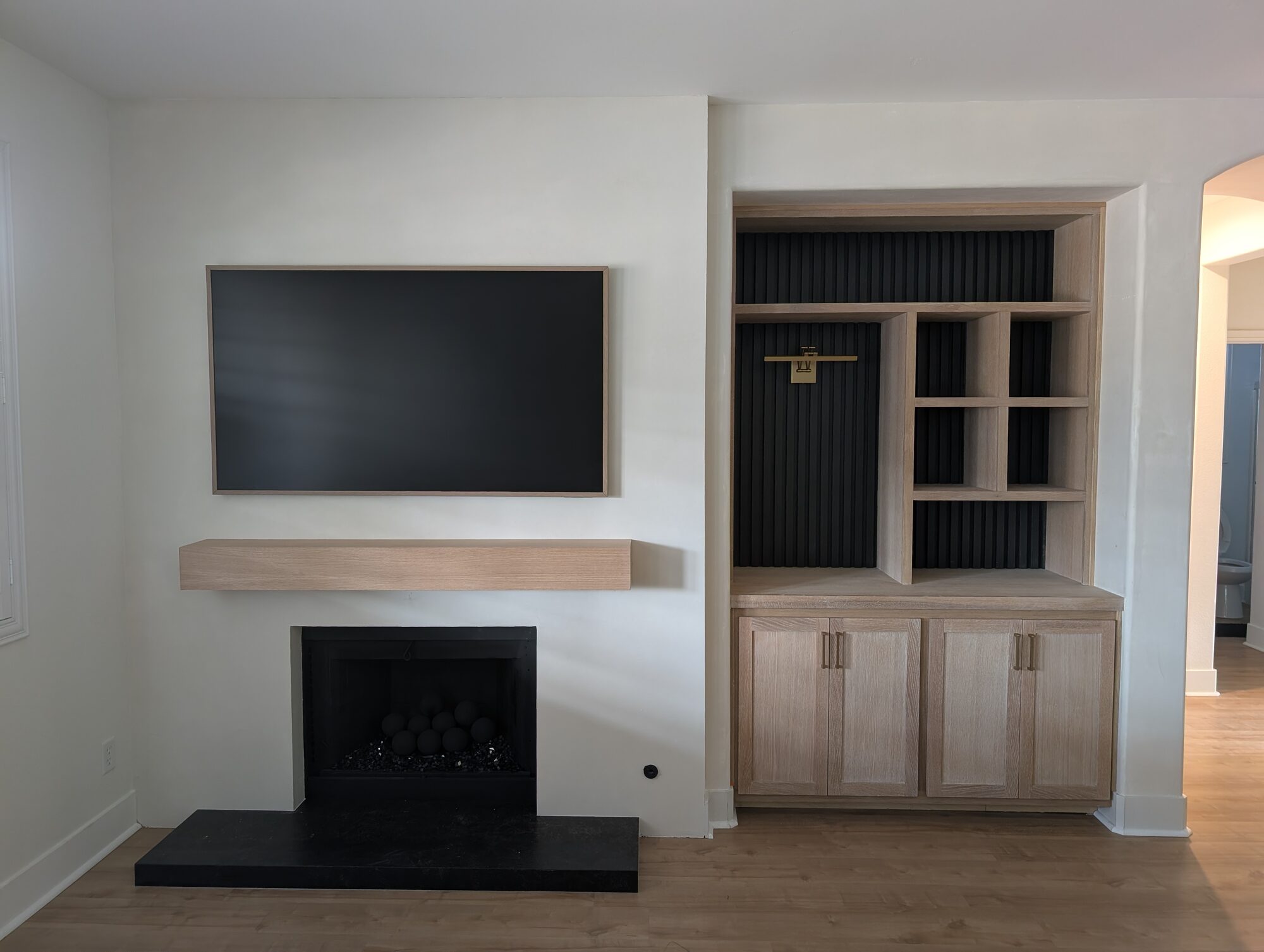
- See this in action: the Winchester fireplace wall project
If you play records, the best setup is a built-in with openings sized to the record, a solid low surface for the turntable with power right there, and a light you can switch on when the music goes on. That's what we built in Winchester, and it's what I'd recommend for anyone whose records get played, not just stored.
If you've got a few hundred records and a renter's budget, an IKEA Kallax will hold them, and I'll say that plainly. The difference is what happens around the records: where the turntable sits, where the cords go, how the light hits it, and whether it looks like it belongs to the room.
The Direct Recommendation
Build openings around the record jacket, put the turntable at counter height on its own solid surface with an outlet built in, and give the shelves enough thickness and short enough spans to carry real weight. For a collection that's part of the living room, a built-in does all three. For a collection that lives in a spare room, good furniture is fine.
What Are Your Options?
A custom built-in with record-height openings
Openings sized to the jacket, shelves built for the load, and the turntable, power and lighting planned into one piece. Best for: records in the main living space that get played. Falls short: larger investment, and it doesn't move with you. My take: the right answer when the listening corner is part of the room.
IKEA Kallax
The cube shelf everybody's seen. IKEA sizes its Kallax inserts at 13 by 13 inches to fit the cubes, which is why LPs fit. Best for: a large collection on a budget. Falls short: no plan for the turntable, power or cords, and it looks like what it is. My take: it works. Just know what you're giving up.
Standard bookshelves or adjustable shelving
Best for: mixed books and records. Falls short: most bookshelves aren't deep enough for a jacket to sit fully supported, and long adjustable shelves can sag under records. My take: check depth and span before you load it.
Flip-through bins or crates on a console
Best for: a small rotation you browse like a record store. Falls short: records lean, and leaning is what warps them. My take: fine for a few dozen; not for long-term storage.
How They Compare
| Option | Holds Records Upright | Turntable, Power and Light Planned In | Looks Built-In | Relative Investment |
|---|---|---|---|---|
| Custom built-in | Yes, sized to your records | Yes | Yes | Highest |
| IKEA Kallax | Yes, in 13" cubes | No | No | Lowest |
| Bookshelves | Depends on depth and dividers | No | Sometimes | Low to moderate |
| Bins or crates | Partly; records lean | No | No | Low |
How Big Should a Record Shelf Be?
A standard LP jacket is about 12-3/8 inches square. Build the opening a little taller than that so records slide in and out without scraping, and deep enough that the jacket sits fully on the shelf. On the Winchester project, the record cubbies are roughly 13 inches tall, which gives a little room to spare and makes the openings look sized on purpose. That's our project's number, not a rule. If you have box sets, gatefolds or 7-inch singles, measure those too and plan a different opening for them.
Should records be stored upright or flat?
Upright. The Library of Congress preservation guidance, published through NEDCC, says LPs should be stored vertically, on edge, with full-height, full-depth dividers spaced 4 to 6 inches apart so records can't lean. Stacking them flat puts the weight of the stack on the bottom records.
How much weight does a record shelf have to hold?
More than most people think. The same guidance puts LPs at an average of 35 to 45 pounds per shelf-foot. So a 3-foot shelf of records can carry well over 100 pounds.
Thickness helps, but it isn't the whole answer. Sag depends on the material, the span between supports, how the shelf is attached and how long the load sits there. The free Sagulator calculator from Woodbin uses a target of 0.02 inches of sag per foot or less, and notes wood shelves keep sagging over time. Short spans, fixed shelves and solid supports are what really carry the weight.
Where Should the Turntable Go?
- At a comfortable height on a solid, level surface. A countertop or the top of a base cabinet works well. Turntables are sensitive to vibration, so keep them off thin or wobbly shelves.
- With clearance for the lid. Measure your turntable with the dust cover open, plus room to lift the tonearm and get records on and off.
- With depth for cables. Leave space behind for power, ground and audio cables, or route them through the back.
- With power built in. An outlet in the countertop or the back of the opening keeps cords off the face of the cabinet. New outlets usually mean a permit.
- With airflow for electronics. Amplifiers and receivers need ventilation. Don't seal them in a closed cabinet without a plan for heat.
- Away from the speakers. Speakers on the same surface as the turntable can feed vibration back into it.
Equipment heat and cable planning trip up a lot of media built-ins, too; we covered that in what goes wrong with built-in entertainment walls.
How to Decide What to Build
- Count and measure. How many records are in daily rotation, and how many in the full collection? Measure your largest jackets and box sets.
- Decide what's on display. A few dozen in rotation near the turntable, with the rest elsewhere, is a common and smart split.
- List the equipment. Turntable, preamp, amplifier, speakers. Get dimensions with lids open.
- Plan power and light. Where the outlets go, and whether the corner gets its own switch.
- Match the room. If there's wood elsewhere in the house, the built-in should look like it belongs.
For the investment side, see what a built-in like this typically runs (Builder-Grade Fireplace Update Cost) and the media wall investment guide. To make sure the shelves are built right, use the stain-grade quality checklist (Stain-Grade Quality Checklist).
See This In Action — Winchester Fireplace Wall
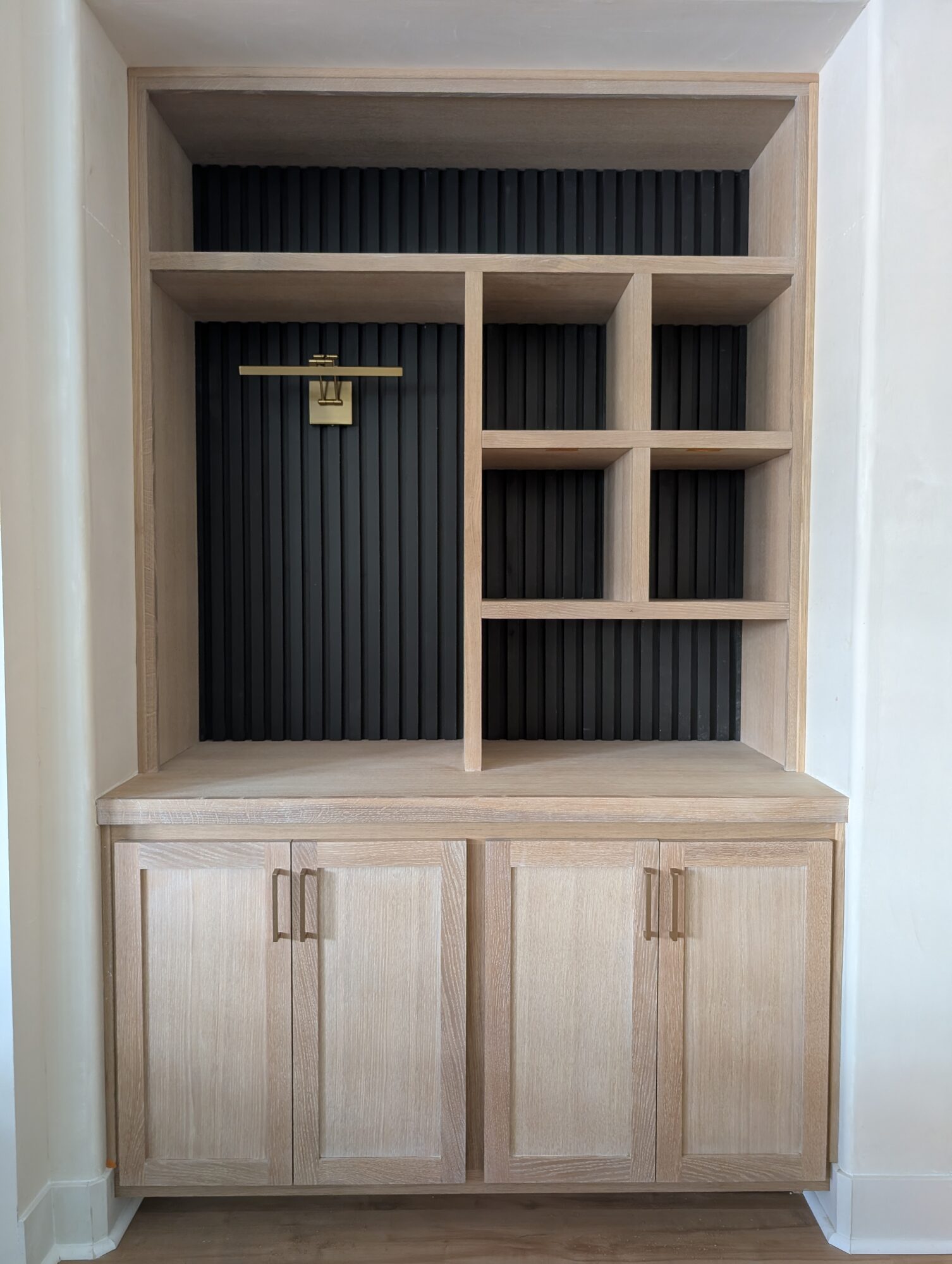
In Winchester, the turntable sits at the bottom of a tall cubby on the left of the built-in. When a record goes on, the jacket stands up behind it, and an antique brass picture light washes over both. An earlier version of the layout traded that tall cubby for one more small one; the final drawing kept it.
What we used on this project:
- Record cubbies roughly 13 inches tall for jackets of about 12-3/8 inches, holding the few dozen records in rotation
- One tall cubby for the turntable, with height above it for the playing record's jacket
- Outlet built into the white oak countertop for the record player
- Antique brass picture light on a wall switch over the tall cubby
- 1-1/2" laminated shelves with solid white oak nosing
Photos of the finished listening corner and the full build are in the project post: Winchester fireplace wall project.
Inland Empire Note: Heat, Sun and Garages
Records don't like heat or light, and the Inland Empire has plenty of both. The Library of Congress guidance recommends a steady 65 to 70°F and 45 to 50% relative humidity for medium-term storage, and keeping recordings away from light, especially sunlight.
Two local rules follow from that. Don't store records in a garage in Winchester, Menifee or Temecula; summer heat in an uninsulated garage is the opposite of what records need. And don't put a record built-in where afternoon sun from a slider hits the jackets every day. An interior wall in a climate-controlled living room is a good home for them. On a fireplace wall, keep the records to the side rather than above the firebox, the way the Winchester cubbies sit in the alcove beside the fireplace.
The Holland & Sons Angle
The tall cubby on the left of the Winchester built-in is the whole point of the wall: the record player at the bottom, the jacket of whatever's playing standing behind it, one light on a switch. It's a small thing, and it's the first thing you notice. Thirty-five years of drawing these by hand has taught me that the detail people remember is usually the one built around how they actually live. Wyatt says carpentry was kind of his only option starting out, and he's grown to like it, though he can't quite put his finger on why. Ask him about a corner like this one and I think you'd find out.
Related Resources — Winchester Fireplace Wall Guide
This post is one part of a set of guides built around a real fireplace wall Holland & Sons finished in Winchester. Start with the project, then go wherever your next question is.
- Custom Fireplace Wall in Winchester, CA: White Oak Built-In with a Record-Player Cubby — The full project: photos, the complete $17,590 investment, timeline and construction details.
- How Much Does It Cost to Update a Builder-Grade Fireplace in Winchester, Temecula and Murrieta? — Real investment ranges for a reface, a new surround and mantel, or a full fireplace wall, and what moves the number.
- Can You Remove a Builder-Grade Fireplace Surround and TV Niche Without Replacing the Fireplace? — What comes off, what stays, mantel clearances over gas, and the permit questions to settle before demo.
- Roman Clay vs. Paint on a Fireplace Wall: Is It Worth It in Inland Empire Homes? — A straight comparison of look, prep, durability and investment, with limewash and Venetian plaster in the mix.
- Rubio Monocoat vs. Polyurethane for White Oak Built-Ins: Color, Protection and Maintenance — Which finish keeps white oak looking like white oak, and where polyurethane still wins.
- How to Tell If Stain-Grade Built-Ins Are Well Made: A White Oak Quality Checklist for Riverside County — What excellent stain-grade work looks like up close, the questions to ask, and what a complete quote includes.
Frequently Asked Questions
What is the typical size of a vinyl record shelf?
A vinyl record shelf typically needs openings a little over 12-3/8 inches tall and deep, the size of a standard LP jacket. Our Winchester project used roughly 13-inch openings. Measure your largest jackets and box sets, and add dividers every 4 to 6 inches so records stay upright.
How deep does a shelf need to be for a record player?
A record player shelf needs to be deeper than the turntable itself, plus room behind it for cables and in front for your hands. Measure your turntable with the lid open and add clearance for lifting the tonearm. A countertop or base cabinet top usually works better than a standard record shelf.
Should vinyl records be stored vertically or horizontally?
Vinyl records should be stored vertically, standing on edge. Library of Congress preservation guidance recommends upright storage with full-height, full-depth dividers spaced 4 to 6 inches apart. Stacking records flat puts pressure on the ones at the bottom, and letting them lean can warp them.
How much weight does a vinyl record shelf need to hold?
A vinyl record shelf should be built for 35 to 45 pounds per foot of shelf, the average weight Library of Congress guidance gives for LPs. Shelf thickness, span, material and attachment all affect how much it sags. Short spans and fixed, well-supported shelves carry records best over time.
Does IKEA Kallax fit vinyl records?
Yes, IKEA Kallax fits standard vinyl records. IKEA sizes its Kallax inserts at 13 by 13 inches to fit the cubes, and LP jackets are about 12-3/8 inches square. It's a solid budget option for a large collection. It doesn't plan for a turntable, power, cords or lighting, which is where a built-in earns its place.
What is the best cabinet to store vinyl records?
The best cabinet for vinyl records holds them upright with dividers, is deep and tall enough for the jackets, has shelves built for 35 to 45 pounds per foot, and sits away from heat and direct sun. For a living room, a built-in that also plans the turntable, power and light is the most complete solution.
Is it okay to store vinyl records in the garage?
No, a garage is a poor place for vinyl records, especially in the Inland Empire. Library of Congress guidance recommends a steady 65 to 70°F and 45 to 50% humidity. Summer heat in an uninsulated garage can warp records. Keep them inside, away from windows and heat sources.
How should I store 7-inch vinyl records?
Store 7-inch records upright like LPs, but in their own shorter section or bins. Mixing sizes on the same shelf lets small records slip and lean between larger ones, which preservation guidance warns increases the risk of warping. Size dividers or a dedicated cubby to the 7-inch format.
Want a Listening Corner Built for Your Records?
If you're in Winchester, Menifee, Murrieta, Temecula, Perris, Riverside or anywhere in the Inland Empire, start at hsconstruct.com/contact. Fill out the form, tell us about your collection and your gear, and upload photos of the room plus any setups you love. We'll come out, measure the wall and the records, and draw it up by hand.
Want to see this advice applied to a real project? Here's the full breakdown: Winchester fireplace wall project.
Follow Holland & Sons on our social channels to see what's on the bench this week.
951-338-8058 | brian@hsconstruct.com | hsconstruct.com | CSLB #1123738
More Than Just Record Storage
A listening corner built around your records is often where a room starts to come together, but it's rarely the only thing a house needs. Brian has been a finish carpenter since 1991, and his sons now build alongside him, which means every room in your home is fair game.
If your space needs more than a place for your records, here's what else we build:
- Kitchen and bathroom remodels — full custom cabinetry, tile work, and finish carpentry from demo to done
- Coffered ceilings — grid beam systems that add architectural depth to any room, sized and proportioned to the space
- Wainscoting and wall paneling — classic raised panel, flat panel, board-and-batten, and shiplap applications
- Reclaimed wood accents — feature walls, fireplace surrounds, and detail work using salvaged material with real character
- Beam wraps — hollow wood wraps that give exposed beams the look of solid timber without the structural engineering
- Crown molding, baseboards, and trim carpentry — the details that make a house feel finished, from a single room to a whole home
- Cased openings and interior door replacements — clean transitions between spaces that most contractors overlook
- Custom built-in entertainment walls and bookshelves — designed by hand, built in the shop, installed to last
Wood, proportion, and rooms that feel right — that's what we do.
hsconstruct.com
About the Author
Brian Holland is the owner and lead carpenter of Holland & Sons Construction, a family-run finish carpentry and general contracting company serving Riverside County and the Inland Empire. He entered the trade at 17 in 1991, learned on the job, and has spent 35 years building the kind of work that makes rooms feel right — often before a homeowner can articulate why. Every project starts at his vintage drafting table, where he sketches the layout by hand with pencil and paper using a Vemco drafting machine before anything gets built. His sons now apprentice alongside him on every project. Holland & Sons is based in Perris, CA and licensed by the CSLB (#1123738).
Related project
This guide is part of our custom built-ins & cabinetry series.
Learn more about Custom Built-Ins & CabinetryHave a project in mind? Let's start a conversation.
Tell us what you are thinking about and we will give you a straight answer about scope, timeline, and investment.
Start a Conversation