
Rift-Sawn, Quarter-Sawn or Plain-Sawn White Oak: Which Cut Is Best for Built-Ins and Benches in the Inland Empire?
Quick Answer
For white oak built-ins, benches and cabinet doors in Inland Empire homes, rift-sawn is our first choice. It has the straightest, most consistent grain with almost no ray fleck, so long surfaces and matching pieces read as one. Quarter-sawn is the pick when you want the dramatic fleck pattern, and plain-sawn is the most affordable cut with the most grain character.
Key Takeaways
- Rift-sawn white oak gives the straightest, most uniform grain and is the strongest choice for modern built-ins
- Quarter-sawn shows dramatic ray fleck; plain-sawn shows cathedral grain and is the most affordable
- Rift and quarter-sawn boards shrink and swell roughly half as much in width as plain-sawn boards
- Rift is typically the most expensive and least common cut because it wastes the most of the log
- See this in action: Winchester Built-In Mudroom
If you're building white oak cabinets, a bench or a built-in, ask for rift-sawn. It's what we reach for first, and it's the reason a long oak bench can look like one continuous piece of wood instead of a patchwork of boards.
Most homeowners never hear the word "rift" until they're standing in front of two samples of the same species that look nothing alike. Same tree. Different saw cut. That cut changes how the grain looks, how much the board moves, how much of the log goes to waste, and what you invest.
The Direct Recommendation
Rift-sawn white oak for built-ins, benches, face frames and cabinet doors. The grain runs straight on the face and the edges, so pieces match across a room and edges don't show a different pattern than faces. The tradeoff is investment: rift wastes the most of the log, so it's typically the most expensive cut.
Choose quarter-sawn if you love the flecked look of Craftsman and Mission furniture. Choose plain-sawn if you want the most wood character for the least investment and you don't need pieces to match closely.
The Three Cuts, Evaluated
Rift-Sawn White Oak
What it is: Lumber cut so the growth rings meet the face at roughly 30 to 60 degrees, with 45 degrees considered ideal. The result is a tight, linear grain with little to no fleck.
Where it performs best: Long benches, shelves, cabinet doors and face frames, anywhere boards need to match each other and edges need to look like faces.
Where it falls short: It's the most expensive option and produces the most waste. Some homeowners find it too uniform for a rustic look.
Who it's right for: Modern, transitional and clean-lined interiors, which describes most of the homes we work in across Temecula and Murrieta.
My take: On built-ins, rift is the cut that makes the work look intentional. Grain that runs straight lets the joinery, not the board, be the detail.
Quarter-Sawn White Oak
What it is: Lumber cut so the growth rings meet the face at about 60 to 90 degrees. In white oak, that exposes the medullary rays, the ribbon-like flecks quarter-sawn oak is known for.
Where it performs best: Furniture, doors and paneling where the fleck is meant to be the star.
Where it falls short: The fleck is busy on large surfaces, and it shows on the faces but not the edges, so a thick shelf can look like two different woods. It also requires a larger investment than plain-sawn.
Who it's right for: Craftsman and Mission styles, and homeowners who want the wood itself to be the pattern.
My take: Beautiful in the right room. In a busy family entry with brass, black slats and painted cabinetry already in play, it can be one pattern too many.
Plain-Sawn (Flat-Sawn) White Oak
What it is: Lumber cut straight through the log, producing the familiar cathedral or arched grain on the face.
Where it performs best: Floors, rustic furniture, and projects where grain variety is welcome.
Where it falls short: It moves the most with humidity and is more prone to cupping, according to Osborne Wood Products. Matching boards across a run of doors is harder.
Who it's right for: Farmhouse and traditional interiors, and budget-conscious projects.
My take: Good wood, honest look. I use it when the design wants movement in the grain and the pieces don't need to match.
Comparison Table
| Factor | Rift-Sawn | Quarter-Sawn | Plain-Sawn |
|---|---|---|---|
| Grain on the face | Straight, tight lines | Straight with ray fleck | Cathedral arches |
| Grain on the edges | Similar to the face | Different from the face | Straight lines |
| Ray fleck | Little to none | Pronounced | Minimal |
| Movement in width | Low | Lowest | Highest |
| Waste from the log | Most | More than plain | Least |
| Investment | Highest | Higher | Lowest |
| Matching across pieces | Easiest | Moderate | Hardest |
| Best for | Modern built-ins, benches, doors | Craftsman furniture and doors | Floors, rustic pieces |
Grain descriptions and waste or investment rankings follow Osborne Wood Products and International Timber. Movement rankings reflect the shrinkage data below.
Why the Cut Changes How Wood Moves
Wood shrinks and swells about twice as much along the growth rings as across them. For white oak, the USDA Wood Handbook values are 10.5% tangential (along the rings) versus 5.6% radial (across them), measured from green to oven-dry. A quarter-sawn board's width runs mostly in the radial direction, so it moves roughly half as much in width as a plain-sawn board. Rift falls between the two, closer to quarter-sawn. In plain terms: the straighter the grain looks on the face, the calmer the board usually behaves.
Your Questions, Answered
What is better, rift sawn or quarter sawn?
Neither is better across the board. Rift is better for uniform, modern built-ins where pieces need to match and edges need to look like faces. Quarter-sawn is better when you want ray fleck as a design feature. Both are more stable than plain-sawn.
Is rift cut white oak more expensive than quarter sawn?
Usually, yes. Rift-sawing yields the least usable lumber per log, and suppliers like International Timber describe it as the most expensive and least common cut. Some yards sell "rift and quartered" lumber together, so ask exactly what you're getting.
What are the disadvantages of rift sawn wood?
Rift-sawn wood requires a larger investment, wastes more of the log, can be harder to source in wide boards, and some people find it too uniform. If you want the wood to show a lot of character, rift isn't the cut.
What is special about quarter sawn white oak?
Quarter-sawn white oak exposes the medullary rays as shimmering flecks and ribbons across the face. That look defined Arts and Crafts furniture. It's also one of the most stable ways to cut oak.
Why is quarter sawn oak so expensive?
Quarter-sawing takes more handling at the mill and produces more waste than plain sawing, so each usable board carries more of the log's investment.
What's the difference between white oak and rift white oak cabinets?
"White oak" is the species. "Rift white oak" is that species cut a specific way. White oak cabinets without a cut specified are often plain-sawn, with cathedral grain. Rift white oak cabinets have straight, consistent grain. If a quote just says "white oak," ask which cut. It's one of the questions to ask about material specification (Is It Really Custom).
Are white oak cabinets outdated?
White oak has been a staple of good furniture for centuries, and it isn't going anywhere. What dates a room is usually the finish color and the style of the doors, not the species. A natural, light finish on rift-sawn oak with simple doors is about as timeless as wood cabinetry gets.
How to Choose
- Do pieces need to match? Long benches, door runs and face frames: rift.
- Do you want the wood to be the pattern? Quarter-sawn.
- Is investment the deciding factor? Plain-sawn, or rift only where it shows most.
- Is it a thick edge or a shelf? Rift, so the edge looks like the face, or a miter fold so the face grain wraps the edge.
- What finish is going on? Oil finishes keep oak close to its natural color. See how material choice affects the finish system (Painted Built-Ins Chip) for the painted side of the same project.
Still choosing the species itself? Our guide to the best wood species for custom built-ins covers that question, and our floating shelf wood comparison weighs white oak against cherry, walnut and maple.
See This In Action — Winchester Built-In Mudroom
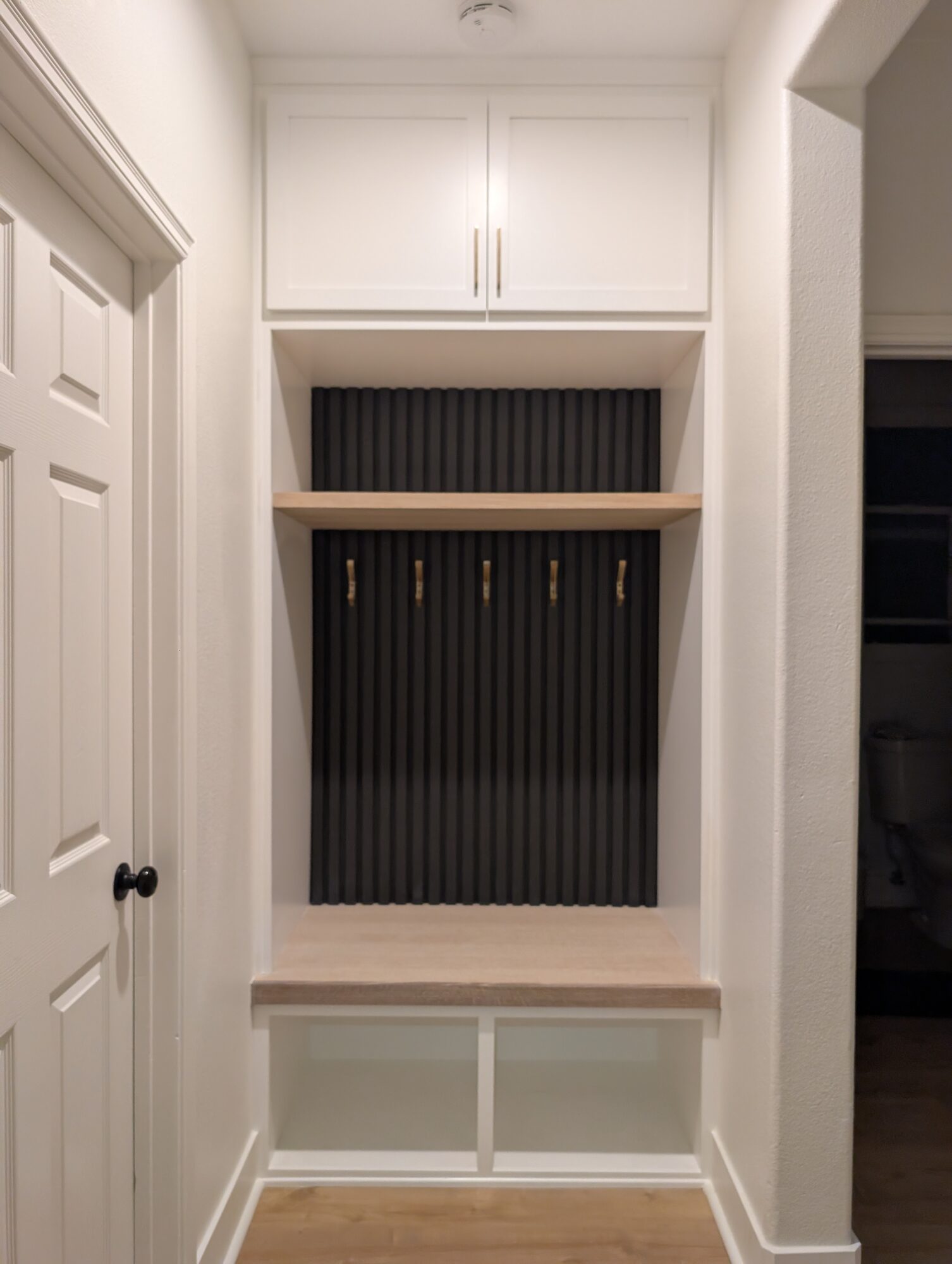
The bench and shelf in this Winchester mudroom are 100% rift-sawn white oak, miter-folded so the grain wraps continuously over the front edge. A miter fold means cutting a 45-degree groove most of the way through the board and folding the edge down, so there's no seam and no end grain showing.
What we used on this project:
- Rift-sawn white oak bench and shelf, miter-folded
- Rubio Monocoat Oil Plus 2C in Natural
- Oak chosen to match the rift-sawn white oak on the fireplace wall in the same house
- Upgrading the bench and shelf from painted maple to rift-sawn oak added about $1,100 to $1,400
Photos, the full investment breakdown and the build timeline are in the project post: Winchester Built-In Mudroom.
White Oak in the Inland Empire Climate
Homes in Winchester, Menifee, Murrieta and Temecula sit in dry air for much of the year, then swing with the seasons and the air conditioning. That's exactly where cut matters. Plain-sawn boards move the most across their width, which can open joints and cup wide panels. Rift and quarter-sawn boards move less and stay flatter. That's why lumber should acclimate before it's milled, and why on built-ins we lean on rift for the pieces that need to stay put. For the bigger picture on mudroom materials, see the best materials for a mudroom built-in.
The Holland & Sons Angle
The Winchester bench is 24 inches deep, rift-sawn white oak with a miter-folded front edge, and it had to match the oak on the fireplace wall you can see from the kitchen without looking like a different tree. Rift made that possible. Plain-sawn would have put cathedral arches on one and straight lines on the other. After 35 years, I'll spend more on the cut before I'll spend time explaining a mismatch. Wyatt knows that feeling. The job he's proudest of so far is installing white oak paneling above a staircase, where the fit and the angles were tricky to get right. White oak doesn't hide anything, and that's exactly why it teaches you so much.
Related Resources — Winchester Mudroom Guide
This post is one part of a four-part guide built around a real Holland & Sons project, a fully custom mudroom built-in in Winchester. Here's where to go next.
- Custom Built-In Mudroom in Winchester, CA — the full project: photos, materials, timeline and the complete investment breakdown.
- How Much Does a Custom Wood Slat Accent Wall Cost in Temecula, Murrieta and Winchester? — real investment ranges for hand-built slats, from a small section inside a built-in to a full wall.
- Why Painted Built-Ins Chip: Cure Time, Tape, Primer and Early-Use Mistakes — why fresh enamel chips, how long it really takes to cure, and what to avoid in the first weeks.
- Custom-Built Wood Slat Wall vs. Prefab Slat Panels — a straight answer on when hand-built slats earn their place and when prefab panels are the smarter call.
- Is Your "Custom" Built-In Really Custom? 8 Ways to Tell — an eight-point checklist for judging whether the built-in on your quote is truly made for your room.
Frequently Asked Questions
What is better, rift sawn or quarter sawn?
Rift-sawn is better for uniform, modern built-ins where pieces must match and edges should look like faces. Quarter-sawn is better when you want ray fleck as a feature. Both move less than plain-sawn lumber, so either is a solid choice for cabinetry.
Is rift cut white oak more expensive than quarter sawn?
Rift-cut white oak is usually more expensive than quarter-sawn because it yields the least usable lumber per log. Suppliers describe it as the most expensive and least common cut. Some yards sell rift and quartered stock together, so confirm what you're buying.
What are the disadvantages of rift sawn wood?
Rift-sawn wood requires a larger investment, creates more waste at the mill, can be harder to find in wide boards, and has a uniform look some people find plain. It's the wrong cut if you want lots of visible grain character.
What is special about quarter sawn white oak?
Quarter-sawn white oak shows the medullary rays as flecks and ribbons across the face, the signature look of Arts and Crafts furniture. It's also one of the most dimensionally stable ways to cut oak, moving about half as much in width as plain-sawn.
Why is quarter sawn oak so expensive?
Quarter-sawn oak requires a larger investment because quarter-sawing takes more handling and produces more waste than plain sawing. Each usable board carries more of the log's investment, and wide quarter-sawn boards are less common.
What are the differences between white oak and rift white oak cabinets?
White oak is the species; rift white oak is that species sawn a specific way. Unspecified white oak cabinets are often plain-sawn with cathedral grain, while rift white oak has straight, consistent grain. Ask which cut a quote includes.
Are white oak cabinets outdated?
White oak cabinets aren't outdated. Oak has been used in fine furniture for centuries. Finish color and door style date a kitchen or built-in more than the species does. Light, natural finishes on rift-sawn oak with simple doors age especially well.
Does rift sawn white oak move less?
Yes, rift-sawn white oak moves less in width than plain-sawn. USDA Wood Handbook data puts white oak's tangential shrinkage at 10.5% versus 5.6% radial, and rift and quarter-sawn boards move closer to the lower radial figure.
Planning White Oak Built-Ins?
If you're planning a white oak bench, cabinetry or built-in anywhere in Winchester, Menifee, Murrieta, Temecula, Perris, Riverside or the Inland Empire, start at hsconstruct.com/contact. Fill out the form, describe the project, and upload photos of the room and any wood already in the house it needs to match. We'll walk you through the cuts and what each one means for your project before anything is ordered.
Want to see this advice applied to a real project? Here's the full breakdown: Winchester Built-In Mudroom.
Follow Holland & Sons on our social channels to see the oak coming off the bench.
951-338-8058 | brian@hsconstruct.com | hsconstruct.com | CSLB #1123738
More Than Just White Oak Built-Ins
A white oak built-in done right is often where a room starts to feel finished, but it's rarely the only thing a house needs. Brian has been a finish carpenter since 1991, and his sons now build alongside him, which means every room in your home is fair game.
If your space needs more than a white oak built-in, here's what else we build:
- Kitchen and bathroom remodels — full custom cabinetry, tile work, and finish carpentry from demo to done
- Coffered ceilings — grid beam systems that add architectural depth to any room, sized and proportioned to the space
- Wainscoting and wall paneling — classic raised panel, flat panel, board-and-batten, and shiplap applications
- Reclaimed wood accents — feature walls, fireplace surrounds, and detail work using salvaged material with real character
- Beam wraps — hollow wood wraps that give exposed beams the look of solid timber without the structural engineering
- Crown molding, baseboards, and trim carpentry — the details that make a house feel finished, from a single room to a whole home
- Cased openings and interior door replacements — clean transitions between spaces that most contractors overlook
- Custom built-in entertainment walls and bookshelves — designed by hand, built in the shop, installed to last
Wood, proportion, and rooms that feel right — that's what we do.
hsconstruct.com
About the Author
Brian Holland has worked in finish carpentry since 1991. Today he owns and leads Holland & Sons Construction, a family-run finish carpentry and general contracting company serving Riverside County and the Inland Empire. He entered the trade at 17, learned on the job, and has spent 35 years building the kind of work that makes rooms feel right — often before a homeowner can articulate why. Every project starts at his vintage drafting table, where he sketches the layout by hand with pencil and paper using a Vemco drafting machine before anything gets built. His sons now apprentice alongside him on every project. Holland & Sons is based in Perris, CA and licensed by the CSLB (#1123738).
This guide is part of our custom built-ins & cabinetry series.
Learn more about Custom Built-Ins & CabinetryHave a project in mind? Let's start a conversation.
Tell us what you are thinking about and we will give you a straight answer about scope, timeline, and investment.
Start a Conversation