Best Wood Species for Custom Built-In Feature Walls in the Inland Empire
Quick Answer
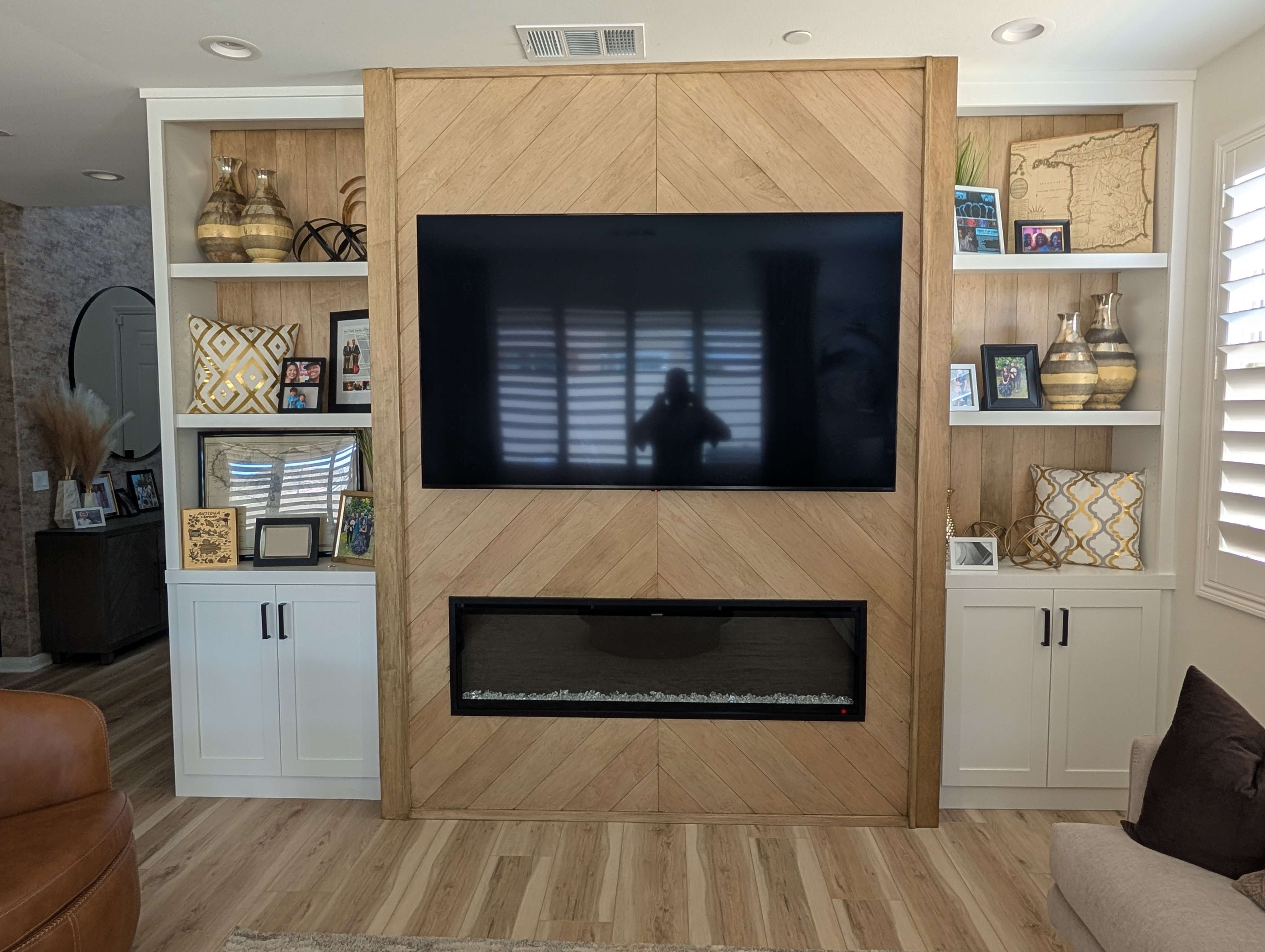
For a custom built-in feature wall in a living room or great room in Menifee and the Inland Empire, hard maple at A1 clear grade is Brian's first recommendation. It is one of the hardest domestic hardwoods (Janka hardness 1,450 — harder than white oak and harder than cherry), dimensionally stable in the dry inland climate, and at A1 clear grade produces a clean, consistent grain with a warm cream-to-ivory color that works across a wide range of interior styles. The Liberty Bell project in Heritage at Bahner Park used custom-milled A1 clear hard maple tongue-and-groove — because that material at that grade and profile does not exist off the shelf. Rift-sawn white oak is the stronger call when the design direction is more contemporary. Walnut is right for a darker, richer palette at a higher material investment.
Key Takeaways
-
Hard maple (Janka 1,450): Brian's first choice for feature wall panels in the Inland Empire — stable in dry climate, clean grain, holds angle cuts at 45 degrees cleanly over time
-
Rift-sawn white oak: increasingly the design direction for contemporary applications — more visible grain character, cooler tone, distinctive medullary ray pattern
-
Walnut: the right choice for a darker, richer palette — significantly higher material investment, requires different finish approach
-
A1 clear grade is the furniture-quality specification — knot-free, consistent color and grain — and often requires a custom mill run at that grade for less common profiles
-
In the Inland Empire dry climate, wood moves with humidity changes — species selection and grain orientation affect dimensional stability in pattern installations
-
UV-stabilized, non-yellowing topcoat is the correct finish specification for south-facing window exposure common in Inland Empire new-build homes
The Direct Recommendation
Hard maple. A1 clear grade. Custom mill run if needed for the profile.
That is the specification on the Liberty Bell project, and it is Brian's default recommendation for a floor-to-ceiling chevron or herringbone feature wall panel in a living room or great room in Menifee, Murrieta, Temecula, or anywhere in the Inland Empire. Here is why that recommendation holds up:
-
Hardness: At Janka 1,450, hard maple is one of the hardest domestic hardwoods. It holds angle cuts cleanly — the 45-degree miter on both ends of every chevron board stays tight. Over time, in a room where the wall is not getting direct abuse, hard maple does not dent, check, or open joints the way a softer species might.
-
Grain at A1 clear grade: A1 clear maple has a subtle, consistent grain — not the dramatic figure of quarter-sawn oak or the distinct patterning of walnut. That subtlety is a feature, not a limitation. It means the pattern reads as the design statement, not the wood character. The chevron V-shape is the eye's destination; the grain supports it without competing.
-
Dimensional stability in the Inland Empire climate: Hard maple is among the more dimensionally stable of the domestic hardwoods in a dry climate. For a chevron installation where tight joints at every 45-degree intersection are critical, stability is part of the specification.
-
Finish compatibility: Hard maple takes a water-based topcoat beautifully and does not amber (yellow) over time the way an oil-based finish on pine or cherry would. General Finishes High Performance Water Based Top Coat Satin — used on the Liberty Bell project — is UV-stabilized and non-yellowing, the correct pairing with maple in an Inland Empire room with south-facing windows.
Full Species Evaluation
Hard Maple (Sugar Maple) — Janka 1,450
The right choice for: chevron and herringbone pattern installations, floor-to-ceiling feature walls where the pattern is the design statement, any application requiring a furniture-quality grain at A1 clear grade.
What it delivers: clean, consistent grain at A1 clear; warm cream-to-ivory base color; takes water-based topcoat beautifully and holds its color over time; one of the hardest domestic hardwoods, holds angle cuts and tight joints well over time.
Where it requires attention: A1 clear hard maple tongue-and-groove does not exist as an off-the-shelf product in most lumber yards. The Liberty Bell project sourced through Forest Plywood / Baker Hardwood, a Southern California hardwood distributor with on-site milling capability, because furniture-quality knot-free maple in a tongue-and-groove profile at A1 clear grade requires a custom mill run. Plan for this in the material sourcing timeline.
Brian's field note: hard maple machines well but demands sharp tooling and careful feed rate management — dull blades produce tearout and rough faces that show in the finished work. At A1 clear, there is nowhere to hide a machining error.
Rift-Sawn White Oak — Janka 1,290
The right choice for: contemporary design directions, flat or vertical panel installations, applications where visible grain character and the distinctive medullary ray pattern are part of the design intent.
What it delivers: pronounced, straight grain with fine ray fleck pattern visible in rift-sawn cut; cooler, more neutral tone than maple; works beautifully with both natural oil finishes and water-based topcoats; widely available in the Inland Empire market through hardwood distributors.
Where it requires attention: white oak is slightly softer than hard maple at Janka 1,290 — still a hard domestic hardwood, but marginally less crisp at angle cuts in a demanding pattern installation. Rift-sawn oak can be more expensive per board foot than standard flat-sawn white oak; verify the cut specification with your hardwood supplier.
Brian's field note: rift-sawn white oak is increasingly the design direction for interior finish work in the Inland Empire — the clean contemporary look it delivers pairs well with the lighter, more neutral interiors common in new-build homes. For a straight vertical plank panel or a flat horizontal installation, white oak is often the stronger design call than maple.
Walnut (Black Walnut) — Janka 1,010
The right choice for: applications calling for a darker, richer palette; built-ins where the wood color itself is the design statement rather than the pattern; rooms with warmer, darker furnishing schemes.
What it delivers: rich chocolate-to-espresso color range; distinctive, slightly open grain with natural luster; pairs exceptionally well with matte black hardware and darker interior palettes; one of the most visually compelling domestic hardwoods at any grade.
Where it requires attention: walnut is softer than maple or white oak at Janka 1,010 — still a hard wood for most applications, but less crisp at angle cuts in a high-precision pattern installation. Material investment is meaningfully higher than maple or white oak, particularly at higher grades. Walnut grain is more open, which requires different finish prep than maple.
Brian's field note: walnut is a beautiful wood that reads as expensive because it is. On the right project — darker design direction, warmer palette, a homeowner who understands and wants the richness of natural walnut — it delivers results that maple cannot. It is not the right call for the typical Inland Empire new-build living room, where the interior palette tends toward lighter, airier tones.
Cherry — Janka 950
The right choice for: traditional or transitional design directions; applications where the warm amber tone of aged cherry is part of the design intent.
Where it requires attention: cherry is notably softer than maple or oak and ambers significantly over time — the wood changes color meaningfully in the first few years of UV exposure. In an Inland Empire home with south-facing windows, cherry will shift noticeably toward red-amber within the first year. Plan for this or avoid it. Cherry grain is also more variable than maple at comparable grades.
Paint-Grade Poplar or MDF — For Painted Finish Applications
The right choice for: cabinet carcasses, face frames, and door panels that will be painted — not stain-grade finish. Paint-grade poplar or MDF is not a downgrade when painted; it is the correct material specification for a painted surface. The Liberty Bell project used solid maple for the face frames and doors on the painted cabinet towers — a higher specification than necessary for a painted finish, but consistent with the overall material quality of the project.
Where it falls short: MDF and paint-grade poplar do not hold angle cuts the way hardwood does, and the core of MDF shows at exposed edges. For any stain-grade application — anywhere the wood grain is visible in the finished work — hardwood at the appropriate grade is the correct specification.
Side-by-Side Species Comparison
| Factor | Hard Maple (A1 Clear) | Rift-Sawn White Oak | Walnut |
|---|---|---|---|
| Janka hardness | 1,450 — very hard | 1,290 — hard | 1,010 — moderately hard |
| Grain character at clear grade | Subtle, very consistent — low variation | Pronounced straight grain, fine ray fleck — distinctive | Open, rich, variable — visually bold |
| Color / tone | Cream to ivory — warm neutral | Gray-beige neutral — cooler tone | Chocolate to espresso — rich, warm |
| Inland Empire climate stability | Excellent — dimensionally stable in dry conditions | Very good | Good — requires careful acclimation |
| Finish compatibility | Excellent with water-based topcoat; do not use oil-based (ambering) | Excellent with oil and water-based; takes stain well | Good; open grain requires careful prep; takes oil finish well |
| Availability at A1 clear grade in SoCal | Requires custom mill run for T&G profile | Available through hardwood distributors | Available; higher cost per board foot |
| Relative material investment | Moderate — mid-range | Moderate to moderate-high | Higher — premium material |
| Best application | Chevron, herringbone, formal feature walls | Vertical plank, contemporary flat panel, open shelving | Darker design directions, accent panels |
Why Grade Matters as Much as Species
Species gets most of the attention in wood selection conversations. Grade is equally important and less often discussed.
A1 clear grade is the furniture-quality specification — knot-free boards, consistent color from board to board, grain character that does not distract from the design. For a floor-to-ceiling feature wall where 80 to 120 board feet of paneling are all visible simultaneously, grade consistency is what makes the wall read as one unified surface rather than a patchwork of boards.
Standard or select grade allows for small knots, mineral streaks, sapwood inclusions, and color variation that can be significant across a full wall. For a painted application, grade matters less — the paint covers the variation. For a stain-grade feature wall, especially at a pattern like chevron where every board is visible and the centerline is the reference point for the entire installation, A1 clear grade is not a luxury. It is the specification.
The practical implication: A1 clear hard maple tongue-and-groove does not exist as an off-the-shelf product in most lumber yards. The Liberty Bell project sourced through Forest Plywood / Baker Hardwood, a Southern California hardwood distributor with on-site milling capability. Lead time for a custom mill run should be factored into the project timeline.
The Inland Empire Climate and Why It Changes the Material Recommendation
Inland Empire is dry. Inland Empire has significant temperature swings between winter nights and summer afternoons. Inland Empire new-build homes tend to have south-facing windows that admit strong direct sun.
These three conditions affect wood feature wall installations in specific ways:
-
Dimensional movement: All wood expands and contracts with humidity changes. In a dry climate with low ambient humidity, wood that was acclimated and installed correctly will stabilize well — but a species or grain orientation that is less dimensionally stable will open joints over time. For a chevron installation with tight 45-degree joints at every intersection, stability at the joint level matters. Hard maple and rift-sawn white oak (rift-sawn cuts are more stable than flat-sawn cuts of the same species) are the strongest choices on this criterion.
-
UV exposure: South-facing windows in Inland Empire homes admit significant direct sun. Hard maple finished with an oil-based product will amber (yellow) noticeably over time. The correct specification is a UV-stabilized water-based topcoat — General Finishes High Performance Water Based Top Coat Satin meets that specification and is the product used on the Liberty Bell project.
-
Acclimation: Hardwood paneling and cabinetry delivered to an Inland Empire site should be acclimated before installation — left in the conditioned space long enough to reach equilibrium moisture content with the room. Brian brings material to site and lets it acclimate before cutting. This step is easy to skip and expensive to regret.
See This In Action — The Liberty Bell Project, Menifee, CA
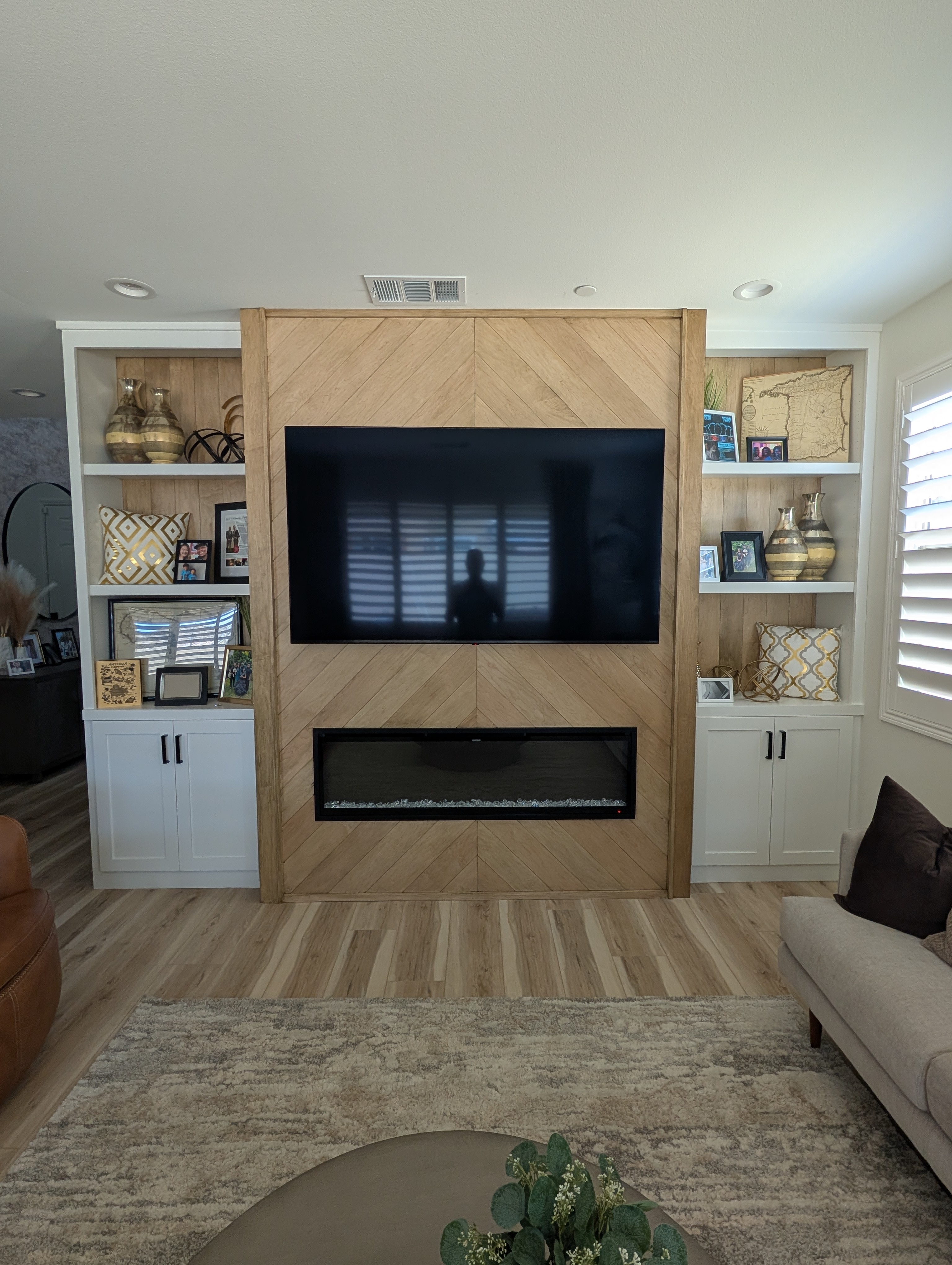
The Liberty Bell project used custom-milled A1 clear hard maple tongue-and-groove across a floor-to-ceiling chevron center panel in a Heritage at Bahner Park living room — more than 100 linear feet of boards in a pattern that references a single perfectly plumb centerline from baseboard to crown. The material was sourced through Forest Plywood / Baker Hardwood because A1 clear maple in tongue-and-groove profile at the required board dimensions does not exist off the shelf.
Material decisions on this project and why they were made:
-
A1 clear hard maple T&G for the center chevron panel — furniture-quality grain consistency across the full wall face; takes UV-stabilized topcoat without ambering
-
A1 maple plywood for cabinet carcasses and bookshelf backs — void-free, consistent face veneer, full 3/4" thickness including backs visible in open shelving sections
-
Solid hard maple for face frames and L-trim corner detail — same species as the panel for a consistent grain story across the stain-grade elements
-
General Finishes High Performance Water Based Top Coat Satin — UV-stabilized, non-yellowing, Fine Woodworking Best Overall Choice award winner; the correct specification for a maple feature wall with south-facing window exposure
-
Sherwin-Williams Emerald Trim Enamel White Flour SW 7102 on painted elements — urethane-modified alkyd, non-yellowing, hard-curing on high-touch cabinet surfaces
The Holland & Sons Angle
The Liberty Bell project material decision was made at the drafting table before anything was ordered. A1 clear hard maple was the specification because the project called for a floor-to-ceiling chevron pattern in a living room — a formal, visible, high-precision installation where grade consistency across the full wall face was not optional. The decision to go stain-grade on the center panel and painted on the cabinet towers was equally deliberate: full stain-grade throughout would have been visually heavy, and the warm maple grain would have competed with itself across 18 feet of wall. The painted white cabinets calm it down. The maple chevron is the feature.
Sourcing A1 clear maple in tongue-and-groove profile at the required dimensions required a call to Forest Plywood / Baker Hardwood and a custom mill run. That is not a complication — it is the consequence of specifying the right material. You do not get furniture-quality results from commodity-grade material.
Brian's sons handled the panel installation — learning not just how to set a board at 45 degrees, but why the material specification underneath the installation matters as much as the craft on top of it. The next generation learning that quality starts with what you order, not just what you do with it.
Frequently Asked Questions
What is the best wood species for a custom built-in feature wall in the Inland Empire?
Hard maple at A1 clear grade is Brian Holland's first recommendation for feature wall panel installations in the Inland Empire. It is one of the hardest domestic hardwoods (Janka 1,450), dimensionally stable in the dry inland climate, and produces a clean, consistent grain at A1 clear grade that works across a wide range of interior styles. Rift-sawn white oak is the stronger choice for contemporary design directions. Walnut is right for a darker, richer palette at a higher material investment.
What is the difference between A1 and standard grade hardwood?
A1 clear grade is the highest furniture-quality grade — knot-free, with consistent color and grain across each board. Standard or select grade allows for small knots, mineral streaks, and color variation. For a floor-to-ceiling feature wall where every board is simultaneously visible, A1 clear grade is the specification that produces a consistent, furniture-quality result. The Liberty Bell project required a custom mill run because A1 clear maple in tongue-and-groove profile is not available off the shelf.
Is white oak or maple better for a feature wall?
It depends on the design direction. Hard maple at A1 clear grade has a cleaner, more uniform grain with a warm cream-to-ivory base color — refined and subtle. White oak has more visible grain character, a distinctive rift-sawn fleck pattern, and a cooler neutral tone. For a formal chevron pattern paired with an electric fireplace in a new-build Inland Empire home, hard maple is the stronger material call. For a contemporary application with flat or vertical plank paneling, rift-sawn white oak is increasingly the right direction.
Does wood expand and contract in the Inland Empire dry climate?
Yes — all wood moves with changes in humidity, and the Inland Empire has a dry climate with low ambient humidity most of the year. For pattern installations like chevron and herringbone, where tight joints at every intersection are critical, dimensional stability is part of the material specification. Hard maple and rift-sawn white oak are among the most dimensionally stable of the domestic hardwoods, making them the stronger choices for feature wall applications in this climate.
What wood finish is best for a feature wall in the Inland Empire?
A UV-stabilized, non-yellowing topcoat is the correct specification for a wood feature wall with south-facing window exposure in the Inland Empire. General Finishes High Performance Water Based Top Coat Satin — used on the Liberty Bell project — is UV-stabilized, non-yellowing, and one of the hardest consumer-grade polyurethane topcoats available. Avoid oil-based finishes that amber over time, especially on maple.
Can I use reclaimed wood for a built-in feature wall?
Reclaimed wood works well for accent feature walls and fireplace surrounds where aged character and texture are the design intent. For a chevron or herringbone pattern installation where tight joints and consistent board dimensioning are critical, reclaimed wood presents significant challenges — board thickness varies, faces are often not flat, and moisture content is unpredictable. Reclaimed wood is right for rustic or industrial design directions; A1 clear hardwood is right for a precise geometric pattern installation.
How does hard maple compare to pine for a feature wall?
Hard maple has a Janka hardness of 1,450 versus eastern white pine at approximately 380. Maple holds angle cuts cleanly, accepts topcoat beautifully, and resists denting and scratching far better than pine. Pine is softer and easier to machine, which is why it is common in off-the-shelf tongue-and-groove products. For a floor-to-ceiling feature wall with a 45-degree chevron pattern in a family living room, hard maple is the correct specification. Pine is the right choice for a painted finish or a softer rustic character.
Where does Holland & Sons source hardwood in Southern California?
The Liberty Bell project sourced A1 clear hard maple tongue-and-groove through Forest Plywood / Baker Hardwood, a Southern California hardwood distributor with on-site milling capability. Because A1 clear maple in tongue-and-groove profile at furniture-quality grade is not available off the shelf at standard lumber yards, a custom mill run was required. Lead time for custom mill runs should be factored into the project timeline — typically one to two weeks.
Start Your Project
If you are planning a custom built-in feature wall in Menifee, Murrieta, Temecula, or anywhere in the Inland Empire and want to think through the material specification alongside the design — this is the conversation Holland & Sons is built for. The right material is the first decision. Everything after it follows.
Ready to talk? <span class="underline">hsconstruct.com/contact</span>
We serve Menifee, Murrieta, Temecula, Perris, Riverside, and the greater Inland Empire. Follow the work at @hollandandsonsconstruction.
951-338-8058 | brian@hsconstruct.com | hsconstruct.com | CSLB #1123738
More Than Just Feature Walls
Material specification is the first decision on every Holland & Sons project — whether it is a feature wall, a coffered ceiling, or a full kitchen remodel. Brian and his sons have been finish carpenters since 1991, which means every room in your home is fair game.
If your space needs more than a feature wall, here is what else we build:
-
Kitchen and bathroom remodels — full custom cabinetry, tile work, and finish carpentry from demo to done
-
Coffered ceilings — grid beam systems that add architectural depth to any room, sized and proportioned to the space
-
Wainscoting and wall paneling — classic raised panel, flat panel, board-and-batten, and shiplap applications
-
Reclaimed wood accents — feature walls, fireplace surrounds, and detail work using salvaged material with real character
-
Beam wraps — hollow wood wraps that give exposed beams the look of solid timber without the structural engineering
-
Crown molding, baseboards, and trim carpentry — the details that make a house feel finished, from a single room to a whole home
-
Cased openings and interior door replacements — clean transitions between spaces that most contractors overlook
-
Custom built-in entertainment walls and bookshelves — designed by hand, built in the shop, installed to last
Wood, proportion, and rooms that feel right — that is what we do.
<span class="underline">hsconstruct.com</span>
About the Author
Brian Holland is the owner and lead carpenter of Holland & Sons Construction, a family-run finish carpentry and general contracting company serving Riverside County and the Inland Empire since 1991. He entered the trade at 17, learned on the job, and has spent 35 years building the kind of work that makes rooms feel right — often before a homeowner can articulate why. His sons now apprentice alongside him on every project. Holland & Sons is based in Perris, CA and licensed by the CSLB (#1123738).
This guide is part of our custom fireplace walls series.
Learn more about Custom Fireplace WallsHave a project in mind? Let's start a conversation.
Tell us what you are thinking about and we will give you a straight answer about scope, timeline, and investment.
Start a Conversation