Best Wood for Floating Shelves: Cherry vs. Walnut vs. White Oak vs. Maple (A Carpenter’s Take)
Quick Answer
For most Inland Empire floating shelves, the best wood is the one that suits the room: white oak for clean, modern, durable spaces; walnut when you want a rich, dramatic statement; cherry for warmth that complements existing woodwork; and maple for a bright, budget-friendly option that takes paint well. All four are hardwoods that resist sagging far better than pine. On a recent Temecula project, Holland & Sons chose cherry specifically so the shelves would complement — not compete with — a handcrafted mantel already in the room.
Key Takeaways
-
Pick a hardwood — cherry, walnut, white oak, or maple — not a softwood like pine, which dents and sags.
-
White oak is the most versatile all-rounder; walnut is the statement piece; cherry is the warm complement; maple is the value choice.
-
In a dry inland climate, dimensional stability and a finish that seals the wood matter as much as looks.
-
On the Brewster project, Brian chose cherry over walnut so the shelves would complement a sentimental handcrafted mantel.
See this in action: the Brewster Built-In project (Paseo Del Sol, Temecula)
After 35 years of building floating shelves into Inland Empire homes, here’s my honest recommendation: there is no single “best” wood — there’s the best wood for your room. White oak is what I reach for most often because it’s clean, stable, and works in almost any space. But the right answer flips the moment the room gives me a reason. On the Brewster project in Temecula, walnut was the obvious statement choice — until I learned the room already had a handcrafted mantel with sentimental weight. Then cherry became the right answer, because cherry complements where walnut competes.
That’s the whole game with shelf wood. The species sets the tone of the room, so you choose it in relationship to everything else that’s already there. This guide walks through the four species worth considering, where each one shines, where it falls short, how each handles our dry climate, and how to keep them looking right.
The Direct Recommendation
If you want one safe answer for a typical Inland Empire living room, choose white oak. It’s dense and stable, it suits modern, transitional, and minimalist rooms alike, and it takes both light and dark finishes beautifully. Choose differently when the room asks for it: walnut for drama, cherry for warmth and to complement existing woodwork, maple when budget or a bright, painted look leads. The wrong choice for any of them is a softwood — pine and fir dent, sag, and disappoint on a shelf you live with every day.
The Four Species, Evaluated
White Oak
What it is: a dense, tight-grained hardwood with a clean, natural look. Where it performs best: modern, transitional, and minimalist rooms; spaces where you want warmth without going dark. Where it falls short: its straight grain is less dramatic than walnut if you want a showpiece. Who it’s right for: most homeowners — it’s the safest, most versatile pick. Brian’s field assessment: the workhorse. It’s stable, it takes finish predictably, and it never looks dated. When a client has no strong direction, this is where I start.
Walnut
What it is: a luxury hardwood with flowing grain and deep brown tones, often steamed to even out color. Where it performs best: as a statement against a neutral wall or minimalist room — it’s almost sculptural. Where it falls short: its bold grain competes with other strong woodwork, and it’s the priciest of the four. Who it’s right for: homeowners who want the shelves to be the focal point. Brian’s field assessment: stunning on its own, but I think hard before specifying it near other handcrafted wood. On the Brewster project, walnut was my first instinct — and the wrong one once I understood the mantel.
Cherry
What it is: a fine-grained furniture-grade hardwood, warm and softer in character, that deepens to a rich patina over time. Where it performs best: rooms with existing warm woodwork it needs to complement rather than overpower. Where it falls short: it’s softer than oak, so it dents a little more easily, and its color shifts as it ages. Who it’s right for: homeowners who want warmth and a classic feel. Brian’s field assessment: cherry’s quieter grain is exactly why it complements instead of competes — the reason it won on the Brewster project over walnut.
Maple
What it is: a hard, fine-grained, light-toned hardwood. Where it performs best: bright, clean, modern rooms — and painted applications, since it takes paint and finish evenly. Where it falls short: its subtle grain reads plain if you want visible character in a clear finish. Who it’s right for: budget-conscious homeowners and anyone wanting a crisp, light look. Brian’s field assessment: the value choice that doesn’t feel cheap. Hard, durable, and the best of the four under paint.
Side-by-Side Comparison
| Factor | White Oak | Walnut | Cherry / Maple |
| Look | Clean, natural, versatile | Rich, dramatic, dark | Cherry: warm & classic / Maple: bright & light |
| Relative cost | Mid-to-high | Highest | Cherry: mid-high / Maple: lowest |
| Stability (dry climate) | Excellent | Very good | Cherry: good / Maple: very good |
| Stain & finish behavior | Takes light & dark well | Best left natural | Cherry: stains warm, ages / Maple: best for paint |
| Dent resistance | High | High | Cherry: moderate / Maple: high |
Stability, Stain, and the Dry-Climate Question
Looks get the attention, but in the Inland Empire stability earns the recommendation. Our dry air and wide day-to-night temperature swings move wood — a shelf that isn’t dimensionally stable can cup or check over a few seasons. All four species here are hardwoods that handle that far better than softwoods, but the construction matters as much as the species: a quality cored panel or properly milled solid stock stays flatter than a thin, poorly dried board regardless of which tree it came from.
On stain behavior: white oak and cherry take stain well, walnut is usually best left natural so the grain isn’t muddied, and maple is the one to choose if you’re painting. According to shelf material guidance from suppliers who build these daily, species selection should follow the room’s design, the intended use, and the shelf’s size and thickness — not just a ranking. That matches what 35 years on the job teaches: the load and the room decide as much as the grain.
Will Floating Shelves Sag?
The most common worry, and the answer is reassuring: a properly specified hardwood shelf on a span matched to its load will not sag. Sagging happens when a thin or softwood shelf gets loaded beyond what the span and bracket were designed for — the classic case is a shelf sized for décor that ends up holding a row of hardcovers. Match the species, thickness, span, and concealed support to what the shelf will actually carry, and it stays flat for decades. That’s a specification decision, made before the shelf is built.
How to Choose for Your Situation
Weigh four things in this order:
-
The room’s existing wood and tone. Complement it, don’t fight it — this is the decision that drove cherry on the Brewster project.
-
What the shelf will hold. Heavier loads push you toward denser species and shorter spans.
-
Clear finish or paint. Clear finish rewards oak, walnut, and cherry; paint favors maple.
-
Budget. Maple is the value pick, white oak the versatile mid-range, walnut the splurge.
See This In Action — The Brewster Built-In
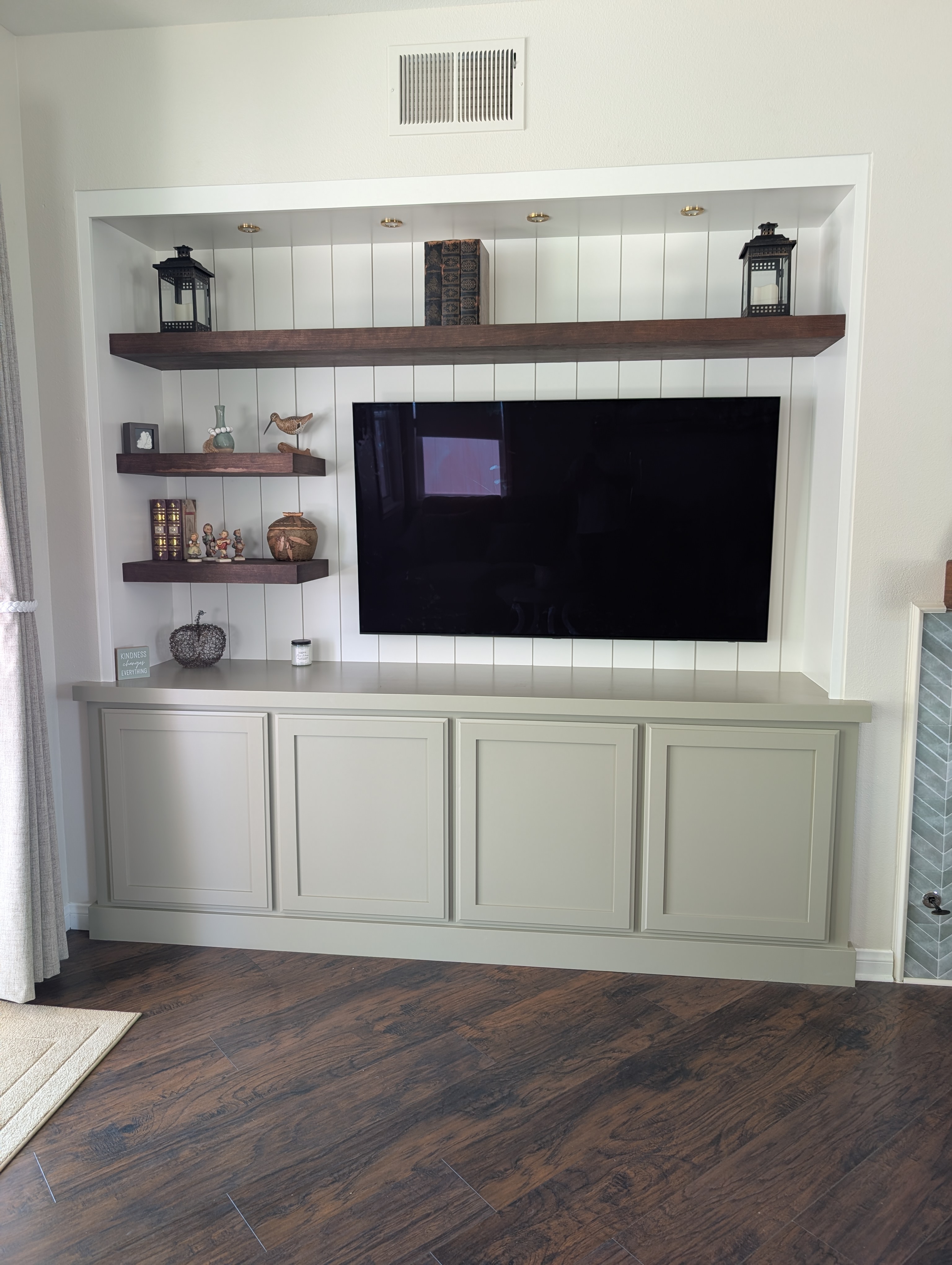
The cherry for the Brewster shelves wasn’t the first wood in the conversation. Walnut was on the table first — darker, more dramatic, and strong on its own. But the adjacent wall held a mantel handcrafted by the homeowner’s son-in-law, carrying real sentimental weight, and walnut’s bold grain would have competed with it. Cherry’s grain is quieter and warmer, and it stained into a tone that read as complementary rather than competitive. When the shelves went up, the homeowner said she couldn’t believe how well they worked with the mantel. That’s the species choice doing its job.
What we used on this project:
-
Cherry veneer plywood (ProCore) for the floating shelves — chosen to complement the existing mantel
-
Rubio Monocoat Chocolate, color-matched to the darker sections of the mantel
-
Miter-folded, grain-wrapped construction so the cherry grain runs continuously around every visible edge
-
Walnut considered and ruled out — because the room already had a wood story to honor
You’ll find the full story, the design sketch, and before-and-after photos here: the Brewster Built-In.
How These Species Perform in the Inland Empire
In Temecula, Murrieta, and Menifee homes, the dry climate is the real test. White oak and maple are the most forgiving here — dense, stable, and slow to move with humidity swings. Walnut holds up well too. Cherry is a touch softer and shifts color over time, which is part of its charm but worth knowing. Across all four, the finish does heavy lifting in our climate: a penetrating hardwax oil or a quality sealed finish keeps moisture moving in and out of the wood evenly, which is what prevents the cupping and checking that dry inland air can otherwise cause. Species sets the look; the finish protects it.
Keeping Them Looking Right
Maintenance is simple and species-agnostic. Dust regularly, wipe with a slightly damp cloth and mild soap, and skip harsh cleaners and abrasive pads. Shelves finished with a penetrating hardwax oil can be refreshed periodically with the manufacturer’s refresher product rather than fully refinished — one of the reasons we like that finish system on visible wood. A sealed shelf in a climate-controlled inland home asks very little of you beyond that.
The Holland & Sons Angle
The walnut-to-cherry switch on the Brewster project is the kind of decision that doesn’t show up on an invoice but defines whether a room works. Anyone can spec walnut because it’s impressive. It takes paying attention to the room — and to a homeowner telling you her son-in-law built that mantel — to put the impressive choice down and pick the right one. Cherry was quieter, warmer, and willing to play a supporting role to a piece that mattered. That’s 35 years of learning that the best material is the one that serves the room, not the one that wins the catalog. My son was there for that conversation, and watched a project change direction because of one detail about a mantel — a lesson in listening that no lumber catalog teaches.
Related Resources — Built-In Entertainment Wall Guide
This guide is part of a full cluster on planning, building, and getting a custom built-in entertainment wall right in the Inland Empire.
How Much Does a Custom Built-In Entertainment Wall Cost? — real line-item pricing, tiers, and what drives the investment.
What Goes Wrong With Built-In Entertainment Walls — the mistakes that derail a build, and how to avoid them.
Built-In Entertainment Wall vs. Freestanding Furniture — which one fits your home, and when furniture is the smarter call.
How to Hire the Right Contractor for a Custom Built-In — the scorecard, the questions, and the red flags.
Built-In Entertainment Wall Materials Explained — how species choice connects to the finish system and cabinet construction.
Frequently Asked Questions
What is the best wood for floating shelves?
The best wood is a hardwood matched to your room: white oak for clean, modern, durable spaces; walnut for a rich, dramatic statement; cherry for warmth that complements existing woodwork; and maple for a bright, budget-friendly, paint-ready option. All four resist sagging and denting far better than softwoods like pine. White oak is the safest all-rounder if you want one answer, but the right pick depends on the room’s existing tone, the shelf’s load, and whether you’re staining or painting.
Cherry vs. walnut for shelves — which is better?
Neither is universally better; they solve different problems. Walnut is darker, bolder, and more dramatic — ideal when you want the shelves to be the focal point against a neutral wall. Cherry is warmer, quieter-grained, and ages into a rich patina — ideal when the shelves need to complement existing woodwork rather than compete with it. On the Brewster project, cherry won over walnut precisely because the room had a handcrafted mantel that the bolder walnut grain would have overpowered.
Will hardwood floating shelves sag or warp?
A properly specified hardwood shelf will not sag, and a stable species with a good finish resists warping. Sagging happens when a thin or softwood shelf is loaded beyond what its span and bracket were designed for. Warping happens when an unstable or poorly dried board meets a dry climate. Match the species, thickness, span, and concealed support to the intended load, seal the wood with a quality finish, and the shelf stays flat for decades.
Are hardwood shelves better than MDF or pine?
For shelves you live with and load, yes. Hardwoods like oak, walnut, cherry, and maple are dense and dimensionally stable, resisting dents, sagging, and warping. Pine is a softwood that dents and bows under everyday weight. MDF is fine for paint-grade shelves carrying light loads but lacks the strength and the natural grain of hardwood. For a visible, load-bearing floating shelf, hardwood is the choice that lasts — the construction and span still have to match the load.
How does wood choice perform in a dry inland climate?
In the dry Inland Empire climate with wide temperature swings, dimensional stability matters as much as looks. White oak and maple are the most forgiving — dense and slow to move with humidity changes. Walnut holds up well; cherry is slightly softer and shifts color over time. Across all species, the finish does the protecting: a penetrating hardwax oil or quality sealed finish keeps moisture moving evenly through the wood, preventing the cupping and checking dry air can cause.
Do floating shelves need a special finish?
They benefit from one. A penetrating hardwax oil sinks into the wood fiber and protects from within without building a plastic film, which suits a dry inland climate and is easy to refresh later. A quality sealed finish works too. The goal is a finish that seals the wood evenly so it handles humidity swings without cupping, and that’s simple to maintain — a damp cloth and mild soap, no harsh cleaners. The finish system connects directly to the species you choose.
What thickness should a floating shelf be?
Three-quarter-inch stock is standard, but a thicker shelf — anywhere from about an inch and a quarter up to three inches — reads as more substantial and carries heavier loads over longer spans without flexing. The right thickness depends on span and load: a short shelf holding light décor can be thinner, while a long shelf carrying books wants more depth and the right concealed support. Decide the load first, then the thickness, then the species.
Ready to Choose the Right Wood for Your Shelves?
If you’re planning floating shelves or a full built-in in Temecula, Murrieta, Menifee, Perris, Riverside, or anywhere in the greater Inland Empire, Brian can help you choose the species that suits your room — not just the one that photographs well. Visit hsconstruct.com/contact, fill out the form, describe your space, and upload a few inspiration photos.
Want to see this advice applied to a real project? Here’s the full breakdown: the Brewster Built-In.
You can also follow Holland & Sons on social media to watch projects come together from sketch to install.
951-338-8058 | brian@hsconstruct.com | hsconstruct.com | CSLB #1123738
More Than Just Floating Shelves
Choosing the right wood for a shelf is the same instinct we bring to every surface in a room — the right material for the job, not the trendy one. Brian and his sons have been finish carpenters since 1991, which means every room in your home is fair game.
If your space needs more than a set of shelves, here's what else we build:
-
Kitchen and bathroom remodels — full custom cabinetry, tile work, and finish carpentry from demo to done
-
Coffered ceilings — grid beam systems that add architectural depth to any room, sized and proportioned to the space
-
Wainscoting and wall paneling — classic raised panel, flat panel, board-and-batten, and shiplap applications
-
Reclaimed wood accents — feature walls, fireplace surrounds, and detail work using salvaged material with real character
-
Beam wraps — hollow wood wraps that give exposed beams the look of solid timber without the structural engineering
-
Crown molding, baseboards, and trim carpentry — the details that make a house feel finished, from a single room to a whole home
-
Cased openings and interior door replacements — clean transitions between spaces that most contractors overlook
-
Custom built-in entertainment walls and bookshelves — designed by hand, built in the shop, installed to last
Wood, proportion, and rooms that feel right — that’s what we do.
hsconstruct.com
About the Author
Brian Holland is the owner and lead carpenter of Holland & Sons Construction, a family-run finish carpentry and general contracting company serving Riverside County and the Inland Empire since 1991. He entered the trade at 17, learned on the job, and has spent 35 years building the kind of work that makes rooms feel right — often before a homeowner can articulate why. His sons now apprentice alongside him on every project. Holland & Sons is based in Perris, CA and licensed by the CSLB (#1123738).
Related project
This guide is part of our custom built-ins & cabinetry series.
Learn more about Custom Built-Ins & CabinetryHave a project in mind? Let's start a conversation.
Tell us what you are thinking about and we will give you a straight answer about scope, timeline, and investment.
Start a Conversation