
The Best Materials for a Mudroom Built-In That Lasts in the Inland Empire
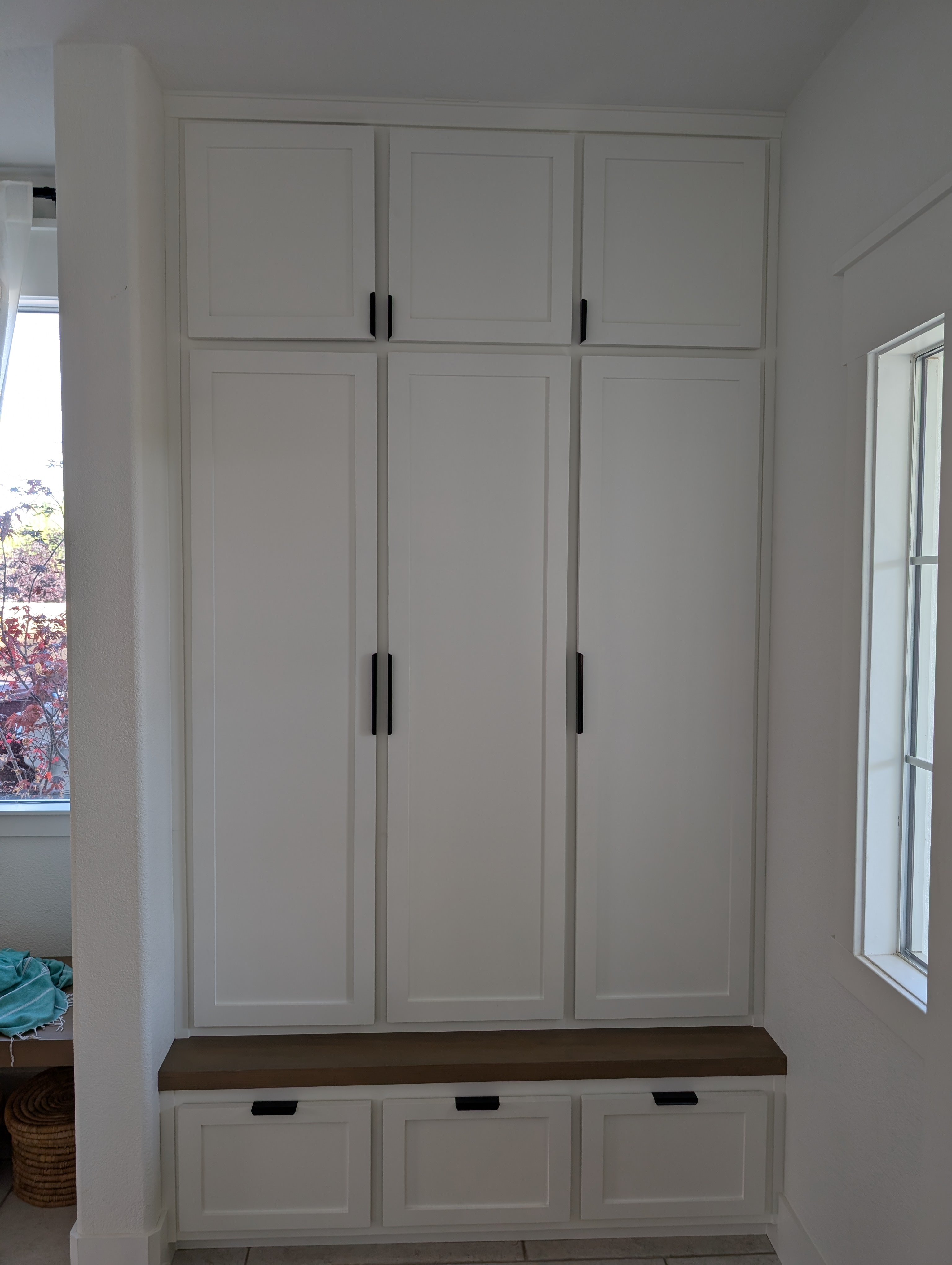
| Quick Answer: The best mudroom built-in uses the right material for each job: void-free Baltic birch for the structural boxes, solid hard maple for paint-grade faces and doors, and vertical-grain Douglas fir for the bench. In a dry Inland Empire climate and a high-traffic family entry, that layered approach — used on the $12,912 Rhapsody Ct. project in Menifee — carries load, takes a hard finish cleanly, and stays stable for decades. The finish matters as much as the wood: a urethane trim enamel keeps the painted surfaces washable and new. |
Key Takeaways
• The right build layers materials by job: Baltic birch boxes, hard maple faces, VG fir bench.
• Plywood beats MDF for structural boxes — MDF swells when wet and holds screws poorly under load.
• Vertical-grain (quarter-sawn) wood stays dimensionally stable, which is why it makes the best bench tops.
• A hard urethane trim enamel, shop-applied, is the most durable finish for painted mudroom cabinets.
• Brian Holland has selected materials for Inland Empire conditions for 35 years — climate and load drive every call.
If you only remember one thing: don’t pick a single material for a mudroom built-in — pick the right one for each part. Brian’s recommendation after 35 years in the Inland Empire is a layered build. Void-free Baltic birch for the boxes, solid hard maple for the painted faces, and vertical-grain Douglas fir for the bench. Each earns its place for a specific reason, and the combination is what makes a unit survive a busy household and a dry-then-swinging inland climate.
Most articles flatten this to "use plywood" and stop. That’s not wrong, but it’s not an answer either — which plywood, for what, and what goes on the parts that aren’t boxes? The materials decision is really four or five decisions, and getting each one right is the difference between a built-in that looks new in a decade and one that sags, swells, or telegraphs grain through its paint.
Here’s the full breakdown: what to use where, why it wins, and how each choice holds up specifically in Menifee, Murrieta, and Temecula conditions.
The Direct Recommendation
For the most common Inland Empire mudroom — a high-traffic family entry with painted cabinetry and a real-wood bench — build it like this: Baltic birch boxes, hard maple face frames and doors, a vertical-grain Douglas fir bench, and a urethane trim enamel finish. That’s the recipe that carries load, takes a hard washable finish without grain showing through, and keeps a wide bench top from cupping.
The reasoning in one line each: Baltic birch because a load-bearing box needs a void-free core; hard maple because paint-grade surfaces in a high-touch entry need a tight, dense grain; VG fir because a stained bench needs dimensional stability. Each is a deliberate call, not a default.
The Materials, Evaluated
Baltic birch — for the structural boxes
What it is: a void-free, high-layer plywood sold in 5x5 sheets. Where it performs best: structural cabinet boxes, drawers, and shelves that carry load across wide spans. Where it falls short: it costs more than standard ply and the sheet size means more planning. Who it’s right for: anyone building a unit that has to hold real weight — which a family mudroom always does. Brian’s assessment: at 9 feet and 500–600 pounds on Rhapsody Ct., it was the only logical choice; cheaper cores sag and strip out over time.
Hard maple — for paint-grade faces and doors
What it is: a dense domestic hardwood with tight, closed grain. Where it performs best: paint-grade face frames and door frames that get touched constantly. Where it falls short: it’s heavier and pricier than poplar. Who it’s right for: high-traffic entries where the painted surface has to stay crisp. Brian’s assessment: maple takes enamel with no grain telegraphing and shrugs off daily abuse — other shops favor alder or poplar, both reasonable, but maple is the more durable paint-grade surface.
Vertical-grain Douglas fir — for the bench and accents
What it is: quarter-sawn fir with straight, tight growth rings. Where it performs best: exposed millwork, bench tops, and accents. Where it falls short: it’s a softwood, so it benefits from a protective finish in high-use spots. Who it’s right for: anyone who wants a warm, stable stained surface that won’t cup. Brian’s assessment: because it’s quarter-sawn, it’s about as dimensionally stable as a softwood gets — it resists the cupping and twisting that would telegraph through a wide bench over time.
Material Comparison
| Material | Best For | Considerations |
| Baltic birch | Structural boxes, drawers, shelves | Costs more than standard ply; sold in 5x5 sheets |
| Hard maple | Paint-grade face frames and doors | Heavier and pricier than poplar; superb paint surface |
| Vertical-grain Douglas fir | Bench tops, exposed millwork, accents | Softwood — needs a protective finish in high-use spots |
| Paint-grade MDF panel | Door panels inside a solid frame | Keep it dry; never use for structural boxes |
| Poplar / alder | Budget paint-grade faces | Reasonable, but softer than maple under daily abuse |
The Material Questions Homeowners Ask Most
MDF or plywood — which for the boxes?
Plywood, decisively, for anything structural. MDF swells and softens when it gets wet, and a mudroom is exactly where dripping coats and boots live. It also holds screws poorly under load. Void-free Baltic birch stays flat across wide spans and lets every fastener bite solid material. MDF does have one good role — as a paint-grade door panel held inside a solid maple frame, where it stays dry and paints smoothly. That’s precisely how it was used on Rhapsody Ct.
What’s the most durable finish?
For painted cabinetry, a hard urethane trim enamel applied in a controlled spray environment. We use Sherwin-Williams Emerald Urethane Trim Enamel, built for high-traffic trim and cabinetry, so a damp cloth and mild cleaner keep it looking new. For a stained bench, a sealed finish controls moisture and wear. The finish isn’t cosmetic in a mudroom — it’s the protective layer doing the daily work. How that finish is applied matters too, which is one good question to ask about material specification when you’re vetting a shop.
Does Baltic birch really beat regular plywood?
Yes, and the reason is the core. Baltic birch uses more, thinner layers with no internal voids, so it stays flatter, holds fasteners better, and carries more load than standard birch or particle-core ply, which can hide gaps that lead to sagging and stripped screws. It costs more and comes in 5x5 sheets, but in a load-bearing built-in that difference is exactly what you’re paying for.
A Material Selection Framework
Pick by the job the part has to do, not by one blanket choice. Walk these four questions in order.
| If the part is... | Choose... |
| A structural box, drawer, or shelf | Void-free plywood (Baltic birch) — never MDF |
| A painted face frame or door frame | Solid hard maple for a clean, durable enamel surface |
| A painted door panel inside a frame | Paint-grade MDF — kept dry inside the frame |
| A stained, exposed bench or accent | Vertical-grain (quarter-sawn) real wood, sealed |
Weigh three things for your specific situation: how much load the part carries, whether it’s painted or stained, and how much moisture and contact it sees. Those three answers point to the right material every time.
See This In Action — Rhapsody Ct. Mudroom
The material decision that took the most craft on Rhapsody Ct. wasn’t a wood at all — it was the finish. There was no can to order for the fir bench. We blended the stain on site with our finisher, sampling against the homeowner’s existing dining table until the color matched and the client signed off. That’s why the bench reads as part of the home instead of a piece dropped into it. The right wood gets you halfway; the right finish, matched to what’s already in the house, gets you the rest.
What we used on this project:
-
Baltic birch casework — full 3/4" boxes, 1/2" backs, 5/8" drawers
-
Hard maple face frame and cope-and-stick doors, paint-grade MDF panels
-
Vertical-grain Douglas fir bench, milled to 1.5", with an on-site blended stain
-
Sherwin-Williams Emerald Urethane Trim Enamel, Extra White, on all painted surfaces
At the link: the full materials story, photos from rough lumber to finish, and the complete investment.
How These Materials Perform in the Inland Empire
Our climate rewards stable materials. The Inland Empire runs dry with real temperature swings, which is hard on wood that wants to move — and gentle on wood that doesn’t. That’s exactly why quarter-sawn vertical-grain fir earns its place on a bench here: its straight, tight grain resists the cupping and twisting that flat-sawn tops show after a few dry summers in Menifee or Temecula. Baltic birch’s stable core holds flat in the same conditions, and a hard urethane enamel resists the daily contact a tract-home family entry takes. None of these are showroom choices — they’re chosen for how they behave in this specific climate, year after year.
The Holland & Sons Angle
The Rhapsody Ct. bench finish started as a problem with no product to solve it. The family’s existing dining table had a specific color, and no can off a shelf would match it. So we made the finish a small project of its own — our finisher blended stain on site, brushing samples and holding them against the table until the match was exact and the homeowner signed off. That’s the part of materials work most people never see: the right wood is only half the answer, and the finish is where a piece stops looking installed and starts looking like it belongs. On this job, one of Brian’s sons worked the sampling with the finisher — learning that "match the existing wood" isn’t a paint chip, it’s a process of patient comparison until the eye can’t tell the new from the old.
Related Resources — Mudroom Built-In Guide
This materials guide is one piece of a full Holland & Sons mudroom cluster. Here’s where to go next.
-
How Much Does a Custom Mudroom Built-In Cost? — real ranges and a $12,912 line-item breakdown.
-
What Goes Wrong With Mudroom Built-Ins — the problems the right materials prevent.
-
Custom Built-In vs. IKEA/Prefab Lockers — how material grade separates the two.
-
How to Vet a Cabinet Maker — ask which plywood and finish they actually use.
-
How to Plan a Mudroom Layout Around Your Routine — zoning storage for how your family actually moves.
Frequently Asked Questions
What is the best material for a mudroom built-in?
For a mudroom built-in that takes real household abuse, the best combination is void-free Baltic birch for the structural boxes, solid hard maple for paint-grade face frames and doors, and a stable real wood like vertical-grain Douglas fir for the bench. Each does one job well: Baltic birch carries load and holds screws across wide spans, hard maple takes enamel cleanly without grain telegraphing, and quarter-sawn fir stays dimensionally stable for a bench top. That layered approach is exactly what we used on the $12,912 Rhapsody Ct. project in Menifee.
Is MDF or plywood better for mudroom cabinets?
Plywood is better for mudroom cabinet boxes, and the gap is not close in a high-moisture, high-traffic space. MDF swells and turns soft when it gets wet, which is a real risk near dripping coats and boots, and it holds screws poorly under load. Void-free plywood like Baltic birch stays flat across wide spans and lets every fastener bite solid material. The one place MDF earns a spot is as a paint-grade door panel inside a solid-wood frame, where it stays dry and takes paint smoothly — which is how it was used on Rhapsody Ct.
What is the best wood for a mudroom bench?
The best mudroom bench wood balances stability, durability, and looks — vertical-grain (quarter-sawn) Douglas fir, white oak, and hard maple all perform well, with the right pick depending on whether you’re staining or painting. Vertical-grain fir is a standout for a stained bench because its straight, tight grain makes it about as dimensionally stable as a softwood gets, resisting the cupping a wide bench top is prone to. On Rhapsody Ct. we chose VG fir specifically, milled it to a solid 1.5 inches, and sealed it. Any bench wood needs a protective finish in a high-use entry.
What is the most durable finish for mudroom cabinets?
A hard, washable urethane trim enamel is the most durable finish for painted mudroom cabinets, and it should be applied in a shop or spray environment rather than brushed on site. We use Sherwin-Williams Emerald Urethane Trim Enamel, which is built for high-traffic trim and cabinetry and stands up to wipe-downs and daily contact. For a stained real-wood bench, a sealed finish protects against moisture and wear. The finish is not a cosmetic afterthought — in a mudroom it’s the layer that keeps everything else looking new.
Does Baltic birch hold up better than regular plywood?
Yes — Baltic birch outperforms standard plywood because its core is void-free and built from more, thinner layers, so it stays flatter across wide spans, holds fasteners better, and carries more load. Standard birch or particle-core plywood can hide gaps in the core that cause sagging and stripped screws over time. For a 9-foot, 500-to-600-pound unit like the one on Rhapsody Ct., Baltic birch was the logical structural choice. It costs more and comes in 5x5 sheets rather than 4x8, but in a load-bearing built-in it pays for itself.
What is the best material for painted cabinet doors?
The best painted-cabinet doors pair a solid hardwood frame — hard maple is ideal — with a paint-grade MDF panel. Hard maple has a tight, closed grain that takes enamel cleanly without the grain telegraphing through the finish, and it shrugs off daily abuse in a high-traffic entry. The MDF panel stays stable and paints smoothly inside the protective frame. Poplar and alder are reasonable budget alternatives some shops prefer, but for a paint-grade surface that gets touched constantly, maple is the more durable choice.
How do you keep a wood mudroom bench from warping?
You prevent warping with the right wood, proper milling, and a sealed finish. Start with a quarter-sawn (vertical-grain) board so the growth rings run straight and tight, which makes the wood resist the cupping and twisting that plague flat-sawn tops. Mill it square, parallel, and true, bring it to a solid thickness — we machine benches to 1.5 inches — and seal it to control moisture exchange. On Rhapsody Ct., vertical-grain Douglas fir handled this beautifully, and Brian stood on the finished bench to prove it.
Build It Out of the Right Stuff
Materials are where a built-in is won or lost, and we’re glad to talk through the right combination for your space — your load, your finish, your climate exposure. Start at hsconstruct.com/contact, fill out the form, describe your project, and upload any inspiration photos. We’ll walk through the materials and the details most contractors never mention before any work begins.
Holland & Sons serves Menifee, Murrieta, Temecula, Perris, Riverside, and the greater Inland Empire. Follow our work on social media to see materials become finished rooms.
951-338-8058 | brian@hsconstruct.com | hsconstruct.com | CSLB #1123738
More Than Just Wood and Storage
Custom mudroom and entry built-ins are a signature project at Holland & Sons — but they’re one chapter in a much longer story. Brian and his sons have been finish carpenters since 1991, which means every room in your home is fair game.
If your space needs more than storage, here’s what else we build:
-
Kitchen and bathroom remodels — full custom cabinetry, tile work, and finish carpentry from demo to done
-
Coffered ceilings — grid beam systems that add architectural depth to any room, sized and proportioned to the space
-
Wainscoting and wall paneling — classic raised panel, flat panel, board-and-batten, and shiplap applications
-
Reclaimed wood accents — feature walls, fireplace surrounds, and detail work using salvaged material with real character
-
Beam wraps — hollow wood wraps that give exposed beams the look of solid timber without the structural engineering
-
Crown molding, baseboards, and trim carpentry — the details that make a house feel finished, from a single room to a whole home
-
Cased openings and interior door replacements — clean transitions between spaces that most contractors overlook
-
Custom built-in entertainment walls and bookshelves — designed by hand, built in the shop, installed to last
Wood, proportion, and rooms that feel right — that’s what we do.
hsconstruct.com
About the Author
Brian Holland is the owner and lead carpenter of Holland & Sons Construction, a family-run finish carpentry and general contracting company serving Riverside County and the Inland Empire since 1991. He entered the trade at 17, learned on the job, and has spent 35 years building the kind of work that makes rooms feel right — often before a homeowner can articulate why. His sons now apprentice alongside him on every project. Holland & Sons is based in Perris, CA and licensed by the CSLB (#1123738).
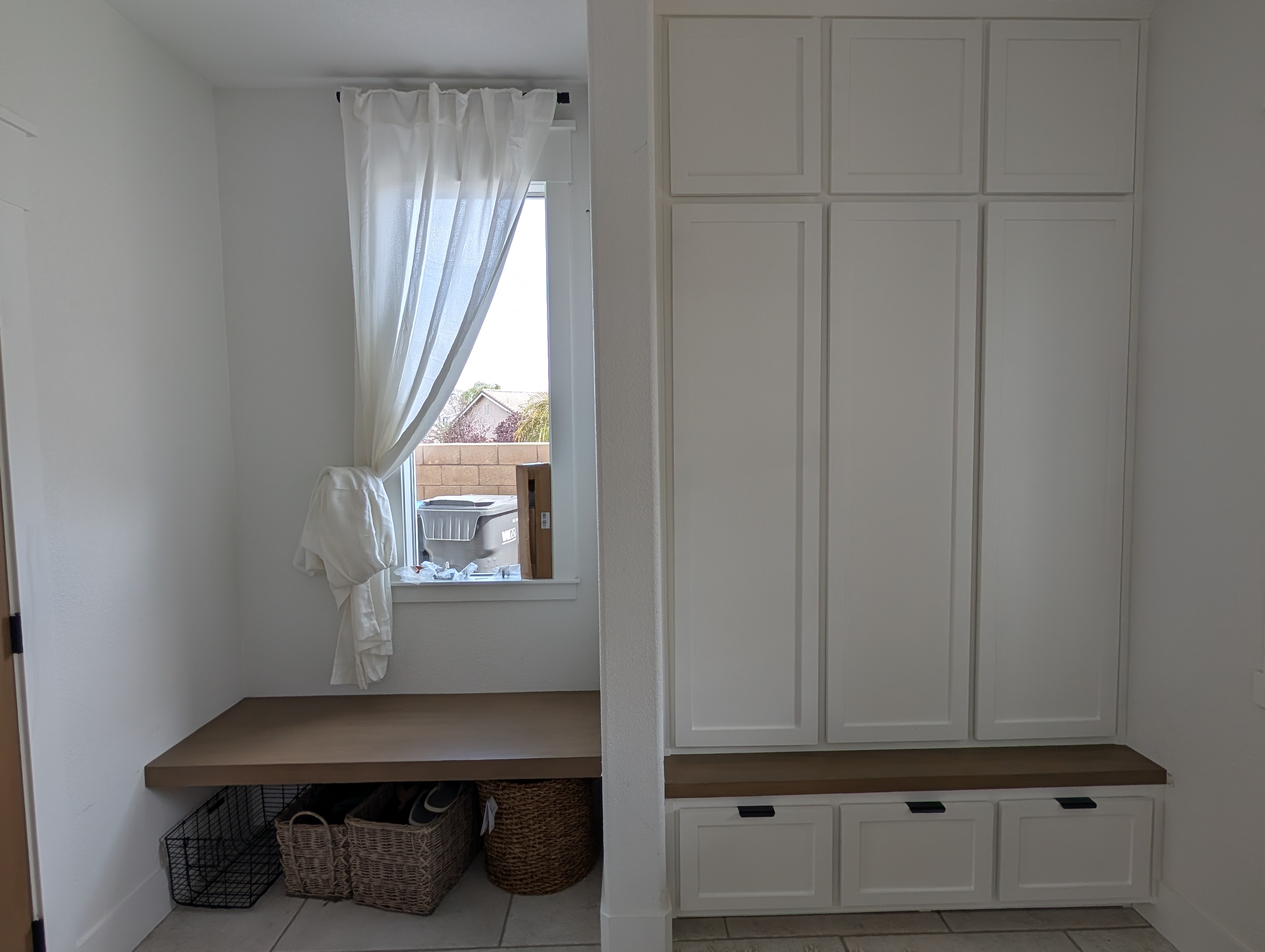
Related project
This guide is part of our mudrooms & storage series.
Learn more about Mudrooms & StorageHave a project in mind? Let's start a conversation.
Tell us what you are thinking about and we will give you a straight answer about scope, timeline, and investment.
Start a Conversation