How Much Does a Custom Built-In Entertainment Wall Cost in Temecula & the Inland Empire?
Quick Answer
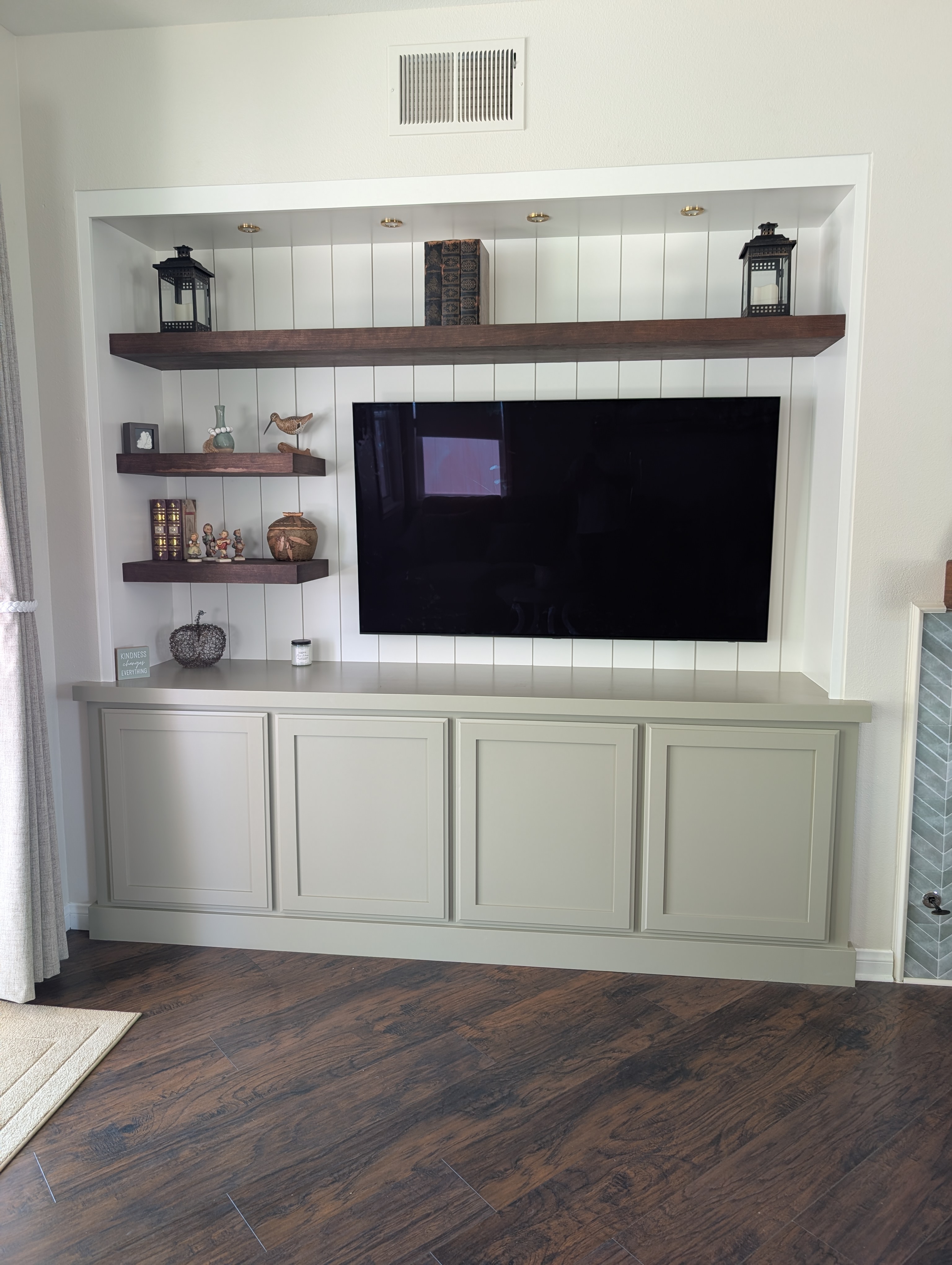
A custom built-in entertainment wall in Temecula and the greater Inland Empire typically represents an investment of $9,000 to $15,000 or more, depending on materials, shelf count, and finish level. A recent Holland & Sons project in Temecula’s Paseo Del Sol neighborhood came in at $12,998 — a hand-built maple cabinet base, nickel-gap shiplap backer, and two cherry floating shelves. The single biggest cost driver is whether the unit is ready-to-assemble, semi-custom, or fully hand-built for the room.
Key Takeaways
-
Custom built-in entertainment walls in Temecula, CA typically range from $9,000 to $15,000+.
-
Build level — RTA, semi-custom, or full custom — moves the investment more than any other single factor.
-
Hand-built maple plywood boxes and stain-grade hardwood shelves cost more upfront but are built to last decades.
-
Holland & Sons has been hand-building cabinetry in Riverside County since 1991 and sketches every project to scale before a board is cut.
See this in action: the Brewster Built-In project ($12,998, Paseo Del Sol)
Most contractors won’t put a number on it. We will. A custom built-in entertainment wall in Temecula, Murrieta, or Menifee usually lands between $9,000 and $15,000, and it can climb past that when the species, shelf count, and finish system get more ambitious. That range isn’t a dodge — it’s the honest spread between a ready-to-assemble box dressed up to look custom and a hand-built unit designed for one specific room.
Here’s why the spread is so wide. A built-in is not a product you pull off a shelf. It’s demo, design, fabrication, finish, and installation — and every one of those stages has a budget version and a built-to-last version. The good news is that once you understand what moves the number, you can decide exactly where your money goes and where it doesn’t.
This guide walks through real pricing from a real Inland Empire project, the three build tiers and what each one actually delivers, the specific line items that should appear on any quote, and how to compare two estimates without getting fooled by a low headline number. By the end you’ll know what to budget and why.
The Direct Answer: What You’ll Invest
For a full-wall custom built-in entertainment center in the Inland Empire, plan on $9,000 to $15,000+. The low end buys a functional unit built largely from ready-to-assemble components with a basic finish. The high end buys a fully hand-built cabinet, premium hardwood floating shelves, a multi-coat durable finish system, and every dimension worked out for your room.
Three things move the number more than anything else: how the unit is built (RTA vs. hand-built), what the visible surfaces are made of (paint-grade MDF vs. stain-grade hardwood), and how many display and storage zones you add. Lighting, fireplace integration, and electrical work push it higher. Reusing what you already have pulls it back.
Investment by Room and Scope
Built-ins scale with the wall they live on and the room they serve. These are typical Inland Empire investment ranges by scope:
| Scope / Room Type | Typical Investment Range |
| Single accent or display wall (shelves only) | $2,500 – $5,000 |
| Bedroom or office built-in (cabinet + shelving) | $4,500 – $8,000 |
| Living room entertainment wall (cabinet base + backer + shelves) | $9,000 – $13,000 |
| Great room / full-wall feature built-in | $13,000 – $20,000+ |
Note: Ranges vary by linear footage, material selection, ceiling height, and finish complexity. A taller wall, a wider footprint, or a stain-grade species will move you toward the top of each band.
Cost by the Linear Foot
Homeowners who think in wall measurements rather than rooms are on a different search path, so here is the same picture by the linear foot — the running measurement of cabinetry or wall span:
| Build Level | Approx. Investment per Linear Foot |
| Entry / RTA-based | $650 – $900 per linear foot |
| Semi-custom (hand-built box, custom doors) | $900 – $1,300 per linear foot |
| Full custom (everything hand-built, hardwood shelves) | $1,300 – $1,800+ per linear foot |
How to apply it: Measure the wall the unit will occupy. A 10-foot wall at the semi-custom rate lands around $9,000–$13,000 — which is exactly where the Brewster Built-In came in. Multiply your wall width by the per-foot rate for the build level you want, then add for floating shelves, lighting, or a fireplace.
What Drives the Investment
-
Build method. A hand-built maple plywood cabinet box costs more than ready-to-assemble components — and outlasts them by decades.
-
Visible surface material. Stain-grade hardwood floating shelves (cherry, walnut, white oak) cost more than paint-grade MDF, and the gap is real once you see them side by side.
-
Number of display and storage zones. Every additional shelf or cabinet bay adds fabrication and finish time. On the Brewster project, the design grew from one shelf to three — that decision lifted the project.
-
Finish system. A multi-coat durable cabinet enamel and a penetrating hardwax oil cost more than basic latex and poly, but they are what keep the unit looking right ten years on. See how material selection prevents long-term problems.
-
Electrical, lighting, and fireplace integration. Reusing existing outlets and salvaging existing lighting keeps cost down. New circuits, integrated LED, or a fireplace insert push it up.
-
Site conditions. Out-of-square walls, flooring that stops short of the niche, or crown that has to come off to measure all add labor — honest contractors plan for this.
What’s Included — and What’s Not
Before you can compare quotes fairly, you need to know what a typical Holland & Sons investment covers. A complete built-in investment generally includes:
-
Demo and haul-away of the existing unit
-
Shop fabrication of the cabinet box, face frame, and doors
-
Backer panel and any upper-zone cladding
-
Floating shelves and their concealed mounting
-
The full finish system — primer, paint or hardwax oil, multiple coats
-
Hardware and soft-close hinges
-
Installation labor, daily cleanup, and a livable job site throughout
Typically separate — ask so there are no surprises:
-
The TV and its mount (usually homeowner-supplied)
-
New electrical circuits or relocated outlets requiring a licensed electrician
-
Flooring repair or replacement beyond the cabinet footprint
-
A fireplace insert or its dedicated power
-
Permit fees, when structural or electrical scope triggers them
How to Compare Built-In Quotes
Two quotes can differ by thousands of dollars and both be “right” — because they’re describing different work. The trick is reading the line items that quietly separate a built-to-last unit from a built-to-a-price one. Watch these:
| Line Item | What to Look For | What Its Absence Signals |
| Cabinet box material | Named species and grade — e.g., 3/4" domestic maple plywood, hand-built | Vague “cabinet-grade” wording often means RTA or imported particleboard |
| Shelf material & construction | Species named; “miter-folded, grain-wrapped” for a furniture-grade edge | No species = likely paint-grade MDF dressed to look like wood |
| Finish system | Specific paint (e.g., durable urethane enamel) and number of coats | A bare “paint included” line hides where the durability gets cut |
| Site-condition allowance | Language acknowledging measuring, scribing, out-of-square walls | Silence here is where change-orders are born |
A low number with none of this detail isn’t a better deal — it’s an incomplete one. For the full vetting framework, see
what to look for when comparing contractor quotes — the contractor-evaluation guide goes deeper on bids, licensing, and red flags.
The Three Build Tiers
| Build Level | Investment Range | What You Get |
| Entry — RTA | $9,000+ | Ready-to-assemble cabinet boxes, basic shaker doors, standard paint-grade finish, minimal custom detail. Functional, but not built to last decades. |
| Mid — Semi-Custom | $10,000 – $13,000 | Hand-built plywood cabinet box, custom doors, nickel-gap or shiplap backer, one to two floating shelves. A significant step up in material and execution. |
| Full Custom | $13,000 – $15,000+ | Everything hand-built, premium hardwood floating shelves, hardwax-oil finishes, MDF upper-zone cladding, premium hardware, and every material chosen for the specific room. |
Which Tier Is Right for You?
The right tier depends less on budget than on how long you plan to live with the result. A quick way to decide:
-
Staying 10+ years? Invest in the hand-built box and hardwood shelves. You’ll see and use them every day, and they won’t date the way a glazed 1990s unit did.
-
Want the custom look without the top spend? Semi-custom is the sweet spot — hand-built structure where it counts, paint-grade where it doesn’t show.
-
Tight budget or a short stay? Entry level is honest and functional — just know you’re trading longevity for the lower number.
See This In Action — The Brewster Built-In
On the Brewster project in Paseo Del Sol, the homeowner came to the design table picturing a single floating shelf. After Brian asked her to pull out everything she actually wanted to display, the design grew to three shelves sized to hold it all. That one consultation decision is exactly the kind of scope choice that moves a project from $10,000 toward $13,000 — and it’s why a real conversation beats a showroom price sheet.
What we used on this project:
-
Hand-built 3/4" domestic maple plywood cabinet box and face frame
-
Two miter-folded, grain-wrapped cherry floating shelves in Rubio Monocoat Chocolate
-
Nickel-gap shiplap backer and MDF upper-zone cladding
-
Reused the homeowner’s existing puck lights — careful salvage instead of new fixtures
You’ll find the complete $12,998 line-item breakdown, the design sketch, and before-and-after photos here: the Brewster Built-In.
Local Market Context: Temecula and Southwest Riverside County
Across Temecula, Murrieta, and Menifee, most living rooms start life with the same builder-grade blank wall — the DR Horton, Lennar, and Richmond American tract homes that fill these communities were designed to a price, and the family room focal point was usually an afterthought. A custom built-in is what separates one of these homes from the identical floor plan three doors down. Builder-grade gives you drywall and an outlet. Custom gives you storage, proportion, and a room that finally has a center.
Local ROI and Home Value
Here is the local argument first: in Temecula, Murrieta, and Menifee, your home competes against nearly identical tract houses every time it hits the market. Architectural built-ins are memory-makers — a buyer walks through a dozen near-twins in a weekend, and the one with a custom wall that looks like it belongs is the one they remember at the kitchen table that night.
On the data side, custom built-in storage consistently ranks among the interior projects with strong homeowner satisfaction and buyer appeal. The 2025 NAR/NARI Remodeling Impact Report puts a comparable custom-storage project — closet renovation — at roughly 83% estimated cost recovery, among the highest in the interior category. A built-in entertainment wall isn’t a one-to-one match, but the principle holds: storage that fits the room and the way you live adds value freestanding furniture cannot. Results vary by home, market, and project scope.
The Holland & Sons Angle
The Brewster homeowner walked in wanting one shelf and walked out of the consultation with a three-shelf design — not because anyone upsold her, but because Brian asked the right question: pull out everything you actually want to display. What ends up on the drawing isn’t always what a homeowner asked for at the start. Sometimes it’s better, and the honest version of pricing means showing how that choice changes the number before anyone signs anything. That’s the difference between a quote and a sales pitch. On that job, Brian’s son ran the tape on the display pieces she’d set out, calling the measurements back while Brian sketched the shelf spacing to fit them — the next generation learning that good pricing starts with listening, not with a price list.
Related Resources — Built-In Entertainment Wall Guide
This guide is part of a full cluster on planning, building, and getting a custom built-in entertainment wall right in the Inland Empire.
What Goes Wrong With Built-In Entertainment Walls — the mistakes that derail a build, and how to avoid them before you start.
Built-In Entertainment Wall vs. Freestanding Furniture — which one actually fits your Temecula home, and when furniture is the smarter call.
Best Wood for Floating Shelves: Cherry vs. Walnut vs. White Oak vs. Maple — a carpenter’s take on choosing the right species.
How to Hire the Right Contractor for a Custom Built-In — the scorecard, the questions, and the red flags.
Built-In Entertainment Wall Materials Explained — the boxes, finishes, and hardware that separate built-to-last from built-to-a-price.
Frequently Asked Questions
How much does a built-in entertainment center cost in the Inland Empire?
A custom built-in entertainment wall in Temecula and the Inland Empire typically runs $9,000 to $15,000 or more. The exact number depends on build method, shelf and cabinet count, the species of any visible wood, and the finish system. A recent Holland & Sons project in Temecula came in at $12,998 for a hand-built maple cabinet base, nickel-gap backer, and two cherry floating shelves. Ready-to-assemble builds sit near the bottom of that range; fully hand-built custom work sits at the top.
How much should I budget for a built-in entertainment wall?
Budget by build level and wall width. Multiply the wall span by a per-linear-foot rate: roughly $650–$900 for entry, $900–$1,300 for semi-custom, and $1,300–$1,800+ for full custom. A typical 10-foot living room wall at the semi-custom rate lands around $9,000–$13,000. Then add for hardwood floating shelves, integrated lighting, or fireplace work. Building in a small contingency for site conditions — out-of-square walls or flooring surprises — is smart on any older home.
What drives the price of a custom built-in most?
Build method moves the number more than anything. A hand-built plywood cabinet box costs more than ready-to-assemble components but lasts decades longer. After that, the biggest drivers are visible surface material (stain-grade hardwood shelves vs. paint-grade MDF), the number of display and storage zones, and the finish system. Electrical, integrated lighting, and fireplace integration add cost; reusing existing outlets and lighting controls it.
What’s the difference in cost between RTA, semi-custom, and full custom?
Entry-level RTA builds start around $9,000 and use ready-to-assemble boxes with basic doors and standard finish. Semi-custom, generally $10,000–$13,000, gives you a hand-built plywood box, custom doors, a shiplap or nickel-gap backer, and one or two floating shelves. Full custom, $13,000–$15,000+, means everything is hand-built, the shelves are premium hardwood, the finish is a multi-coat durable system, and every dimension is worked out for your specific room.
Does adding a fireplace or lighting increase the cost?
Yes. A fireplace insert and its dedicated power typically add several hundred to a couple thousand dollars depending on the model and whether new electrical is required. Integrated LED or new puck lighting adds cost when it involves a licensed electrician and new circuits. On the Brewster project, the homeowner’s existing puck lights were carefully salvaged and reinstalled — which kept that line item to labor only rather than new fixtures and wiring.
How do I compare two built-in quotes fairly?
Read the line items, not just the totals. A complete quote names the cabinet box material and grade, the shelf species and construction, the specific finish system and number of coats, and includes language about handling site conditions. A low number that omits these details isn’t cheaper — it’s describing less work or lower-grade material. For a full bid-comparison framework, see the contractor-evaluation guide in this cluster.
Is a custom built-in worth it compared to buying furniture?
For homeowners staying several years, a built-in usually delivers storage, proportion, and a finished look that freestanding furniture can’t match — and it reads as a permanent upgrade to buyers. Furniture wins on flexibility and lower upfront cost. The built-in-versus-furniture guide in this cluster walks through exactly when each option is the right call for an Inland Empire home.
Ready to Talk About Your Built-In?
If you’re weighing a custom built-in entertainment wall in Temecula, Murrieta, Menifee, Perris, Riverside, or anywhere in the greater Inland Empire, the next step is simple. Visit hsconstruct.com/contact, fill out the form, describe your space, and upload a few inspiration photos. Brian will walk you through what your project would actually involve — honestly, and with real numbers.
Want to see this advice applied to a real project? Here’s the full breakdown: the Brewster Built-In.
You can also follow Holland & Sons on social media to see current projects come together from sketch to install.
951-338-8058 | brian@hsconstruct.com | hsconstruct.com | CSLB #1123738
More Than Just a Built-In
A custom entertainment wall is one of the most visible upgrades you can make to a tract-home living room — but it’s far from the only thing we do. Brian and his sons have been finish carpenters since 1991, which means every room in your home is fair game.
If your space needs more than a built-in, here's what else we build:
-
Kitchen and bathroom remodels — full custom cabinetry, tile work, and finish carpentry from demo to done
-
Coffered ceilings — grid beam systems that add architectural depth to any room, sized and proportioned to the space
-
Wainscoting and wall paneling — classic raised panel, flat panel, board-and-batten, and shiplap applications
-
Reclaimed wood accents — feature walls, fireplace surrounds, and detail work using salvaged material with real character
-
Beam wraps — hollow wood wraps that give exposed beams the look of solid timber without the structural engineering
-
Crown molding, baseboards, and trim carpentry — the details that make a house feel finished, from a single room to a whole home
-
Cased openings and interior door replacements — clean transitions between spaces that most contractors overlook
-
Custom built-in entertainment walls and bookshelves — designed by hand, built in the shop, installed to last
Wood, proportion, and rooms that feel right — that’s what we do.
hsconstruct.com
About the Author
Brian Holland is the owner and lead carpenter of Holland & Sons Construction, a family-run finish carpentry and general contracting company serving Riverside County and the Inland Empire since 1991. He entered the trade at 17, learned on the job, and has spent 35 years building the kind of work that makes rooms feel right — often before a homeowner can articulate why. His sons now apprentice alongside him on every project. Holland & Sons is based in Perris, CA and licensed by the CSLB (#1123738).
Related project
This guide is part of our custom built-ins & cabinetry series.
Learn more about Custom Built-Ins & CabinetryHave a project in mind? Let's start a conversation.
Tell us what you are thinking about and we will give you a straight answer about scope, timeline, and investment.
Start a Conversation