
Handyman, Door Company, or Finish Carpenter: Who Should Install Your Interior Doors in Menifee?
Quick Answer
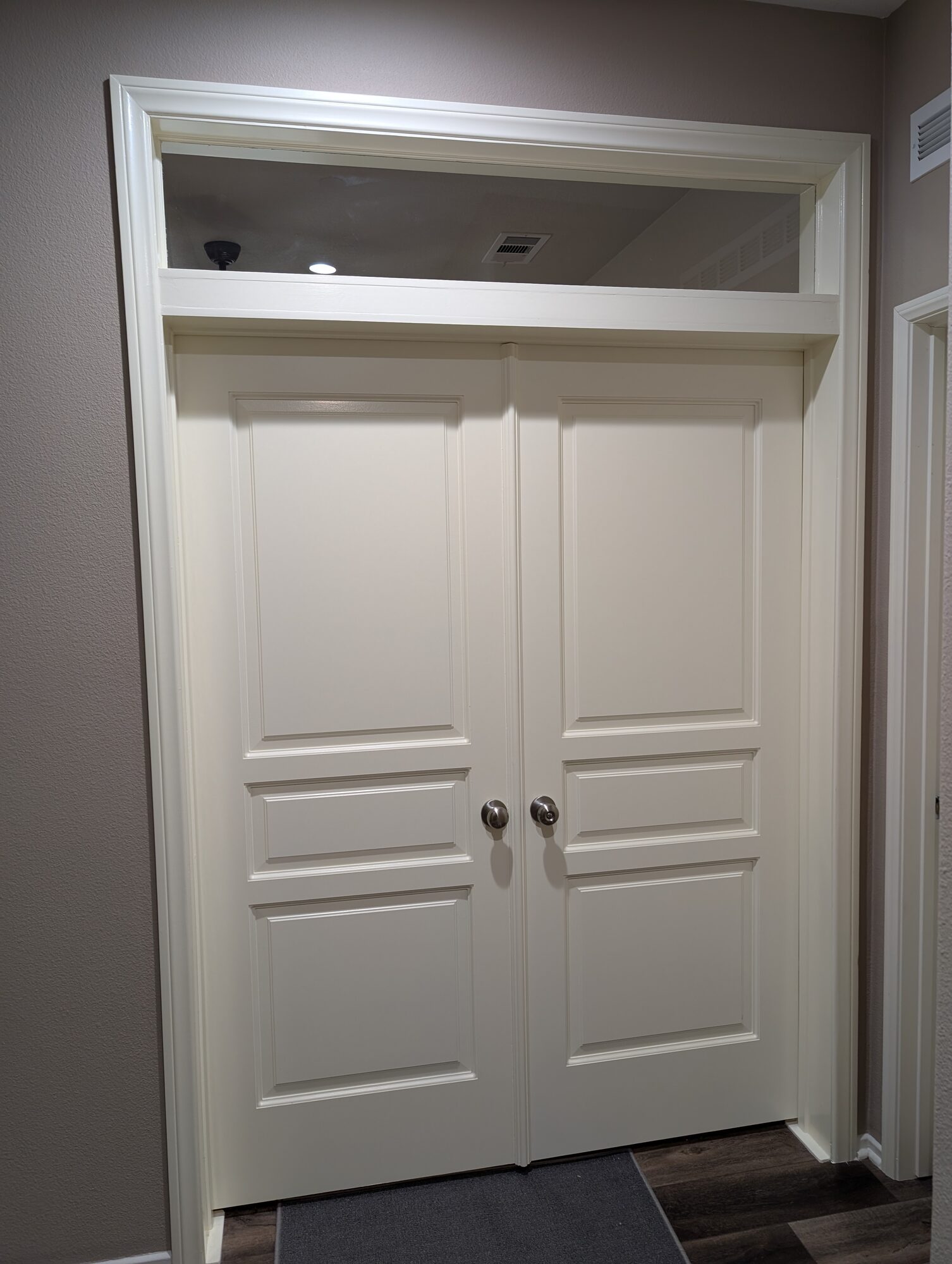
Holland & Sons Construction tells Menifee and Inland Empire homeowners the same thing about who should install interior doors: match the installer to the job, and judge the person, not the label. A handyman can be right for a slab swap under $1,000, a box-store installer can be right for a prehung swap into a ready jamb, and a licensed finish carpenter is the fit for a pair of doors into a cased opening with casing, a transom, and paint. The work is not hard to judge. An even nickel-thick gap on all sides, doors that stay put when you let go, and casing that meets the baseboard like the builder did it.
Key Takeaways
-
Match the installer to the job: handyman under $1,000, door installer for jamb-ready swaps, finish carpenter for cased openings, transoms, and matched trim
-
The decision factor that matters most is whether the quote names the door, the casing profile, the paint, and the exclusions
-
In California, check the license at cslb.ca.gov; a license check shows the bond and workers’ comp, not general liability, so ask for that separately
-
Holland & Sons is CSLB licensed, NAHB, NARI, and BBB A+ rated, and warranties door and trim workmanship for 5 years
-
See this in action: Sage Creek Office
A handyman can hang a door. A box-store installer can hang a door. A finish carpenter can hang a door. The question is not who can, it is which one should hang yours, and the honest answer is that the label matters less than demonstrated competence on this exact job. What the opening needs decides who is likely to have it: a slab in a ready jamb, or a pair of doors, a transom, matched casing, and two days of paint in a cased opening that was never framed for a door.
I have hung doors since 1991, and I have fixed a lot of doors other people hung. The fixes are always the same: a tapered gap, a door that drifts, casing that almost matches. None of that shows up in a quote. It shows up a year later. So this post covers what good looks like first, then how to tell before you sign whether the person in front of you can produce it.
What Excellent Looks Like
Use this as a checklist on finished work, yours or anyone's. Excellent door work in a tract home has these marks:
-
An even reveal on every side. The gap between door and jamb, and between the two doors of a pair, is about the thickness of a nickel, and it is the same width top to bottom. This Old House puts it at 1/8 to 3/16 inch at the head, uniform left to right. A tapered gap means the jamb is not plumb.
-
Doors that stay where you leave them. Open a door halfway and let go. A plumb hang holds it there. Fine Homebuilding notes that a door in an out-of-plumb frame opens or closes on its own.
-
A latch that catches without a slam. The door closes with a click under light pressure. On a pair, the active door latches and the inactive door does not rattle.
-
Casing that matches the house. Same profile, same width, same reveal (the small step between casing and jamb) as every other opening, and the new casing lands on the existing baseboard like it was always there. Our guide to baseboard and casing proportions covers why that reveal matters.
-
A finish that is a finish. Caulk at every joint, filler in every nail hole, two coats of enamel, no brush marks on the panels, and no paint on the glass if there is a transom.
-
Nothing relocated that did not need to be. The switch plate, the thermostat, and the return grille are where the builder put them, and the casing clears them with a clean reveal.
The homeowners at the Sage Creek Office in Menifee wrote on Google that Brian "is reliable, trustworthy and has a great eye for detail," and then called Holland & Sons back for cabinet doors in the pantry. The call-back is the review that matters.
What Adequate Looks Like, and Why It Is Not Enough
Adequate door work closes the opening. The doors swing, the latch catches most of the time, the casing is white. From the couch it looks done. Up close, the gap at the head is wider on the left than the right, the casing profile is the one the yard had in stock rather than the one on the hall closet, and the paint is wall paint that will burnish where hands land by spring.
What adequate means long term is a second job. The door that drifts gets a hinge shimmed in a year. The casing that almost matches gets replaced when the house is painted. The ball catch that does not hold gets swapped for a latch after the third time the office door swings open on a call. Together they are the difference between a $4,000 job and a $4,000 job plus a do-over, and the do-over never quite matches either. Adequate does not fail on day one. It fails in month eight.
Contractor Scorecard: Who Can Actually Do This Work
Ask each question directly. Score 1 point for a red-flag answer, 2 for a vague one, and 3 for a good one. Seven criteria, 21 points possible.
| What to Evaluate | Ask This Directly | Good Answer vs. Red Flag |
|---|---|---|
| License and classification | What is your CSLB license number, and what classification? | Good: a number you can verify at cslb.ca.gov, B or C-6. Red flag: "I do not need one for this," on a job over $1,000. |
| Insurance | Do you carry general liability, and can your agent send me a certificate? | Good: yes, and a certificate from the carrier. Red flag: "I am bonded," offered as if it were the same thing. |
| Sizing method | How will you size the pair to my opening? | Good: measure in three places, pick the stock unit, fur or shim the opening to fit. Red flag: "We will just order a 60." |
| Matching | How will you match the casing and panel style to the rest of the house? | Good: they ask to see the hall closet door and bring a profile sample. Red flag: "Casing is casing." |
| Transom and finish | Who builds the transom, and who paints? | Good: built on site to the opening, painted with a named enamel, two days. Red flag: a transom "kit" and "you can paint it." |
| Warranty | How long do you stand behind the hang? | Good: a stated number of years in writing. Red flag: "Call me if anything happens." |
| References and proof | Can I see a door job like mine, and talk to that homeowner? | Good: photos, an address or a post, a phone number. Red flag: stock photos or "trust me." |
18 to 21: hire with confidence. 13 to 17: get the weak answers in writing before you sign. 12 or below: keep looking. The NARI remodeler guide adds one more tip worth stealing: confirm license and insurance by calling the issuing agency or carrier, because a printed certificate may not show current coverage.
Questions to Ask a Door Installer
These separate the installers who know the work from the ones who are guessing.
-
What is your license number and classification?
-
Do you carry general liability insurance, and will your agent send a certificate?
-
How will you size the pair to my opening, and what happens if the opening is out of square?
-
How will you match the casing profile and the panel style to the rest of my house?
-
Is the door hollow-core or solid-core, and which brand and panel style?
-
Which door will be active, and what hardware holds the other one closed?
-
Will the transom be built on site or ordered as a unit, and is the glass tempered?
-
What paint, what sheen, and how many days of finish?
-
What is excluded from this quote?
-
How long is the workmanship warranty, and is it in writing?
Bob Vila's list of questions for French door installers adds two good ones: do you use subcontractors, and what is your policy if the doors or the surrounding area are damaged during installation.
What a Complete Quote Should Include
Anything missing from this list should be requested in writing before you sign.
-
Material specification: door brand, panel style, core, size, and hardware finish and function, named
-
Fabrication method: stock unit sized to the opening, or custom; transom built on site or ordered; what is done to the opening to make the unit fit
-
Casing and trim: profile, width, and how it meets the existing baseboard
-
Paint or finish system: product, sheen, number of coats, and days
-
Timeline: days on site and the cure days between carpentry and paint
-
Exclusions: what the quote does not cover (relocating devices, widening, painting walls, permits)
-
Warranty: years, and what it covers
-
Payment terms: a deposit at or under the California limit, and the balance tied to completion
Our pricing guide shows what to look for when comparing contractor quotes line by line, including what each item's absence tells you.
Red Flags
In the quote: no license number; no door named; "install double doors" as the entire scope; a figure far under the others, which Angi flags as a sign of inexperience; no exclusions at all.
In the contract: a deposit over 10 percent or $1,000, whichever is less, which the CSLB says is the legal limit in California; no start and completion dates; no warranty language.
In the communication: slow or no replies before the job starts, which only gets worse after; a refusal to put changes in writing; pressure to decide today.
In the work: a jamb set without a level; casing cut before the doors are hung; paint going on the day the caulk goes in; a ball catch used as the only thing holding a door shut; and a transom built with annealed glass because tempered "was not required."
What Homeowners Ask About Hiring
Can a handyman install my doors? Yes, if the job stays under $1,000 in labor and materials, needs no permit, and he works alone; that is California's threshold as of January 1, 2025, per the CSLB, and the implementing bulletin adds that unlicensed ads must say so. A slab swap fits. A pair with casing, transom, and paint does not.
What does a license check actually tell me? The CSLB license lookup shows whether the license is current, the bond, and workers' compensation. It does not show general liability insurance, because the CSLB does not require it, only strongly recommends it. Ask for the certificate separately. The NAHB hiring checklist says the same: confirm both workers' comp and general liability.
Does a BBB rating matter? It is one signal. BBB ratings run A+ to F, based partly on complaint history, and BBB itself says a rating is not a guarantee of performance. Pair it with a license check and a call to a past customer.
See This In Action: Sage Creek Office
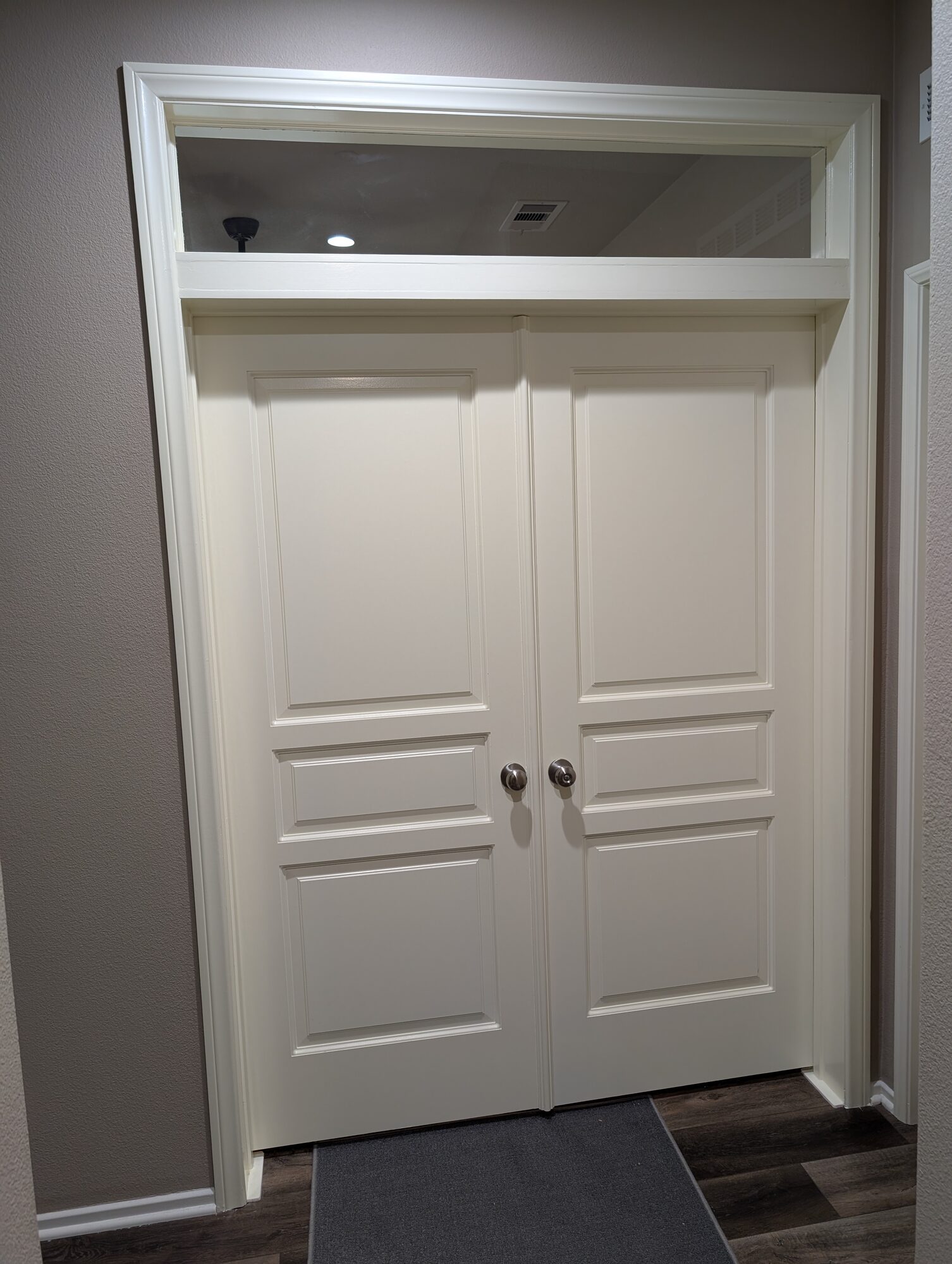
New 2-1/2 inch casing, matched to the existing profile, landing on the existing baseboard with the same reveal as every other door in the house. Wider casing would have looked richer in a catalog and crowded the switch plate in the room. That is the kind of judgment call this post is teaching you to hire for.
What we used on this project:
-
Prehung hollow-core three-panel double doors, stock unit, opening furred in a hair to fit it
-
Site-built fixed transom with 1/4 inch tempered glass and a pencil mould stop, built in the opening
-
Sherwin-Williams Emerald Urethane Trim Enamel in Swiss Coffee, two days of prep and finish
-
Casing sized to clear the switch plate and return grille; nothing relocated
The hub post has the before, during, and after photos, the full $4,805 breakdown, the 3-day timeline, and the construction details. Link: the full project story
The Holland & Sons Angle
The transom frame at Sage Creek was built in the opening, not in the shop, because on a one-off the room is the jig. Brian framed the glass pocket to the opening as it actually was, and the pencil mould reveal came out even on all four sides because of it. That is the thing to look for in finished work: not whether the transom exists, but whether the reveal is the same width everywhere you look. The ones who build to the room are the ones who measured it. That is what is being passed down at Holland & Sons, one opening at a time: not a method for hanging doors, but the habit of reading the room before touching it.
Related Resources: Adding Doors to an Open Den Guide
This post is one piece of a complete guide to turning a builder's open den into a room that closes.
-
Double Doors with a Glass Transom in Menifee, CA: Turning a Builder's Open Den into a Private Office (Sage Creek Office): the project to measure other quotes against
-
How Much Does It Cost to Add Doors to an Open Den or Cased Opening in Menifee in 2026?: what each line runs and how to compare quotes
-
Can You Add Double Doors to a Cased Opening? 7 Things That Go Wrong in Inland Empire Tract Homes: the problems a good installer solves before ordering
-
French Doors vs. Solid Double Doors for a Home Office: Which Is Right in the Inland Empire?: glass in the doors or glass above them
-
Best Interior Doors for a Home Office: What a Menifee Carpenter Recommends: the door lines, hardware, and paint a good installer specifies
-
Transom Windows Above Interior Doors: Height, Glass, and When They Make Sense: proportions a good installer draws before building
Hiring FAQ
Do carpenters install interior doors?
Yes, hanging and casing interior doors is finish carpentry, and in California it falls under the CSLB's C-6 Cabinet, Millwork and Finish Carpentry classification, which covers doors, trim, and nonbearing partitions. A general building contractor (B license) can also do it when the job involves two or more trades. For a pair of doors into a cased opening with new casing, a transom, and paint, a finish carpenter is the specialist. The Sage Creek Office in Menifee is that kind of job: the full project story
Can a handyman install interior doors?
Yes, legally, as long as the whole job is under $1,000 in labor and materials, needs no permit, and the handyman hires no one to help; above that, California requires a contractor's license, per the CSLB, as of January 1, 2025. Confirm the current rules at cslb.ca.gov. A door swap into an existing jamb often fits under that line. A pair of doors with new casing, a transom, and paint does not. The unlicensed line is also the line where recourse ends: no bond, no CSLB complaint process, and often no insurance.
Is Lowe’s or Home Depot better for door installation?
Both box stores sell interior door installation through subcontracted installers, and Home Depot's published guide lists interior installs at $178 to $398 in labor and French pairs at $324 each, excluding the door. That can be a fair deal for a slab or prehung swap into a jamb-ready opening, if the installer they send is good; ask. Neither program is built for a cased opening that needs furring, a site-built transom, matched casing, and two days of enamel. Ask who the installer is and what the quote excludes; the answer tells you which job it is.
What are red flags when hiring a contractor for doors?
The biggest red flags are no license number on the quote, a deposit over the legal limit, a figure well under everyone else's, and a quote with no exclusions. California caps the down payment on a home improvement contract at 10 percent or $1,000, whichever is less, per the CSLB consumer guide; confirm current terms at cslb.ca.gov. Angi adds the classics: no written contract, no insurance, and a contractor who goes quiet. On a door job specifically, watch for a quote that never names the door, the casing profile, or the paint.
What should I not tell my contractor?
Do not tell a contractor your budget before you have a written scope, and do not tell them "whatever matches" when you mean a specific door, casing, and color. The first invites the quote to grow to the number; the second invites a near miss you will look at for twenty years. Tell them what the room is for, what the other doors in the house look like, and what you want to be true when they leave. A good contractor asks those questions before you have to.
How many doors should a carpenter hang in a day?
A finish carpenter can hang several prehung single doors in a day when the openings are ready and the jambs are standard; a pair into a cased opening with a site-built transom and new casing is a full day. The Sage Creek Office took one day of carpentry for the pair, the transom, and the casing, then two days of paint. Speed is not the measure. A door that hangs plumb and stays put is.
What does a misaligned door look like, and how do I know mine was installed right?
A correctly hung door shows an even gap around all three sides, about the thickness of a nickel, latches without a slam, and stays put at any position when you let go of it. This Old House puts the head gap at 1/8 to 3/16 inch, uniform left to right, and Fine Homebuilding notes a door in an out-of-plumb frame will open or close on its own. A misaligned door shows a tapered gap, rubs at the head or the latch side, or drifts. On a pair, look at the gap where the two doors meet: it should be the same width top to bottom.
How much does it cost to get a door realigned?
Realigning a door is usually an hour or two of a carpenter's time: longer screws at the top hinge, a shim behind a hinge, or a strike plate moved. On a Holland & Sons install, it is covered by our 5-year workmanship warranty on doors and trim, which is one reason to ask any installer how long they stand behind the hang before you sign.
Want to Run the Scorecard on Us?
Ask every question above. We will answer them before you sign, in writing, and you can check the license at cslb.ca.gov while we wait.
Fill out the project intake form at hsconstruct.com/contact, describe the project, tell us the city, and upload a photo of the opening and any inspiration photos. Wyatt and I handle every design meeting in person. Want to see this advice applied to a real project? Here's the full breakdown: the full project story
We build in Menifee, Murrieta, Temecula, Perris, Riverside, and across the greater Inland Empire. More of our work is on Instagram, Facebook, YouTube, and TikTok.
951-338-8058 | brian@hsconstruct.com | hsconstruct.com | CSLB #1123738
More Than Just Door Installation
Hiring the right person for a pair of doors is the same decision as hiring for any finish work. Interior doors are one piece of what we do at Holland & Sons, and one chapter in a much longer story. Brian has been a finish carpenter since 1991, and his sons now build alongside him, which means every room in your home is fair game. If your space needs more than a pair of doors, here's what else we build:
-
Kitchen and bathroom remodels: full custom cabinetry, tile work, and finish carpentry from demo to done
-
Coffered ceilings: grid beam systems that add architectural depth to any room, sized and proportioned to the space
-
Wainscoting and wall paneling: classic raised panel, flat panel, board-and-batten, and shiplap applications
-
Reclaimed wood accents: feature walls, fireplace surrounds, and detail work using salvaged material with real character
-
Beam wraps: hollow wood wraps that give exposed beams the look of solid timber without the structural engineering
-
Crown molding, baseboards, and trim carpentry: the details that make a house feel finished, from a single room to a whole home
-
Cased openings and interior door replacements: clean transitions between spaces that most contractors overlook
-
Custom built-in entertainment walls and bookshelves: designed for the room, built in the shop, installed to last
Wood, proportion, and rooms that feel right. That's what we do. hsconstruct.com
About the Author
Brian Holland is the owner and lead carpenter of Holland & Sons Construction, a family-run finish carpentry and general contracting company serving Riverside County and the Inland Empire. He entered the trade at 17 in 1991, learned on the job, and has spent every year since building the kind of work that makes rooms feel right, often before a homeowner can articulate why. Many projects start at his vintage drafting table, where he sketches the layout by hand with pencil and paper using a Vemco drafting machine before anything gets built. His sons now apprentice alongside him on every project. Holland & Sons is based in Perris, CA and licensed by the CSLB (#1123738).
Memberships & Credentials: NAHB Member | CBIA Member | NARI Member | BBB A+ Rated | Tanya Holland, NAHB Certified Aging-in-Place Specialist (CAPS) | CSLB #1123738
Related project
This guide is part of our interior doors & trim series.
Learn more about Interior Doors & TrimHave a project in mind? Let's start a conversation.
Tell us what you are thinking about and we will give you a straight answer about scope, timeline, and investment.
Start a Conversation