Best Interior Doors for a Home Office: What a Menifee Carpenter Recommends
Quick Answer
Holland & Sons Construction recommends a matched pair of molded panel doors in a solid-core version for most home offices in Menifee, Murrieta, and Temecula: Masonite Solid Core or JELD-WEN ProCore in the same panel style as the rest of the house, a passage latch on the active door with a flush bolt on the inactive one, and Sherwin-Williams Emerald Urethane Trim Enamel in satin. Match the look the house already has and upgrade the core, the hardware, and the finish.
Key Takeaways
-
Best for most offices: the house’s existing panel style in a solid-core molded door, from Masonite or JELD-WEN
-
The decision that matters most is match first, core second: a door that fights the house looks wrong no matter how quiet it is
-
In Inland Empire tract homes, a composite or MDF door stays flat through dry summers; solid wood moves
-
Brian Holland has hung every option on this list since 1991, and the Sage Creek Office in Audie Murphy Ranch shows the matched pick built
-
See this in action: Sage Creek Office
The best door for your home office is the one that already hangs on every other opening in your house, in a heavier core. That is the recommendation, and it surprises people who came looking for a brand name. The brand is on the list below. The reason it comes second is that a home office door has two jobs, close the room and look like it belongs, and the second job is where most upgrades fail.
I have hung hollow-core, solid-core, MDF stile-and-rail, and stain-grade wood doors in Inland Empire homes since 1991. Each one is the right door somewhere. This post says where, names the product lines we actually use, and covers the hardware and paint that make or break a pair, because a great door with a ball catch that will not hold is a door that drifts open on a call.
The Direct Recommendation
For a home office in a Menifee, Murrieta, or Temecula tract home, Holland & Sons recommends a matched molded panel pair in a solid-core version: Masonite Solid Core or JELD-WEN ProCore, in the same panel layout as the rest of the house. Two reasons. The molded skin matches the existing doors exactly, so the new pair reads as original. And the dense core is expected to cut the sound coming through to roughly half of what a hollow-core door passes, based on JELD-WEN's published slab ratings; the installed result depends on the reveal and the sweep, but the difference is usually hearing the TV versus hearing that the TV is on.
The order of decisions: first the glass and privacy configuration (opaque panels with a transom, or glass in the doors; our French doors comparison settles that), then the core, by noise, matching, weight, and budget. The criteria that decide the core are match, noise, weight, stability in dry heat, hardware, finish, and investment, in roughly that order. When the house has a mix of door styles already, or the office is meant to be a showpiece, the recommendation moves up the list to an MDF stile-and-rail door. When exact match beats everything, including quiet, it moves down to a matched hollow-core pair. That is the Sage Creek Office: a project-specific call, not the universal answer.
The Full Evaluation: Four Door Types for a Home Office
1. Matched molded hollow-core. This is the door the builder put in: a molded composite skin over a honeycomb core, in lines like the Masonite Winslow 3-Panel and the JELD-WEN 3 Panel Craftsman. Best where exact match is the goal and the office is on the quiet side of the house. Falls short on sound, around STC 25, and on feel, since a hollow door weighs a third of a solid one. Right for homeowners who want the opening to disappear into the house. Field assessment: the most underrated choice here. In a house full of hollow doors, it is the only one that matches.
2. Matched molded solid-core. Same skin, dense engineered core. Masonite offers its Logan, Lincoln Park, Livingston, and Riverside panel styles in solid core with a 7-year limited warranty, and the Winslow 3-panel comes in a solid-core slab. JELD-WEN ProCore rates up to STC 36 and carries a 20-minute fire rating. Best in offices next to living rooms, kitchens, and kids' rooms. Falls short only on weight: heavier doors want long hinge screws and a real latch, and the pair runs $1,000 to $1,500 more installed. Right for anyone who takes calls with the door shut. Field assessment: the best value upgrade in a tract home, provided the panel style matches.
3. MDF stile-and-rail. TruStile's MDF doors are built like a wood door, with real stiles and rails (the vertical and horizontal frame members) around flat or raised panels, out of refined MDF that will not shrink, expand, or warp, with a warranty for the life of the installation. Best where the homeowner wants a crisp paint-grade panel profile that molded doors cannot copy. Falls short on match, since nothing else in a tract home looks like them, and on lead time. Right for whole-home door packages and feature rooms. Field assessment: the door we spec when the whole house is getting new doors, because it holds a paint line like nothing else.
4. Stain-grade wood. Simpson builds interior doors in fir, alder, white oak, walnut, and a dozen other species, plus a paint-grade Redi-Prime line that comes double-primed with a 10-year warranty. Best as a showpiece: a pair of rift white oak doors on a study is the kind of thing buyers remember. Falls short in our climate, where solid wood moves with humidity, and adds $2,000 to $3,000 over a painted pair. Field assessment: beautiful, and the one door here I would not put in a house where every other door is painted molded composite.
Comparison Table: Home Office Door Options
| Option | Sound (STC, approx.) | Stability in Dry Heat | Match to Tract-Home Doors | Investment vs. Hollow-Core Pair | Best For |
|---|---|---|---|---|---|
| Masonite Winslow / JELD-WEN 3 Panel hollow-core | 25 | Excellent | Exact | Baseline | Exact match, quiet side of the house |
| Masonite Solid Core / JELD-WEN ProCore | 28 to 36 | Excellent | Exact | +$1,000 to $1,500 | Offices next to living rooms or kitchens |
| TruStile MDF stile-and-rail | 30 to 35 | Excellent | Different profile | Per project | Whole-home packages, feature rooms |
| Simpson stain-grade wood | 30 to 35 | Moves with humidity | Different | +$2,000 to $3,000 | Showpiece rooms |
| French (glass) pair | Glass pane 30; gaps decide | Depends on frame material | Different | Per project | Dining rooms and libraries; see our French doors comparison |
STC figures are manufacturer and acoustics-lab ranges for the slab, from JELD-WEN and Commercial Acoustics; a door's installed performance depends on the reveal, the sweep, and the stop.
Hardware: The Part That Decides Whether the Doors Work
A pair needs three decisions: how the active door latches, how the inactive door stays put, and what the knobs look like.
-
A real latch on the active door. A passage set like the Kwikset Juno knob in satin nickel has a spring latch that catches a strike plate. On a pair, the strike mounts in the edge of the inactive door. Swap in a privacy set and the office locks from inside.
-
A flush bolt on the inactive door. A Baldwin residential flush bolt mortises into the edge of the inactive leaf and throws into the head jamb, so that door stays fixed and gives the active door something to latch to. When you need the full opening, it releases.
-
A dummy knob to match. The inactive leaf gets a non-turning dummy knob in the same finish, so the pair looks symmetrical. It is a pull, not a latch.
-
What we steer away from: a ball catch alone. A drive-in ball catch in the head jamb holds a light door shut and nothing more; Ives says plainly its catches are not designed to keep a door secure. The Sage Creek Office got a dummy knob and ball catch on the inactive side to match the hardware in the house, and it works. On an office where you want the doors to stay shut against a leaning kid or a dog, specify the latch.
Paint and Finish: What Holds Up on a Door
Doors get handled. Wall paint on a door burnishes where hands land and chips at the edges within a year. The right finish is an enamel that cures hard: Sherwin-Williams Emerald Urethane Trim Enamel, a waterbased urethane-modified alkyd that levels like oil and comes in satin, semi-gloss, and gloss, or Benjamin Moore Advance, a waterborne alkyd with a 16-hour recoat. Sheen: satin to match most builder trim in Menifee and Murrieta, semi-gloss where the existing trim is semi-gloss. The enamel runs $75 to $150 more than standard acrylic trim paint on a pair, which is the cheapest upgrade on this entire list. Prep matters more than brand: caulk, filler, sand, two coats, and a few weeks of easy use while it cures.
What Homeowners Ask Before They Buy
Do hollow-core doors feel cheap? Light, yes. Cheap is relative. In a house where every door is hollow-core, a matching pair feels like the rest of the house. One solid pair in that same house feels heavy and different, and not everyone wants that. Decide which house you are building toward, then pick the core.
What lasts longest? InterNACHI's life expectancy chart puts a hollow-core interior door at 20 to 30 years, a solid-core door at 30 to 100 or more, and interior paint at 10 to 15. In practice the finish is what you replace, not the door.
Should the office doors match the trim color? Yes, in a tract home. Doors, casing, and base in one color is what makes an opening read as original. Our solid-core vs. hollow-core guide goes deeper on the core, and prehung vs. slab covers whether your existing jambs are worth keeping.
How to Choose
-
By project type. Adding a pair to one opening: match the house, pick hollow or solid by the noise next door. Replacing every door in the house: this is the time to step up to solid-core or MDF stile-and-rail throughout.
-
By room conditions. Office off a living room or kitchen: solid-core. Office down a hall from the bedrooms: hollow-core matched is fine. Room with a west-facing window and big afternoon heat: composite or MDF over solid wood.
-
By budget. Best return first: the enamel finish ($75 to $150), the latch hardware, the solid core ($1,000 to $1,500), then wood. Do them in that order.
-
By how long you plan to stay. Selling in two years: match the house, do not over-build the one room. Staying ten: solid-core, because you will take a thousand calls behind those doors. How each choice affects the total investment is covered line by line in our Menifee pricing guide.
See This In Action: Sage Creek Office
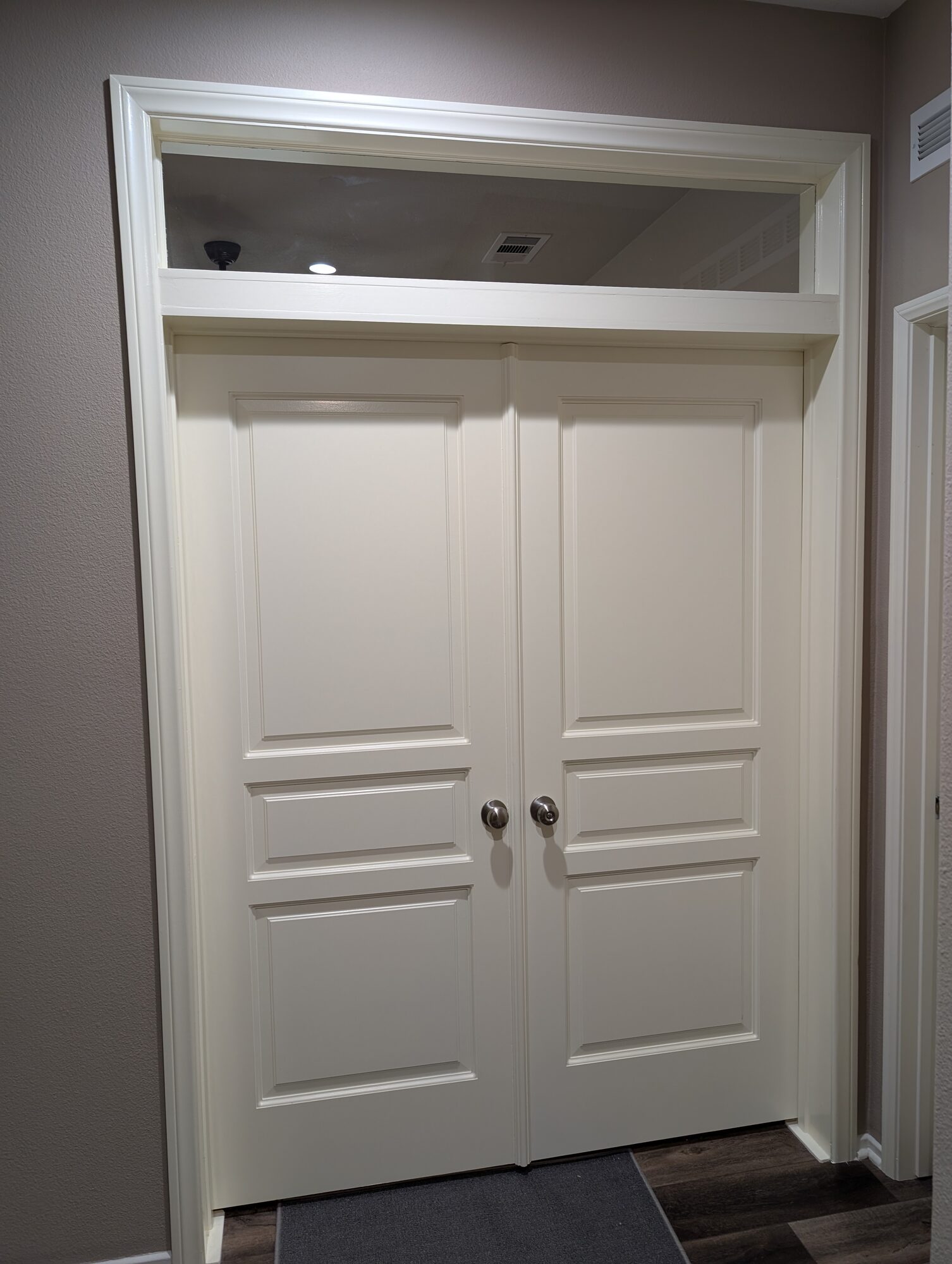
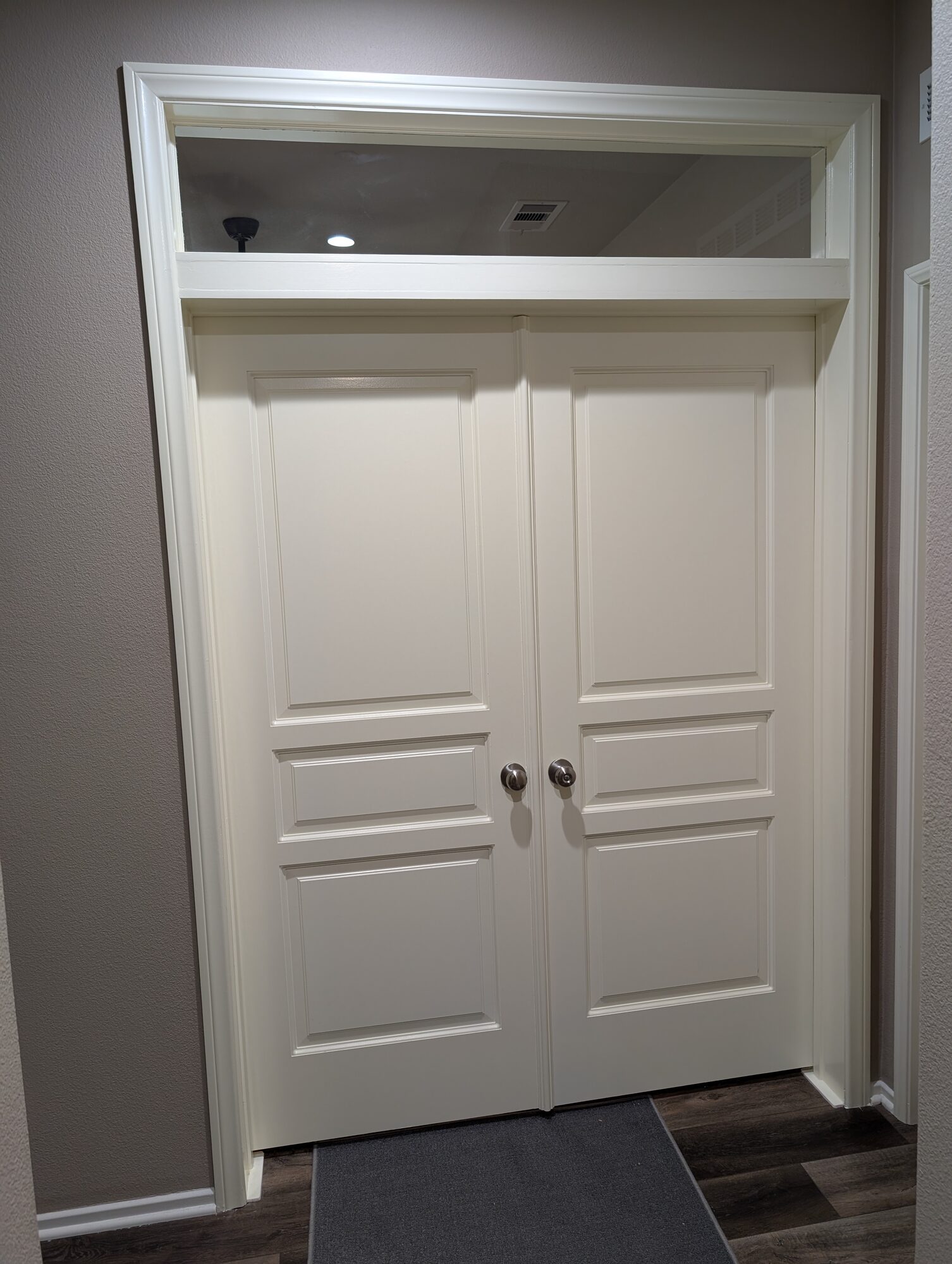
Emerald Urethane over standard acrylic trim paint, for about $75 to $150 more on the whole pair. That was the finish decision at the Sage Creek Office, and it is the one we never skip: the doors level out like oil enamel and wipe clean with a damp cloth, which matters on a pair that gets pushed open with a shoulder twenty times a day.
What we used on this project:
-
Prehung hollow-core three-panel double doors, chosen to match every other door in the house over a solid-core upgrade
-
Sherwin-Williams Emerald Urethane Trim Enamel in Swiss Coffee, satin, two days of prep and finish
-
Satin nickel knobs matched to the home: passage on the active door, dummy knob and ball catch on the inactive door
-
Site-built fixed transom, 1/4 inch tempered glass, above the pair
The hub post has the before, during, and after photos, the full $4,805 breakdown, the 3-day timeline, and the construction details. Link: the full project story
How These Doors Hold Up in the Inland Empire
Dry heat is the test. From June through October, humidity in Menifee and Temecula sits in the single digits for days at a time, and in January the same house sees damp mornings. Molded composite and MDF doors do not care; TruStile states its MDF will not shrink, expand, or warp. Solid wood pairs open up at the panel edges every summer and close again every winter, and a painted wood door shows that as a hairline at each panel.
Tract-home framing is the other test. Openings are a hair out of square, and a heavy solid-core pair exposes that faster than a light one, because the weight pulls on the hinge side. A solid-core pair needs long screws through the top hinges into the framing and a plumb hang; our guide to the most common mistakes to watch for covers that hang in detail.
The Holland & Sons Angle
The Sage Creek homeowners could have had solid-core doors for about $1,000 to $1,500 more, and we talked about it. Hollow-core won, and not for the money. Every other door in that house is hollow-core three-panel, and the goal was an office that looked like the builder had always planned it. A heavier pair would have matched in the photo and felt different in the hand, every single day. A door catalog cannot make that call for you. It takes standing in the house. Waylon and Wyatt were there for the other half of the finish lesson on this one: why the transom glass goes in last. Caulk, filler, and the first coats go on with the opening empty, so there is no glass to tape and no bead of enamel on the pane, and the stop gets painted before it ever touches glass. The doors are the easy part. The order of operations is the craft.
Related Resources: Adding Doors to an Open Den Guide
This post is one piece of a complete guide to turning a builder's open den into a room that closes.
-
Double Doors with a Glass Transom in Menifee, CA: Turning a Builder's Open Den into a Private Office (Sage Creek Office): the matched-pair recommendation, built
-
How Much Does It Cost to Add Doors to an Open Den or Cased Opening in Menifee in 2026?: what each option runs, line by line
-
Can You Add Double Doors to a Cased Opening? 7 Things That Go Wrong in Inland Empire Tract Homes: what to settle before fabrication
-
French Doors vs. Solid Double Doors for a Home Office: Which Is Right in the Inland Empire?: glass in the doors or glass above them
-
Handyman, Door Company, or Finish Carpenter: Who Should Install Your Interior Doors in Menifee?: what to ask before you hire
-
Transom Windows Above Interior Doors: Height, Glass, and When They Make Sense: proportions and when to skip the glass
Best Doors FAQ
What are the best doors for a home office?
The best doors for a home office in a tract home are a matched pair in the same panel style as the rest of the house, in a solid-core version if the office sits next to a TV or a kitchen. Match the look, upgrade the core. For a Menifee home full of molded three-panel doors, that means a Masonite solid core or JELD-WEN ProCore pair in the matching panel, a real latch on the active door, and a hard enamel finish. The Sage Creek Office kept hollow-core to match exactly; see why here: the full project story
Which interior door is the most soundproof?
A solid-core composite door with a tight reveal and a sweep is the quietest interior door most homeowners will buy; JELD-WEN rates its top ProCore door at STC 36 against STC 25 for a hollow-core molded door, and a 10 point STC gain is roughly half the sound coming through. Solid wood doors are heavier but not quieter than a dense composite core. Nothing on a residential door is soundproof; the gaps around it decide more than the slab does, which is why the hang matters as much as the door.
How do I make my office door more soundproof?
Start with the gaps, not the door: a door sweep at the bottom and weatherstrip in the stop close the leaks that let most of the sound through. Second Skin Audio notes that even the best door leaks if there are gaps at the edges, and Commercial Acoustics measured a hollow-core door at STC 26 bare and 28 to 30 with a sweep. After the gaps, upgrade to a solid-core slab in the same jamb. A rug on the office side helps more than people expect.
Which brand of interior doors is the best?
Masonite and JELD-WEN make the molded doors in nearly every Inland Empire tract home, and both make solid-core versions of their common panel styles, which is what makes a matched upgrade possible. TruStile builds MDF stile-and-rail doors for custom work, and Simpson builds stain-grade wood doors. The best brand is the one whose panel style already hangs in your house, in the heaviest core your budget allows. Brand matters less than match and core.
Do hollow-core doors feel cheap?
A hollow-core door feels light, and if the rest of the house is solid-core, one light pair will feel cheap by comparison. In a house where every door is hollow-core, a matching hollow-core pair feels exactly like the rest of the house, which is the point. That is why the Sage Creek Office in Menifee got hollow-core: matching every other door won over a heavier pair that would have felt different the first time someone pulled on it. Feel is relative. Match the house, or upgrade the house.
What type of paint is best for interior doors?
A waterborne alkyd or urethane-modified enamel is the best paint for interior doors, because it levels like an oil enamel and cures to a hard, wipeable film. Holland & Sons uses Sherwin-Williams Emerald Urethane Trim Enamel in satin; Benjamin Moore Advance is the comparable choice. Standard wall acrylic stays soft on a door and shows every fingernail. Expect the enamel to feel dry in a day and keep curing for weeks, so go easy on the doors at first.
Is eggshell or satin better for doors?
Satin or semi-gloss is better than eggshell for interior doors, because doors get handled and wiped and a flatter sheen scuffs and burnishes. Sherwin-Williams' sheen guide lists satin and semi-gloss for doors and trim and reserves eggshell for walls. Satin matches most builder trim in Menifee and Murrieta homes; go semi-gloss if the existing trim is semi-gloss, so the new pair does not read as a different color under the same light.
What hardware works best on a pair of office doors, and can they lock?
Put a real latch on the active door, not just a ball catch, and hold the inactive door with a flush bolt. A passage knob like the Kwikset Juno latches into a strike on the inactive leaf; a dummy knob goes on the inactive leaf as a pull; a flush bolt mortised into that leaf's edge keeps it shut. Swap the passage knob for a privacy knob and the office locks from inside. A ball catch alone holds a door closed but will not hold it against a push.
Want a Recommendation for Your House?
Send a photo of one of your existing doors and one of the opening. We will tell you which line matches it and whether the room earns the solid core.
Fill out the project intake form at hsconstruct.com/contact, describe the project, tell us the city, and upload a photo of the opening and any inspiration photos. Wyatt and I handle every design meeting in person. Want to see this advice applied to a real project? Here's the full breakdown: the full project story
We build in Menifee, Murrieta, Temecula, Perris, Riverside, and across the greater Inland Empire. More of our work is on Instagram, Facebook, YouTube, and TikTok.
951-338-8058 | brian@hsconstruct.com | hsconstruct.com | CSLB #1123738
More Than Just Office Doors
Picking the right door for a home office is the kind of small decision that makes a house feel finished. Interior doors are one piece of what we do at Holland & Sons, and one chapter in a much longer story. Brian has been a finish carpenter since 1991, and his sons now build alongside him, which means every room in your home is fair game. If your space needs more than a pair of doors, here's what else we build:
-
Kitchen and bathroom remodels: full custom cabinetry, tile work, and finish carpentry from demo to done
-
Coffered ceilings: grid beam systems that add architectural depth to any room, sized and proportioned to the space
-
Wainscoting and wall paneling: classic raised panel, flat panel, board-and-batten, and shiplap applications
-
Reclaimed wood accents: feature walls, fireplace surrounds, and detail work using salvaged material with real character
-
Beam wraps: hollow wood wraps that give exposed beams the look of solid timber without the structural engineering
-
Crown molding, baseboards, and trim carpentry: the details that make a house feel finished, from a single room to a whole home
-
Cased openings and interior door replacements: clean transitions between spaces that most contractors overlook
-
Custom built-in entertainment walls and bookshelves: designed for the room, built in the shop, installed to last
Wood, proportion, and rooms that feel right. That's what we do. hsconstruct.com
About the Author
Brian Holland is the owner and lead carpenter of Holland & Sons Construction, a family-run finish carpentry and general contracting company serving Riverside County and the Inland Empire. He entered the trade at 17 in 1991, learned on the job, and has spent every year since building the kind of work that makes rooms feel right, often before a homeowner can articulate why. Many projects start at his vintage drafting table, where he sketches the layout by hand with pencil and paper using a Vemco drafting machine before anything gets built. His sons now apprentice alongside him on every project. Holland & Sons is based in Perris, CA and licensed by the CSLB (#1123738).
Memberships & Credentials: NAHB Member | CBIA Member | NARI Member | BBB A+ Rated | Tanya Holland, NAHB Certified Aging-in-Place Specialist (CAPS) | CSLB #1123738
Related project
This guide is part of our interior doors & trim series.
Learn more about Interior Doors & TrimHave a project in mind? Let's start a conversation.
Tell us what you are thinking about and we will give you a straight answer about scope, timeline, and investment.
Start a Conversation