
Stone Veneer vs. Tile vs. Shiplap for Fireplace Surrounds: Which Works Best in Menifee Homes?
Quick Answer
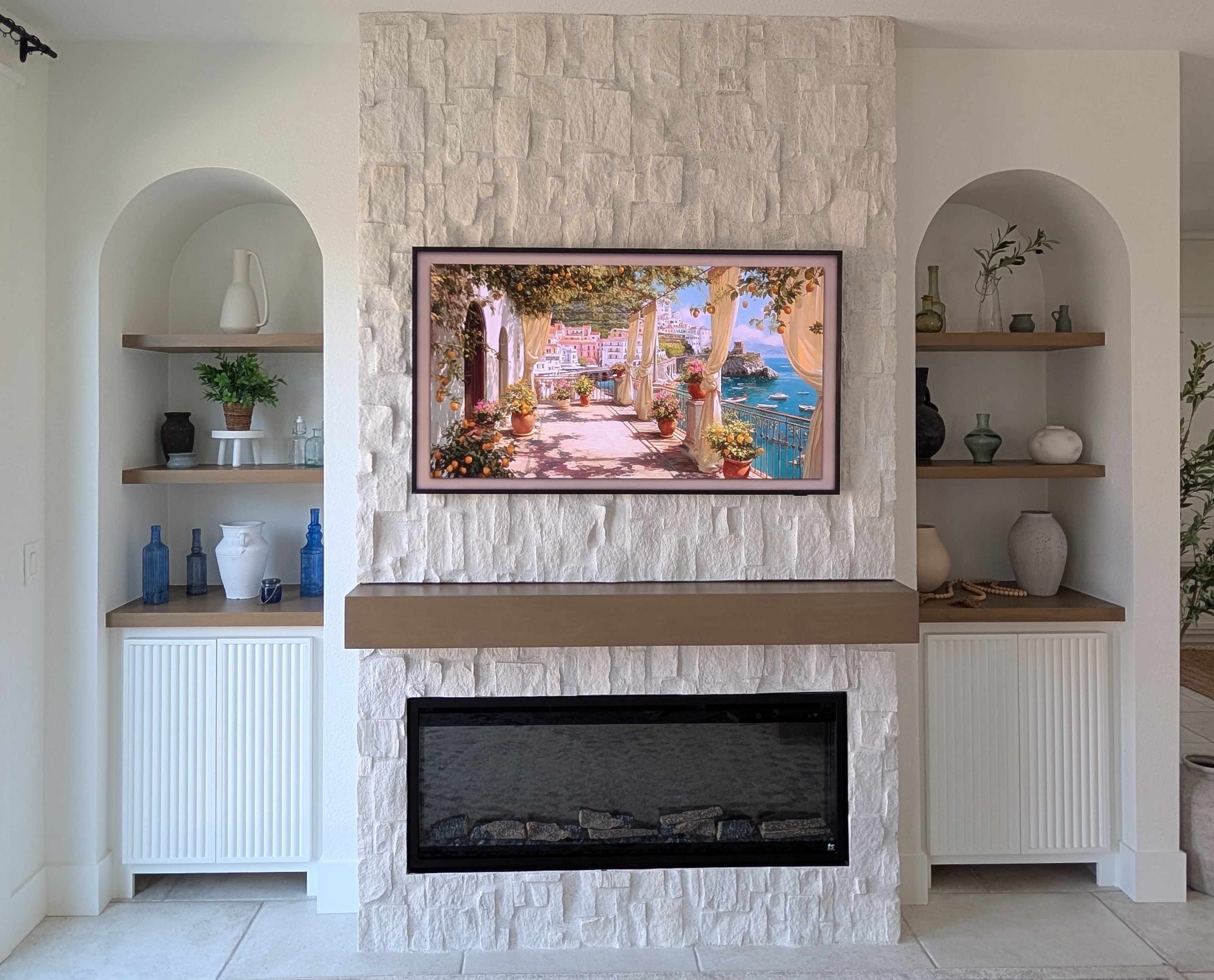
For most Menifee homes, stone veneer is the better choice when you want a dimensional, heat-tolerant focal point that reads as permanent and custom — tile is the better choice when you want design flexibility and an easier install; shiplap is the most affordable option but works best away from direct heat and in a more casual, farmhouse-leaning room. A recent Rhapsody Ct. project paired stacked stone veneer with hand-milled wood millwork for exactly this reason.
Key Takeaways
-
Stone veneer delivers the most dimensional, permanent-feeling focal point for a Menifee living room
-
Tile offers the widest design flexibility and is typically the easiest of the three to install
-
Shiplap is the most affordable option but needs distance from direct heat and reads more casual
-
Holland & Sons credential: 35 years pairing surround materials with wood millwork across Menifee, Murrieta, and Temecula
Stone veneer is the right call for most Menifee homeowners who want a fireplace wall that feels permanent, dimensional, and custom. Tile is the right call if you want more design flexibility and an easier installation. Shiplap is the right call if budget matters most and you're building a more casual, farmhouse-leaning room — as long as it stays clear of direct heat.
That's the short version. The longer version depends on your budget, your home's style, how close the surface sits to actual heat, and how the surround will work alongside any wood millwork or cabinetry in the design — which is exactly the decision Holland & Sons walked through on a recent Rhapsody Ct. project in Menifee Ranch.
The Direct Answer
If your fireplace wall is the focal point of the room and you want it to feel substantial — the kind of wall that makes a builder-grade tract home stop looking like every other house on the street — stone veneer is almost always the right call. It has visual weight that tile and shiplap can't fully replicate, and it pairs naturally with wood millwork, which is exactly what made the Rhapsody Ct. project work.
Tile earns its place when a homeowner wants more control over exact color and pattern, or when the budget needs to stay tighter without sacrificing durability. Shiplap earns its place when the room's style is more casual, and the fireplace isn't the only design statement in the space.
Stone Veneer vs. Tile: Side-by-Side
| Factor | Stone Veneer | Tile |
| Typical investment | $25–$100+ per sq. ft. installed | $1–$40 per sq. ft. installed, wide range by tile type |
| Installation complexity | Moderate to high — coursing and joint work take skill | Low to moderate — well understood by most tile setters |
| Heat tolerance | Excellent, safe close to a firebox | Excellent, safe close to a firebox |
| Maintenance | Low — occasional dusting or damp wipe-down | Low — grout lines need occasional cleaning |
| Regional performance (dry inland climate) | Very stable, no expansion or contraction concerns | Very stable, occasional grout maintenance in dry heat |
| Best home style | Transitional, modern farmhouse, craftsman-custom | Modern, transitional, or highly patterned design schemes |
| Resale appeal | Reads as a permanent upgrade; strong buyer appeal | Strong appeal, especially with a timeless tile choice |
Why This Comparison Matters
Most online comparisons treat this as a purely aesthetic choice. In the Inland Empire, it's also a practical one. Menifee, Murrieta, and Temecula homes are overwhelmingly newer-build tract construction, which means the builder-grade fireplace wall in most of these homes is functionally identical from house to house — flat drywall, maybe a mantel shelf. The surround material you choose is one of the clearest ways to differentiate a home from its neighbors.
Brian's field experience across hundreds of Inland Empire fireplace walls points to one pattern that generic national advice misses: the surround material rarely stands alone. It has to work visually with whatever wood millwork, cabinetry, or shelving surrounds it. Stone pairs beautifully with hand-milled wood — the texture contrast does a lot of the design work. Tile pairs well with cleaner, more minimal millwork. Shiplap tends to compete with wood millwork rather than complement it, since both read as "wood" to the eye.
Other Surround Options Worth Knowing About
Stone and tile aren't the only paths. Here's how the other common alternatives stack up:
| Option | What It Solves | What It Doesn't Solve | Right For |
| Shiplap / nickel-gap wood | Affordable texture and a farmhouse-casual look | Direct heat tolerance and a more formal, permanent feel | Casual rooms, budget-conscious projects, secondary living spaces |
| Painted drywall | Lowest cost, cleanest and most modern look | Visual interest and dimension | Minimalist design schemes, rental or transitional properties |
| Full-bed natural stone | Maximum authenticity and dimensional weight | Budget — this is the most expensive surround option | High-end, statement fireplace walls with no budget ceiling |
| Stone veneer over existing brick | Updating a dated brick fireplace without a full demo | A completely custom footprint — you're working within the existing shape | Refacing projects where the existing firebox and chase stay in place |
The Questions Homeowners Actually Ask
Is natural stone or manufactured stone veneer more expensive?
Natural stone veneer generally costs more than manufactured veneer — often $35 to $100+ per square foot compared to $25 to $75 for manufactured. Manufactured veneer is lighter, easier to install, and available in a wider range of consistent colors, which is why it's the more common choice for full-wall coverage.
Can I install stone veneer over an existing brick or drywall fireplace?
In many cases, yes. Stone veneer can often be applied directly over existing brick with proper surface preparation, which saves the cost and mess of demolition. Over drywall, the wall typically needs additional bracing or a mortar bed system to support the weight, depending on the veneer type.
Is shiplap going out of style for fireplaces?
Shiplap has cooled from its peak popularity, but it remains a legitimate, affordable option for the right room — especially when installed vertically, which reads as more current than the horizontal farmhouse look most associated with the trend. It's simply not the right fit for every home style, particularly homes leaning transitional or modern-custom.
The Decision Framework
Choose stone veneer when the fireplace wall is the primary focal point of the room, you're pairing it with wood millwork or cabinetry, and you want a result that reads as custom and permanent.
Choose tile when you want more control over exact color and pattern, a somewhat easier installation, or a cleaner, more contemporary look.
Choose shiplap when budget is the primary driver, the room's overall style is more casual, and the surface will sit a reasonable distance from direct heat.
See This In Action — Rhapsody Ct. Fireplace Wall
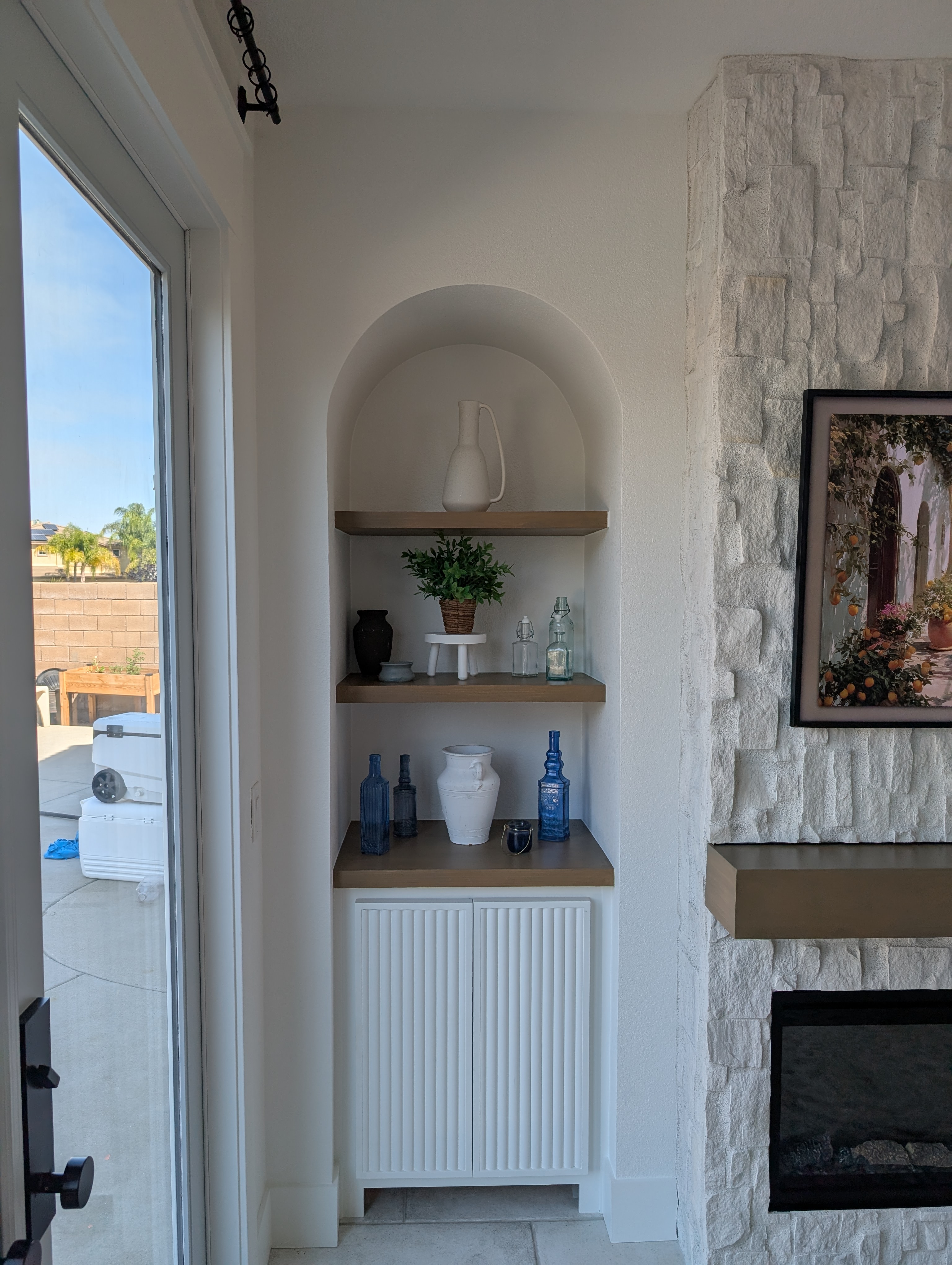
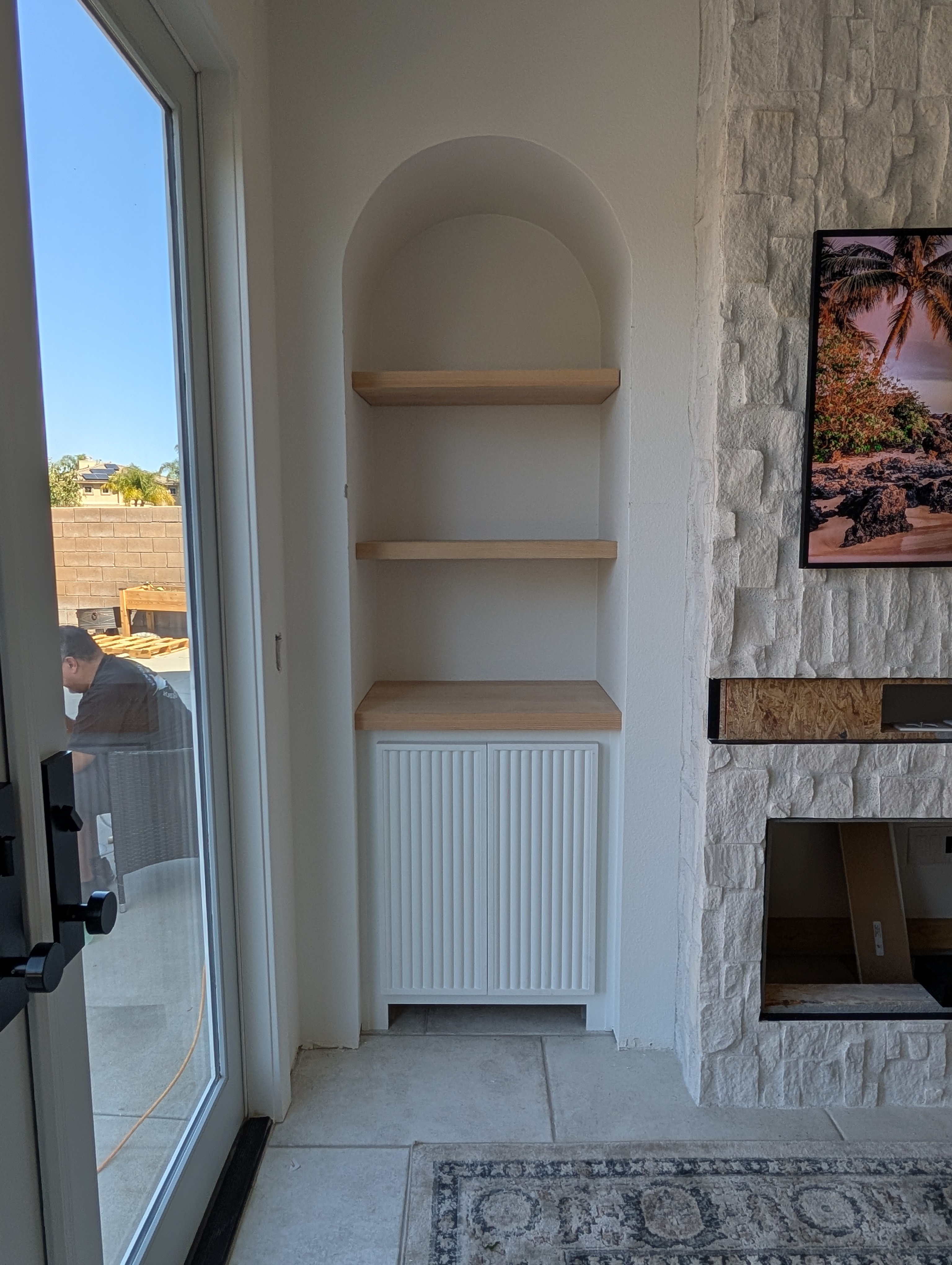
On the Rhapsody Ct. project, stacked stone veneer and hand-milled vertical-grain fir do very different jobs on the same wall — and the combination is exactly why the room finally looks intentional. The stone pulls the eye up and gives the wall visual weight; the fir ties the arches and shelving back together with warmth the stone alone couldn't provide.
What we used on this project:
-
Stacked stone veneer, sourced through Floor & Decor, for the dual-depth fireplace pop-out
-
Hand-milled vertical-grain fir for the countertops, floating shelves, and mantel
-
Sherwin-Williams Pure White on the surrounding cabinetry and wall paint, to let the stone and fir carry the visual interest
See the full before-and-after photo story and investment breakdown at the link below.
Regional Performance Note: Dry Inland Climate
Both stone veneer and tile perform very well in the Inland Empire's dry, temperature-swinging climate — neither is prone to the moisture-related issues that plague more humid regions. Shiplap and other wood-based surrounds need a bit more attention: wood naturally expands and contracts with seasonal humidity shifts, so proper acclimation before installation matters more here than in a milder, more consistent climate.
The Holland & Sons Angle
On Rhapsody Ct., the stone and the fir had to earn their place next to each other — stone alone would have felt heavy and closed off; fir alone wouldn't have had the visual weight to anchor the room. Getting that balance right isn't a formula. It's field judgment, built from pairing these materials on hundreds of Inland Empire living rooms.
It's also a conversation Brian is starting to bring his older son into directly — sitting in on material selection meetings with homeowners, holding stone and wood samples side by side against the actual room's lighting, and learning to explain why one combination works and another doesn't. That's not a skill you learn from a catalog.
Related Resources — Rhapsody Ct. Fireplace Wall Guide
This post is part of a full guide to planning a custom fireplace feature wall in Menifee. Here's the rest of the cluster:
Versus FAQ
Is stone veneer or tile better for a fireplace surround?
Stone veneer is generally better when you want a dimensional, permanent-feeling focal point, especially paired with wood millwork. Tile is better when you want more control over exact color and pattern, a somewhat easier install, or a more contemporary look. Both perform equally well against heat.
What's the difference between stone veneer and shiplap for a fireplace?
Stone veneer is heavier, more expensive, and reads as permanent and custom. Shiplap is lighter, more affordable, and reads as casual and farmhouse-leaning. Stone tolerates direct heat better than wood-based shiplap, which needs distance from the firebox.
Is shiplap going out of style for fireplaces?
It's cooled from its peak popularity but remains a legitimate, affordable option for casual rooms. Vertical shiplap installation reads as more current than the horizontal farmhouse look most associated with the trend, but it's not the right fit for a more transitional or modern-custom home.
Is natural stone or manufactured stone veneer more expensive?
Natural stone veneer typically costs more — often $35 to $100+ per square foot versus $25 to $75 for manufactured veneer. Manufactured veneer is lighter, easier to install, and available in a more consistent range of colors.
Can I install stone veneer over an existing brick or drywall fireplace?
In many cases, yes. Stone veneer can often go directly over existing brick with proper surface prep, avoiding a full demolition. Over drywall, the wall usually needs additional bracing or a mortar bed system to support the material's weight.
Which fireplace surround material performs best in a dry inland climate?
Stone veneer and tile both perform very well in the Inland Empire's dry, temperature-swinging climate, with no moisture-related concerns. Wood-based surrounds like shiplap need proper acclimation before installation, since wood expands and contracts more with seasonal humidity shifts than stone or tile.
Does the surround material affect resale value?
Stone veneer tends to read as the strongest permanent upgrade to buyers, since it's the material most associated with a custom, non-builder-grade home. Tile can perform just as well with a timeless color and pattern choice. Results vary by home, market, and overall project scope.
Ready to Talk About Your Own Project?
If you're weighing stone, tile, or shiplap for your own fireplace wall in Menifee, Murrieta, Temecula, Perris, or Riverside, we're happy to walk through what will actually work best with your room and your budget.
Reach out through hsconstruct.com/contact to start the conversation — fill out the form, tell us about your project, and upload a few inspiration photos if you have them. We'll follow up to talk through scope, timeline, and investment.
You can also find Brian and his sons' latest work on Holland & Sons' social media channels.
Serving Menifee, Murrieta, Temecula, Perris, Riverside, and the greater Inland Empire.
951-338-8058 | brian@hsconstruct.com | hsconstruct.com | CSLB #1123738
More Than Just Fireplace Surrounds
Pairing the right surround material with the right millwork is a big part of what makes a fireplace wall feel custom instead of generic. Brian and his sons have been finish carpenters since 1991, which means every room in your home is fair game.
If your space needs more than that, here's what else we build:
-
Kitchen and bathroom remodels — full custom cabinetry, tile work, and finish carpentry from demo to done
-
Coffered ceilings — grid beam systems that add architectural depth to any room, sized and proportioned to the space
-
Wainscoting and wall paneling — classic raised panel, flat panel, board-and-batten, and shiplap applications
-
Reclaimed wood accents — feature walls, fireplace surrounds, and detail work using salvaged material with real character
-
Beam wraps — hollow wood wraps that give exposed beams the look of solid timber without the structural engineering
-
Crown molding, baseboards, and trim carpentry — the details that make a house feel finished, from a single room to a whole home
-
Cased openings and interior door replacements — clean transitions between spaces that most contractors overlook
-
Custom built-in entertainment walls and bookshelves — designed by hand, built in the shop, installed to last
Wood, proportion, and rooms that feel right — that's what we do. hsconstruct.com
About the Author
Brian Holland is the owner and lead carpenter of Holland & Sons Construction, a family-run finish carpentry and general contracting company serving Riverside County and the Inland Empire since 1991. He entered the trade at 17, learned on the job, and has spent 35 years building the kind of work that makes rooms feel right — often before a homeowner can articulate why. His sons now apprentice alongside him on every project. Holland & Sons is based in Perris, CA and licensed by the CSLB (#1123738).
This guide is part of our custom fireplace walls series.
Learn more about Custom Fireplace WallsHave a project in mind? Let's start a conversation.
Tell us what you are thinking about and we will give you a straight answer about scope, timeline, and investment.
Start a Conversation