
Half-Height Paneling With Wallpaper Above vs. Full-Height Paneling: Which Is Right for a Bedroom Wall?
By Brian Holland, Owner and Lead Carpenter, Holland & Sons Construction · Carpenter since 1991 · CSLB #1123738 · NARI Member · NAHB Member
Published
Quick Answer
Holland & Sons Construction has built both on bedroom walls in the Inland Empire, and neither one is built better than the other. Half-height paneling with wallpaper above fits a homeowner who loves a pattern and wants the wall to feel dressed. Full-height paneling fits a homeowner who wants one solid, calm wall that never needs a second decision. Pick by the look you want to live with.
Key Takeaways
-
This is a look-and-feel decision. Both versions are sound when they are built right.
-
Wallpaper above paneling is a very sophisticated look. Not everybody likes it, and that is fine.
-
Half height means two trades and a handoff. Full height means one carpenter and one painter.
-
Most Inland Empire walls are textured, and wallpaper wants a smooth wall. Plan for that prep.
-
The paneling on our Live Oak wall carries a 10-year written warranty on the woodwork. The wallpaper was the designer's scope.
-
See this in action: hsconstruct.com/blog/live-oak-wall-paneling-jurupa-valley
Which One Should You Choose?
If you love a wallpaper and can already picture it in the room, go half height and put it above. The paneling gives the pattern a frame and keeps it off the part of the wall that takes the wear.
If you are not sure about pattern, go full height, or go half height with paint above. Wallpaper is a commitment to one design. Painted wood is a commitment to a color, and a color is easy to change.
Side by Side
| Factor | Half Height + Wallpaper Above | Full-Height Paneling |
|---|---|---|
| Investment range | Paneling $3,000–$6,000+ from Holland & Sons, plus wallpaper and its installation as a separate scope. Our $3,958 on Live Oak covered paneling and paint only, so it is not the whole-wall total. | More wood, more joints, and more paint on the same wall, so it lands toward the upper end of $3,000–$6,000+ or past it |
| Installation complexity | Two trades and a handoff at the top rail | One carpenter and one painter |
| Wall prep | The wall above usually needs smoothing for wallpaper | Paneling can go over a textured wall |
| Maintenance | Enamel wipes down; wallpaper care depends on the paper | One enamel finish, top to bottom |
| Changing it later | Wallpaper can be replaced without touching the woodwork | Repaint to change the color; the pattern stays |
| Longevity | The woodwork stays; how long the paper lasts depends on the paper and the room | Depends on how it is built, the conditions in the room, and upkeep; repaint as needed |
| Performance in dry inland climates | Ask your installer which paste and prep they use for our dry summers | Wood moves a little with the seasons; glued joints help the paint hold |
| Best home style | Traditional, transitional, and rooms built around fabrics | Works from traditional to modern, depending on the pattern |
| Resale appeal | Depends on the buyer's taste in pattern | Reads as architecture, in a color a buyer can repaint |
Why This Comparison Matters
Generic advice treats these as two finishes. On a real wall they are two different jobs.
The first difference is the wall itself. Most homes in Jurupa Valley, Eastvale, Corona, and Riverside have textured drywall. A paneling grid can go right over it, and we compared the ways to handle that in board and batten over textured walls. Wallpaper asks more of the wall. Bob Vila's guide notes that texture often shows through, and that liner paper or a skim coat (a thin coat of joint compound troweled smooth) is the usual prep.
The second is who is in the room. Half height brings in a wallpaper installer. Angi's 2025 data puts wallpaper installation labor at $1 to $7 per square foot before the paper itself, and lists skim coating as an added line. None of that is in a carpenter's number.
The third is proportion. A taller run of paneling wants different spacing than a short one. Fine Homebuilding's trim guide (2026) points out that taller stiles usually look best wider and farther apart. So full height is not the half-height pattern stretched. It is a different layout.
Which Goes First, the Paneling or the Wallpaper?
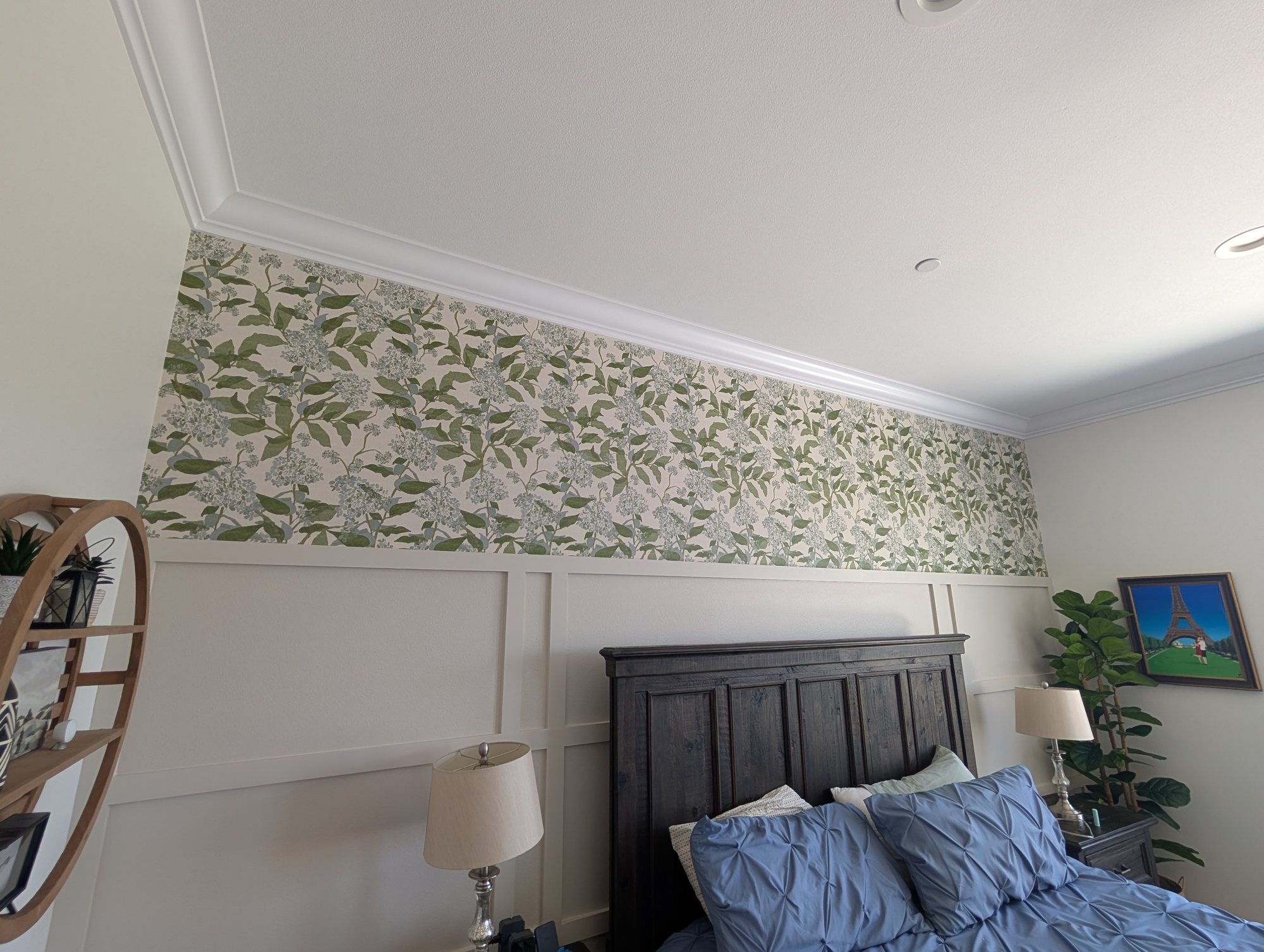
Paneling first. The carpentry sets a straight line, and the wallpaper finishes to it. On Live Oak the wallpaper went on after our work and runs from the top rail to the crown.
Settle three things before anybody starts: how high the paneling should go, who preps the wall above, and who owns the joint where paper meets wood. When a designer is running the job, they usually coordinate that handoff. We wrote up who does what when a designer and a finish carpenter work together.
Other Ways to Finish the Wall Above
| Option | What It Solves | Best For |
|---|---|---|
| Paint above, same color as the paneling | Makes the whole wall read as one piece without full-height woodwork | Rooms where you want calm, and a lower investment than full height |
| Paint above, different color | Sets the paneling off as a band | Rooms with a strong color in the bedding or rug |
| Paneling with art or sconces above | Gives the upper wall a job without committing to pattern | People who change art often |
| Applied molding frames above (picture frame molding vs. assembled panels) | Adds detail to the upper wall with less depth | Formal rooms with tall ceilings |
Does Pattern Above Paneling Make a Bedroom Feel Busy or Smaller?
It can, and that is the fear behind most of these searches. The room does not get smaller. What changes is how much your eye has to take in on one wall.
-
The paneling is the calm part. A plain painted grid gives a pattern something quiet to sit on.
-
Scale matters more than color. A large, open pattern above a simple grid reads as one idea. A small, tight pattern above a busy grid reads as two.
-
One color in common ties it together. On Live Oak the paneling paint was custom matched to the designer's fabric swatch.
-
Keep it to one wall. The bed wall can carry it. Four walls of it is a different room.
If you read that list and it still makes you nervous, that's your answer. Go full height or paint above.
How to Decide
Half height with wallpaper above is right when
-
You have a wallpaper you love, or a designer who does
-
The room is built around fabrics and you want the wall to join in
-
You like the idea of changing the paper someday and keeping the woodwork
-
You are comfortable with two trades and a little more coordination
Full-height paneling is right when
-
You want one solid wall and one finish
-
You are not sure about pattern, or you know you get tired of it
-
The wall is textured and you would sooner not smooth it
-
You want the wall to read as part of the house, in a color you can repaint
The three things that settle it
-
How you feel about pattern, today and in five years
-
Whether the wall above is smooth or textured
-
The whole-wall investment for each version, with every trade counted. Start with what a paneled bed wall runs.
See This In Action: Live Oak Wall Paneling
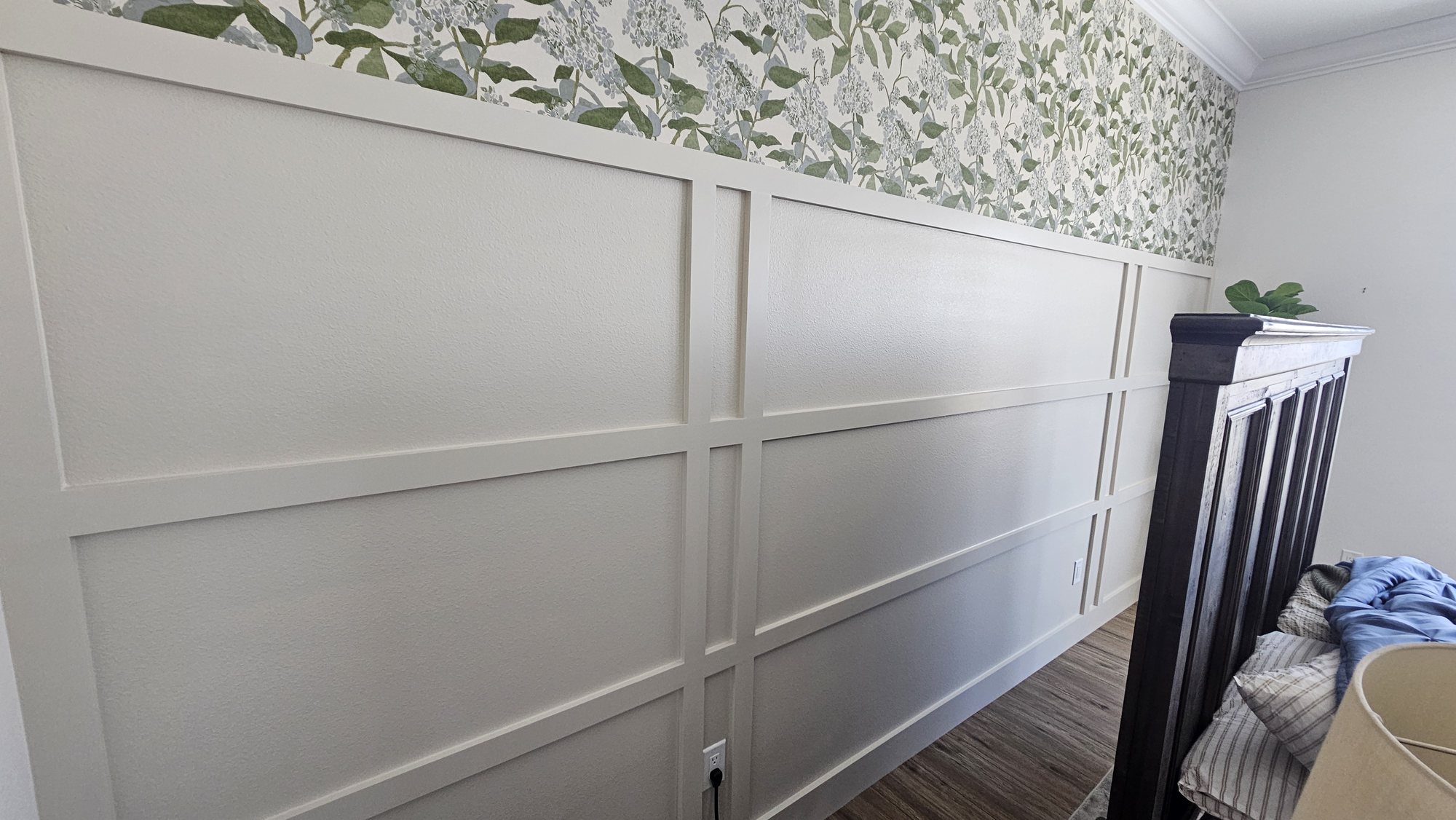
Sixty inches of painted pine on a 9-foot wall, then wallpaper the rest of the way to the crown.
What we used on this project:
-
Primed pine 1x3 rails and stiles, three rows of frames to 60 inches
-
Sherwin-Williams Emerald Urethane Trim Enamel, custom matched to a fabric swatch from the designer
-
A flat top rail that the wallpaper finishes against
-
Wallpaper selected and coordinated by Kathy Hernandez of Kathleen Ann Design, outside our scope
The project profile has the photos, the full investment, the timeline, and how the wall went together: hsconstruct.com/blog/live-oak-wall-paneling-jurupa-valley
How Each One Holds Up in the Inland Empire
Our summers are hot and dry, and a house here swings from air-conditioned afternoons to cool nights. Wood responds to that. It takes on a little moisture and gives it back, and the joints are where you would see it. Glued joints and a hard enamel are how a painted wall stays quiet through those swings. More on the finish in the paint we use on trim.
Wallpaper has its own relationship with a dry climate, and it depends on the paper, the paste, and the prep. I hang wood, not paper, so I won't tell you how a given wallpaper behaves. Ask the installer what they use here and what they warranty.
One more local note. In newer tract homes the bed wall is often the one with the outlets for both nightstands, so whichever version you choose, sort out outlets, switches, and the headboard before the pattern is final.
The Holland & Sons Angle
On Live Oak our work stops at a line 60 inches off the floor. Above that line it was the designer's wall. Most of our projects start as a hand drawing at my drafting table, and this one didn't. Kathy drew the grid, picked the height, and chose the paper. Our job was to build the bottom five feet so well that the top four had a clean place to start. Knowing when to leave a design alone is part of the trade. That is something I want my sons to take from a job like this: you build somebody else's drawing with the same care as your own.
Related Resources: Bedroom Wall Paneling Guide
This post is one part of our guide to paneling the wall behind a bed. Here is the rest.
-
Bedroom Wall Paneling in Jurupa Valley, CA: A Designer's Rendering, Built in Pine (Live Oak Wall Paneling) | hsconstruct.com/blog/live-oak-wall-paneling-jurupa-valley: the Live Oak project itself, with photos, the full investment breakdown, and the timeline
-
How Much Does Wall Paneling Behind a Bed Cost in Jurupa Valley in 2026?: what a painted paneling wall behind a bed runs and what moves the number
-
Outlets, Switches, and the Headboard: What Goes Wrong When You Panel the Wall Behind a Bed: what to decide about outlets, switches, and the headboard before anything is built
-
How High Should Bedroom Wall Paneling Be? Comparing Heights for Different Ceilings and Headboards: how to pick a height for your ceiling and your headboard
-
How to Tell if a Painted Paneling Wall Is Built Right: Joints, Seams, and How It's Attached: a checklist for joints, seams, and attachment on a finished wall
Frequently Asked Questions
Should I wallpaper above panelling?
Wallpaper above paneling is a good choice if you love a pattern and want the wall to feel dressed. Holland & Sons Construction built exactly that on a bedroom wall in Jurupa Valley: painted paneling to 60 inches with the designer's wallpaper from the top rail to the crown. It is a very sophisticated look, and not everybody likes it. If you are unsure about pattern, paint above the paneling keeps your options open.
What can you put above wall panelling?
Above half-height paneling you have three common choices: wallpaper, paint in the same color as the paneling, or paint in a different color. Wallpaper adds pattern. Matching paint makes the whole wall read as one piece. A different paint color makes the paneling stand out as a band. Art and sconces can go above any of them.
What kind of wallpaper goes well with panelling?
A wallpaper works with paneling when the two share a color and differ in scale. On the Live Oak wall the paneling paint was custom matched to a fabric swatch from the interior designer, so the woodwork and the room's fabrics tie together on purpose. A straight grid below is a calm backdrop for an organic pattern above. Picking the paper itself is a designer's call, not a carpenter's.
Which goes up first, the paneling or the wallpaper?
The paneling goes up first. On the Live Oak wall the wallpaper went on after the carpentry, and it runs from the top rail up to the crown. That order gives the wallpaper installer a straight, finished edge to trim to. Ask your wallpaper installer how they want the wall above prepared, because that prep belongs to their scope.
Does a feature wall make a room feel smaller?
A feature wall does not change the size of a room. It changes where your eye stops. A dark or busy wall can feel closer, and a light, simple one can feel farther away. On a bed wall that is usually fine, because the bed already pulls your eye there. If the room is small, keep the paneling color light and the pattern simple.
What paneling makes a room look bigger?
Paneling with strong vertical lines, in a light color, carried to full height, does the most to make a wall feel taller. Half-height paneling adds a horizontal line across the room, which can make a narrow room feel wider. Neither one adds a square foot. Pick by the proportion you want to correct: height or width.
Can you wallpaper over textured walls above the paneling?
Wallpaper can go on a textured wall, but the texture often shows through, so most installers want the wall smoothed first. Bob Vila's guide lists liner paper and skim coating (a thin coat of joint compound troweled smooth) as the usual prep. Most Inland Empire homes have textured walls, so plan on that prep for the wall above the paneling.
Is half-height paneling with wallpaper less of an investment than full-height paneling?
The carpentry is usually less at half height, because there is less wood, fewer joints, and less to paint. But wallpaper and its installation are a separate investment, and wall prep can add to it. On the Live Oak wall our paneling was $3,958 and the wallpaper was outside our scope. Compare the two as whole walls, not as carpentry alone.
Not Sure Which Way to Go?
That's a normal place to be. If you are looking for a finish carpenter or a trim carpenter to panel a bedroom wall in Jurupa Valley, the next step is the project intake form at hsconstruct.com/contact. Fill out the form, describe the wall, and upload a photo of it along with inspiration photos of both looks, or your designer's drawing. We'll get back to you to set up a time to come measure.
You can also see our wainscoting and wall paneling and accent walls pages.
Want to see this advice applied to a real project? Here's the full breakdown: hsconstruct.com/blog/live-oak-wall-paneling-jurupa-valley
Follow the jobs as they happen on Facebook, Instagram, YouTube, and TikTok.
We work in Jurupa Valley, Eastvale, Norco, Corona, Riverside, Chino, Chino Hills, Ontario, Fontana, Rancho Cucamonga, and all across Riverside County, San Bernardino County, and the Inland Empire.
951-338-8058 | brian@hsconstruct.com | hsconstruct.com | CSLB #1123738
More Than Just Paneling and Wallpaper
Half height or full height, a paneled wall is one of our favorite things to build. Bedroom wall paneling is one piece of what we do at Holland & Sons, and it's one chapter in a much longer story. Brian has been a finish carpenter since 1991, and his sons now build alongside him, which means every room in your home is fair game. If your space needs more than one wall behind the bed, here's what else we build:
-
Kitchen and bathroom remodels: full custom cabinetry, tile work, and finish carpentry from demo to done
-
Custom and built-in cabinetry: designed for the room, built in the shop, installed to last
-
Media walls and entertainment walls: built-in TV walls with storage, lighting, and clean cable management
-
Fireplace walls: mantels, surrounds, and full-height paneling that make the fireplace the center of the room
-
Accent walls: paneling, slat walls, and feature walls that give one wall a job to do
-
Mudrooms: lockers, bench seating, cubbies, and hooks, built for the way your family comes through the door
-
Coffered ceilings: grid beam systems that add architectural depth to any room, sized and proportioned to the space
-
Wainscoting and wall paneling: classic raised panel, flat panel, board-and-batten, and shiplap applications
-
Reclaimed wood accents: feature walls, fireplace surrounds, and detail work using salvaged material with real character
-
Beam wraps: hollow wood wraps that give exposed beams the look of solid timber without the structural engineering
-
Crown molding, baseboards, and trim carpentry: the details that make a house feel finished, from a single room to a whole home
-
Cased openings and interior door replacements: clean transitions between spaces that most contractors overlook
Wood, proportion, and rooms that feel right. That's what we do. hsconstruct.com
This guide is part of our wainscoting & paneling series.
Learn more about Wainscoting & PanelingHave a project in mind? Let's start a conversation.
Tell us what you are thinking about and we will give you a straight answer about scope, timeline, and investment.
Start a Conversation