
Do Acoustic Slat Wall Panels Really Reduce Echo? What Inland Empire Homeowners Should Know
By Brian Holland, Owner and Lead Carpenter, Holland & Sons Construction · Carpenter since 1991 · CSLB #1123738 · NARI Member · NAHB Member
Published
Quick Answer
Holland & Sons Construction installs acoustic slat wall panels in the Inland Empire, and the plain answer is yes, they reduce echo, and no, they do not soundproof. The backing absorbs sound that would bounce off a hard wall. How much depends on the product and how it is mounted, so ask for the published NRC rating and the mounting method behind it.
Key Takeaways
-
Acoustic slat panels absorb echo inside a room; they do not block sound between rooms
-
The same panel can rate very differently depending on how it is mounted
-
Ask for a published NRC rating and which mounting it was tested in
-
In a two-story entry, the upper wall is often the largest hard surface in the house
-
Brian Holland has been a carpenter since 1991; every job carries a written workmanship warranty
-
See this in action: the Live Oak Project in Jurupa Valley, hsconstruct.com/blog/live-oak-stairwell-paneling-jurupa-valley
Yes, they reduce echo. No, they will not make a room quiet. Both of those are true, and most of the confusion about acoustic slat panels comes from mixing them up.
Nearly everything written about these panels is written by a company selling them. We install them and we do not sell them, so here is the plain version: what the backing does, what the numbers on the box mean, and what to expect in the kind of tall, hard-surfaced entry that is common from Eastvale to Temecula.
What We Recommend for Echo in a Tall Entry or Stairwell
For a two-story entry or stairwell that sounds hollow, start with the soft things: a stair runner, a rug at the door. If you are already planning to finish the upper wall, a backed slat panel is a sensible choice, because it gives you a finished wood wall and some absorption on the largest hard surface in the space.
Choose a panel with a published NRC rating, find out which mounting that rating refers to, and expect the low end of the range when the panels are glued flat to drywall. Buy it because you like the wall. Count the acoustic help as a real but secondary benefit.
Absorbing Sound vs. Blocking Sound
These are two different jobs, and slat panels only do one of them.
Absorption deals with sound that stays in the room. Sound bounces off hard surfaces and arrives at your ear a moment late, which is what makes a room ring. As Stikwood explains, absorbing materials soften those reflections. That is the job a backed slat panel does.
Blocking deals with sound that travels through a wall or floor to another room. That takes mass, sealing, and separation inside the structure. A panel on the face of the wall does not change that in any way you would notice.
If your complaint is "the entry echoes," panels can help. If it is "I can hear the TV upstairs," they are the wrong tool.
What an NRC Rating Tells You, and What It Leaves Out
NRC means noise reduction coefficient. It is a single number from 0 to 1 that describes how much sound a surface absorbs. Higher is more.
The part that gets left off the box is the mounting. Primacoustic publishes four ASTM C423 ratings for one slat wall panel, and they run from NRC 0.55 with the panel mounted flat to 0.95 with the panel spaced off the wall over a cavity filled with absorptive material. Same panel. The difference is what is behind it.
That number belongs to that product only, and it is not the panel on our Live Oak Project. It does not transfer to any other panel, because backing thickness and material differ from one maker to the next. What does transfer is the lesson: when a listing shows one big NRC figure, ask how the panel was mounted for the test, and compare that to how it will go on your wall.
The Options, Evaluated
Backed slat panels, glued flat to the wall
Factory panels with a wood veneer over a core and an absorptive backing. This is the common residential install. Built for large walls where you want wood and some echo control in one step. Expect the lower end of the product's published range. Field note: they go up fast, and the edges need a plan.
Backed slat panels over furring with a filled cavity
The same panels fastened to strips (furring) that hold them off the wall, with absorptive material in the gap. Built for rooms where sound is the main goal: media rooms, music rooms, offices on calls all day. More absorption, more depth off the wall, more labor at every edge, outlet, and corner.
Hand-built wood slats over drywall
Individual slats made and finished in a shop and installed over a painted wall. Built to match cabinetry, fit an exact opening, or take any spacing and color. Mostly a visual treatment. We compare these two approaches fully in custom slat wall vs. prefab slat panels.
Soft furnishings
Runners, rugs, fabric shades, upholstered furniture. Built for exactly this problem and often the most effective first step. Right for anyone, with or without a wall project.
Comparison Table
| Option | Echo Control | Blocks Sound Between Rooms | Best For |
|---|---|---|---|
| Backed slat panels, flat to wall | Some | No | Large feature walls and tall upper walls |
| Backed slat panels over a filled cavity | More | No | Media rooms, music rooms, home offices |
| Hand-built slats over drywall | Little | No | Built-ins and exact-match details |
| Stair runner and rugs | Some | No | Any hard-floored entry or stairwell |
One example of a published spec: Primacoustic EcoScapes Slat Wall lists a 9 mm PET backing under 12 mm MDF slats with a wood veneer.
Your Questions, Answered
Do they work if I only cover part of the wall? Any absorptive surface helps a little. More coverage helps more. In a stairwell, covering the upper wall treats a surface nothing else in the house touches.
Are the slats real wood? Often the face is a real wood veneer over a core, not solid wood. The hub post for this project answers that for the Live Oak panels.
What about the edges? Slat panels end in a raw edge wherever the wall stops. How that edge is finished is the clearest sign of a careful install, and it has its own checklist in how to evaluate a slat wall installation.
How to Decide
-
If the room rings and you want a wood wall anyway: backed slat panels on the biggest hard wall.
-
If sound is the main reason for the project: plan the cavity-mounted version and get the product's test data first.
-
If you only want it quieter: try a runner and rugs before any wall work.
-
If you want slats to match cabinetry: hand-built slats, and treat sound as a separate question.
-
If you plan to stay a long time: pick a veneer and color you will still like, since panels cannot be refinished like solid wood.
Where the panels stop on the wall is a layout decision. We cover it in what to decide before the first board goes up. What a slat section adds to a stairwell project is in what a paneled staircase wall runs.
See This In Action: The Live Oak Project
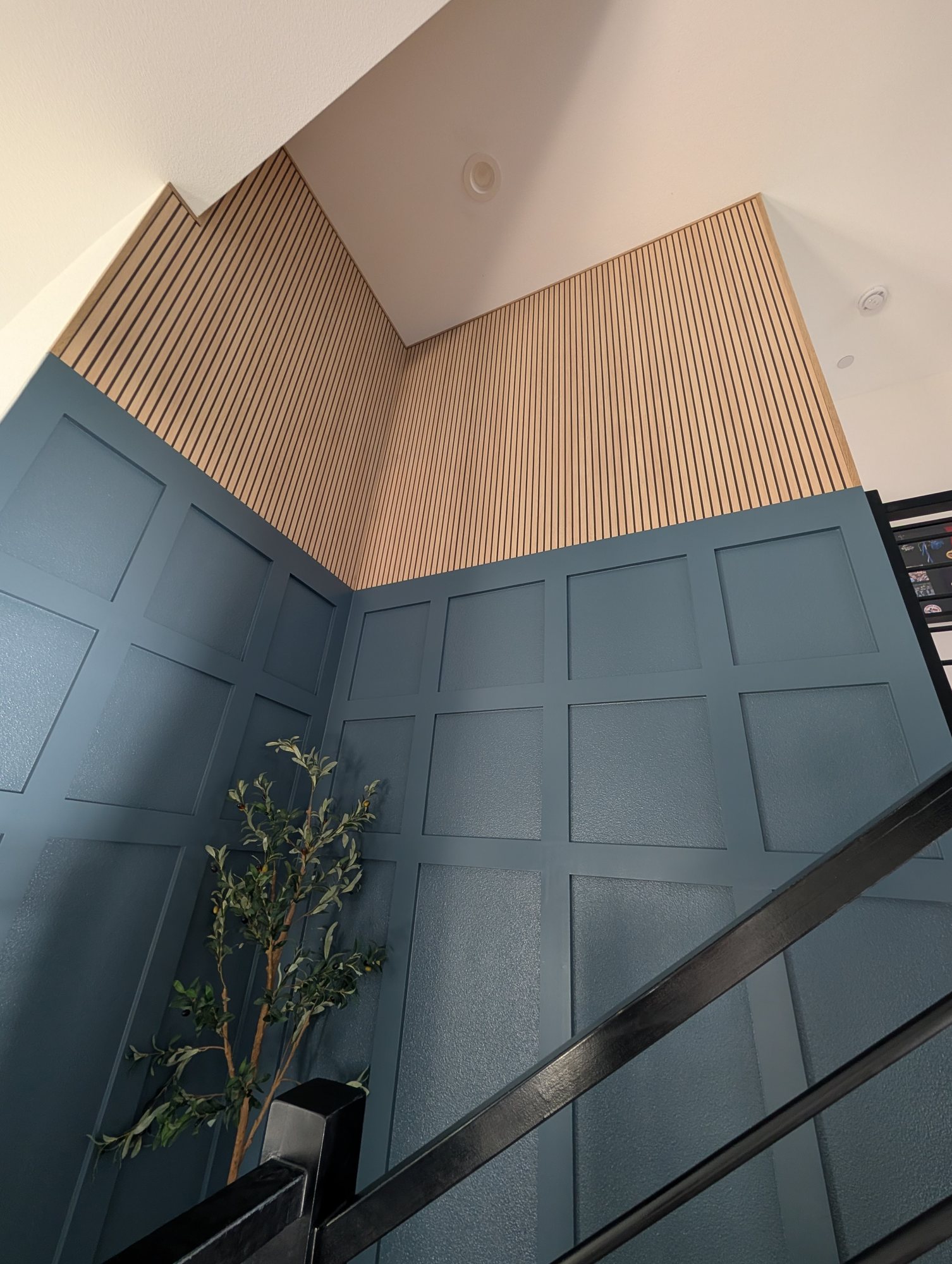
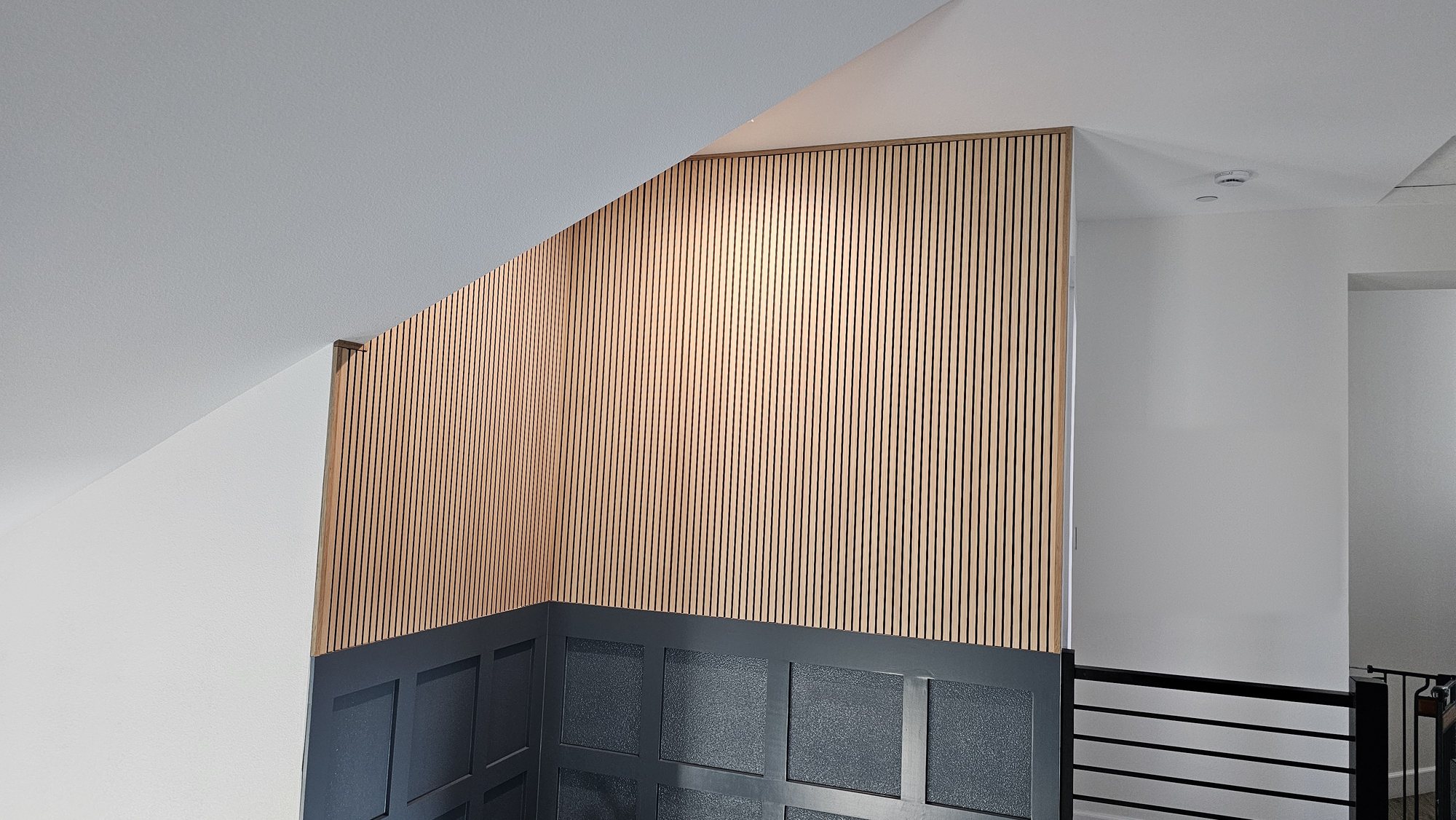
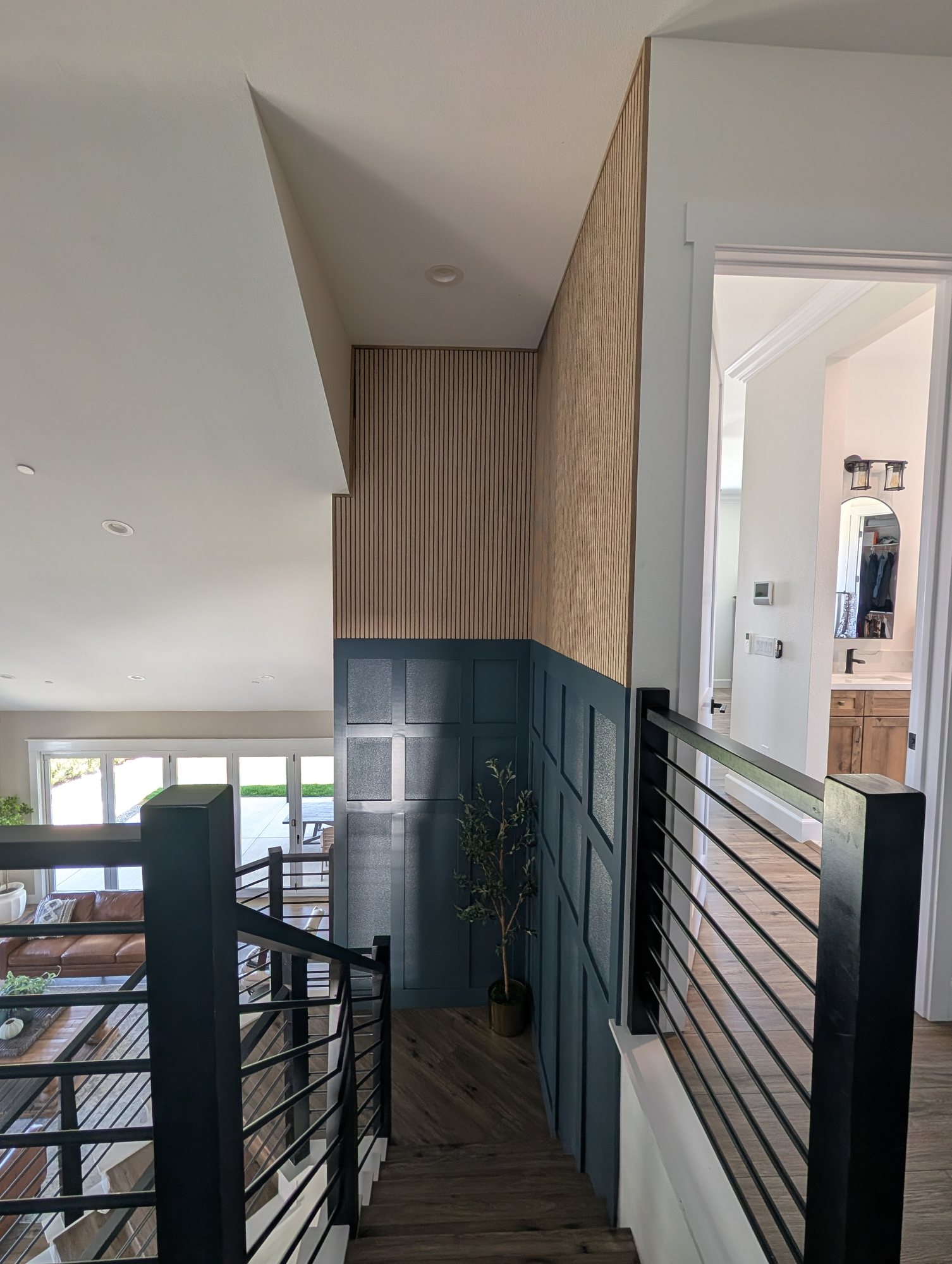
The upper walls on Live Oak were finished the day the panels went up. No stain, no clear coat, no second trip up the ladder. On a wall you can only reach from a plank, that matters as much as anything acoustic.
What we used on this project:
-
Prefinished tongue-and-groove white oak acoustic slat paneling, oak veneer over a core with a black backing
-
Supplied by Hudson and West Temecula and selected by the designer, Kathy Hernandez of Kathleen Ann Design
-
Glued and nailed flat to the wall
-
A white oak border milled in our shop to finish every edge
We did not measure the sound in that stairwell before or after, so we are not going to tell you what it did to the echo. The panels were chosen for how the wall looks.
The hub post has the photos, the full investment breakdown, the timeline, and the construction details: hsconstruct.com/blog/live-oak-stairwell-paneling-jurupa-valley
How Acoustic Slat Panels Perform in Inland Empire Homes
Homes out here are built with a lot of hard surface: tile or plank flooring, tall ceilings, open plans, and stairwells that run two stories. That is the recipe for a room that rings, and it is why this question comes up so often in Jurupa Valley, Eastvale, Corona, and Menifee.
On the material side, our dry climate is easy on these panels. They are an indoor product with a wood veneer, so keep them out of direct, all-day sun where you can, and off any wall that sees moisture.
The Holland & Sons Angle
What I liked about the panels on Live Oak had nothing to do with sound. They came prefinished. When you are standing on a plank over a staircase, a material that is done the moment it is fastened is worth a lot. Nobody had to go back up there with a brush.
The acoustic backing is a real feature, and I am glad it is there. But I am a carpenter, not an acoustical engineer, and I will not put a number on a wall I did not test. If sound is the reason for your project, we will get the manufacturer's data on the table before anything is ordered. That goes for every one of our accent walls.
It is the same rule I hold my sons to: say what a product does, say what it does not, and stop there.
Related Resources: Stairwell Wall Paneling Guide
This post is one part of a set built around one real stairwell in Jurupa Valley. Here is the rest of it.
-
Stairwell Wall Paneling in Jurupa Valley, CA: Shaker Grid Below, White Oak Slats Above (Live Oak Project), hsconstruct.com/blog/live-oak-stairwell-paneling-jurupa-valley: the full project, with photos, materials, timeline, and the complete investment breakdown
-
How Much Does It Cost to Panel a Staircase Wall in Jurupa Valley in 2026?: real ranges and what height and access do to them
-
Staircase Wall Paneling: What Goes Wrong and What to Decide Before the First Board Goes Up: the layout decisions to settle before anything gets cut
-
Board and Batten Over Textured Walls vs. Smooth Backing: what each option looks like and when smooth backing is worth adding
-
How to Evaluate a Slat Wall Installation: a checklist for edges, seams, corners, and finish
Frequently Asked Questions
Do acoustic sound panels actually work?
Yes, acoustic panels work for the job they are made for, which is absorbing sound that would otherwise bounce off a hard wall. That reduces echo inside the room. They are not made to stop sound from passing through a wall to the next room. How much they absorb depends on the product and on how it is mounted, so look for a published NRC rating and the mounting method it was tested with.
What are the disadvantages of acoustic wall panels?
The main disadvantages of acoustic slat wall panels are that they do not soundproof, the grooves collect dust, a damaged veneer is hard to repair, and the panels end in a raw edge that needs trim. Colors and slat spacing are set by the manufacturer. Most are made for dry indoor walls only. None of that makes them a poor choice. It means they are a wall finish with an acoustic benefit, and they should be bought with that expectation.
Are acoustic slat panels any good?
Acoustic slat panels are a good fit for a large, hard wall where you want the look of wood and some echo control in one product. They go up faster than hand-built slats, they arrive finished, and the backing does real acoustic work. They are a less natural fit where slats need to match cabinetry exactly or follow an unusual spacing, which is where hand-built slats come in.
How long do acoustic wall panels last?
Acoustic slat panels have no moving parts and nothing that wears in normal use, so on a dry interior wall they should last as long as the finish holds up. We do not have a verified lifespan figure to give you, and we would be careful with any that is not backed by the manufacturer. What shortens their life is moisture, direct sun on the veneer, and impact damage.
How do you dampen sound in a stairwell?
You dampen sound in a stairwell by adding soft or absorptive surface to a space that is nearly all hard surface. The options, roughly from simplest to most involved, are a stair runner, a rug at the landing and the entry, fabric window coverings, and absorptive panels on the largest wall. A stairwell is tall, so the upper wall is often the biggest untreated surface in the house.
What does an NRC rating mean on a slat panel?
NRC stands for noise reduction coefficient, a number from 0 to 1 that describes how much sound a surface absorbs. The figure depends heavily on mounting. Primacoustic's published data for one slat wall panel, tested to ASTM C423, lists NRC 0.55 mounted flat and 0.9 or higher over a cavity filled with absorptive material. Always ask which mounting a quoted NRC refers to.
Will acoustic slat panels block noise between rooms?
No, acoustic slat panels will not meaningfully block noise between rooms. Blocking sound is a different job that calls for mass, sealing, and separation inside the wall itself. Slat panels treat the sound that stays in the room. If the goal is to keep a TV from being heard in the bedroom next door, panels on the wall are not the fix.
Thinking About Slat Panels for a Tall Wall?
Tell us about the room at hsconstruct.com/contact. Fill out the form, describe the space and what bothers you about it, and upload photos along with any panels or inspiration you have been looking at. We will set a time to see it and talk through what the wall can and cannot do for you.
Want to see this advice applied to a real project? Here's the full breakdown: hsconstruct.com/blog/live-oak-stairwell-paneling-jurupa-valley
We work in Jurupa Valley, Eastvale, Norco, Corona, Riverside, Chino, Chino Hills, Ontario, Fontana, Rancho Cucamonga, and all across Riverside County, San Bernardino County, and the Inland Empire.
See more of our work on Facebook, Instagram, YouTube, and TikTok.
951-338-8058 | brian@hsconstruct.com | hsconstruct.com | CSLB #1123738
More Than Just Slat Wall Panels
A slat wall is a finish first and a sound treatment second. Slat Wall Panels is one piece of what we do at Holland & Sons, and it's one chapter in a much longer story. Brian has been a finish carpenter since 1991, and his sons now build alongside him, which means every room in your home is fair game. If your space needs more than slat panels on one wall, here's what else we build:
-
Kitchen and bathroom remodels: full custom cabinetry, tile work, and finish carpentry from demo to done
-
Custom and built-in cabinetry: designed for the room, built in the shop, installed to last
-
Media walls and entertainment walls: built-in TV walls with storage, lighting, and clean cable management
-
Fireplace walls: mantels, surrounds, and full-height paneling that make the fireplace the center of the room
-
Accent walls: paneling, slat walls, and feature walls that give one wall a job to do
-
Mudrooms: lockers, bench seating, cubbies, and hooks, built for the way your family comes through the door
-
Coffered ceilings: grid beam systems that add architectural depth to any room, sized and proportioned to the space
-
Wainscoting and wall paneling: classic raised panel, flat panel, board-and-batten, and shiplap applications
-
Reclaimed wood accents: feature walls, fireplace surrounds, and detail work using salvaged material with real character
-
Beam wraps: hollow wood wraps that give exposed beams the look of solid timber without the structural engineering
-
Crown molding, baseboards, and trim carpentry: the details that make a house feel finished, from a single room to a whole home
-
Cased openings and interior door replacements: clean transitions between spaces that most contractors overlook
Wood, proportion, and rooms that feel right. That's what we do. hsconstruct.com
This guide is part of our accent walls series.
Learn more about Accent WallsHave a project in mind? Let's start a conversation.
Tell us what you are thinking about and we will give you a straight answer about scope, timeline, and investment.
Start a Conversation