The Hidden Pull-Out Drawer Mantel: A Rare Detail Almost No Fireplace Wall Has
Quick Answer
A hidden pull-out drawer mantel — a mantel that looks completely solid and stationary but glides out on concealed slides to reveal a full drawer — is one of the rarest storage details in fireplace wall design, because it requires a level of mechanism engineering most finish carpenters never attempt. Holland & Sons built one into a recent Menifee Ranch fireplace wall, and it's the detail the crew is proudest of on the entire job.
Key Takeaways
-
A pull-out drawer mantel has to look and feel like solid, stationary millwork while functioning as a smooth-gliding drawer — a genuine engineering challenge
-
Most fireplace walls skip mantel storage entirely, or settle for fixed shelving instead
-
Side cabinets, floating shelves, and false panels are more common — and more achievable — hidden storage alternatives
-
Holland & Sons credential: built a fully functional hidden pull-out drawer into a mantel on a real Menifee Ranch project
A hidden pull-out drawer mantel is one of the rarest details you'll find on any fireplace wall — and once you understand why, it's obvious this isn't something most contractors would even attempt. Plenty of homeowners have a nice mantel. Almost none have one that quietly functions as a full pull-out drawer, disappearing seamlessly into the millwork until someone shows them it's there.
Holland & Sons built exactly that into a recent Menifee Ranch fireplace wall — and it's worth understanding both why it's rare and what the more common hidden storage alternatives look like, in case a full pull-out mechanism isn't the right fit for your project.
The Direct Recommendation
If your fireplace wall has the depth and scale to support it, a pull-out drawer mantel is the single most impressive hidden storage detail available — a mantel that reads as solid, stationary millwork from across the room, but glides open on concealed hardware to reveal genuine storage. It's not the right call for every project, but where it fits, nothing else comes close for sheer "how did they do that" impact.
For most homeowners, though, side cabinets or floating shelves will deliver real, functional storage without the added engineering complexity — and that's a perfectly good answer too. The rest of this guide walks through both paths.
Why the Pull-Out Drawer Mantel Is So Rare
A fixed mantel just has to look good and hold weight. A pull-out drawer mantel has to do that and function smoothly as a drawer — matching the surrounding millwork exactly, gliding on a mechanism strong enough to support a mantel-scale piece, and closing flush enough that the seam disappears entirely when it's shut.
That combination is why most finish carpenters don't attempt it. Building a drawer at typical cabinet scale is routine. Building one at mantel scale, integrated into stonework, that has to look like a permanent architectural feature every day it's closed, is a different level of difficulty — and it's exactly why almost no fireplace wall has one.
Side Cabinets
Flanking cabinets built into the fireplace wall, matched to the surrounding millwork or cabinetry finish. This is the most common hidden storage solution because it's the most achievable — standard cabinet construction, just built into the wall's design rather than added as furniture.
Floating Shelves
Open shelving built into cabinetry niches. Not "hidden" in the strictest sense, but it gives homeowners flexible display and storage space without any mechanism complexity at all.
False Panels
Wall or cabinet panels that open on hidden hinges to reveal a compartment behind them. Less mechanically demanding than a pull-out drawer, but still requires precise fitting so the seam stays invisible when closed.
Comparison Table
| Storage Option | Engineering Difficulty | Storage Capacity | Best For |
| Pull-out drawer mantel | Very high — custom mechanism required | Moderate, shallow but wide | Homeowners who want a signature, conversation-starting detail |
| Side cabinets | Low to moderate — standard cabinet construction | High | Most homeowners who want real, functional storage |
| Floating shelves | Low — no moving parts | Low to moderate, open display only | Homeowners who want flexible display space, not concealment |
| False panels | Moderate — hidden hinges and precise fitting | Low to moderate | Small, low-visibility items like remotes or keepsakes |
The Questions Homeowners Actually Ask
How does a hidden pull-out mantel drawer work?
The mantel itself is built as a shallow drawer box, mounted on concealed slides strong enough to support its weight, and finished so the drawer face matches the surrounding millwork exactly — grain, color, and reveal lines all continuous with the rest of the mantel. When closed, there's no visible seam, hardware, or gap to give it away.
Is a hidden drawer mantel worth the extra cost?
That depends on what you value. It adds real cost over a fixed mantel — roughly $800 to $1,200 for the mechanism and additional build time — and it doesn't add more storage than a side cabinet would. What it adds is a genuinely rare, memorable detail that most visitors have never seen before. If that kind of "wow" factor matters to you, it's worth it. If you just need storage, a side cabinet delivers more capacity for less.
Are floating shelves or built-in cabinets better for fireplace niche storage?
Built-in cabinets offer more functional, concealed storage capacity. Floating shelves offer more flexible display space but no concealment. Many designs, including the Rhapsody Ct. project, use both — floating shelves in the niches for styling, with concealed storage built into the mantel and cabinetry below.
The Decision Framework
Choose a pull-out drawer mantel if your fireplace wall has the depth to support it, your budget has room for the added mechanism cost, and you want a signature detail that sets the project apart. Choose side cabinets if functional storage capacity matters most. Choose floating shelves if display space matters more than concealment. Choose false panels for small, low-profile items that don't need much room.
See This In Action — Rhapsody Ct. Fireplace Wall
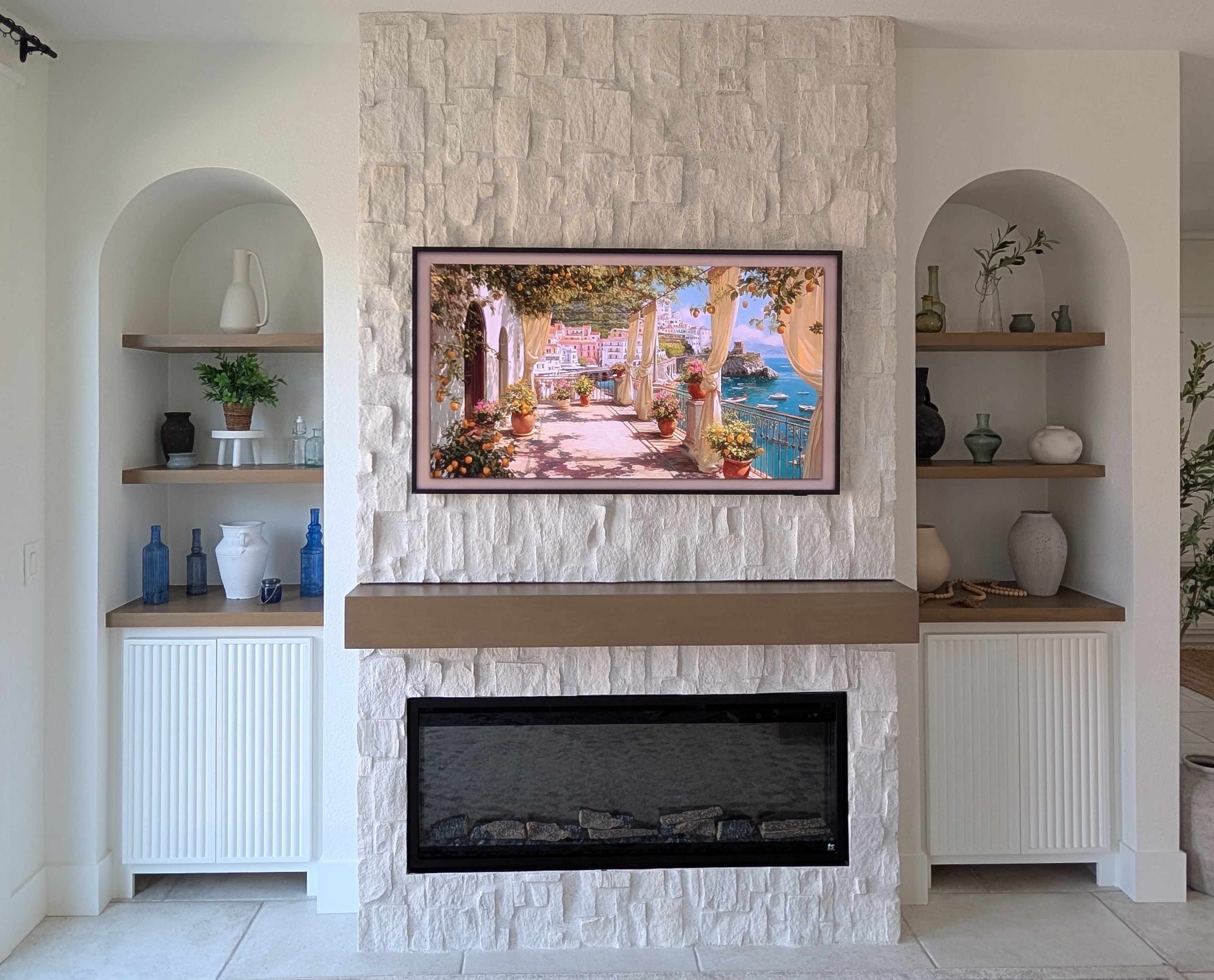
On the Rhapsody Ct. project, the mantel isn't just a mantel — it's a fully functional pull-out drawer, built to disappear into the stonework until someone shows you it's there. It's the detail Holland & Sons is proudest of on the entire job.
What we used on this project:
-
A hand-milled vertical-grain fir mantel, built as a shallow drawer box on concealed slides
-
A drawer face grain-matched exactly to the surrounding millwork, with no visible seam when closed
-
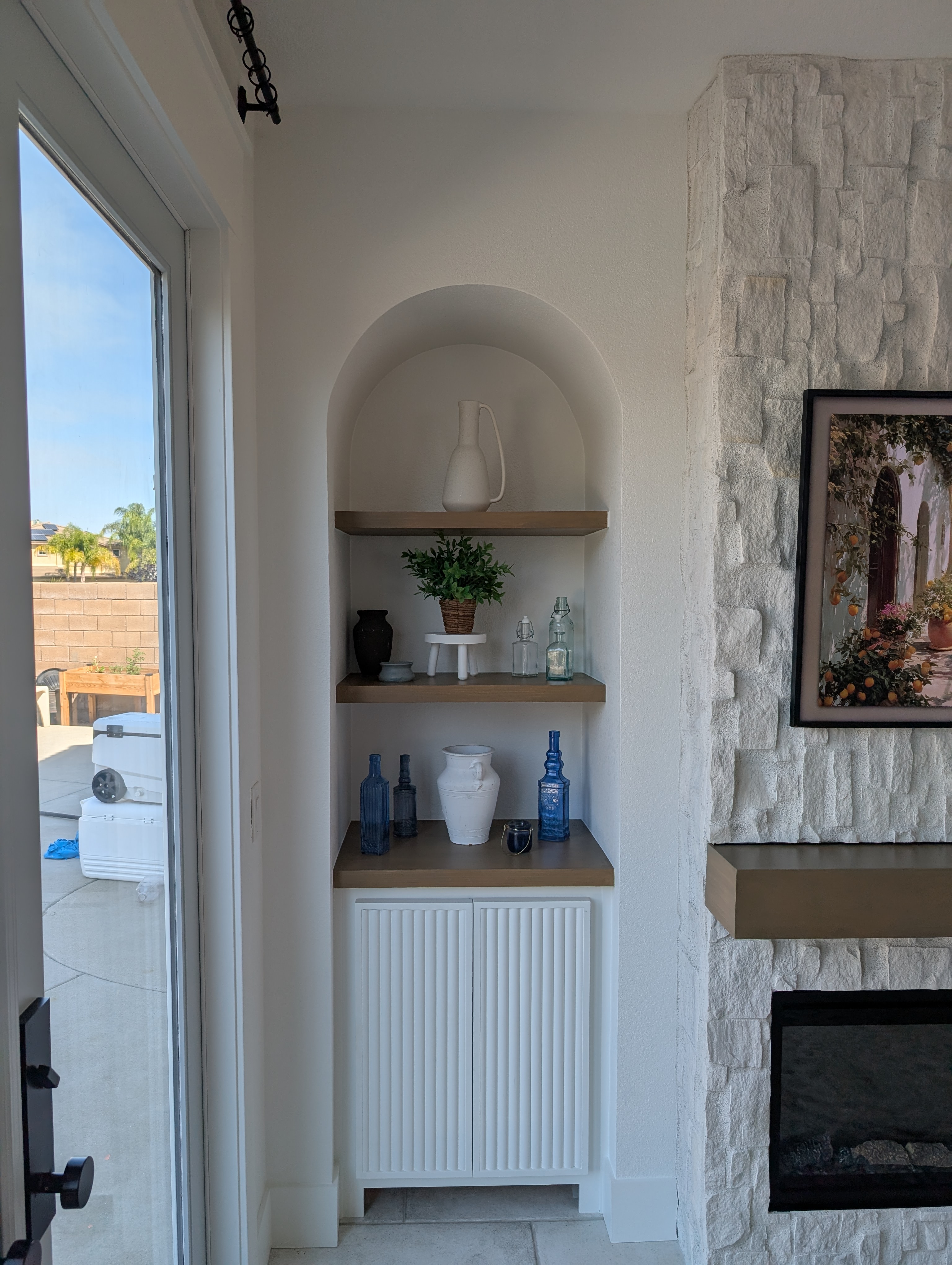
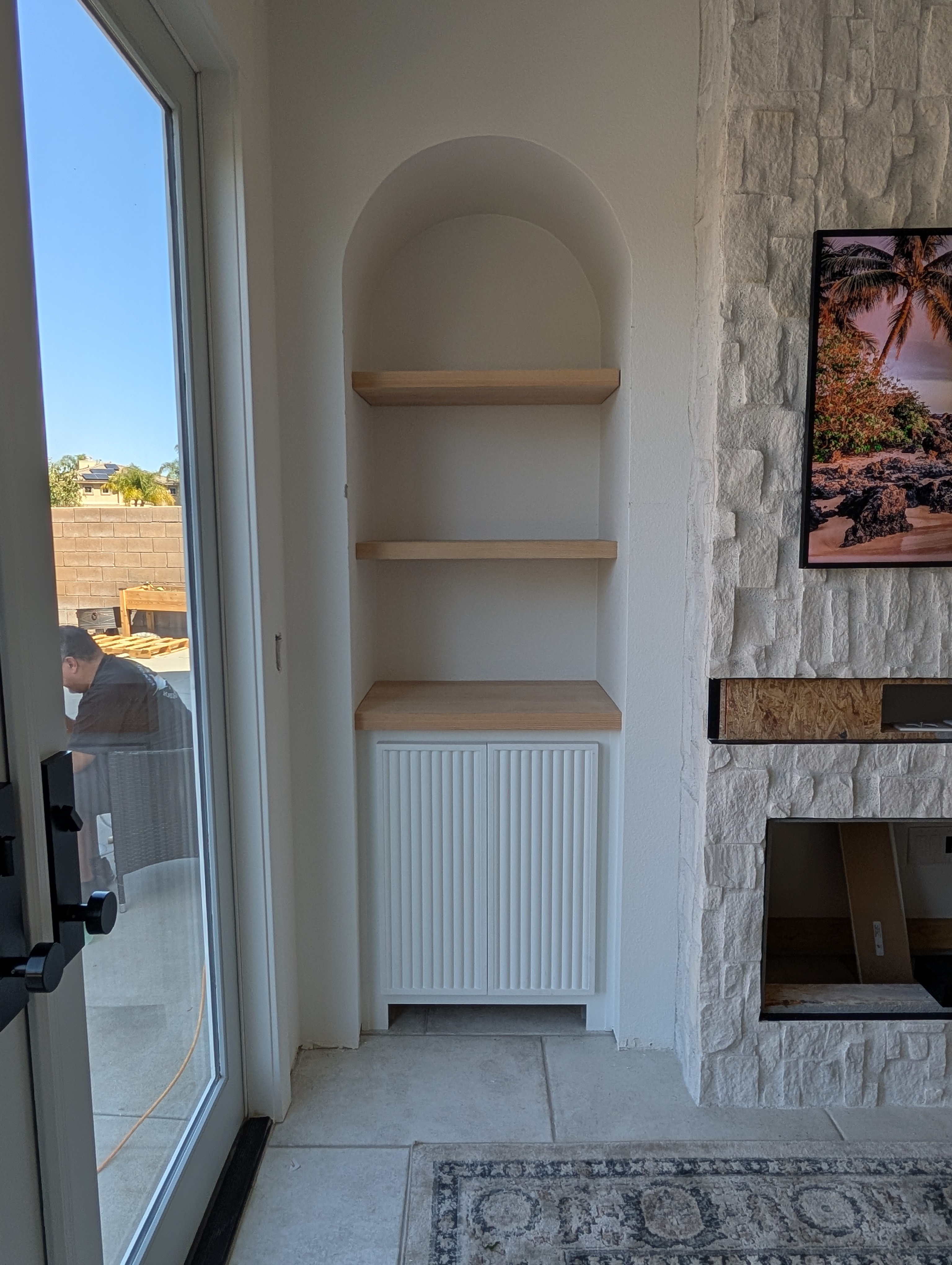
Floating shelves in the flanking arched niches for the homeowner's own styling
See the full photo story and finished project details at the link below.
Why Don't More Fireplace Walls Have This?
Most contractors don't build mantels this way, and it isn't because homeowners wouldn't want one — it's because the mechanism work required is genuinely uncommon in residential finish carpentry. Building a drawer that has to disappear seamlessly into a mantel, at that scale, integrated into stonework, demands a level of custom fabrication most shops simply don't take on. The default is a fixed mantel, or no mantel storage at all.
The Holland & Sons Angle
The pull-out drawer mantel started as one line in the designer's plan for Rhapsody Ct. — easy to draw, much harder to actually build. Making a mantel-scale piece glide smoothly while looking completely solid and stationary when closed took real trial and fitting, not a standard cabinet-hardware install.
It's also where Brian's younger son spent hands-on time on this job — fitting the drawer slides into the mantel box and testing the glide until it moved smoothly under real weight, then adjusting the reveal so the seam disappeared completely when the drawer closed. It's a small, unglamorous piece of the process that determines whether the finished detail actually works or just looks good in a photo.
Related Resources — Rhapsody Ct. Fireplace Wall Guide
This post is part of a full guide to planning a custom fireplace feature wall in Menifee. Here's the rest of the cluster:
Hidden Storage FAQ
What are good ways to add hidden storage to a fireplace wall?
The most common options are side cabinets built into the wall's design, floating shelves for open display, false panels with hidden hinges, and — rarest of all — a pull-out drawer built into the mantel itself. Each offers a different balance of storage capacity, concealment, and construction complexity.
How does a hidden pull-out mantel drawer work?
The mantel is built as a shallow drawer box mounted on concealed slides strong enough to support its weight, with a drawer face finished to match the surrounding millwork exactly. When closed, there's no visible seam or hardware — it reads as a completely solid, stationary mantel.
Are floating shelves or built-in cabinets better for fireplace niche storage?
Built-in cabinets offer more functional, concealed storage capacity. Floating shelves offer flexible, open display space but no concealment. Many designs use both together — shelves for styling, concealed cabinetry for actual storage.
What's the most functional storage option for a fireplace feature wall?
Side cabinets typically offer the most storage capacity for the investment, since they use standard cabinet construction rather than custom mechanisms. A pull-out drawer mantel offers less capacity but a far rarer, more memorable detail.
Is a hidden drawer mantel worth the extra cost?
It depends on your priorities. It typically adds $800 to $1,200 over a fixed mantel for the mechanism and additional build time, without adding more storage capacity than a side cabinet. What it adds is a genuinely rare, conversation-starting detail — worth it if that's what you're after, less so if storage capacity is the main goal.
Why don't more fireplace walls have a hidden drawer mantel?
Most finish carpenters don't attempt it because the mechanism work is genuinely difficult — the drawer has to glide smoothly at mantel scale while looking completely solid and seamless when closed. That level of custom fabrication is uncommon in residential finish carpentry, so most fireplace walls default to a fixed mantel or skip mantel storage entirely.
Can a hidden drawer mantel be added to an existing fireplace wall, or does it have to be built in from the start?
It's far easier to build into a new mantel from the start, since the drawer mechanism and box need to be integrated into the mantel's construction from the beginning. Retrofitting an existing solid mantel is possible in some cases but often requires rebuilding the mantel entirely, which can approach the cost of building it in from the start.
Ready to Talk About Your Own Project?
If you love the idea of a hidden storage detail like this — or just want real, functional storage built into your fireplace wall — we'd love to talk about what's achievable for your space in Menifee, Murrieta, Temecula, Perris, or Riverside.
Reach out through hsconstruct.com/contact to start the conversation — fill out the form, tell us about your project, and upload a few inspiration photos if you have them. We'll follow up to talk through scope, timeline, and investment.
You can also find Brian and his sons' latest work on Holland & Sons' social media channels.
Serving Menifee, Murrieta, Temecula, Perris, Riverside, and the greater Inland Empire.
951-338-8058 | brian@hsconstruct.com | hsconstruct.com | CSLB #1123738
More Than Just Custom Fireplace Details
Rare details like a hidden pull-out drawer mantel are what separate a truly custom fireplace wall from a builder-grade one. Brian and his sons have been finish carpenters since 1991, which means every room in your home is fair game.
If your space needs more than that, here's what else we build:
-
Kitchen and bathroom remodels — full custom cabinetry, tile work, and finish carpentry from demo to done
-
Coffered ceilings — grid beam systems that add architectural depth to any room, sized and proportioned to the space
-
Wainscoting and wall paneling — classic raised panel, flat panel, board-and-batten, and shiplap applications
-
Reclaimed wood accents — feature walls, fireplace surrounds, and detail work using salvaged material with real character
-
Beam wraps — hollow wood wraps that give exposed beams the look of solid timber without the structural engineering
-
Crown molding, baseboards, and trim carpentry — the details that make a house feel finished, from a single room to a whole home
-
Cased openings and interior door replacements — clean transitions between spaces that most contractors overlook
-
Custom built-in entertainment walls and bookshelves — designed by hand, built in the shop, installed to last
Wood, proportion, and rooms that feel right — that's what we do. hsconstruct.com
About the Author
Brian Holland is the owner and lead carpenter of Holland & Sons Construction, a family-run finish carpentry and general contracting company serving Riverside County and the Inland Empire since 1991. He entered the trade at 17, learned on the job, and has spent 35 years building the kind of work that makes rooms feel right — often before a homeowner can articulate why. His sons now apprentice alongside him on every project. Holland & Sons is based in Perris, CA and licensed by the CSLB (#1123738).
This guide is part of our custom fireplace walls series.
Learn more about Custom Fireplace WallsHave a project in mind? Let's start a conversation.
Tell us what you are thinking about and we will give you a straight answer about scope, timeline, and investment.
Start a Conversation