MDF vs. Solid Wood for Wainscoting: Which Is Better for a Painted Interior in Southern California?
By Brian Holland, Owner and Lead Carpenter, Holland & Sons Construction · Carpenter since 1991 · CSLB #1123738 · NARI Member · NAHB Member
Published
Quick Answer
The correct answer is neither — and both. A properly specified painted wainscoting installation uses solid pine for rails, stiles, and structural framing, and MDF for the recessed panel fields. Pine holds joinery — pocket-hole screws, construction adhesive, and mechanical fasteners need real wood to bite into. MDF produces a dead-flat, paint-grade surface that solid wood cannot match for painted applications. In the Inland Empire climate, where dry heat stresses wood movement more aggressively than coastal California, this hybrid approach outperforms all-wood or all-MDF systems on every measure that matters for a painted installation.
Key Takeaways
| Key Takeaways | Details |
| Brian's specification | Pine for structural framing; MDF for panel fields — the hybrid approach |
| Why not all-wood panel fields | Solid wood moves seasonally — grain telegraphs through paint, joints work open in dry heat |
| Why not all-MDF framing | MDF cannot hold pocket-hole screws the way solid wood does — structural failure risk |
| Inland Empire climate factor | Dry summer heat and low humidity increase wood movement beyond coastal California norms |
| Moisture exception | MDF is wrong for bathrooms — moisture-resistant options or PVC where humidity exists |
The Direct Answer: Pine and MDF, Used Correctly
Every wainscoting decision starts with the same question: what is this material being asked to do? Rails and stiles — the structural members of the panel system — are being asked to hold joints. They need to accept pocket-hole screws, resist racking under the weight of the assembly, and maintain rigidity through installation and the decades after. That job requires wood with real fiber structure.
Panel fields — the recessed infill that sits within the rail-and-stile frame — are being asked to provide a paint-grade surface. They need to be flat, stable, and smooth. They are not load-bearing. They are not holding any joinery. They are a surface. That job is done better by MDF than by any wood species available at the same price point.
This is why professional finish carpenters specify pine framing and MDF panel fields for painted wainscoting. It is not a cost-cutting choice. It is the right material for each structural role in the assembly.
Is MDF Better Than Wood for Wainscoting? The Full Comparison
| Property | Pine (rails and stiles) | MDF (panel fields) | All-MDF (framing) |
| Surface for painting | Good — requires grain filling and sanding | Excellent — dead-flat, no grain, no texture | Excellent — but edges absorb moisture |
| Joinery strength | Excellent — holds screws, nails, adhesive | Poor — MDF cannot grip pocket-hole screws reliably | Poor — structural failure risk |
| Seasonal movement | Moderate — expands and contracts with humidity | Minimal — dimensionally stable, no grain movement | Minimal — but edges swell in moisture |
| Moisture resistance | Good in dry conditions | Good in dry interiors; fails in wet areas | Fails in wet areas — not suitable for bathrooms |
| Cost | Moderate — standard softwood pricing | Low to moderate — less expensive than hardwood | Lower material cost, higher structural risk |
| Best use in wainscoting | Rails, stiles, cap, baseboard — all structural members | Recessed panel fields only | Not recommended for structural framing |
Why Solid Wood Panel Fields Are the Wrong Choice for Painted Wainscoting
Solid wood panel fields are the right choice for stain-grade wainscoting — oak, maple, or cherry panels where the wood grain is part of the visual. For painted wainscoting, solid wood panel fields work against you in three ways.
First: grain texture. Solid wood has grain — raised fiber patterns that telegraph through paint even after proper sanding and priming. In direct or raking light, a painted solid-wood panel surface shows the ghost of the grain below. MDF has no grain. The surface is as flat as the substrate you build it on.
Second: seasonal movement. Wood expands and contracts with changes in humidity. A solid-wood panel field in the Inland Empire will shrink measurably during the dry summer months and expand slightly when interior humidity increases in winter. That movement works on the paint film at the edges of the panel, eventually producing a hairline gap between the panel face and the surrounding rail. In a high-humidity climate, this is a slow process. In the Inland Empire, where summer humidity levels drop significantly, it happens faster.
Third: cost. For painted applications where the grain will not be visible, using a more expensive hardwood species in panel fields provides no benefit over MDF. The investment goes toward material that the paint system will obscure entirely.
Why All-MDF Framing Fails
MDF cannot hold pocket-hole screws the way solid wood does. The fiber core of MDF is dense but has no grain structure — a screw driven into MDF end grain or face grain can pull out under far less load than a screw in pine. A rail-to-stile joint fastened with pocket-hole screws in MDF framing will hold on installation day and will fail under the repeated expansion and contraction of a Southern California heating cycle within a few years.
Beyond joinery, all-MDF framing has an edge moisture problem. MDF panel fields in a dry interior space — sealed with shellac primer before any water-based products are applied — perform well over the long term. MDF framing members are thicker and have more exposed edge surface. Any moisture contact that gets past the paint film — a leak, a spill, a wet-mopped entry floor — is absorbed more aggressively by thick framing members than by thin panel fields.
The solution is not to avoid MDF. It is to use it where its properties serve the installation and use pine where they do not.
Does MDF Swell? The Moisture Question
MDF swells when its edges and end grain are exposed to moisture — this is the most common concern homeowners have about MDF in wainscoting applications. The answer requires context.
Standard MDF in a dry interior space — an entry hallway, a dining room, a living room in a Menifee or Murrieta new-build — does not swell under normal conditions. The edges of MDF panel fields in these applications are surrounded by pine framing on all sides and sealed with shellac-based primer before any water-based products are applied. The combination of proper edge sealing and dry interior conditions produces a panel that is dimensionally stable across years of normal use.
Standard MDF in a bathroom or kitchen is a different story. Steam from showers and cooking introduces moisture at levels that overwhelm edge sealing over time. The panel edges absorb moisture, swell, and telegraph through the paint film as a raised ridge. For bathroom wainscoting, specify moisture-resistant MDF — sometimes called MRDF or moisture-resistant board — which uses a modified binder that resists absorption. In very wet applications, PVC trim board is the appropriate choice.
Why Professionals Use MDF: The Actual Argument
The case for MDF in painted panel fields is not complicated. It produces a better surface. That is the entire argument.
Sherwin-Williams Emerald Urethane Trim Enamel applied over a properly prepared MDF panel field produces a surface that is visually indistinguishable from a molded plaster panel. No grain, no texture variation, no ghost of the substrate below. The paint film lies flat because the substrate is flat. Under direct light, under raking light, under the morning sun flooding through a sidelight at an angle — the panel reads as a single plane.
The same paint system applied over a solid pine panel field requires additional grain-filling steps, produces a slightly textured surface even after proper prep, and shows seasonal movement gaps at the panel perimeter within the first few years in a dry inland climate.
For stain-grade applications, this argument reverses entirely. A stain-grade white oak panel field has a visual quality that MDF cannot replicate. But for painted wainscoting — where surface flatness and paint adhesion are the performance criteria — MDF is the correct specification.
The Inland Empire Climate Factor
The case for MDF panel fields is stronger in the Inland Empire than in coastal California because of climate. The combination of high summer temperatures and low indoor humidity during the heating season creates a wood movement cycle that is more aggressive than most national specifications assume.
Menifee, Murrieta, and Temecula regularly see summer temperatures above 100 degrees Fahrenheit with indoor humidity levels that drop significantly when air conditioning runs continuously. Pine rails and stiles will shrink measurably during this period. A solid-wood panel field would add additional movement stress at the frame-to-panel joint. MDF panel fields, which are dimensionally stable in dry conditions, do not add that stress.
The practical result: a hybrid pine-and-MDF installation in a Menifee entry hallway will show fewer joint-related finish issues over a ten-year period than an all-wood installation built to the same initial standard. That is not theoretical — it is what 35 years of finish carpentry work in this climate produces as observed evidence.
The Gypsy Canyon Specification: Pine and MDF in Practice
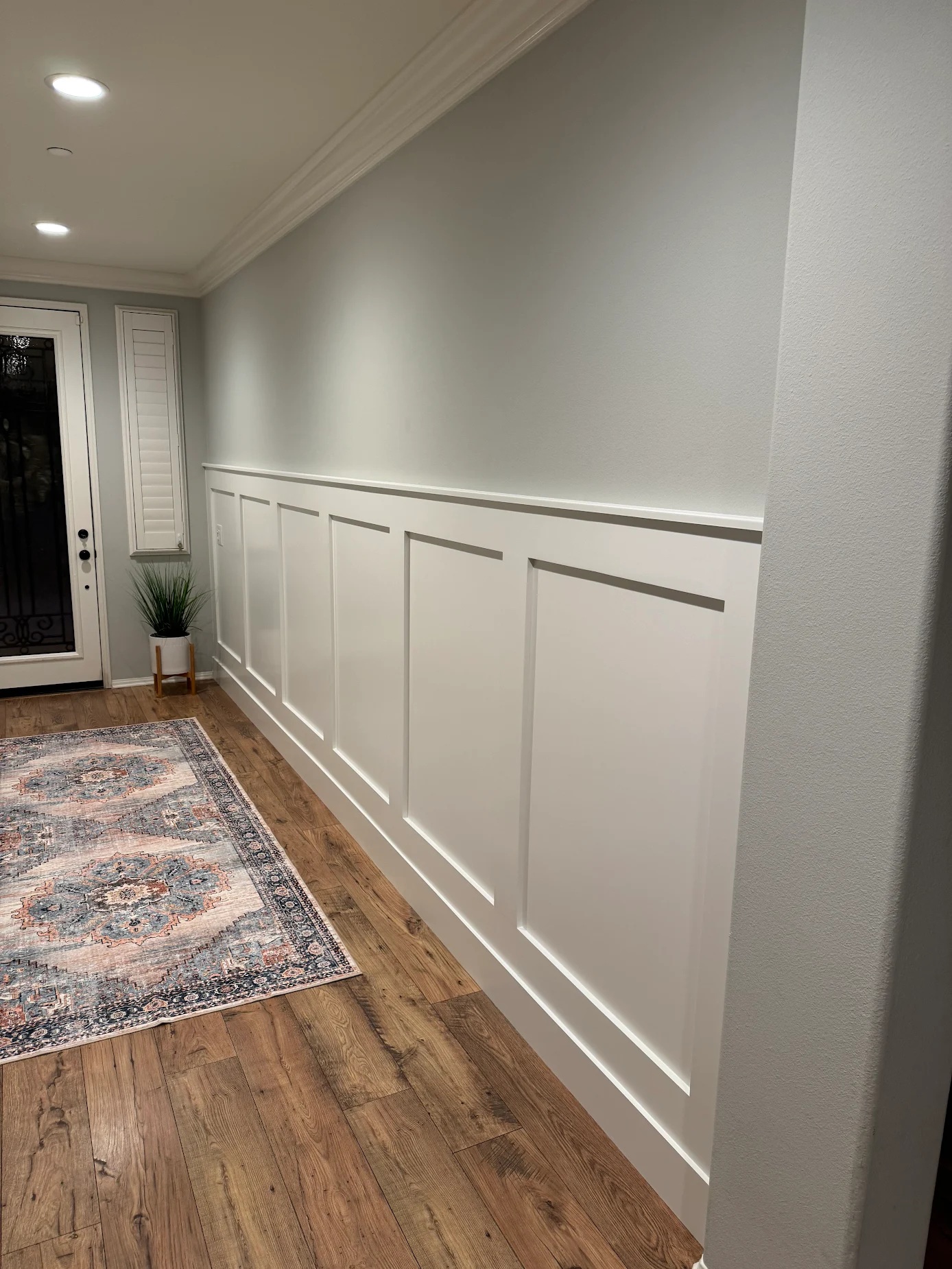
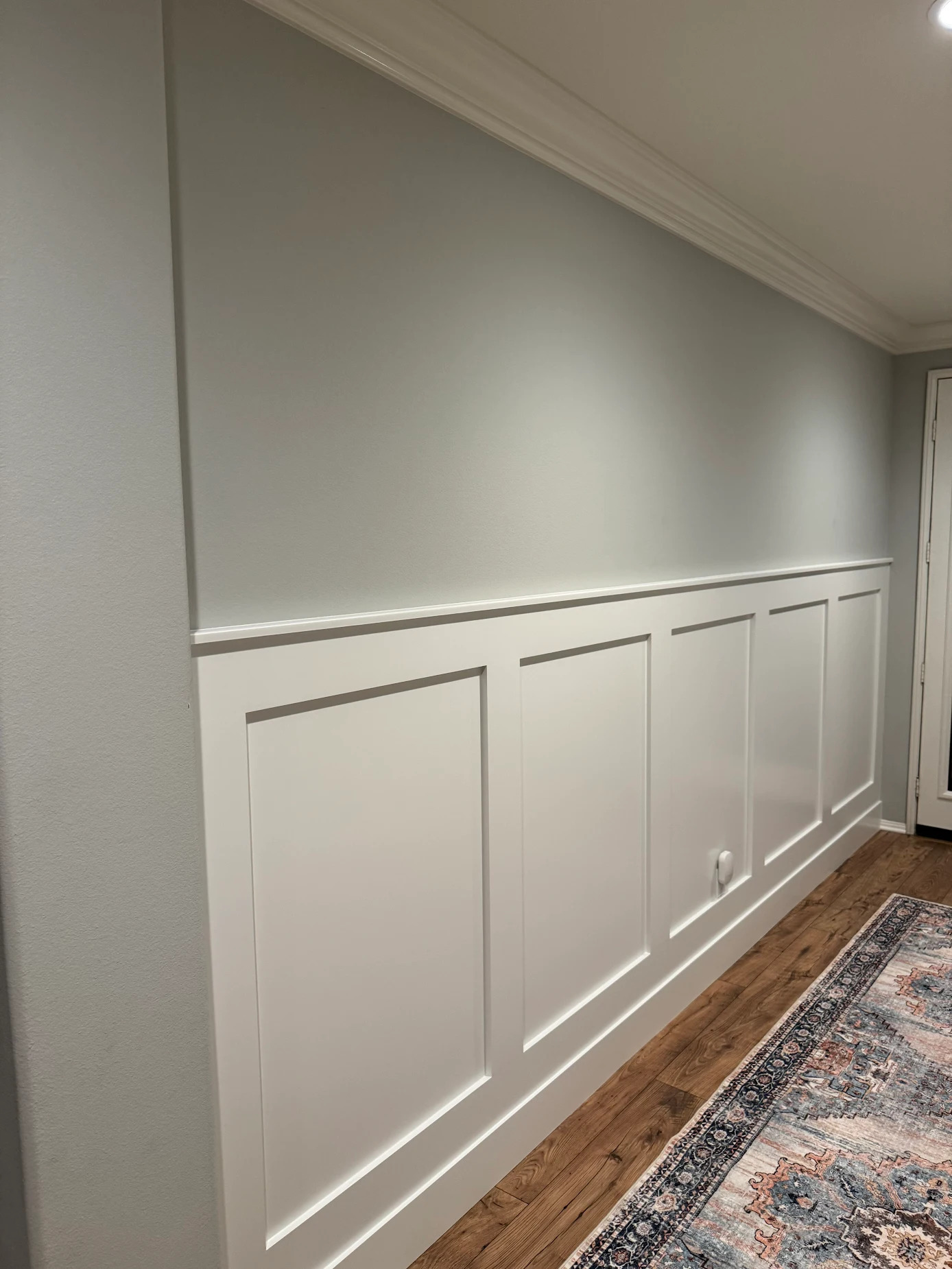
The Gypsy Canyon project used 5.5-inch pine rails and stiles throughout — top rail, bottom rail, and all vertical stiles. The recessed panel fields are 1/4-inch MDF. That specification is Brian's standard for painted flat-panel wainscoting in any Inland Empire new-build application.
The MDF panel fields were sealed on all edges with shellac-based primer before shop assembly. The full assembly was primed with oil-based primer after fabrication. Bondo body filler at all rail-to-stile joints and at the four scarf joint connections on the long wall. Two coats of Sherwin-Williams Emerald Urethane Trim Enamel in satin sheen. Under the morning light through the entry sidelights, the panel fields read as a single flat plane.
See This In Action — The Gypsy Canyon Project, Menifee, CA
Thirty-four linear feet of entry wainscoting in the Audie Murphy Ranch neighborhood uses the hybrid specification exactly as described: pine framing throughout, MDF panel fields in each of the nine recessed cavities. The long wall — 210 inches — required 1/4-inch MDF panel fields custom-cut to fill seven cavities at 23.75 inches wide. Those panels have been in place through at least one Menifee summer cycle without any edge swelling, grain telegraphing, or joint movement visible under raking light.
Material specification on this project:
-
Pine, 5.5 inches wide — all rails, stiles, cap, and baseboard
-
1/4-inch MDF — all recessed panel fields
-
Shellac-based primer (Zinsser BIN) — all MDF edges before shop assembly
-
Oil-based primer — full assembly after fabrication
-
Bondo body filler — all joints and scarf connections
-
Sherwin-Williams Emerald Urethane Trim Enamel, Pure White, Satin
See it here: Full project breakdown — photos, investment, construction details, and material rationale
Holland & Sons Angle
The Gypsy Canyon panels used nine individual MDF fields cut from 4x8 sheets at the Perris shop. That is nine cuts that need to be accurate to within a sixteenth of an inch to sit flat in the framed cavities without a visible gap at the rail or stile. MDF does not forgive sloppy cuts the way solid wood does — there is no grain to hide the edge. Shop fabrication in a controlled environment, with a quality fence and blade, is the only way to produce nine consecutive cuts that pass that standard. Brian's sons ran those cuts alongside him. The precision is not a talent — it is a practice.
Frequently Asked Questions
Is MDF better than wood for wainscoting?
For painted panel fields, MDF is better than solid wood — it produces a dead-flat surface with no grain, no seasonal movement, and no texture telegraphing through paint. For structural framing members — rails, stiles, cap, and baseboard — solid pine is better than MDF because it holds joinery that MDF cannot. The professional specification uses both: pine for structure, MDF for panel fields.
Does MDF swell in wainscoting applications?
Standard MDF swells when its edges are exposed to moisture. In dry interior spaces — entries, hallways, living rooms — MDF panel fields with properly sealed edges perform well over the long term. In bathrooms or kitchens with regular moisture exposure, specify moisture-resistant MDF or PVC trim board. Shellac-based primer on all MDF edges before any water-based product is applied is a required step regardless of room conditions.
Why do professionals use MDF for wainscoting?
Professionals use MDF for wainscoting panel fields because it produces a better paint-grade surface than solid wood. No grain, no seasonal movement, no texture variation. The paint film lies flat because the substrate is flat. For painted applications where the grain will not be visible, MDF outperforms solid wood on every surface quality measure.
Is MDF durable enough for wainscoting?
Yes, in dry interior applications with proper edge sealing and a quality paint system. MDF panel fields in a Menifee or Murrieta entry hallway, finished with Sherwin-Williams Emerald Urethane Trim Enamel, will hold up to the daily contact, cleaning, and temperature cycles of normal use. The durability limitation of MDF is moisture — dry interior conditions are within its performance envelope.
What wood is best for wainscoting rails and stiles?
Pine is the standard specification for painted wainscoting rails and stiles in the Inland Empire. It is a paint-grade softwood with sufficient hardness for trim applications, holds joinery well, and is available in consistent widths. For stain-grade wainscoting where the wood grain will be visible in the finished product, the species selection matters more — white oak, maple, and poplar are common choices depending on the desired grain character.
What is the difference between MDF and moisture-resistant MDF?
Standard MDF uses a urea-formaldehyde binder that absorbs moisture through exposed edges and end grain. Moisture-resistant MDF uses a modified binder — typically melamine — that resists moisture absorption significantly better. For bathroom wainscoting or any application with regular humidity exposure, moisture-resistant MDF is the appropriate specification. It costs more than standard MDF but will not swell or delaminate in humid conditions. Both require edge sealing before water-based primer is applied.
Can wainscoting be installed in a bathroom?
Yes, with the right material specification. Moisture-resistant MDF panel fields, properly edge-sealed, or PVC trim board throughout for the highest moisture exposure applications. Standard MDF in a bathroom will swell at the panel edges within one to two years regardless of paint quality. Pine rails and stiles perform acceptably in a bathroom environment with proper priming and a quality topcoat. The critical point is edge sealing on any MDF component before the first water-based product is applied.
How long does MDF wainscoting last?
A properly specified MDF wainscoting installation — sealed edges, oil-based primer, quality topcoat — in a dry interior space should last as long as the home. The paint system will require touch-up over time as any painted surface does. The MDF itself, in dry conditions with no moisture exposure, does not degrade. Failures in MDF wainscoting are almost always moisture failures at unsealed edges or joinery failures in all-MDF framing — both of which are specification failures, not material failures.
Ready to Talk About Your Project?
Fill out the contact form at hsconstruct.com/contact, describe your project, and upload any inspiration photos. Brian will come out, assess the specific conditions, and specify the right materials for your walls and your climate.
Holland & Sons serves Menifee, Murrieta, Temecula, Perris, Riverside, and the greater Inland Empire.
Find us on Facebook and Instagram for project photos from recent Inland Empire installations.
951-338-8058 | brian@hsconstruct.com | hsconstruct.com | CSLB #1123738
More Than Just Wainscoting
Wainscoting is one of the most satisfying projects we do — the before and after is immediate and impossible to miss. But it is one chapter in a much longer story. Brian has been a finish carpenter since 1991, and his sons now build alongside him, which means every room in your home is fair game.
If your space needs more than wainscoting, here is what else we build:
-
Kitchen and bathroom remodels — full custom cabinetry, tile work, and finish carpentry from demo to done
-
Coffered ceilings — grid beam systems that add architectural depth to any room, sized and proportioned to the space
-
Wainscoting and wall paneling — classic raised panel, flat panel, board-and-batten, and shiplap applications
-
Reclaimed wood accents — feature walls, fireplace surrounds, and detail work using salvaged material with real character
-
Beam wraps — hollow wood wraps that give exposed beams the look of solid timber without the structural engineering
-
Crown molding, baseboards, and trim carpentry — the details that make a house feel finished, from a single room to a whole home
-
Cased openings and interior door replacements — clean transitions between spaces that most contractors overlook
-
Custom built-in entertainment walls and bookshelves — designed by hand, built in the shop, installed to last
Wood, proportion, and rooms that feel right — that is what we do.
Related project
This guide is part of our wainscoting & paneling series.
Learn more about Wainscoting & PanelingHave a project in mind? Let's start a conversation.
Tell us what you are thinking about and we will give you a straight answer about scope, timeline, and investment.
Start a Conversation