How to Choose the Right Electric Fireplace Insert for a Custom Built-In Feature Wall in Menifee, CA
Quick Answer
For a custom built-in feature wall in a living room or great room in Menifee and the Inland Empire, Brian's recommendation is a quality smart linear electric fireplace in the 50- to 72-inch range, designed specifically for recessed installation. The Modern Ember Aerus 60-inch — used in the Liberty Bell project in Heritage at Bahner Park — is his field choice for mid-to-upper range built-in applications: WiFi-enabled, 5 LED flame colors, 5,000 BTU, recessed into a custom 2x6 framed chase. The five criteria that matter most in a built-in application are unit depth relative to chase depth, ventilation requirements, LED flame quality, smart controls, and the proportional fit between the fireplace width and the center panel it sits in.
Key Takeaways
-
For a living room feature wall in a Menifee new-build, a 50- to 72-inch wide recessed linear electric fireplace is the right size range
-
The fireplace model must be selected before framing — the chase is built to the specific unit dimensions
-
Five criteria matter most in a built-in application: unit depth, ventilation requirements, LED flame quality, smart controls, and proportional fit
-
Electric fireplaces are supplemental heating appliances — 4,500 to 5,000 BTU is appropriate for most living rooms in the Inland Empire
-
Quality LED flame technology in 2026 produces a compelling flame effect at typical room viewing distances
-
Standard plug-in units do not require a dedicated circuit or a permit — verify requirements for your specific model
The Direct Recommendation
Brian's field recommendation for a custom built-in feature wall in a mid-to-upper range Menifee living room: the Modern Ember Aerus 60-inch smart linear electric fireplace, recessed into a purpose-built 2x6 framed chase.
Why this unit on the Liberty Bell project: the Aerus 60-inch is designed for recessed installation, with a unit depth that fits a standard 2x6 framed chase without the ventilation complications that some shallower chases create. The LED flame system uses 5 colors with adjustable height and speed — in motion, in a room with ambient lighting, the effect reads convincingly. The WiFi-enabled smart controls integrate with the home's app ecosystem. The 5,000 BTU output is appropriate for a living room in the 400 to 500 square foot range. And the matte black frame coordinates with the matte black hardware spec on the flanking cabinet towers.
That is not an endorsement of one brand over all others. There are other quality linear electric fireplaces designed for recessed built-in applications — Dimplex, Amantii, Napoleon, Modern Flames, among others. What matters is the evaluation criteria, applied to your specific project. Walk through those below.
The Five Criteria That Matter in a Built-In Application
1. Unit Depth vs. Chase Depth
This is the first and most important number. The fireplace unit depth must fit within the framed chase — and the chase is built from 2x4 or 2x6 framing on an existing wall. A standard 2x4 chase gives you approximately 3.5 inches of clear depth. A standard 2x6 chase gives you approximately 5.5 inches. Many quality linear electric fireplaces require 5 to 7 inches of chase depth.
The Modern Ember Aerus 60-inch requires a 2x6 chase. The Liberty Bell project framed accordingly. Verify the unit depth before framing begins — this is not a number to discover after the substrate wall is up.
2. Ventilation Requirements
Electric fireplaces do not require venting for combustion gases — there are none. But they do have ventilation requirements for heat dissipation from the heating element and the LED system. Most recessed linear electric fireplaces require clear space above and around the unit for air circulation. If a unit is installed in a fully enclosed chase with no ventilation path, it will overheat and shut down.
The Liberty Bell chase was framed with the ventilation requirements of the Aerus 60-inch accounted for. Verify these requirements in the spec sheet before finalizing the chase dimensions.
3. LED Flame Quality
This is the most visible differentiator between budget and quality units. Entry-level electric fireplaces use simple LED arrays with limited color and motion control — the flame effect looks flat and mechanical. Quality units use multi-color LED systems with independently controlled zones, adjustable flame height, ember bed effects, and realistic motion patterns.
The Aerus 60-inch uses 5 LED flame colors with adjustable flame height and speed. In a room with ambient lighting, at typical living room viewing distances of 8 to 15 feet, the effect reads convincingly. No electric fireplace looks exactly like a real wood fire under close inspection. At normal use distance, a quality unit is entirely convincing.
4. Smart Controls
A recessed electric fireplace in a built-in is not easily accessed once the wall is finished. Smart controls — WiFi-enabled app integration, voice control compatibility — matter more in this application than in a freestanding unit. The Aerus 60-inch is WiFi-enabled and compatible with standard smart home platforms. Verify the control interface before selecting a unit; a fireplace you control only by remote in a built-in wall is a feature-use limitation.
5. Proportional Fit
The fireplace width should be proportional to the center panel it sits in. A 30-inch fireplace in a 120-inch wide center panel reads as an afterthought. A 60-inch fireplace in a well-proportioned center panel reads as intentional — the focal point the wall is built around.
On the Liberty Bell project, the Aerus 60-inch was selected partly on proportional grounds — its width relative to the center panel width, and its height from the floor (set at 12 inches from finished floor on the drawing) relative to the TV centerline above (62 inches on the drawing). Those proportions were worked out at the drafting table before the unit was ordered.
Electric Fireplace Evaluation Comparison
| Criteria | Entry Level | Mid-Range / Quality |
|---|---|---|
| Unit depth | Often shallower — may fit 2x4 chase | Typically requires 2x6 chase — verify spec sheet |
| LED flame quality | Flat, limited color, mechanical motion | Multi-color, adjustable height and speed, realistic motion at distance |
| BTU output | 1,500 to 3,000 BTU — zone heating, smaller rooms | 4,500 to 5,000+ BTU — appropriate for 400 to 600 sq ft living rooms |
| Smart controls | Remote only, or basic app control | WiFi-enabled, voice control compatible, full app integration |
| Frame finish options | Limited — often chrome or standard black | Matte black, brushed nickel, custom trim options |
| Typical unit investment | $300 to $800 | $1,200 to $3,000+ |
| Design for built-in application | Often designed for freestanding or wall-mount | Purpose-built for recessed installation |
Sizing Guide: How Wide Should the Fireplace Be?
| Center Panel Width (approximate) | Recommended Fireplace Width Range |
|---|---|
| 60 to 80 inches | 36 to 50 inches |
| 80 to 100 inches | 48 to 60 inches |
| 100 to 120 inches | 60 to 72 inches |
| 120+ inches | 72 inches or dual unit configuration |
Note: these are proportional guidelines, not fixed rules. The fireplace height from the floor and the TV centerline above also affect the proportion read. Work these out on paper — at scale — before ordering.
Are Electric Fireplaces Realistic Enough?
This is the question Brian hears most often from homeowners who are considering electric over gas. The honest answer: quality units with current LED technology produce a flame effect that reads convincingly at typical room viewing distances — 8 to 15 feet — under ambient lighting conditions. The Motion, color, and depth of a quality LED flame system in 2026 is meaningfully better than it was 10 years ago.
No electric fireplace looks exactly like a wood fire under close, bright inspection. At normal use distance, in a room lit for evening comfort rather than surgical precision, a quality unit reads as fire. The Liberty Bell homeowners report that guests do not immediately realize the fireplace is electric.
The practical advantages are real: no gas line, no venting, no permit, plug-in installation, smart controls, and adjustable flame color to suit the room's mood. In the Inland Empire — where mild winters make a high-BTU heat source unnecessary most of the year — an electric fireplace delivers the ambiance without the infrastructure.
See This In Action — The Liberty Bell Project, Menifee, CA
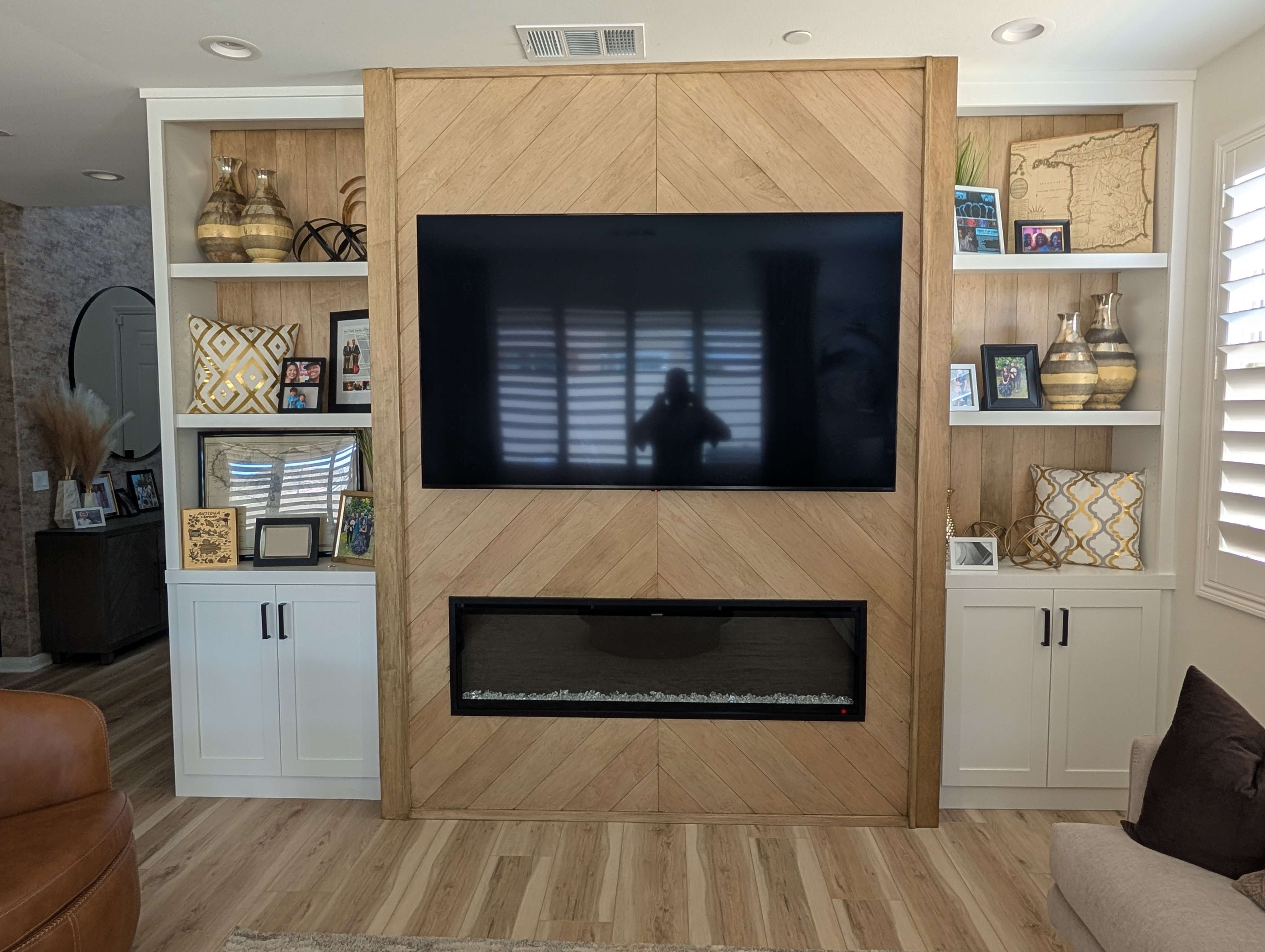
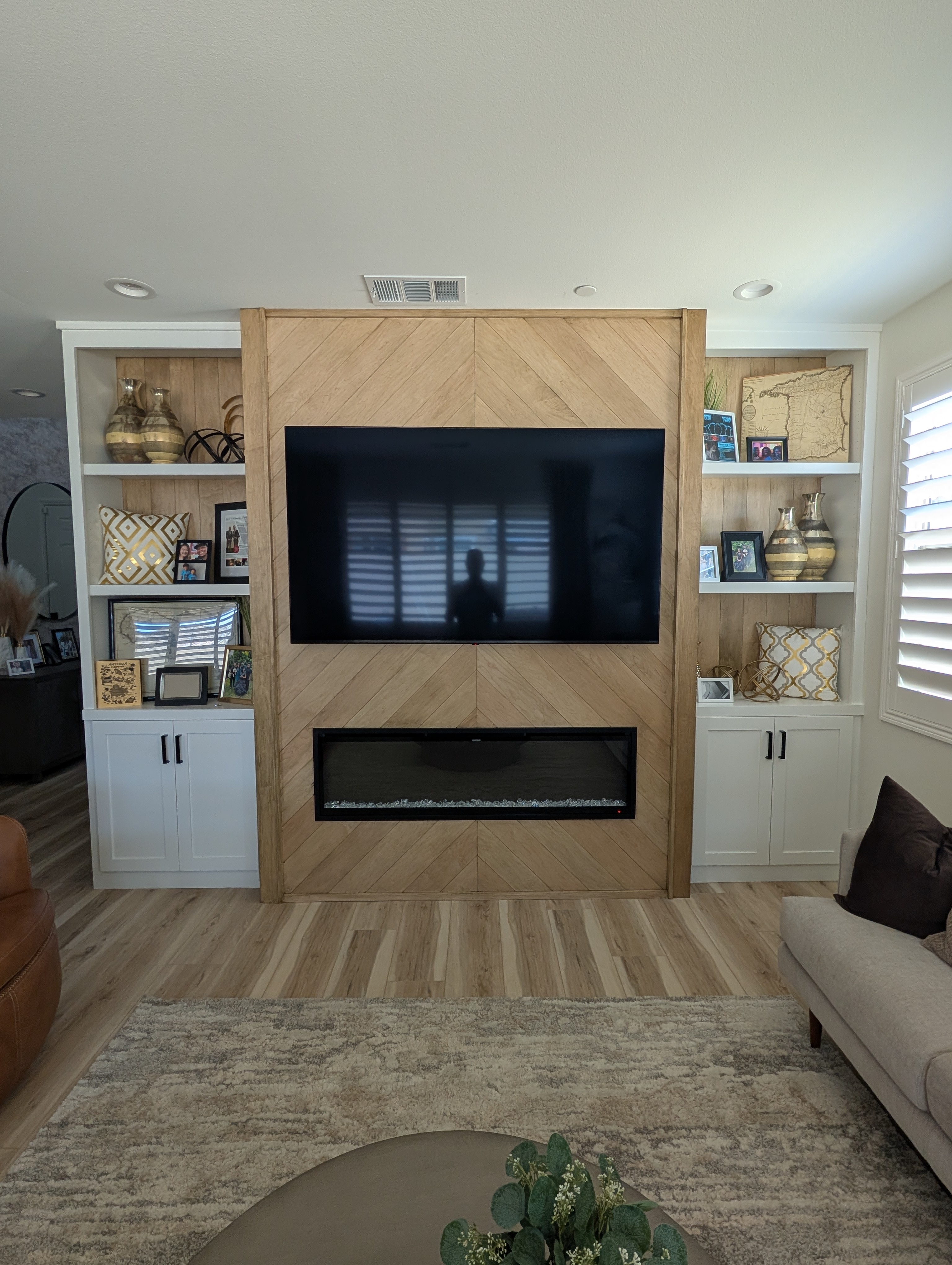
The Modern Ember Aerus 60-inch was installed into a custom-framed 2x6 chase on the Liberty Bell project in Heritage at Bahner Park. The chase was framed with the exact rough opening dimensions from the Aerus spec sheet — confirmed before the substrate wall went up. The fireplace height was set at 12 inches from the finished floor, matching the drawing. The result is a 60-inch linear electric fireplace recessed flush into the center of a floor-to-ceiling hard maple chevron panel, flanked by floor-to-ceiling bookshelf and cabinet towers.
What was selected and why on this project:
-
Modern Ember Aerus 60-inch — 2x6 chase depth, 5-color LED flame system, WiFi-enabled smart controls, 5,000 BTU
-
Recessed installation — flush with the surrounding chevron panel surface, no protruding frame
-
Matte black frame — coordinated with matte black bar pulls on the flanking cabinet towers per homeowner specification
-
Height at 12-inch from finished floor — established at the drafting table based on proportional relationship to the 62-inch TV centerline above
Regional Performance Note: Electric Fireplaces in the Inland Empire
The Inland Empire climate is mild to warm, with cold winter nights but relatively short heating seasons compared to northern California or mountain communities. This affects the electric fireplace decision in a useful way: in most Inland Empire living rooms, supplemental heating for a zone — 400 to 600 square feet — is the realistic use case, not whole-house heating.
A 5,000 BTU linear electric fireplace handles that zone comfortably on a cold Menifee evening. It is not a primary heat source and should not be sized as one. The practical value in this climate is ambiance with supplemental heat — the flame effect and the warmth when you want it, controllable from your phone.
UV exposure from south-facing windows is a real consideration for the surrounding wood feature wall — not the fireplace itself. A UV-stabilized topcoat on the wood surfaces protects the finish and the color of the hardwood over time. That is a material decision for the carpentry, not the fireplace.
The Holland & Sons Angle
The fireplace decision on the Liberty Bell project was made before the framing started. That is the sequence that matters. The Aerus 60-inch was selected, the spec sheet was confirmed, and the rough opening dimensions were handed to Brian before the OSB substrate wall went up. The chase was framed to those dimensions. The fireplace slid in. It fit because the numbers were right before the wood was cut.
The proportional decision — 60-inch wide fireplace in this center panel, at this height, with the TV this far above — was worked out on paper at 3/4" = 1' scale. The fireplace does not feel like it was added to the wall after the fact. It feels like the wall was built around it. Because it was.
Brian's sons handled the fireplace chase installation on site — learning not just how to frame and install, but how a well-sequenced build feels different from one where decisions get made on the fly. The next generation learning that sequence is part of what Holland & Sons is.
Frequently Asked Questions
What is the best electric fireplace insert for a custom built-in feature wall?
For a custom built-in feature wall in a living room or great room in the Inland Empire, a quality smart linear electric fireplace in the 50- to 72-inch range is the right category. The Modern Ember Aerus 60-inch is Brian's field recommendation for mid-to-upper range built-in applications. Other quality options in this category include Dimplex, Amantii, Napoleon, and Modern Flames. The five criteria that matter most are unit depth, ventilation requirements, LED flame quality, smart controls, and proportional fit to the center panel.
What size electric fireplace do I need for a living room feature wall?
For a living room or great room feature wall in a standard new-build Menifee home, a 50- to 72-inch wide linear electric fireplace is the right range. The fireplace should feel proportional to the center panel it sits in — too small reads as an afterthought, too large overwhelms the panel proportions. Work out the sizing at scale on paper, in relationship to the TV centerline above and the panel width on each side.
What is the difference between a recessed and wall-mounted electric fireplace?
A recessed electric fireplace is designed to be installed into a framed chase, sitting flush or near-flush with the surrounding surface. A wall-mounted fireplace hangs on the face of the wall. For a custom built-in feature wall, recessed installation is always the right approach — it integrates the fireplace into the wall rather than adding it on top.
Are linear electric fireplaces realistic-looking?
Quality linear electric fireplaces with current multi-color LED technology produce a flame effect that reads convincingly at typical room viewing distances of 8 to 15 feet under ambient lighting. The Modern Ember Aerus 60-inch uses 5 LED flame colors with adjustable height and speed. Most Liberty Bell project visitors do not immediately identify the fireplace as electric. No electric fireplace looks exactly like wood fire up close under bright light — but at normal use distance, quality units are entirely convincing.
How many BTUs do I need for a living room electric fireplace?
Most quality linear electric fireplaces in the 50- to 72-inch range produce 4,500 to 5,000 BTU. Electric fireplaces are supplemental heating appliances designed to warm a zone of 400 to 600 square feet, not a primary heat source. The Modern Ember Aerus 60-inch produces 5,000 BTU — appropriate for most living rooms in the Inland Empire mild climate.
Do I need a dedicated electrical circuit for a recessed electric fireplace?
Standard plug-in electric fireplaces operate on a standard 120V 15- or 20-amp circuit. The Modern Ember Aerus 60-inch used in the Liberty Bell project is a plug-in unit using an existing outlet — no new circuit required, no permit triggered. Some larger or higher-BTU units require a dedicated 240V circuit. Verify the power requirements for your specific unit before finalizing outlet placement in the chase.
What brand of electric fireplace is most reliable for built-in applications?
For built-in applications, Brian recommends units designed specifically for recessed installation — not wall-mounted units retrofitted into an opening. Modern Ember, Dimplex, Amantii, Napoleon, and Modern Flames all produce quality linear electric fireplaces designed for recessed built-in applications. Evaluate each unit against the five criteria above for your specific project.
Start Your Project
If you are planning a custom built-in feature wall in Menifee, Murrieta, Temecula, or anywhere in the Inland Empire and want help thinking through the fireplace selection alongside the carpentry design — this is the conversation Brian builds for.
Ready to talk? <span class="underline">hsconstruct.com/contact</span>
We serve Menifee, Murrieta, Temecula, Perris, Riverside, and the greater Inland Empire. Follow the work at @hollandandsonsconstruction.
951-338-8058 | brian@hsconstruct.com | hsconstruct.com | CSLB #1123738
More Than Just Feature Walls
Fireplace walls are one of the most visible things Holland & Sons builds — but the same level of planning and craft goes into every project. Brian and his sons have been finish carpenters since 1991, which means every room in your home is fair game.
If your space needs more than a feature wall, here is what else we build:
-
Kitchen and bathroom remodels — full custom cabinetry, tile work, and finish carpentry from demo to done
-
Coffered ceilings — grid beam systems that add architectural depth to any room, sized and proportioned to the space
-
Wainscoting and wall paneling — classic raised panel, flat panel, board-and-batten, and shiplap applications
-
Reclaimed wood accents — feature walls, fireplace surrounds, and detail work using salvaged material with real character
-
Beam wraps — hollow wood wraps that give exposed beams the look of solid timber without the structural engineering
-
Crown molding, baseboards, and trim carpentry — the details that make a house feel finished, from a single room to a whole home
-
Cased openings and interior door replacements — clean transitions between spaces that most contractors overlook
-
Custom built-in entertainment walls and bookshelves — designed by hand, built in the shop, installed to last
Wood, proportion, and rooms that feel right — that is what we do.
<span class="underline">hsconstruct.com</span>
About the Author
Brian Holland is the owner and lead carpenter of Holland & Sons Construction, a family-run finish carpentry and general contracting company serving Riverside County and the Inland Empire since 1991. He entered the trade at 17, learned on the job, and has spent 35 years building the kind of work that makes rooms feel right — often before a homeowner can articulate why. His sons now apprentice alongside him on every project. Holland & Sons is based in Perris, CA and licensed by the CSLB (#1123738).
This guide is part of our custom fireplace walls series.
Learn more about Custom Fireplace WallsHave a project in mind? Let's start a conversation.
Tell us what you are thinking about and we will give you a straight answer about scope, timeline, and investment.
Start a Conversation