How Much Does a Reclaimed Barn Wood Accent Wall Cost in the Inland Empire?
By Brian Holland, Owner and Lead Carpenter, Holland & Sons Construction · Carpenter since 1991 · CSLB #1123738 · NARI Member · NAHB Member
Published
| Quick Answer: A professionally installed reclaimed barn wood accent wall in the Inland Empire typically runs $4,000 to $12,000 for a single feature wall, with material alone often landing between $12 and $30 per square foot for authentic stock. A full ceiling-and-wall feature build with built-ins climbs to $15,000 to $50,000 or more. Coverage, authentic-versus-aged wood, and whether you add shelves or cabinets are the three biggest cost drivers in Riverside County. |
Key Takeaways
-
A single installed reclaimed wood accent wall in the Inland Empire usually runs $4,000–$12,000; a full feature build reaches $15,000–$50,000+.
-
Coverage is the single biggest cost driver — one wall versus a wall-plus-ceiling versus a full built-in changes everything.
-
Authentic century-old wood costs roughly $6,000–$9,000 more than budget 'aged' lumber on a project this size — a real choice, not an upsell.
-
Brian Holland has been a finish carpenter in Riverside County since 1991, and Holland & Sons publishes real numbers most contractors won't put in writing.
A reclaimed barn wood accent wall in the Inland Empire runs about $4,000 to $12,000 installed for a single wall, and a full ceiling-and-wall feature build with cabinets and shelves can reach $15,000 to $50,000 or more. There — that's the number most contractors dodge. We'd rather you have it up front.
Here's why the range is so wide, and why that's actually honest rather than evasive. Reclaimed wood pricing is driven by three things you control: how much surface you cover, whether you use authentic century-old stock or budget 'aged' lumber, and whether you add built-ins like cabinets or solid floating shelves. A weekend peel-and-stick accent wall and a full custom dining room are both 'reclaimed wood projects,' and they're separated by tens of thousands of dollars.
This guide breaks down the real numbers — per square foot, by room, and by build tier — so you can walk into any conversation knowing roughly what your project should cost before anyone quotes you. Brian Holland has been building feature walls and built-ins across Riverside County since 1991, and the figures here come from real projects in towns like Norco, Menifee, and Temecula, not a national average.
The Direct Answer: What a Reclaimed Wood Feature Costs
Here's the investment landscape, high to low, with no hedging:
| Project Scope | Typical Investment Range |
| DIY peel-and-stick or thin-plank panels (material only) | $8+ per sq. ft. |
| Single accent wall, budget 'aged' wood, installed | $4,000 – $7,000 |
| Single accent wall, authentic reclaimed wood, installed | $7,000 – $12,000 |
| Wall + ceiling feature, authentic wood, installed | $15,000 – $30,000 |
| Full feature build — wall, ceiling, cabinets, live-edge shelves | $30,000 – $50,000+ |
What drives the spread is straightforward: coverage and material grade do most of the work, and built-ins do the rest. A single wall in budget aged lumber is a different animal from a wall-and-ceiling wrap in authentic century-old stock with a cabinet run underneath. Both are legitimate — they just answer different questions and different budgets.
Reclaimed Wood Investment by Room
Different rooms call for different coverage, which changes the number. These ranges assume authentic or quality reclaimed material, professionally installed, for the feature surface only:
| Room / Feature Type | Typical Investment Range |
| Single accent wall (bedroom, office) | $4,000 – $8,000 |
| Living room or great room feature wall | $6,000 – $12,000 |
| Dining room feature wall + tray ceiling | $12,000 – $25,000 |
| Fireplace surround / chimney breast | $5,000 – $14,000 |
| Full feature build with built-ins & shelves | $25,000 – $50,000+ |
Ranges vary by linear footage, material selection, ceiling height, and finish complexity. A two-story great-room wall or a tall tray ceiling pushes toward the upper end simply because there's more surface and more challenging access.
Cost Per Square Foot — The Other Way to Estimate
Some homeowners think in walls; others think in square feet. If you're pricing material to compare options, here's the per-unit view:
| Material Path | Material Cost / Sq. Ft. | Notes |
| DIY peel-and-stick panels | $8 – $15 | Thin, adhesive-backed; install yourself |
| Budget 'aged' lumber | $6 – $12 | New wood weathered to look old |
| Authentic reclaimed barn wood | $12 – $30 | Genuine century-old stock, hand-selected |
| Solid live-edge walnut shelf slab | ~$1,000 each | Priced per slab, not per sq. ft. |
To convert a per-square-foot figure to a room: measure the wall height times width to get square footage, add about 15–20% for waste and cutting (reclaimed stock is irregular, so waste runs higher than with new lumber), then multiply by your material rate. Installation labor is separate and, for authentic reclaimed wood, often equals or exceeds the material cost because of the layout and templating involved.
What Turns a $15,000 Wall Into a $35,000 Project?
This is the question that decides your budget, so let's answer it directly. The jump from a $15,000 feature to a $35,000 showpiece isn't markup — it's scope. Each of these adds a defined layer of investment:
| Decision | What It Adds | Why |
| Wrapping the ceiling, not just a wall | +$6,000 – $12,000 | Overhead install is slower; tray returns add cuts |
| Authentic wood instead of aged lumber | +$6,000 – $9,000 | Genuine century-old stock plus careful handling |
| Adding a custom cabinet run | +$5,000 – $8,000 | Shop-built boxes, solid faces, doors, crown |
| Solid live-edge floating shelves | +$3,000 – $4,000 | ~$1,000 per slab plus concealed steel mounting |
| Waterfall quartz on the cabinet run | +$2,000 – $3,000 | Fabricated edge wraps the cabinet end |
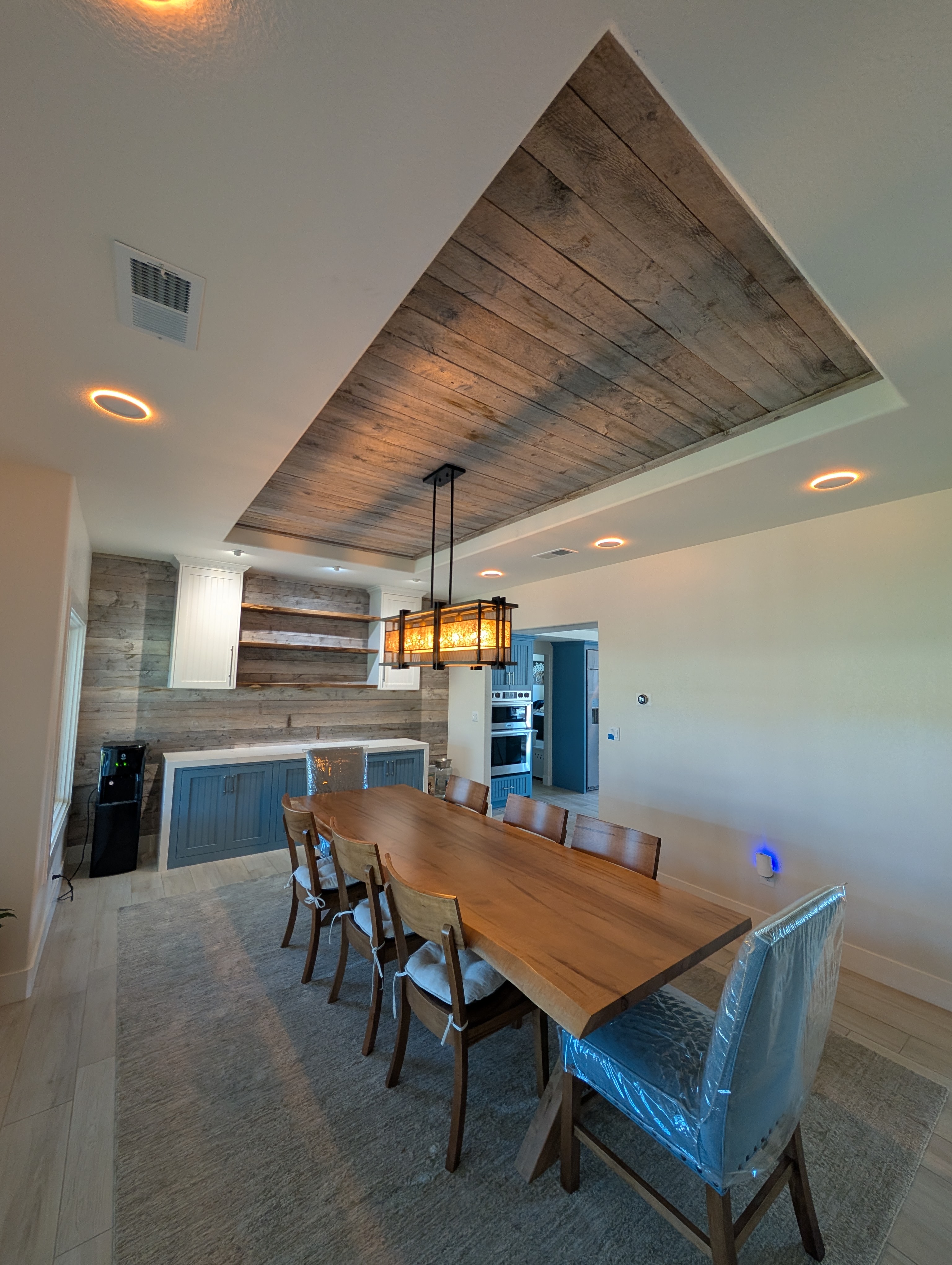
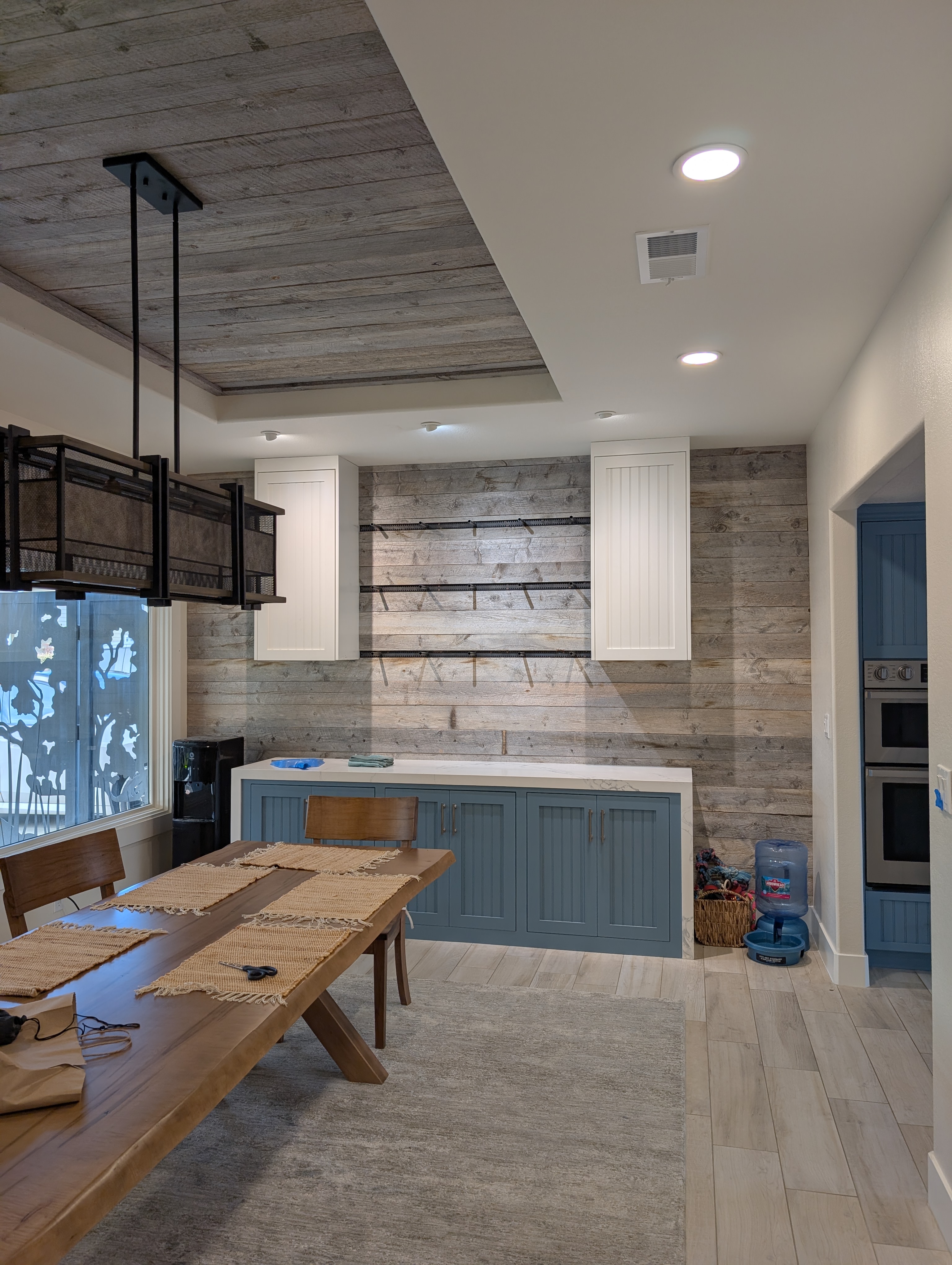
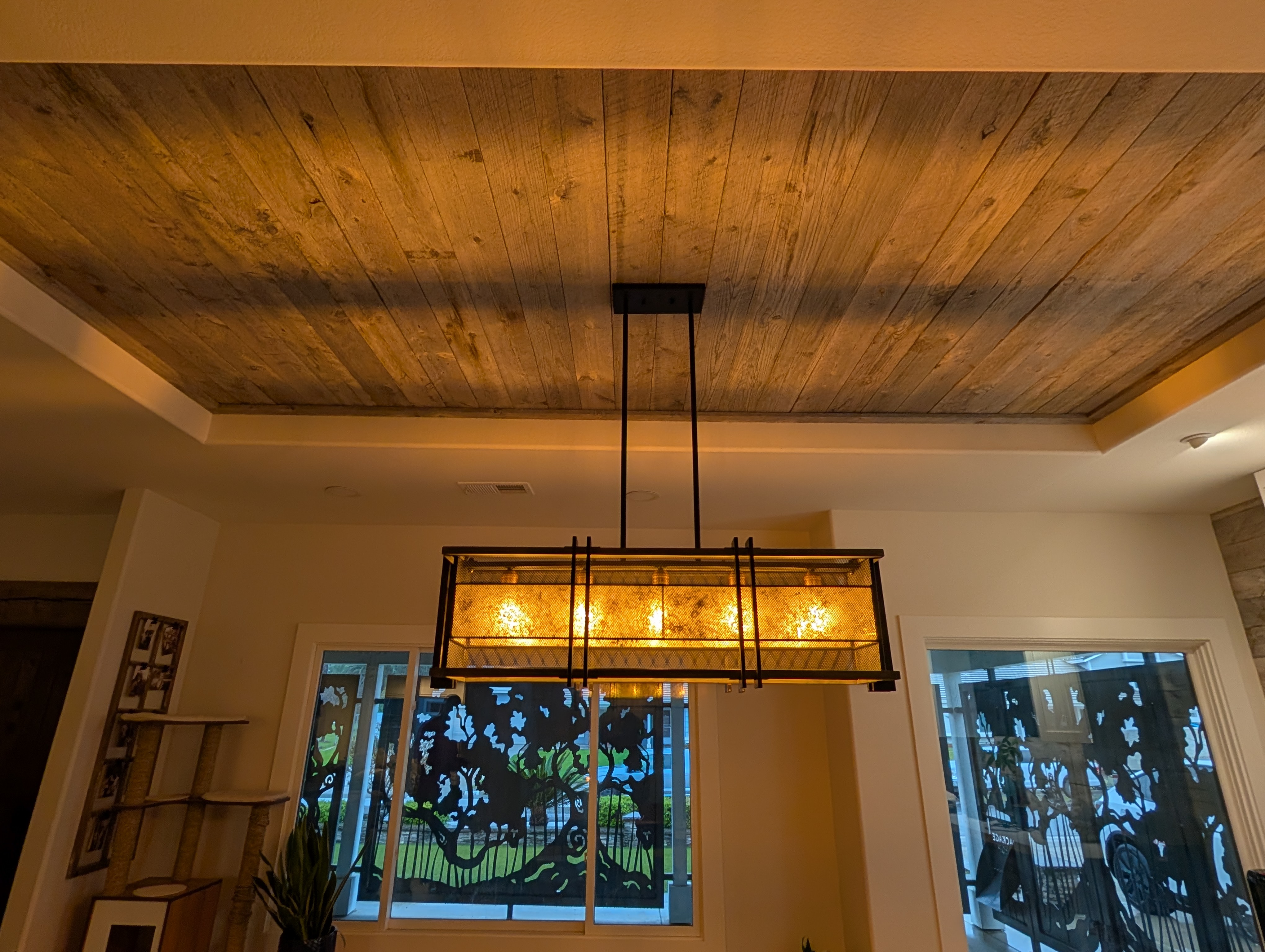
The Broken Twig project in Norco is a clean example of how this stacks. It started as a more conventional idea — crown in the tray ceiling, a lower cabinet run, two uppers — and grew through the design conversation into authentic barn wood on both the wall and ceiling, solid live-edge walnut shelves, and a waterfall quartz top. Each layer was a deliberate choice, and together they took the project to $35,230. The lesson: you control this number by choosing your scope, one layer at a time.
What Drives the Investment
What increases the investment
-
More coverage — full walls plus a ceiling rather than a single accent surface.
-
Authentic century-old stock instead of budget aged lumber (a $6,000–$9,000 swing on a feature build).
-
Solid live-edge slabs — each shelf can run about $1,000 in material alone.
-
Custom shop-built cabinetry and solid hardwood crown versus stock boxes.
-
Fabricated stone details like a waterfall quartz edge.
-
Tall ceilings, tray returns, and difficult overhead access.
What lowers the investment
-
Less wall and ceiling coverage while still using genuine reclaimed wood.
-
Skipping the live-edge shelves and/or the custom cabinets.
-
Choosing quality 'aged' wood instead of true century-old stock — a significant savings if authenticity isn't the priority.
-
Keeping existing finishes — flooring, lighting, and electrical that don't need to be touched.
Material grade is the lever most homeowners underestimate. Because material choices affect the total investment more than almost anything else, it's worth understanding the authentic-versus-aged decision in full before you set a budget — we cover that head-on in our guide to authentic reclaimed barn wood versus aged and faux wood.
What's Included vs. What's Not
Before you can compare quotes fairly, you need to know what a typical feature-build investment actually covers. Here's the honest split.
What a typical Holland & Sons project investment covers
-
Hand-selection, milling coordination, and installation of the reclaimed wood on walls and/or ceiling.
-
Substrate and backing prep so the finished wood reads clean.
-
All layout, templating, and scribe work to fit the wood around obstacles without filler trim.
-
Any shop-built cabinetry, shelves, and crown specified in the scope.
-
Finish coordination and final install labor.
What is typically separate
-
Electrical work and new lighting, if the room needs it (the Broken Twig room already had recessed lighting in place).
-
Flooring — most feature projects keep the existing floor.
-
Owner-provided items like a commissioned table, chandelier, or decorative screens.
-
Structural changes or permits, where a project triggers them.
How to Compare Reclaimed Wood Quotes Accurately
Reclaimed wood quotes vary more than almost any other carpentry job, because so much of the cost is hidden in layout skill and material grade. Here's what to look for line by line — the presence or absence of each item tells you what kind of contractor you're dealing with:
| Line Item to Check | What a Strong Quote Shows | What a Vague Quote Signals |
| Wood grade | Names authentic, aged, or DIY-grade explicitly | Just says 'reclaimed wood' with no source |
| Layout method | Mentions balanced layout and templating | Silent — likely a slap-up with cover trim |
| Coverage | Square footage and surfaces listed | A lump sum with no scope detail |
| Waste allowance | Builds in 15–20% for irregular stock | No waste line — expect a change order |
| Fastening / finish | Specifies blind-nailing and finish plan | Unspecified |
A quote that names the wood grade, describes the layout approach, and lists coverage is from someone who has done this before. For the full vetting framework — including what to look for when comparing contractor quotes and the red flags that should give you pause — see our guide to hiring a finish carpenter for custom wood walls and built-ins.
Reclaimed Wood Pricing Tiers
| Build Level | Investment Range | What You Get |
| Entry | $4,000+ | Authentic or aged wood on a single accent surface, reduced coverage, no shelves or cabinets — or a step down to DIY/aged stock for real savings |
| Mid-Range | $15,000 – $30,000 | Wood on a wall and ceiling, a cabinet run, and either floating shelves or uppers — a strong feature without the full package |
| Full Custom | $30,000 – $50,000+ | Full ceiling and wall, solid live-edge shelves, both cabinet sets, waterfall quartz, and crown — the complete showpiece |
The Decision Framework: Which Tier Is Right for You?
Three honest questions will point you to your tier:
-
How much surface are you covering? One wall keeps you in the entry tier. A wall plus a ceiling moves you to mid-range. Add built-ins and you're at full custom.
-
Does authenticity matter to you? If genuine century-old patina is the whole point, budget for authentic stock. If you just want the warm look, aged lumber or DIY panels stretch the dollar.
-
Is this a feature or a furnished room? A pure accent wall is decorative. Once you add storage, display shelves, and a work surface, you're building a functional room — and pricing it accordingly.
See This In Action — The Broken Twig Project, Norco
On the Broken Twig dining room in Norco, the bottom plank and the top plank of the accent wall landed within an inch of each other in width — and that wasn't luck. Brian did the math before the first board went up so the wall would read balanced top to bottom. A lesser crew starts with a full board at the bottom and ends with a random sliver at the top. That planning is invisible in the final photo, and it's exactly the kind of work that separates a $35,230 showpiece from a cheaper job that feels 'off' without the homeowner being able to say why.
What we used on this project:
-
Authentic 100+ year-old Kentucky reclaimed barn wood, resawn to 1x6 and installed aged-side-out.
-
Three solid live-edge walnut floating shelves on concealed heavy-duty steel rods.
-
Two shop-built maple cabinet sets with a waterfall quartz top.
-
Total investment: $35,230 — 3.5 days of shop fabrication and 8 days on site.
Local Market Context — The Inland Empire
In Norco, Menifee, Murrieta, and Temecula, most homes started life as builder-grade tract houses from the same handful of developers — DR Horton, Lennar, Richmond American and their peers. They're well-built, but they're built to a price and a template, which means thousands of nearly identical floor plans across the region. That's the baseline a custom reclaimed wood feature competes against.
What custom work delivers that builder-grade can't is character that's genuinely one-of-a-kind. A reclaimed wood feature wall is the kind of upgrade that makes a tract home stop feeling like a tract home. In a market this saturated with sameness, that distinction is worth real money — and real enjoyment every day you live in it.
Local ROI and Home Value
Here's the local argument first, because it matters more than any national percentage: homes in Menifee, Murrieta, and Temecula compete against nearly identical builder-grade tract homes. Architectural upgrades are memory-makers — a buyer walks through a dozen similar houses in a weekend and remembers the one with the warm, custom wood feature. On the national data, the National Association of Realtors notes that genuine salvaged wood adds authentic warmth and character that distressed new lumber simply can't replicate. A custom, well-built feature also reads as overall care and quality to a future buyer. That said, results vary by home, market, and project scope.
The Holland & Sons Angle
The reason Brian does the balanced-layout math before cutting a single board comes down to one belief: the cost of a feature wall is justified by the planning you never see. Anyone can buy reclaimed wood. What you're paying a finish carpenter for is the half-day at the drafting table working out where every course lands, so the finished wall feels intentional instead of accidental. That's the difference between an investment and an expense — and it's why we'll always tell you the real number and the real scope before anything is committed.
This is also where the next generation learns the part that doesn't show up on an invoice. On a recent layout, one of Brian's sons ran the course math himself for the first time — measuring the wall, dividing it out, and adjusting the starting plank so the top and bottom would balance. Watching him catch that a full board at the bottom would leave a sliver up top, and fix it before a single nail went in, is how the judgment behind the price gets passed down. One calculation at a time.
Related Resources — Reclaimed Wood Feature Guide
This cost guide is one part of a full series on planning a reclaimed wood feature in the Inland Empire. The other guides cover the decisions that come before and after pricing:
-
Authentic vs. Aged & Faux Reclaimed Wood — which material is right for your home, and the real cost and quality tradeoffs.
-
What Goes Wrong With Reclaimed Wood Walls — the installation and material problems to know about before you start.
-
Best Wood for Floating Shelves & Feature Walls — a finish carpenter's species picks for shelves and walls.
-
How to Hire a Finish Carpenter — how to evaluate quotes and contractors so you compare fairly.
-
The Hidden Layer Behind a Reclaimed Wood Wall — backing, substrate, and mounting that determine whether the wall lasts.
Frequently Asked Questions
How much does a reclaimed barn wood accent wall cost in the Inland Empire?
A professionally installed reclaimed barn wood accent wall in the Inland Empire typically runs $4,000 to $12,000 for a single feature wall, and a full ceiling-and-wall feature build can reach $15,000 to $50,000 or more. The biggest variables are coverage, whether the wood is authentic century-old stock or budget 'aged' lumber, and whether the project adds built-ins or floating shelves. Material alone for authentic reclaimed wood often lands between $12 and $30 per square foot before any installation labor, while DIY peel-and-stick panels can start around $8 per square foot. A straightforward accent wall is the entry point; the investment climbs once you wrap a ceiling, add a cabinet run, or bring in solid live-edge shelves.
How much does reclaimed barn wood cost per square foot?
Authentic reclaimed barn wood material commonly runs $12 to $30 per square foot in Southern California, before installation. The wide range reflects species, board width, thickness, and how much hand-selection and milling the supplier has already done. Budget 'aged' lumber — new wood weathered to look old — typically runs far less, and DIY peel-and-stick kits start near $8 per square foot. Installed by a finish carpenter, expect the all-in number to be meaningfully higher than material alone, because reclaimed stock is irregular and demands careful layout, templating, and cutting. Per-square-foot pricing is useful for estimating, but always confirm whether a quote is material-only or installed.
Is reclaimed wood more expensive than new wood?
Yes — authentic reclaimed wood is usually more expensive than comparable new lumber, and the premium is the point. You are paying for genuine century-old patina, old-growth density and stability, and a supply that is genuinely finite. On the Broken Twig project in Norco, choosing authentic Kentucky barn wood over budget 'aged' lumber added roughly $6,000 to $9,000 to the job. New 'aged' wood mimics the look at a fraction of the cost but lacks the real story and the decades of slow drying that make old stock so stable. Whether the premium is worth it depends entirely on whether authenticity is a priority for you — both are honest choices.
How much should I budget for an accent wall installed by a professional?
For a single professionally installed reclaimed wood accent wall in Riverside County, budget $4,000 to $12,000 depending on coverage and material grade. That range assumes a finish carpenter doing a planned, balanced layout with templated cuts around any obstacles — not a slap-up job covered with trim. If you are adding a ceiling, a cabinet run, or solid floating shelves, the project moves into the $15,000 to $50,000-plus territory of a full feature build. The smartest first step is to define your scope clearly: one wall, a wall and ceiling, or a full built-in. That single decision drives the budget more than any other.
Does a wood accent wall add home value in the Inland Empire?
A well-built wood accent wall can strengthen a home's appeal, especially in Inland Empire markets like Menifee, Murrieta, and Temecula where homes compete against nearly identical builder-grade tract houses. Architectural character is a memory-maker — buyers remember the home with the warm, custom feature long after the showing ends. The National Association of Realtors notes that genuine salvaged wood adds authentic warmth and character that distressed new lumber cannot replicate. A custom, well-executed feature also reads as overall care and quality. That said, results vary by home, market, and project scope, so treat it as an enjoyment-first upgrade with resale upside, not a guaranteed dollar return.
Why is a reclaimed wood ceiling more expensive than a wall?
A reclaimed wood ceiling costs more than a comparable wall because every board is installed overhead, which is slower, more physically demanding, and harder to fasten cleanly. Layout matters even more on a ceiling because the eye reads any drift in the courses immediately. On a tray ceiling, the angled returns add cuts and complexity. The material cost per square foot is similar to a wall, but the labor contribution climbs. If budget is tight and you want maximum impact for the dollar, a single feature wall usually delivers more visible character per dollar than a ceiling — though wrapping both, as on the Broken Twig project, is what turns a room into a true showpiece.
What is the cheapest way to get a reclaimed wood look?
The cheapest route is a DIY peel-and-stick or thin-plank reclaimed paneling kit, which can start around $8 per square foot in material and skips installation labor entirely. The next step up is budget 'aged' lumber — new boards weathered to look old — installed on a single accent wall. Both can look good in the right room. The tradeoffs are authenticity and longevity: thin DIY panels lack the depth and stability of solid old-growth stock, and they rarely fit cleanly around cabinets, outlets, and trim without visible gaps. If the look is all you need, budget options work. If you want the real material and a clean professional install, plan for a higher investment.
Let's Talk About Your Project
If you're pricing a reclaimed wood feature for your home, the best next step is a real conversation about scope — that's what turns a wide range into your actual number. Head to our contact page, fill out the form, tell us about your room, and upload any inspiration photos you've been saving. We'll walk you through the design phase and give you honest numbers before anything is ever committed.
We serve Norco, Corona, Eastvale, Riverside, Temecula, Murrieta, Menifee, Perris, and the wider Inland Empire. Follow along with our latest projects on social media, and reach out whenever you're ready to start a conversation.
951-338-8058 | brian@hsconstruct.com | hsconstruct.com | CSLB #1123738
More Than Just Reclaimed Wood Feature Walls
Pricing out a reclaimed wood feature is often the first step in a bigger vision for a room. Brian has been a finish carpenter since 1991, and his sons now build alongside him, which means every room in your home is fair game.
If your space needs more than that, here's what else we build:
-
Kitchen and bathroom remodels — full custom cabinetry, tile work, and finish carpentry from demo to done
-
Coffered ceilings — grid beam systems that add architectural depth to any room, sized and proportioned to the space
-
Wainscoting and wall paneling — classic raised panel, flat panel, board-and-batten, and shiplap applications
-
Reclaimed wood accents — feature walls, fireplace surrounds, and detail work using salvaged material with real character
-
Beam wraps — hollow wood wraps that give exposed beams the look of solid timber without the structural engineering
-
Crown molding, baseboards, and trim carpentry — the details that make a house feel finished, from a single room to a whole home
-
Cased openings and interior door replacements — clean transitions between spaces that most contractors overlook
-
Custom built-in entertainment walls and bookshelves — designed by hand, built in the shop, installed to last
Wood, proportion, and rooms that feel right — that's what we do.
hsconstruct.com
This guide is part of our accent walls series.
Learn more about Accent WallsHave a project in mind? Let's start a conversation.
Tell us what you are thinking about and we will give you a straight answer about scope, timeline, and investment.
Start a Conversation