How Much Does a Custom Mudroom Built-In Cost in Menifee?
| Quick Answer: A custom mudroom built-in in Menifee, CA typically runs $8,000 to $20,000+, with most mid-range, shop-built projects landing between $12,000 and $16,000. A real 9-foot floor-to-ceiling example on Rhapsody Ct. in Menifee Ranch came in at $12,912 — Baltic birch casework, custom maple doors, a milled fir bench, Blum hardware, and a single-day install. Your final number is driven by linear footage, material grade, ceiling height, and finish complexity. |
Key Takeaways
• Most custom mudroom built-ins in Menifee land between $8,000 and $20,000+; a real Rhapsody Ct. project was $12,912.
• Expect roughly $500–$1,200 per linear foot; floor-to-ceiling closed storage sits at the high end.
• The biggest cost drivers are size, material grade (void-free plywood and solid-wood faces), and finish complexity — not labor alone.
• Converting an existing niche or closet is far cheaper than a new bump-out addition.
• Holland & Sons has built finish carpentry across Riverside County since 1991 and publishes real, line-item project investments — not national averages.
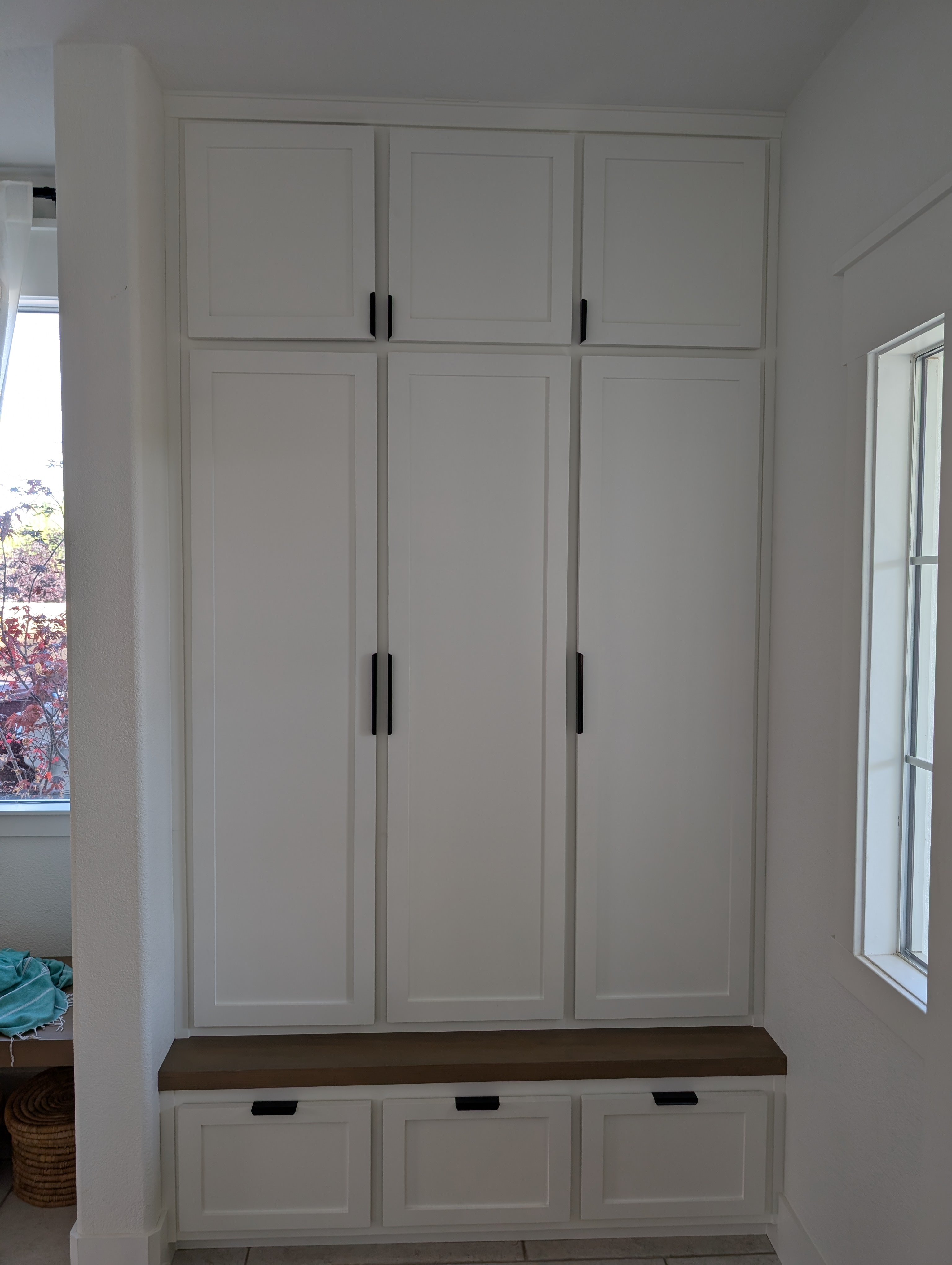
Here’s the number most contractors won’t put in writing: a custom mudroom built-in in Menifee runs about $8,000 on the low end and north of $20,000 at the top, with most quality mid-range projects landing between $12,000 and $16,000. We’ll go further than a range, though. On Rhapsody Ct. in Menifee Ranch, we built a 9-foot floor-to-ceiling storage wall for a family of nine, and the investment was $12,912 — broken out line by line below.
Most pricing articles hand you a national average and move on. That doesn’t help you write a check. What actually moves the number is specific: how many linear feet of wall you’re covering, whether the boxes are void-free plywood or particle core, how tall the unit runs, and how much of the work is real millwork versus stock parts. After 35 years of finish carpentry across the Inland Empire, those are the levers we can show you.
This is a cost guide, start to finish. If you want to weigh the options themselves — custom versus prefab, one material against another — those live in their own posts, linked below. Here, we’re answering one question: what does this cost, and what drives the number up or down?
The Direct Answer: What a Mudroom Built-In Costs
A custom mudroom built-in in Menifee and the surrounding Inland Empire runs $8,000 to $20,000+. Entry-level, off-the-shelf setups start around $8,000. Mid-range, shop-built units with real wood and soft-close hardware — the tier most homeowners actually want — land between $12,000 and $16,000. Full stain-grade custom work with specialty finishes and the largest footprints climbs past $20,000.
Three things move you within that range: total size (linear feet and height), material grade, and finish complexity. A wider wall costs more because there’s more material and labor. Void-free plywood and solid-wood face frames cost more than particle core and MDF, and they’re the reason a unit survives a busy household. And a hand-milled, miter-folded bench costs more than a butcher-block blank dropped on a base. Each of those is a choice you control.
Investment by Project Type
Mudroom built-ins aren’t one-size-fits-all. Here’s how typical investment ranges shake out by the kind of entry storage you’re building.
| Project Type | Typical Investment Range |
| Single bench with hooks (small niche) | $2,500 – $5,000 |
| Closet conversion to mudroom built-in | $6,000 – $12,000 |
| Wall-to-wall locker + drawer unit | $10,000 – $16,000 |
| Floor-to-ceiling storage wall (this project type) | $12,000 – $20,000+ |
Ranges vary by linear footage, material selection, ceiling height, and finish complexity.
Cost Per Linear Foot
Homeowners searching by the foot are on a different path than those searching by project. Here’s the per-foot view, which is how most cabinetmakers actually price.
| Scope | Per Linear Foot |
| Open shelving / cubbies | $350 – $600 |
| Mixed open and closed storage | $500 – $900 |
| Full closed lockers + drawers | $900 – $1,400 |
| Real-wood bench (separate) | $165 – $500+ |
How to apply it: Measure the width of the wall you want to cover, then multiply by a figure in the range that matches your storage type. A 9-foot floor-to-ceiling closed unit like Rhapsody Ct. worked out to roughly $1,400 per linear foot because it ran full height, used premium materials, and included a milled fir bench. A 6-foot mixed open-and-closed unit might land closer to $700 per foot, or about $4,200 before the bench.
What Drives the Investment
Here’s where the money actually goes — and what you can influence.
What increases it:
-
Linear footage and height. A floor-to-ceiling, wall-to-wall unit uses more material and more labor than a partial-height bench.
-
Material grade. Void-free Baltic birch and solid hard maple cost more than particle-core ply and poplar — and hold up far better.
-
Real millwork. A shop-milled, miter-folded bench and custom shoe dividers add craft and cost a slab dropped on a base never will.
-
Stain-grade vs. paint-grade. Walnut or white oak with a stain-grade finish runs well above paint-grade maple and vertical-grain Douglas fir.
-
Premium hardware. Blum full-extension soft-close slides and hinges cost more than standard self-close hardware.
What lowers it:
-
A smaller footprint — less material, less labor, less weight to manage.
-
Open cubbies instead of full closed doors.
-
Off-the-shelf bench blanks instead of shop-milled wood.
-
Omitting specialty details like custom dividers or a folded accent.
What’s Typically Included vs. Not Included
You can’t compare two quotes fairly until you know what each one covers. Here’s what a Holland & Sons project investment typically includes:
-
A full custom built-in, designed and engineered to your exact space.
-
All shop fabrication — boxes, doors, drawers, dividers, and the bench.
-
Custom on-site finish work, including stain matching where needed.
-
Soft-close hardware, hooks, pulls, and any rods.
-
Delivery and installation.
And what’s typically separate:
-
Drywall, paint, or electrical work outside the cabinet itself.
-
Flooring or tile changes.
-
Window treatments and styling/baskets.
-
Plumbing work — on Rhapsody Ct. we designed around the existing cleanout rather than touching it.
How to Compare Contractor Quotes Accurately
Two quotes for "a mudroom built-in" can differ by thousands and both be honest — because they’re describing different things. Here are the line items that vary, and what their presence or absence tells you about the contractor’s standards.
| Line Item | What to Look For | What It Signals |
| Box material | Void-free plywood specified by name | A vague "wood" or "MDF" box signals a lighter build that may sag under load |
| Face frame / doors | Solid hardwood, joinery method named | Slab MDF doors with no frame signal a budget shortcut, not a custom build |
| Drawer hardware | Brand named (e.g., Blum), full-extension soft-close | Unnamed "soft-close" hardware often means the cheapest available |
| Finish | Product named, shop vs. on-site stated | No finish detail means you don’t know what’s protecting the wood |
| Fabrication | Shop-built, then installed | Stick-built-in-place units fight an out-of-square house and show it in the seams |
| Exclusions | A written list of what’s not covered | No exclusions list means surprise charges are likely |
If a quote leaves any of these blank, ask for it in writing before you sign. A contractor who knows the work will answer every line without hesitating. For the full vetting process, see our guide on how to evaluate a cabinet maker before you hire.
Pricing Tiers: Entry, Mid-Range, Full Custom
| Build Level | Investment Range | What You Get |
| Entry — RTA / off-the-shelf | $8,000+ | Pre-made boxes, stock doors, laminate or butcher-block surfaces, standard hardware, smaller footprint |
| Mid-Range — semi-custom | $12,000 – $16,000 | Shop-built boxes, paint-grade custom doors, a real wood bench, soft-close hardware (the Rhapsody Ct. project lives here) |
| Full Custom | $20,000+ | Stain-grade hardwoods, raised-panel doors, specialty finishes, integrated lighting, and the largest footprints |
Which Tier Is Right for You?
Match the tier to how hard the space will work and how long you plan to stay.
-
Choose entry-level if the entry sees light use, you’re on a tight budget, or you may move within a few years and want function over permanence.
-
Choose mid-range if you have a busy household, want real wood and soft-close hardware that lasts a decade-plus, and want the unit to look original to the house. This is where most Menifee and Murrieta families land.
-
Choose full custom if you want stain-grade hardwoods, specialty details, and a centerpiece that matches high-end finishes elsewhere in the home.
One honest note: spending more on the decorative layer is optional, but underspending on the structural box and hardware is the one regret we see. In a full house, that’s what fails first. For why that happens, see the most common mistakes to watch for.
See This In Action — Rhapsody Ct. Mudroom
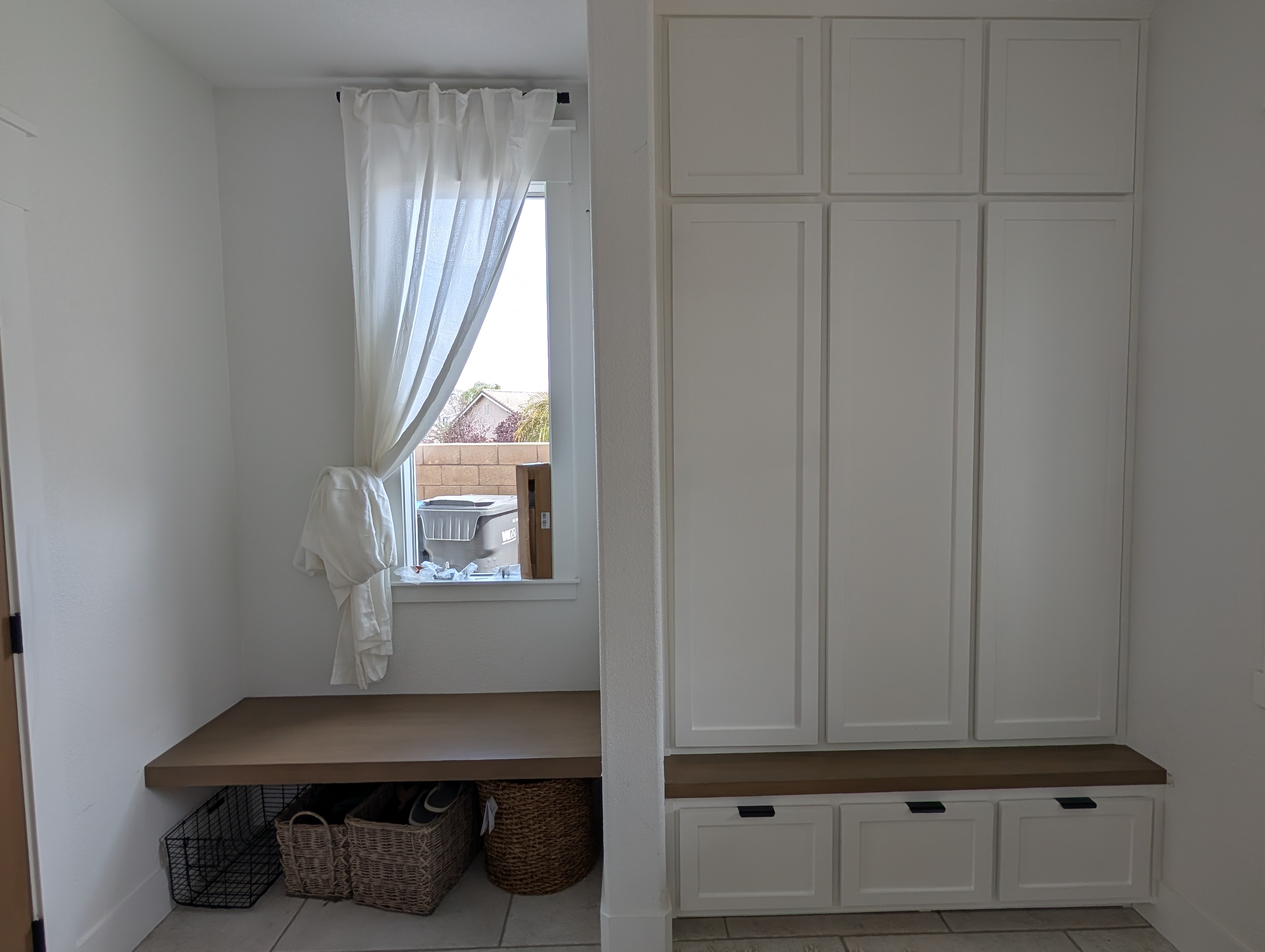
The detail that explains where custom money goes: we pushed the lower drawer bank deeper than the closet section above it, a change we proposed to the designer’s flat-front rendering before the contract was signed. That one move created a stepped ledge, which we filled with a miter-folded fir accent. You’re not paying for more plywood there — you’re paying for the judgment that turns a flat front into a real design moment without shrinking a single inch of storage.
What we used on this project:
-
Baltic birch casework — a two-part 9-ft carcass system
-
Hard maple face frame with cope-and-stick doors, paint-grade MDF panels
-
Vertical-grain Douglas fir bench, miter-folded, with an on-site blended stain
-
Blum full-extension soft-close slides and hinges throughout
At the link you’ll find the complete line-item breakdown, photos from rough lumber to finished room, the materials story, and the single-day install timeline.
Local Market Context: Menifee and Southwest Riverside County
Most homes in Menifee, Murrieta, and Temecula came out of the ground as builder-grade tract houses — DR Horton, Lennar, Richmond American and the like. The bones are solid, but the entries were built generic: a coat closet here, an open niche there, and not much thought given to where a busy family actually drops its stuff. That’s the gap a custom built-in fills.
What custom work delivers that builder-grade can’t: a unit scribed tight to your actual (out-of-square) walls, real materials that survive a decade of daily abuse, and a design that ties into the rest of the home rather than looking bolted on. In a market full of near-identical floor plans, that’s how an entry stops looking like everyone else’s.
Local ROI and Home Value
National remodeling-ROI percentages don’t tell the Inland Empire story, so start with the local argument. Homes in Menifee, Murrieta, and Temecula compete against nearly identical builder-grade tract homes a few streets over. Architectural upgrades are memory-makers — a buyer who walked ten similar houses remembers the one with the floor-to-ceiling, built-to-last storage wall long after the showing ends.
Menifee is one of the region’s most active markets, with a median home value in the mid-$500,000s as of early 2026. Custom, functional storage in a high-traffic entry is exactly the kind of upgrade buyers in family neighborhoods notice and value. According to Angi, a well-built mudroom both protects flooring from daily wear and adds the storage buyers consistently look for. Results vary by home, market, and project scope.
The Holland & Sons Angle
The single change we’re proudest of on Rhapsody Ct. is one you’d never put on an invoice line: stepping the lower drawer bank deeper than the closet above it. The original rendering was flat top to bottom. We saw a better build — a deeper base creates a ledge, the ledge gets a miter-folded fir accent, and a flat wall becomes a piece with dimension, all without losing the full 24 inches of depth up top. That’s what a custom investment actually buys: not more material, but the judgment to spend it well. On this job, one of Brian’s sons ran the rough fir through the planer, watching clean grain emerge pass after pass — learning early that the cost of good work is mostly the cost of doing the invisible parts right.
Related Resources — Mudroom Built-In Guide
This cost guide is one piece of a full Holland & Sons mudroom cluster. Here’s where to go next depending on what you’re deciding.
-
What Goes Wrong With Mudroom Built-Ins — the planning and sequencing mistakes that cost homeowners later, and how to avoid them.
-
Custom Built-In vs. IKEA/Prefab Lockers — a straight comparison of when prefab is fine and when it isn’t.
-
The Best Materials for a Mudroom Built-In — which woods and finishes last in a dry inland climate.
-
How to Vet a Cabinet Maker — the questions that separate a real custom shop from a guess.
-
How to Plan a Mudroom Layout Around Your Routine — zoning storage for how your family actually moves.
Frequently Asked Questions
How much does a custom mudroom built-in cost in Menifee?
A custom mudroom built-in in Menifee typically runs $8,000 to $20,000+, with most mid-range, shop-built projects landing between $12,000 and $16,000. A real example: a 9-foot floor-to-ceiling unit on Rhapsody Ct. in Menifee Ranch came in at $12,912, including Baltic birch casework, custom maple doors, a vertical-grain fir bench, soft-close hardware, and a single-day install. Your number depends on linear footage, material grade, ceiling height, and finish complexity. Off-the-shelf units start around $8,000; full stain-grade custom work runs past $20,000.
How much do custom mudroom cabinets cost per linear foot?
Custom mudroom cabinetry generally runs $500 to $1,200 per linear foot, and closed lockers with doors and drawers sit at the higher end of that range. The Rhapsody Ct. project worked out to roughly $1,400 per linear foot because it was full floor-to-ceiling, included a milled fir bench, and used premium Baltic birch and Blum hardware throughout. To estimate your own scope, measure the wall width you want covered and multiply by a per-foot figure in that range, then adjust up for floor-to-ceiling height and down for open shelving instead of closed doors.
Does a mudroom built-in add home value in the Inland Empire?
Yes, functional built-in storage is a feature Inland Empire buyers notice, especially in family-oriented markets like Menifee, Murrieta, and Temecula. Homes here compete against nearly identical builder-grade tract houses, so a custom, built-to-last entry storage wall is a memory-maker that sets a listing apart. Menifee’s median home value sits in the mid-$500,000s as of early 2026, and a permanent organizational upgrade in a high-traffic entry reads as move-in-ready quality. That said, results vary by home, market, and project scope.
How much does a mudroom bench cost?
A mudroom bench ranges from about $165 per linear foot for a simple built version to $500+ per linear foot for custom millwork. A shop-milled, real-wood bench like the vertical-grain Douglas fir top on the Rhapsody Ct. project contributed roughly $2,200 to that build, which covered milling rough lumber, gluing up the slab, the miter-fold detail, and an on-site blended finish. A budget alternative — an off-the-shelf butcher-block blank dropped onto a base — costs far less but won’t match surrounding woodwork or carry the same detail.
Is it cheaper to convert a closet into a mudroom than build a new one?
Usually yes — converting an existing closet or niche is one of the most cost-effective ways to add a mudroom because you skip foundation and framing work. The Rhapsody Ct. project did exactly this, turning two underused entry niches into a built-in for $12,912 rather than building a new bump-out, which can run $15,000 to $30,000+ once a foundation is involved. Most Menifee and Murrieta tract homes already have a niche, coat closet, or garage-entry wall that’s a strong candidate for conversion.
What’s included in a custom mudroom built-in quote?
A complete quote should cover design and shop drawings, all casework and doors, drawers and any dividers, the bench, hardware, finish, delivery, and installation. On the Rhapsody Ct. project, the $12,912 included design collaboration, the two-part Baltic birch carcass, maple face frame and doors, a three-drawer bank with custom shoe dividers, the fir bench, Blum hardware, paint, and a single-day install. It did not include drywall, painting outside the cabinet, flooring changes, or plumbing work. Knowing what’s in and out of scope is the only way to compare two quotes fairly.
Why are custom mudroom built-ins more expensive than IKEA or prefab?
You’re paying for material grade, real joinery, and a unit engineered to your exact wall, not stock boxes. Custom work uses void-free plywood, solid-wood face frames, soft-close hardware, and shop fabrication held to tight tolerances, then scribed tight to an out-of-square wall on install. Prefab and IKEA-based units cost less upfront but use lighter materials and standard sizes that leave filler gaps and tend to sag or wear within a few years under heavy household use. For a full side-by-side, see our comparison of custom built-ins versus prefab lockers.
How can I lower the cost of a mudroom built-in without cheapening it?
Focus your investment where it shows and lasts, and economize where it doesn’t. Keeping a smaller overall footprint, choosing paint-grade materials over stain-grade hardwoods, using open cubbies instead of full closed doors, and skipping specialty details like a miter-folded accent all reduce the number meaningfully. What we’d never cut on a high-traffic family entry is the structural box and the hardware — void-free plywood and soft-close slides are what keep the unit working a decade in. Spend there, save on the decorative extras.
Ready to Price Your Project?
If you’ve got an awkward niche or a builder-grade closet that could be doing a lot more, we’d love to talk numbers with you. Start at hsconstruct.com/contact, fill out the form, describe your space, and upload any inspiration photos you’ve been saving. We’ll walk through the design and the real investment — including the details most contractors never mention — before any work begins.
Holland & Sons serves Menifee, Murrieta, Temecula, Perris, Riverside, and the greater Inland Empire. Follow our work on social media to see projects come together from rough lumber to finished room.
951-338-8058 | brian@hsconstruct.com | hsconstruct.com | CSLB #1123738
More Than Just Storage
Custom mudroom and entry built-ins are a signature project at Holland & Sons — but they’re one chapter in a much longer story. Brian and his sons have been finish carpenters since 1991, which means every room in your home is fair game.
If your space needs more than storage, here’s what else we build:
-
Kitchen and bathroom remodels — full custom cabinetry, tile work, and finish carpentry from demo to done
-
Coffered ceilings — grid beam systems that add architectural depth to any room, sized and proportioned to the space
-
Wainscoting and wall paneling — classic raised panel, flat panel, board-and-batten, and shiplap applications
-
Reclaimed wood accents — feature walls, fireplace surrounds, and detail work using salvaged material with real character
-
Beam wraps — hollow wood wraps that give exposed beams the look of solid timber without the structural engineering
-
Crown molding, baseboards, and trim carpentry — the details that make a house feel finished, from a single room to a whole home
-
Cased openings and interior door replacements — clean transitions between spaces that most contractors overlook
-
Custom built-in entertainment walls and bookshelves — designed by hand, built in the shop, installed to last
Wood, proportion, and rooms that feel right — that’s what we do.
hsconstruct.com
About the Author
Brian Holland is the owner and lead carpenter of Holland & Sons Construction, a family-run finish carpentry and general contracting company serving Riverside County and the Inland Empire since 1991. He entered the trade at 17, learned on the job, and has spent 35 years building the kind of work that makes rooms feel right — often before a homeowner can articulate why. His sons now apprentice alongside him on every project. Holland & Sons is based in Perris, CA and licensed by the CSLB (#1123738).
Related project
This guide is part of our mudrooms & storage series.
Learn more about Mudrooms & StorageHave a project in mind? Let's start a conversation.
Tell us what you are thinking about and we will give you a straight answer about scope, timeline, and investment.
Start a Conversation