Custom Built-In vs. IKEA Mudroom Lockers: Which Is Right for Your Menifee Home?
| Quick Answer: For most busy Inland Empire families in a Menifee tract home with an awkward niche, a custom built-in is the better long-term call — it’s engineered to your exact wall, carries real load, and looks original to the house. But IKEA-based and prefab lockers are genuinely fine when the entry sees light use, the budget is firm, the wall is a standard width, or you may move soon. Match the solution to the load and the timeline, not the marketing. |
Key Takeaways
• Custom wins on fit, durability, and resale; prefab/IKEA wins on upfront cost and speed.
• The deciding factors are household load, wall fit, and how long you’ll keep the home — not which is "better."
• IKEA hacks can close the visual gap, but not the structural, material, or continuity gap.
• Buyers read built-ins as part of the home; freestanding pieces read as furniture that leaves with the seller.
• Holland & Sons matched the Rhapsody Ct. fir to doors installed for the same family on a prior job — continuity prefab can’t replicate.
Here’s the straight answer most comparison articles won’t give you: neither one is universally "right." If you’re a busy family in a Menifee or Murrieta tract home, with seven backpacks landing at the door every afternoon and an oddly sized niche to fill, a custom built-in is what Brian would build — and what lasts. If you’ve got a light-traffic side entry, a firm budget, and a standard-width wall, an IKEA-based or prefab unit will serve you just fine, and spending custom money would be overkill.
Most of the advice online quietly assumes custom always wins. It doesn’t. Prefab earns its place under the right conditions, and pretending otherwise just erodes trust. What actually decides it is three things: how hard the space will work, whether stock sizes fit your wall, and how long you plan to stay. Get honest about those and the answer is usually obvious.
This post compares the two head-to-head, names the tradeoffs without spin, and tells you exactly when each one is the smart move.
The Direct Answer
For the most common Inland Empire homeowner — a move-up family in a builder-grade tract house with a niche or closet that doesn’t fit anything off the shelf — a custom built-in is the better investment. It’s scribed to your actual (out-of-square) walls, built to carry a full household’s daily load, and designed to look like it came with the house.
The other option is right too, under different conditions. Choose IKEA or prefab when the entry is low-traffic, the budget is fixed, the wall is a standard width that stock units fit cleanly, or you may move within a few years. In those cases you’d be paying for engineering you’ll never stress. There’s no virtue in over-buying.
Custom Built-In vs. IKEA/Prefab: Side by Side
| Factor | Custom Built-In | IKEA / Prefab Lockers |
| Investment range | $8,000 – $20,000+ | ~$1,000 – $4,000 in product |
| Fit to your wall | Scribed tight; no gaps; uses every inch | Stock sizes; filler gaps on odd walls |
| Installation | Pro install, often a single day | DIY assembly; hours to days |
| Durability under load | Void-free plywood; decades in a busy home | Lighter materials; can sag in a few years |
| Longevity | Built to outlast the household’s use | Moderate; replaced sooner under heavy use |
| Dry inland climate | Stable, sealed real wood resists movement | Veneer/particle core less forgiving over time |
| Best home style | Anything — matched to the home | Modern, standard layouts |
| Resale appeal | Reads as part of the home | Reads as furniture; leaves with seller |
Why This Comparison Matters — and What Generic Advice Gets Wrong
Homeowners ask this question because the price gap is enormous and the photos look similar. A well-styled IKEA hack and a custom built-in can read almost identically in a listing photo, so it’s fair to ask why one costs four times the other. The generic advice usually answers with either "custom is always worth it" or "just hack IKEA" — and both are wrong because both ignore your specific conditions.
Where field experience in the Inland Empire changes the answer: our homes are mostly builder-grade tract houses with walls that aren’t square and niches that aren’t standard. Stock units leave gaps there. And our dry-then-swinging inland climate is harder on veneer and particle cores than it is on stable, sealed real wood. Those two local realities tilt more Menifee and Temecula projects toward custom than a national article would suggest — but not all of them.
The Other Options, Honestly
Custom and IKEA aren’t the only two paths. Here’s the rest of the landscape in one view, so you can see where each fits without turning this into five separate debates.
| Option | What It Solves | What It Doesn’t | Right For |
| IKEA hack (with trim) | Built-in look on a budget | Load, scribe-fit, continuity | Standard walls, light use, handy owners |
| Freestanding hall tree | Instant, movable storage | Permanence, full-height capacity | Renters, temporary setups |
| Semi-custom cabinets | Better fit than stock | Exact odd-wall fit; still has fillers | Near-standard layouts, mid budgets |
| Full DIY build | Lowest cost if skilled | Forgiveness for mistakes | Confident builders, simple layouts |
The Questions Homeowners Actually Ask
Can’t I just hack IKEA and get the same thing?
You can get most of the look, and for the right space that’s enough. A wood base, filler strips, trim, and paint will hide the seams between stock boxes and approximate a built-in front. What the hack can’t do is scribe itself to a wall that’s out of square, give you structural boxes rated for heavy load, deliver real millwork like a miter-folded bench, or match woodwork elsewhere in your home. If your wall is standard and your use is light, the hack is smart. If any of those gaps matter to you, that’s the line where custom earns its premium.
Will prefab really wear out faster?
Under heavy use, generally yes — lighter materials and standard joinery sag and rack sooner than void-free plywood that’s glued, screwed, and dadoed. But "faster" is relative to load. A lightly used entry may never stress a prefab unit, and it could last many years. A family of nine piling on shoes and backpacks daily is a different test entirely. Match the build to the abuse it’ll actually take. For why materials drive this, see how material selection differs between these options.
Does the built-in actually help resale?
It helps perception, which is what moves buyers. A built-in reads as part of the house — permanent, intentional, move-in-ready. A freestanding piece or an obvious prefab unit reads as furniture the seller will take with them. In a market full of near-identical Menifee floor plans, the built-in is the detail a buyer remembers after walking ten similar homes.
Which One Is Right for You?
Choose custom if:
-
Your entry sees heavy daily use (kids, pets, sports gear).
-
Your wall is an awkward size or out of square — most tract-home niches are.
-
You want the unit to last decades and look original to the home.
-
You’re staying put and want resale-grade quality.
Choose IKEA/prefab if:
-
The entry is low-traffic.
-
Your budget is firm and four figures, not five.
-
The wall is a standard width stock sizes fit.
-
You may move within a few years.
If you land on custom, the next question is what it costs — see our cost guide for real pricing examples for each option.
See This In Action — Rhapsody Ct. Mudroom
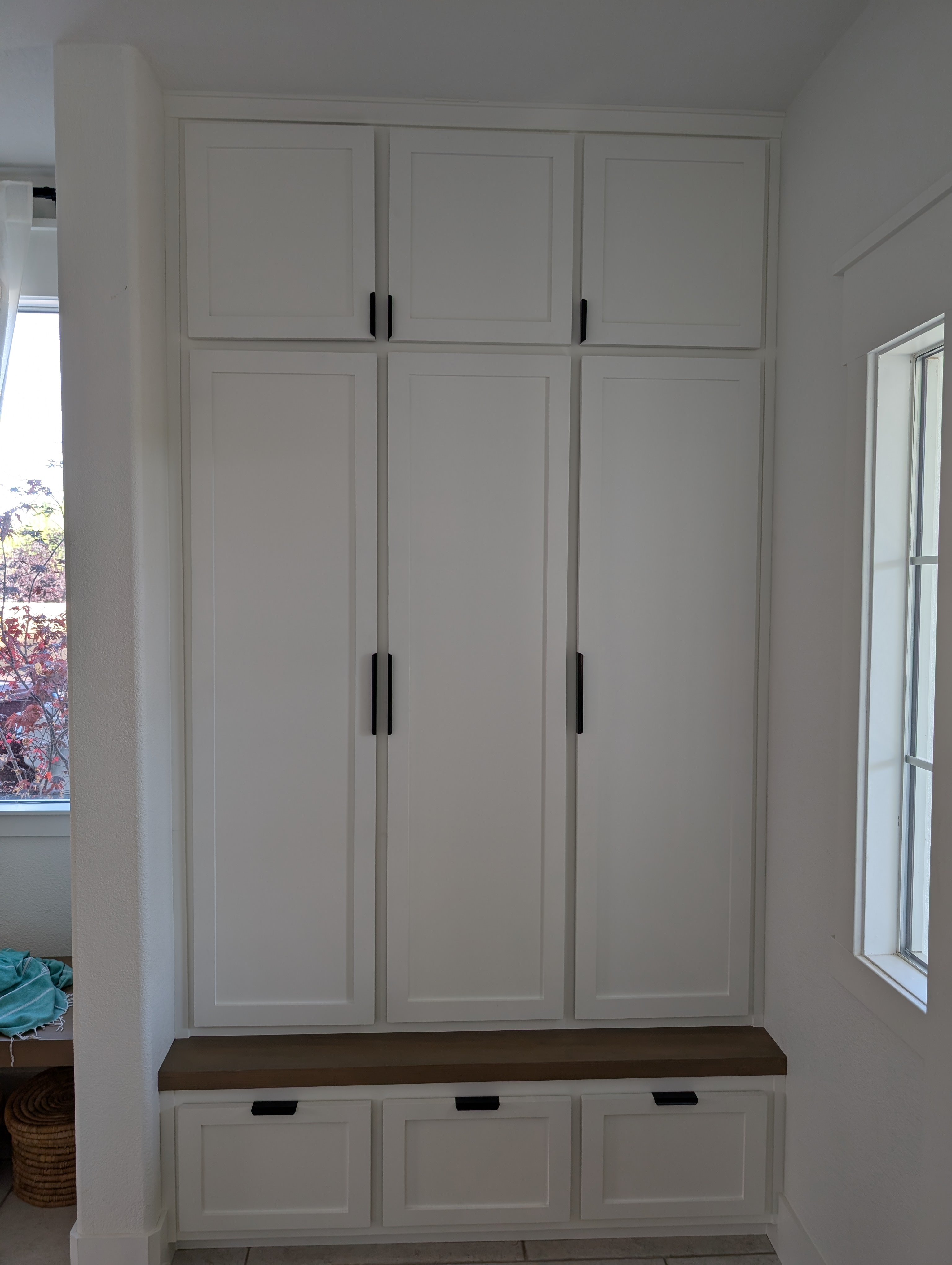
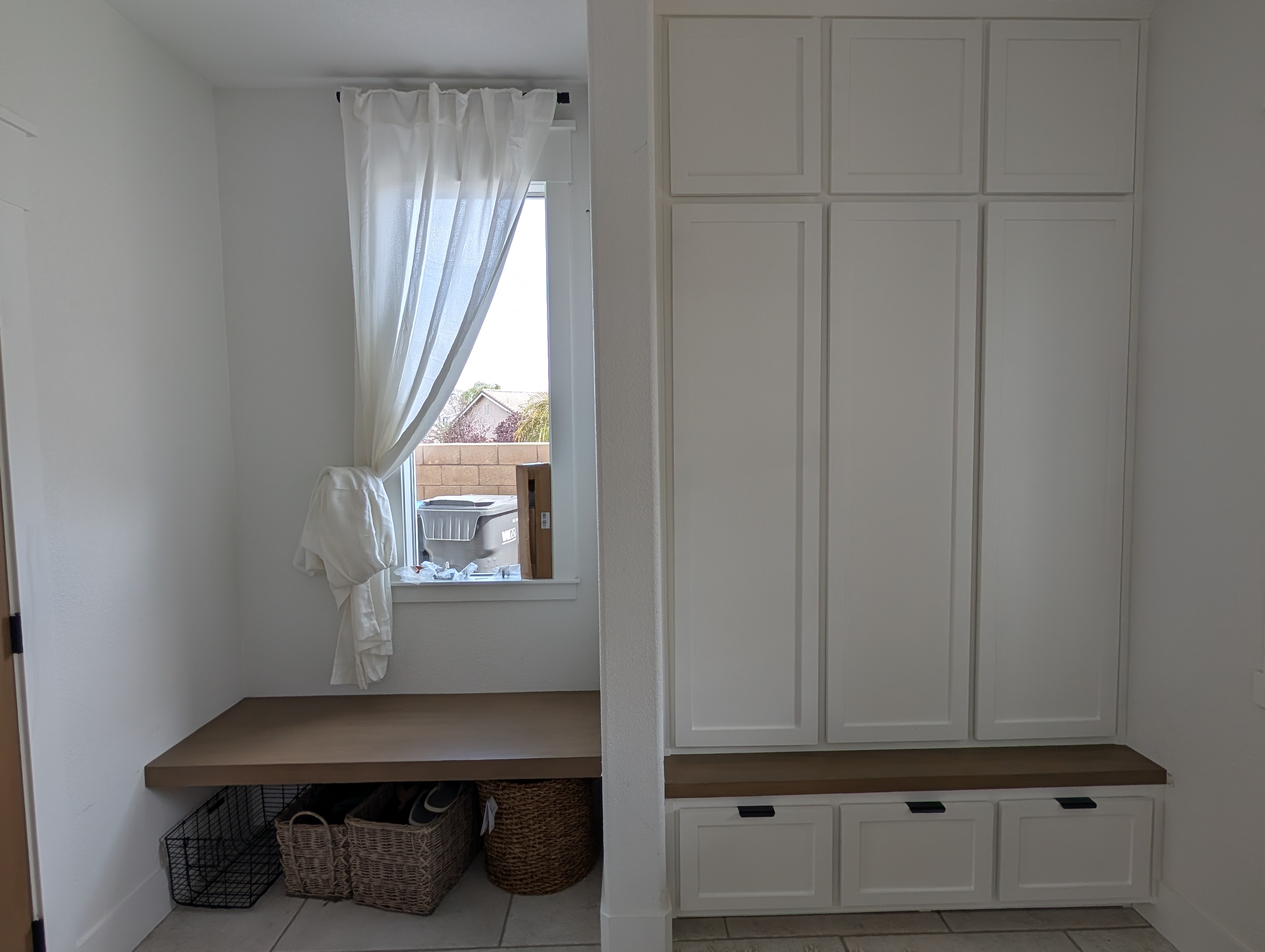
The thing IKEA can never do showed up before we cut a board on Rhapsody Ct.: we chose vertical-grain Douglas fir to match interior doors we’d installed for this same family on an earlier project. Two jobs, one continuous material story. The bench didn’t just belong to the mudroom — it belonged to the whole house, because it spoke the same language as woodwork already in it. No stock unit and no hack carries that kind of continuity, because continuity is a relationship, not a product.
What we used on this project:
-
Vertical-grain Douglas fir bench, matched to the family’s existing interior doors
-
An on-site blended stain, sampled against their dining table until it matched
-
Baltic birch casework scribed tight to the actual walls
-
A unit that uses every inch of two niches no stock size would have fit
At the link: photos, the full investment, the materials story, and the single-day install.
How Each Option Performs in the Inland Empire
Our climate and our housing stock both matter here. The Inland Empire runs dry with real temperature swings, which is harder on veneer and particle-core materials than on stable, sealed real wood — over years, lesser cores can telegraph movement that quality plywood and quarter-sawn millwork resist. And because Menifee, Murrieta, and Temecula are dominated by builder-grade tract homes with walls that aren’t square and niches that aren’t standard, stock prefab units more often leave the filler gaps that custom work eliminates by scribing. Neither point disqualifies prefab — it just means the conditions that favor custom show up more often here than the national averages imply.
The Holland & Sons Angle
The reason the Rhapsody Ct. bench works isn’t in this room — it’s in the last room we built for this family. We’d installed vertical-grain fir interior doors for them on a prior job, so when the bench came up, the wood chose itself. We milled the fir to match, and the piece reads as part of a house that’s been thoughtfully built over time, not a unit dropped into one afternoon. That’s the one thing a box off a shelf structurally cannot do: remember the last project. On this build, one of Brian’s sons pulled the specs from that earlier job to color-match the new fir — learning that custom work isn’t just about this room, it’s about the whole home and the history a family is building inside it.
Related Resources — Mudroom Built-In Guide
This comparison is one piece of a full Holland & Sons mudroom cluster. Here’s where to go next.
-
How Much Does a Custom Mudroom Built-In Cost? — real ranges and a $12,912 line-item breakdown.
-
What Goes Wrong With Mudroom Built-Ins — the problems to design out before you build.
-
The Best Materials for a Mudroom Built-In — which woods and finishes last in a dry inland climate.
-
How to Vet a Cabinet Maker — the questions that separate a real custom shop from a guess.
-
How to Plan a Mudroom Layout Around Your Routine — zoning storage for how your family actually moves.
Frequently Asked Questions
Is a custom built-in worth it over IKEA mudroom lockers?
A custom built-in is worth it when the space will work hard, when the wall is an awkward size, or when you want the unit to last decades and look original to the house. IKEA-based and prefab lockers are completely fine for light-use entries, tight budgets, and standard wall widths where stock sizes fit. The deciding factors are household load, fit, and how long you’ll keep the home. For a busy family in a Menifee tract house with an odd niche, custom usually pays off; for a renter or a low-traffic side door, prefab often makes more sense.
How long do IKEA or prefab mudroom lockers last?
Prefab and IKEA-based mudroom units typically hold up for a handful of years under moderate use, and some last much longer with light loads. The common failure points are sagging shelves, worn finishes, and racked boxes under heavy daily abuse — contractors regularly replace prefab units within about five years in high-traffic homes. Custom built-ins made from void-free plywood, when built right, often last decades. The gap comes down to material grade and joinery, not brand name. A lightly used entry may never stress a prefab unit; a family of nine will.
Do built-ins add more resale value than freestanding storage?
Yes — buyers read built-ins as part of the home, while freestanding or prefab pieces read as furniture that leaves with the seller. A permanent, well-fitted storage wall in a high-traffic entry signals move-in-ready quality, which matters in Inland Empire markets like Menifee, Murrieta, and Temecula where near-identical tract homes compete on details. Freestanding hall trees and stock lockers add function but rarely add the same perceived value because they don’t feel original to the house. Results vary by home, market, and scope.
Can you make IKEA cabinets look built-in?
Yes, with work — IKEA hacks can approximate a built-in look by adding a wood base, filler strips, trim, and paint to close gaps and hide the seams between stock boxes. Done carefully, the result can look convincing in a standard-width space. What the hack can’t replicate is a unit scribed tight to out-of-square walls, structural boxes rated for heavy load, real-wood millwork like a miter-folded bench, and continuity with existing woodwork elsewhere in the home. It closes the visual gap, not the structural or material one.
Is a DIY mudroom cheaper than custom or IKEA?
DIY is usually the cheapest option upfront because you eliminate labor, which can be 60 to 70 percent of a custom quote. The catch is that carpentry is unforgiving — scribing to crooked walls, building boxes that carry load, and routing around hidden plumbing are skills, not shortcuts. A botched DIY job can cost more to fix than hiring out would have. DIY makes sense for confident builders on simple layouts; for a complex, load-bearing, full-height unit, the savings often evaporate into mistakes and time.
What’s the real cost difference between custom and IKEA?
An IKEA or prefab mudroom can land anywhere from roughly $1,000 to $4,000 in product, while a custom built-in typically runs $8,000 to $20,000+ depending on size and materials. The custom premium buys void-free plywood, solid-wood faces, soft-close hardware, a unit engineered to your exact wall, and a professional install. For the full picture, including a real $12,912 line-item breakdown, see our mudroom cost guide — it shows exactly where the difference goes.
When is prefab or IKEA actually the better choice?
Prefab or IKEA is the smarter call when the entry sees light use, your budget is firm, the wall is a standard width that stock sizes fit, or you may move within a few years and don’t want to invest in something permanent. In those cases, paying for custom engineering you won’t stress is overkill. The honest rule: match the solution to the load and the timeline. Custom isn’t automatically better — it’s better when the conditions that justify it are present.
Not Sure Which Way to Go?
If you’re weighing custom against prefab and want a straight read on your specific space, we’re happy to give you one — even if the honest answer is that prefab is right for you. Start at hsconstruct.com/contact, fill out the form, describe your entry, and upload any inspiration photos. We’ll talk through fit, load, and budget before you commit a dollar.
Holland & Sons serves Menifee, Murrieta, Temecula, Perris, Riverside, and the greater Inland Empire. Follow our work on social media to see the difference custom makes.
951-338-8058 | brian@hsconstruct.com | hsconstruct.com | CSLB #1123738
More Than Just a Storage Wall
Custom mudroom and entry built-ins are a signature project at Holland & Sons — but they’re one chapter in a much longer story. Brian and his sons have been finish carpenters since 1991, which means every room in your home is fair game.
If your space needs more than storage, here’s what else we build:
-
Kitchen and bathroom remodels — full custom cabinetry, tile work, and finish carpentry from demo to done
-
Coffered ceilings — grid beam systems that add architectural depth to any room, sized and proportioned to the space
-
Wainscoting and wall paneling — classic raised panel, flat panel, board-and-batten, and shiplap applications
-
Reclaimed wood accents — feature walls, fireplace surrounds, and detail work using salvaged material with real character
-
Beam wraps — hollow wood wraps that give exposed beams the look of solid timber without the structural engineering
-
Crown molding, baseboards, and trim carpentry — the details that make a house feel finished, from a single room to a whole home
-
Cased openings and interior door replacements — clean transitions between spaces that most contractors overlook
-
Custom built-in entertainment walls and bookshelves — designed by hand, built in the shop, installed to last
Wood, proportion, and rooms that feel right — that’s what we do.
hsconstruct.com
About the Author
Brian Holland is the owner and lead carpenter of Holland & Sons Construction, a family-run finish carpentry and general contracting company serving Riverside County and the Inland Empire since 1991. He entered the trade at 17, learned on the job, and has spent 35 years building the kind of work that makes rooms feel right — often before a homeowner can articulate why. His sons now apprentice alongside him on every project. Holland & Sons is based in Perris, CA and licensed by the CSLB (#1123738).
Related project
This guide is part of our mudrooms & storage series.
Learn more about Mudrooms & StorageHave a project in mind? Let's start a conversation.
Tell us what you are thinking about and we will give you a straight answer about scope, timeline, and investment.
Start a Conversation