Custom Built-In Bed vs. Production Storage Bed: Which Is Right for Your Menifee Bedroom?
Quick Answer
For most Menifee and Inland Empire bedrooms with a specific storage problem — no built-in closet, unusual room dimensions, or heavy daily-use load requirements — a custom built-in is the better solution. It is engineered for the actual room, designed for the actual load, and can integrate wardrobe infrastructure where none exists. For a standard bedroom with adequate closet space and no unusual dimensions, a well-made production storage bed is a practical and honest choice. Here is how to know which situation you are in.
Key Takeaways
-
Custom built-in: right when the room has a specific problem a production bed cannot solve — no closet, unusual dimensions, heavy load requirements
-
Production storage bed: right when the room has adequate closet space, standard dimensions, and the storage need is supplemental rather than primary
-
In Menifee and the Inland Empire, production homes frequently deliver bedrooms without built-in closets — which changes the calculation significantly
-
Investment difference: production storage bed $400–$1,200 vs. custom built-in $12,000–$35,000+ — entirely different category of product and permanence
-
A Murphy bed solves a different problem — floor space when the bed is away — not accessible daily storage while the bed is in use
This comparison comes up every time a homeowner starts researching a bedroom storage project. The options are everywhere: production storage beds at $400 to $1,200, IKEA frames with drawers, lift-up hydraulic beds, and at the far end, custom built-ins that start at $12,000 and go up from there. The investment difference is real. So is the difference in what you actually get.
The honest answer is that these are not competing products. They solve different problems. A production storage bed adds some storage to a bedroom that already functions reasonably well. A custom built-in adds the storage infrastructure the room was missing — including, when there is no built-in closet, a wardrobe where none existed.
In Menifee, Murrieta, and most of the Inland Empire's newer production neighborhoods, the bedroom-without-a-closet situation is not rare. It is the standard. Canyon Heights, Audie Murphy Ranch, Heritage Lake — production builders sized bedrooms for beds. What happens when a teenager, a multigenerational household member, or a primary occupant has no built-in storage at all is a problem the production bed at Home Depot does not solve. That changes the comparison considerably.
A. The Direct Answer — Brian's Recommendation
For a Menifee or Inland Empire bedroom with no built-in closet: custom built-in. Not because it is more expensive, but because it is the only solution that actually solves the problem. A production storage bed adds four drawers. A custom built-in adds four drawers, a 60-inch pull-out wardrobe, and a platform designed for the specific width of your room. Those are not the same product.
For a bedroom with adequate closet space, standard room dimensions, and a supplemental storage goal — "I want more accessible storage under the bed" — a well-made production storage bed is a reasonable choice. The IKEA MALM with drawers, for example, is a legitimate product for a legitimate use case. It is not built to last 30 years. It is built to be affordable and functional for the use case it was designed for.
The question that determines which category you are in: does your room have a built-in closet? If no — the comparison is not really about preference. It is about what actually solves the storage problem you have.
B. Side-by-Side Comparison — Custom Built-In vs. Production Storage Bed
| Factor | Custom Built-In | Production Storage Bed |
| Investment | $12,000 – $35,000+ | $400 – $1,200 (IKEA, retail) |
| Fit to room | Fabricated to actual room dimensions | Fixed product dimensions — fits or it doesn't |
| Storage capacity | Configured to room width and depth; drawers up to 48" deep | Fixed drawer count and depth — typically 18–21" max |
| Wardrobe integration | Pull-out wardrobe possible where no closet exists | Not available |
| Slide hardware | Specified for actual working load — up to 550 lb rated | Standard soft-close, typically 75–100 lb rated |
| Materials | 3/4" Baltic birch carcass, solid wood face frame | Particleboard, MDF, or furniture-grade plywood; varies by product |
| Longevity | Decades under normal use | 5–15 years depending on material quality and use intensity |
| Portability | Permanent installation — stays with the room | Freestanding — moves with you |
| Home value impact | Differentiates the room in a production home market | No material impact |
| Lead time | 2–4 weeks from deposit to installation | Days (in stock) to a few weeks (order) |
| Permit required | Usually no — confirm locally | No |
| Design flexibility | Fully custom — any dimension, any feature | Fixed catalog options |
C. Why This Comparison Matters in the Inland Empire
The generic version of this comparison treats custom built-ins as a luxury upgrade for homeowners who want premium quality. That framing misses what is actually happening in Menifee, Murrieta, and the production neighborhoods that define most of Riverside County's newer housing stock.
A DR Horton or Lennar bedroom in Canyon Heights has approximately 8-foot ceilings and somewhere between 100 and 140 square feet of floor space. Many secondary bedrooms do not have a built-in closet. The builder's solution to storage is not built into the room — it is assumed to be the homeowner's problem. And it is.
In that context, the comparison between a custom built-in and a production storage bed is not "which is better quality." It is "which one can actually solve the problem I have." A production storage bed with four 18-inch-deep drawers in a room with no closet is supplemental storage. It does not replace the closet that was never built. A custom built-in with a 60-inch pull-out wardrobe does.
That is the market context most comparison articles miss because they are written for a generic national audience, not for homeowners in production neighborhoods in the Inland Empire where the specific failure of the builder's bedroom design is the reason the project is happening at all.
D. Secondary Options — When Murphy Beds, Lift-Up Beds, and Closet Systems Come Up
These alternatives come up frequently in the research process. Here is the honest comparison.
| Option | What It Solves | What It Does Not Solve | Right For |
| Custom built-in platform bed | Room-specific storage, no-closet bedrooms, heavy daily use, permanent upgrade | Portability; rooms where future use is uncertain | Bedrooms with no closet or specific storage problems that production options cannot solve |
| Production storage bed (IKEA, retail) | Supplemental storage in a bedroom with adequate closet space | No-closet rooms; heavy loads; non-standard room widths | Standard bedrooms, transitional spaces, budget-constrained situations |
| Murphy bed | Floor space when the bed is folded away; dual-purpose rooms | Storage access while the bed is in use; no-closet bedrooms | Studios, home offices that double as guest rooms, rooms used for multiple purposes |
| Lift-up hydraulic storage bed | Maximum storage volume under the mattress | Daily access without disturbing the bed; no-closet rooms | Seasonal or infrequently accessed storage in a bedroom with other furniture |
| Closet system (California Closets, etc.) | Wardrobe organization where a closet already exists | No-closet bedrooms; under-bed storage | Existing closets that need organization and better use of space |
E. The Decision Framework — When Each Option Is Right
When Custom Built-In Is Right
-
The bedroom has no built-in closet and wardrobe infrastructure is needed
-
The room has non-standard dimensions that production products cannot fit correctly
-
The storage will be used daily and at load levels that standard furniture hardware cannot sustain
-
The room is intended to serve its occupant for years — a teenager's long-term bedroom, a multigenerational household space, a primary suite
-
The homeowner wants a room that looks finished rather than furnished — architectural rather than furniture-store
When Production Storage Bed Is Right
-
The bedroom has adequate closet space and the storage goal is supplemental
-
The room dimensions are standard and a production product fits without modification
-
The room is transitional — a guest room, a child's room that will change as they grow, a space with uncertain future use
-
Budget is the primary constraint and the room's function does not require a permanent solution
When Murphy Bed Is Right
-
The room is used for multiple purposes and floor space matters when the bed is not in use
-
A studio apartment, a home office that needs to convert to a guest room, or a space where the daytime floor space is as important as the sleeping space
Note: a Murphy bed is the wrong choice if the primary goal is accessible daily storage while the bed is in use. A Murphy bed folds the sleeping surface away — it does not put drawer storage within reach while you are sleeping in it.
See This In Action — The Escalante Project, Canyon Heights, Menifee
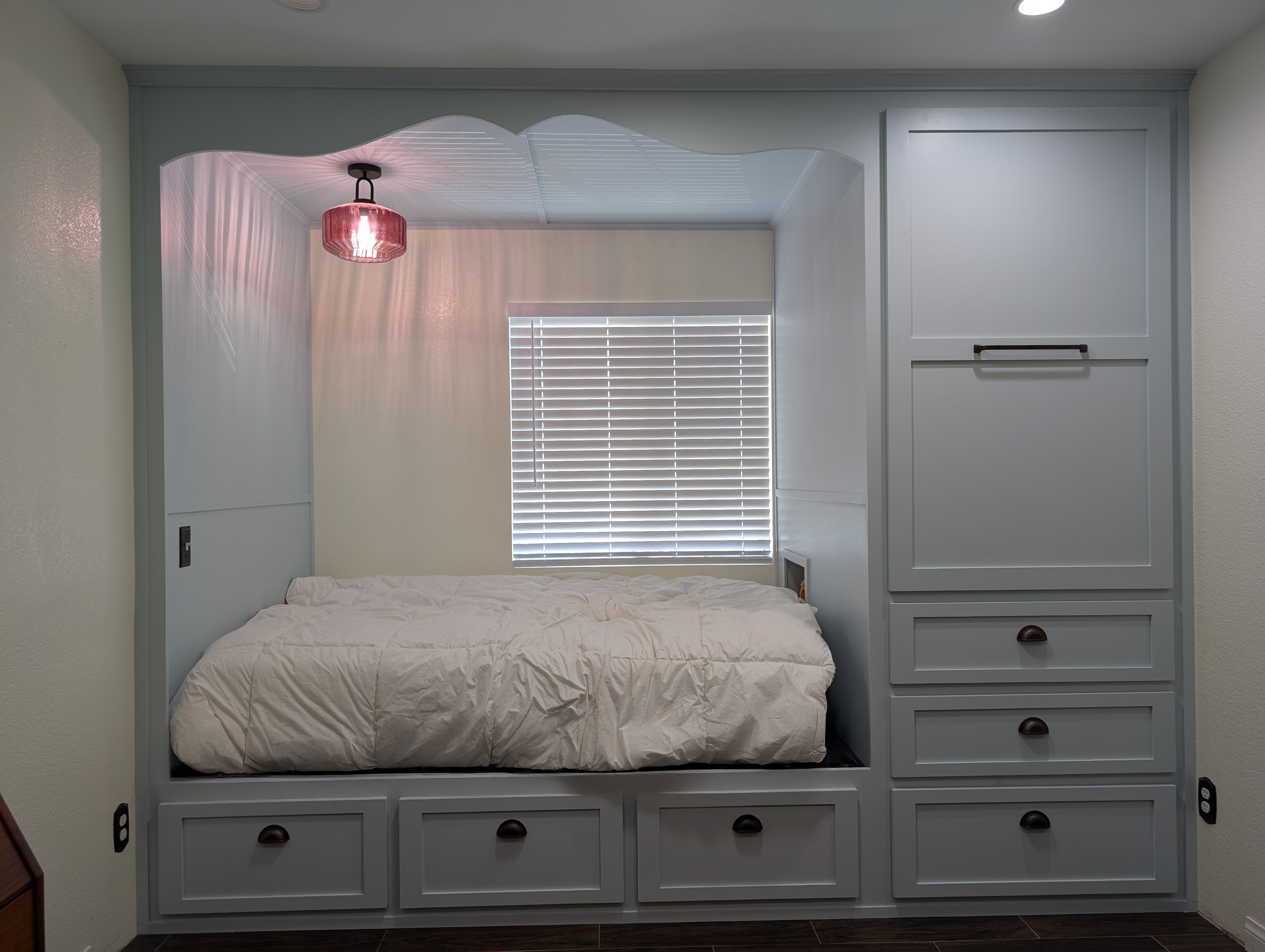
The Escalante bedroom had no built-in closet. That single fact changed the entire project scope. A production storage bed with four drawers would have added storage. It would not have added a closet.
What the custom built-in delivered that no production alternative could:
-
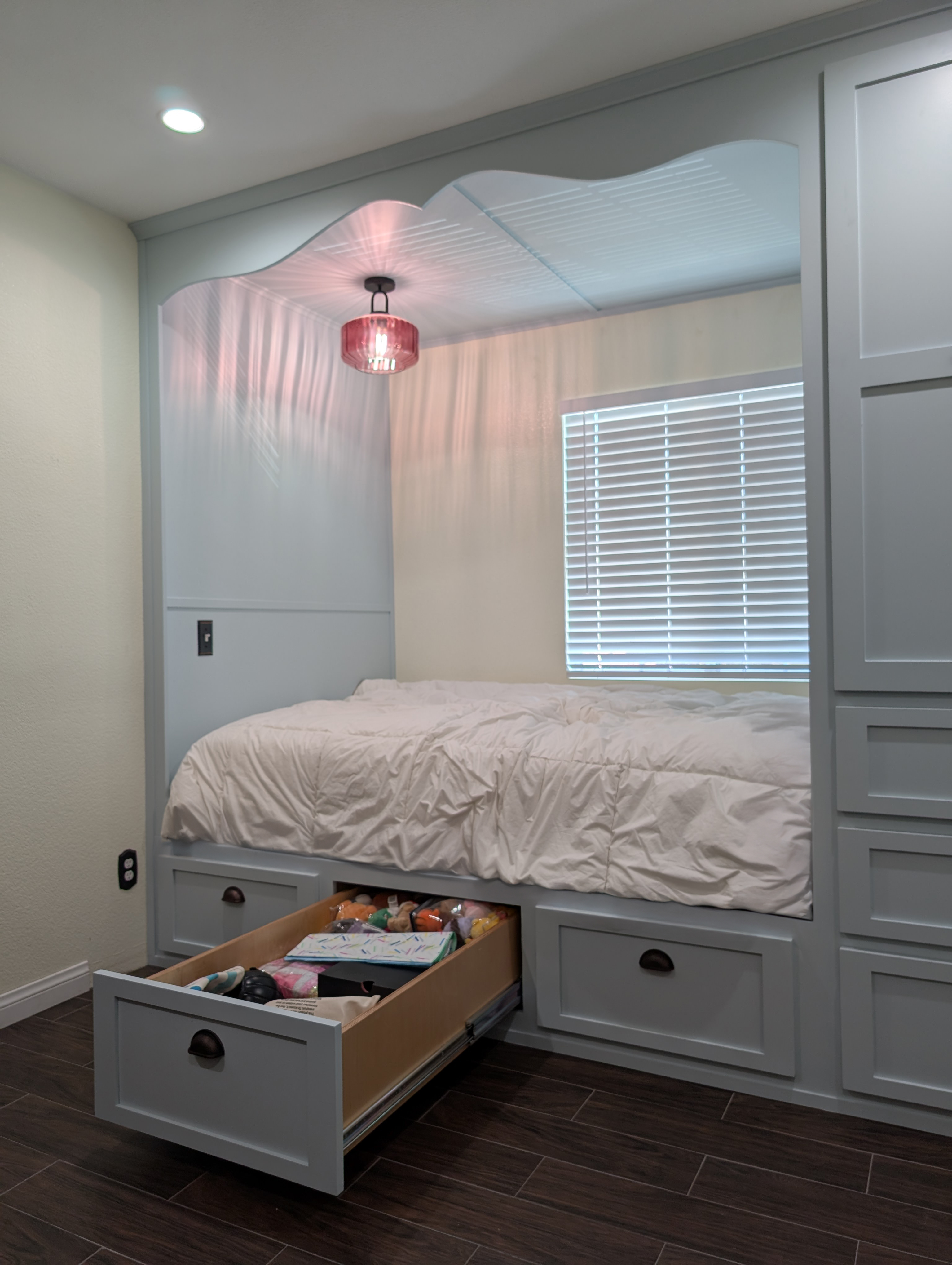
Six under-bed drawers on Fulterer FR 5400 industrial slides — 48" deep, 450–550 lb rated — accessible without disturbing the mattress
-
60-inch deep pull-out wardrobe with full hanger rod — a closet engineered into the built-in where no built-in closet existed
-
Wall-to-wall scope in a 9'10" room — no production bed fits that width cleanly
-
Hand-formed eyebrow arch framing the bed alcove — architectural detail that makes the room memorable
F. How These Options Perform in the Inland Empire
The Inland Empire's dry climate is one of the more demanding environments for wood furniture. Interior temperatures swing significantly between summer and winter, and Southern California's low humidity during summer months affects wood movement and hardware performance differently than a coastal climate.
For production storage beds: particleboard and MDF — the materials in most budget production beds — are more sensitive to humidity swings than solid wood or high-quality plywood. In the Inland Empire's summer heat (regularly 95–105°F in Menifee and Murrieta), an uninsulated garage-stored or direct-sun bedroom can push interior temperatures high enough to accelerate joint failure in particleboard furniture. This is a real durability consideration that production beds' national warranty language typically does not address.
For custom built-ins: ¾-inch Baltic birch plywood is dimensionally stable under humidity variation. It does not expand and contract the way solid wood does in solid-panel applications. The face frame and door fronts (solid maple rails and stiles, MDF center panels) are also designed for dimensional stability — the solid wood where rigidity matters, the stable MDF panel where flat surface is the priority. This is why cabinetmakers have used this construction method for painted built-ins for decades in variable climates.
For hardware: the Inland Empire's dry air is not a corrosion problem for quality hardware, but thermal expansion in metal components can affect slide operation if hardware is not specified with appropriate clearances. Fulterer FR 5400 slides are zinc-plated cold rolled steel with stainless ball bearings — appropriate for this climate and use case.
The Holland & Sons Angle
The Escalante project exists because a family asked the right question at the right time: what would it take to build a room with a real closet in a bedroom that has none? Not a wardrobe cabinet. Not a freestanding armoire. A wardrobe built into the wall, on slides, accessible the way a closet is accessible — fully, every day, without limitations.
That is not a question a production bed answers. It is a question that requires a contractor who has engineered that hardware before, who knows what a 60-inch pull-out under load actually demands of the cabinet box around it, and who is willing to stop mid-installation, research the right slides, and redesign the cabinet when the scope changes. Brian's son Wyatt was on that project learning exactly that — that the right answer to "can we do this differently" is not "no" or "maybe." It is "let me figure out what that requires."
Frequently Asked Questions
Custom built-in bed vs. production storage bed — which is better for Menifee?
For Menifee bedrooms without a built-in closet: custom built-in — it is the only solution that adds wardrobe infrastructure where none exists. For bedrooms with adequate closet space and supplemental storage goals: a well-made production storage bed is a practical and honest choice. The room's specific storage problem determines the answer, not a preference for one product category over another.
Is a Murphy bed better than a custom built-in platform bed?
They solve different problems. A Murphy bed prioritizes floor space when the bed is folded away — useful in a studio or dual-purpose room. A custom built-in platform bed prioritizes accessible storage while the bed is in use. If floor space during the day matters more than storage access at night, a Murphy bed may be right. If accessible, load-rated daily storage in a dedicated bedroom is the goal, a built-in platform bed is the better solution.
How long does a custom built-in bed last compared to a production bed?
A custom built-in fabricated from ¾-inch Baltic birch with load-rated hardware is designed to last decades under normal use — the same way well-built cabinetry lasts. Production storage beds vary widely: solid wood or metal frames from quality manufacturers perform comparably for many years, while budget particleboard frames typically show joint failure and screw fatigue within 5 to 10 years of regular use. The lifespan of the materials is not the same question as the lifespan of the product.
What are the pros and cons of a custom built-in bed?
Pros: fabricated to actual room dimensions, engineered for actual working loads, wardrobe integration where no closet exists, lasts decades, adds home value in production neighborhoods. Cons: significantly higher investment than production alternatives, permanently installed (stays with the room), requires a contractor with specifically relevant experience, 2–4 week lead time minimum. These tradeoffs are straightforward. The question is whether your room's specific situation makes the investment worth it.
Is a lift-up storage bed or a drawer bed better?
Lift-up hydraulic beds maximize storage volume — you get the entire under-mattress space — but you have to get out of the bed to access it. That makes them practical for seasonal or infrequently accessed items, not daily-use storage. Drawer beds offer access without disturbing the mattress. Custom built-in drawer beds, with full-extension slides rated for the actual load, combine that access advantage with the depth and capacity of a purpose-built system. For daily-use storage in a bedroom, the drawer bed wins on usability.
Should I get a production storage bed or a custom built-in for a bedroom with no closet?
Custom built-in. A production storage bed cannot integrate a wardrobe where no closet exists. It adds drawer storage — useful, but not a closet substitute. If the room genuinely needs hanging storage for clothing, only a custom built-in can deliver that within the bedroom footprint.
What is the difference between a custom cabinet shop and a general contractor for a built-in bed?
A custom cabinet shop fabricates components and may or may not install them. A general contractor with finish carpentry and cabinetry experience manages the full scope — design, fabrication, installation, incidental repairs, and any mid-build scope changes. For a project that includes carcass work, plywood wall cladding, arch fabrication, hardware engineering, and finish prep across a full bedroom wall, a contractor who manages the complete build is typically the better fit than a shop that delivers components and steps back.
Ready to Talk About Your Project?
If you're trying to solve a bedroom storage problem in Menifee, Murrieta, Temecula, Perris, or anywhere in the Inland Empire — fill out the form at hsconstruct.com/contact. Describe the room, describe the problem you're trying to solve, and upload any photos or rough sketches. Brian reviews every submission personally.
Serving Menifee, Murrieta, Temecula, Perris, Riverside, and the greater Inland Empire since 1991.
951-338-8058 | brian@hsconstruct.com | hsconstruct.com | CSLB #1123738
More Than Just Custom Beds
Custom built-in platform beds are one part of what Brian and his sons have been building since 1991 — which means every room in your home is fair game.
If your space needs more than a built-in bed, here's what else we build:
-
Kitchen and bathroom remodels — full custom cabinetry, tile work, and finish carpentry from demo to done
-
Coffered ceilings — grid beam systems that add architectural depth to any room, sized and proportioned to the space
-
Wainscoting and wall paneling — classic raised panel, flat panel, board-and-batten, and shiplap applications
-
Reclaimed wood accents — feature walls, fireplace surrounds, and detail work using salvaged material with real character
-
Beam wraps — hollow wood wraps that give exposed beams the look of solid timber without the structural engineering
-
Crown molding, baseboards, and trim carpentry — the details that make a house feel finished, from a single room to a whole home
-
Cased openings and interior door replacements — clean transitions between spaces that most contractors overlook
-
Custom built-in entertainment walls and bookshelves — designed by hand, built in the shop, installed to last
Wood, proportion, and rooms that feel right — that's what we do.
About the Author
Brian Holland is the owner and lead carpenter of Holland & Sons Construction, a family-run finish carpentry and general contracting company serving Riverside County and the Inland Empire since 1991. He entered the trade at 17, learned on the job, and has spent 35 years building the kind of work that makes rooms feel right — often before a homeowner can articulate why. His sons now apprentice alongside him on every project. Holland & Sons is based in Perris, CA and licensed by the CSLB (#1123738).
Related project
This guide is part of our custom built-ins & cabinetry series.
Learn more about Custom Built-Ins & CabinetryHave a project in mind? Let's start a conversation.
Tell us what you are thinking about and we will give you a straight answer about scope, timeline, and investment.
Start a Conversation