Chevron vs. Herringbone vs. Diagonal: Which Wood Wall Pattern Is Right for Your Menifee Home?
Quick Answer
For a formal living room feature wall in a Menifee new-build home — especially one anchored by an electric fireplace and flanking cabinetry — chevron is Brian's recommendation. The V-shape is directional and architectural, draws the eye up in a room with standard 9-foot ceilings, and reads as a clear intentional design decision rather than a texture. Herringbone is the right call when you want movement and layered depth without a single strong centerline. Straight diagonal or vertical planking is right when the room is smaller or when a simpler profile serves the space better. The correct answer depends on the wall, the room, and what the homeowner wants to happen when someone walks in.
Key Takeaways
-
Chevron: every board angle-cut at 45 degrees, continuous V-shape from a plumb centerline — more formal, more architectural, more labor-intensive
-
Herringbone: boards cut square on the ends, offset at 90 degrees — more textural, more layered, more forgiving to install
-
Diagonal (straight): boards run at a uniform angle, no mirroring — the simplest of the angled patterns, lower labor intensity
-
For a floor-to-ceiling feature wall anchored by an electric fireplace in a new-build Menifee living room, chevron delivers the strongest architectural impact
-
Chevron is not a trend — it is a classical geometric pattern; how it is executed determines whether it lasts
-
In the dry Inland Empire climate, hard maple with a UV-stabilized topcoat is the strongest material choice for any of these patterns
The Direct Answer
If you are choosing between these three patterns for a custom feature wall in a living room or great room in Menifee, Murrieta, or Temecula, here is Brian's call:
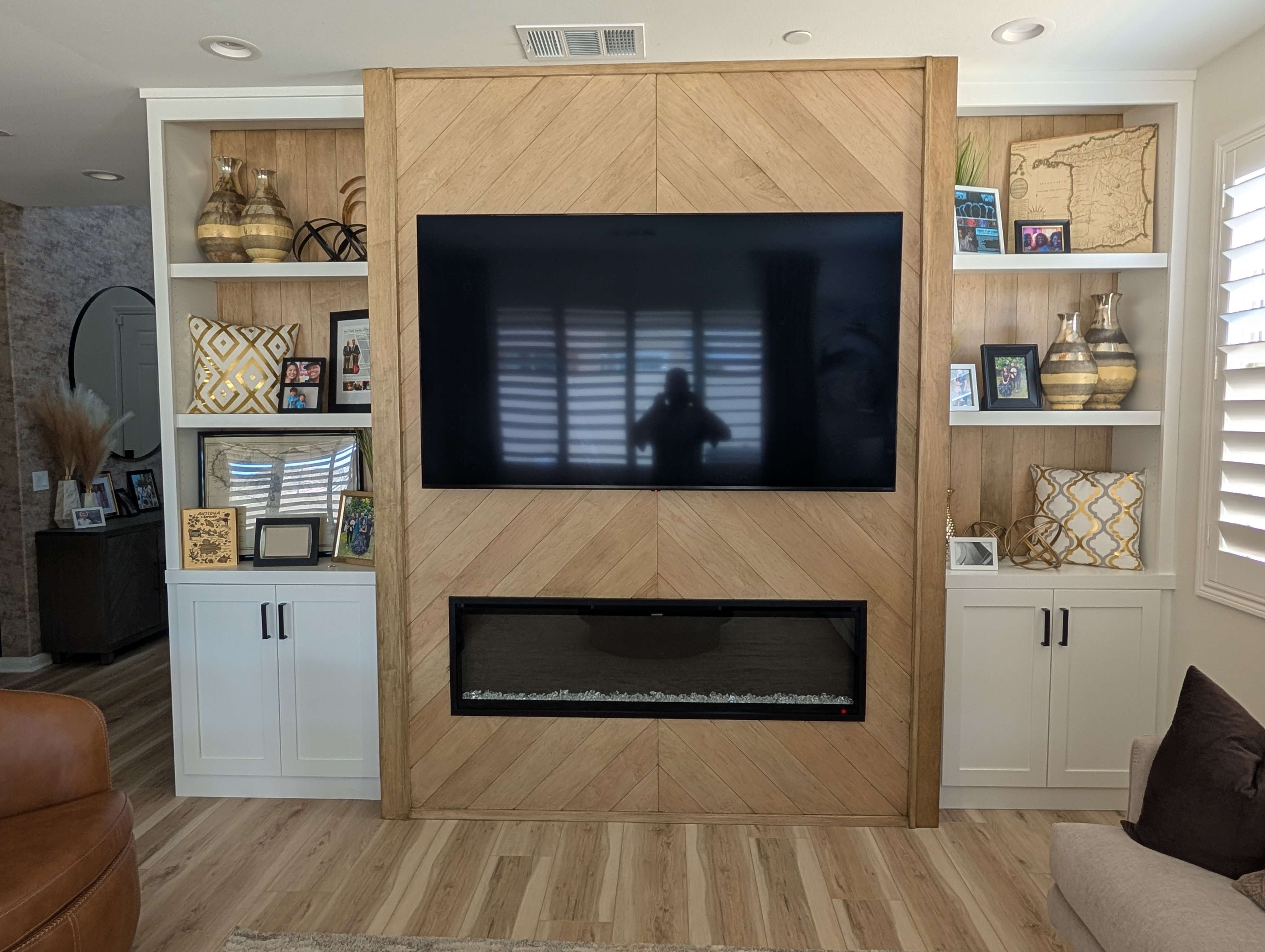
Chevron is the most architecturally bold of the three. The V-shape is intentional — it does not happen by accident and it does not read as wallpaper. When it is executed well, with a perfectly plumb centerline and tight intersecting cuts, it is a room-defining decision. That is what happened on the Liberty Bell project in Heritage at Bahner Park: A1 clear hard maple, 45-degree chevron, floor to ceiling, anchored by a Modern Ember Aerus 60" electric fireplace at the apex of the V. The wall stopped people before the fireplace was even lit.
Herringbone is the better call when you want the pattern to serve the room rather than command it. The staggered offset reads as texture from a distance and reveals its geometry up close. In a bedroom or study, or on a wall where the pattern needs to share visual space with strong furniture or architectural details, herringbone recedes where chevron asserts.
Straight diagonal planking is the right answer when the budget or the room proportions do not support a V-pattern. A single 45-degree run of boards — no mirroring, no center seam — delivers visual movement with lower labor cost and less precision required at installation.
Side-by-Side Comparison
| Factor | Chevron | Herringbone |
|---|---|---|
| Pattern geometry | Boards angle-cut at 45° on both ends; left and right boards mirror at a center seam to form continuous V-shape | Boards cut square on ends; offset at 90° angles in staggered zigzag — no mirrored cuts |
| Visual character | Bold, directional, architectural; strong vertical pull; reads as a formal design statement | Layered, textural, dimensional; lateral movement; more subtle at distance, richer up close |
| Installation complexity | High — plumb centerline is everything; small drift reads wrong across entire wall | Moderate — more forgiving than chevron; stagger tolerates minor variation without compound error |
| Labor vs. straight planking | Significantly higher — every board is a double angle cut | Moderately higher — no angle cuts required; offset adds layout time |
| Room size fit | Works best in larger rooms with floor-to-ceiling height — standard 9-foot or greater | Works in a broader range of room sizes; handles smaller walls without overwhelming |
| Feature wall with fireplace | Excellent — the V-apex naturally frames the fireplace opening from above | Good — the texture adds interest without competing with the fireplace |
| Inland Empire climate performance | Hard maple with UV-stabilized topcoat: excellent | Same material recommendation applies |
| Cost relative to straight planking | Higher labor cost | Moderate labor premium |
Why This Comparison Matters in the Inland Empire
Most online comparison content is written for tiles on kitchen backsplashes or floors. The rules are different for a solid wood feature wall in a living room in Menifee.
On a floor — where herringbone and chevron both originated, in Roman road paving and European parquet — the tolerances are different. Floor boards sit on a substrate. A small error in a floor installation is absorbed by the substrate and grouting. On a wall, every joint is visible. A centerline that drifts on a chevron wall compounds as the pattern builds outward — by the time you reach the ceiling on a 9-foot wall, a half-inch of drift at the floor reads as a full inch at the top. There is no hiding it.
This is why the centerline is the entire game on a chevron wall installation. Establish it, verify it is plumb, protect it through the entire installation. Slow the work down at that step. Everything else builds from that decision.
The PAA Questions — What Homeowners Are Actually Searching
Is chevron going out of style?
No. Chevron is a classical geometric pattern with origins in Roman road construction circa 500 BC and Egyptian jewelry long before that. It is not a trend. What goes in and out of style is how the pattern is executed — the wood species, the finish, the proportional relationship between the pattern and the room. A well-proportioned chevron wall in A1 clear hard maple, finished with a non-yellowing UV-stabilized topcoat, is as architecturally sound in 2026 as it would have been in 1986. The Liberty Bell project demonstrates exactly that: the wall does not look trendy. It looks like a decision made by someone who thought carefully about the room.
Does chevron pattern make a room look bigger?
The upward V-shape of a chevron pattern draws the eye vertically, which makes a wall feel taller. In a Menifee new-build home with standard 9-foot ceilings — the baseline for most DR Horton, Lennar, and Richmond American homes in the area — a floor-to-ceiling chevron panel creates a sense of vertical scale that a horizontal pattern does not. Herringbone creates lateral movement, which reads as widening rather than heightening. Neither is universally better; the choice depends on what the room needs.
Which pattern is easier to install on a wall?
Herringbone is more forgiving than chevron. Herringbone boards are cut square on the ends and offset — small variations in installation are absorbed by the staggered pattern. Chevron boards are each cut at 45 degrees on both ends, and the entire pattern references a centerline that must stay perfectly plumb from floor to ceiling. A small error at the centerline compounds through the whole wall. Both are significantly more labor-intensive than straight horizontal or vertical planking. Straight diagonal falls between the two.
The Decision Framework
When is chevron right?
-
The wall is the primary feature of the room and needs to command it
-
A fireplace is integrated — the V-apex frames the fireplace opening naturally from above
-
The room has enough volume to carry a bold directional pattern without feeling claustrophobic
-
The homeowner wants the wall to be the thing people talk about when they describe the house
When is herringbone right?
-
The pattern needs to add texture and movement without competing with strong furniture or architectural details
-
The room is smaller or the ceiling height is lower than standard
-
The goal is a layered, dimensional wall that rewards close inspection
-
The budget is sensitive to labor cost but the homeowner still wants a pattern that is genuinely interesting
When is straight diagonal right?
-
The room does not need a V-pattern to feel complete — directional movement is enough
-
The budget or timeline does not support the labor of a mirrored pattern
-
The design language of the home calls for something simpler and less formal
See This In Action — The Liberty Bell Project, Menifee, CA
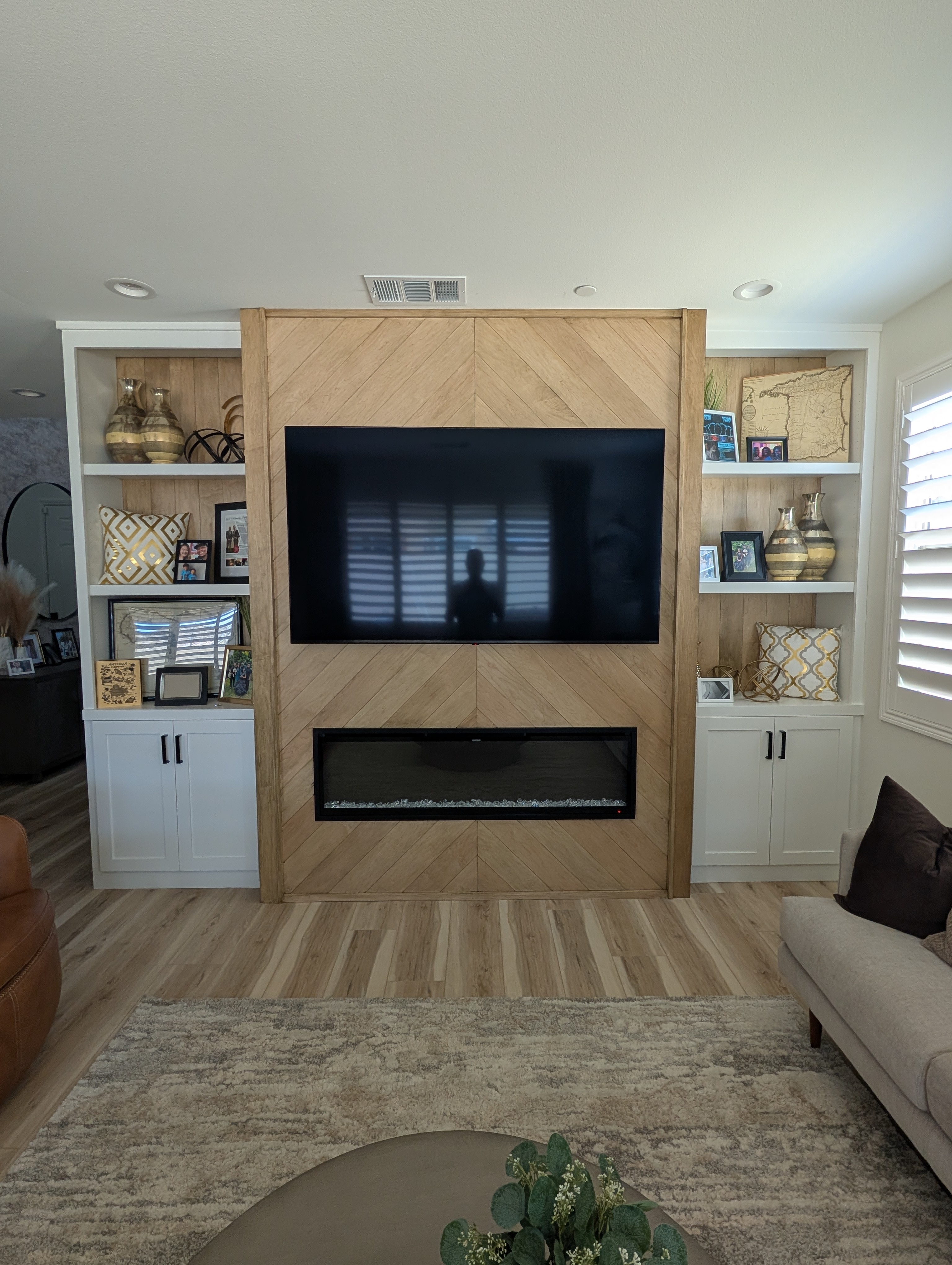
The Liberty Bell project put a 45-degree chevron pattern in A1 clear hard maple across a floor-to-ceiling center feature panel in a Heritage at Bahner Park living room. Every board was cut on both ends at 45 degrees. Left-side boards and right-side boards mirror each other. They all meet at a centerline verified plumb before the first board was set.
What was built and why chevron was the right call on this project:
-
The room needed a focal point — not texture, but a centerpiece. Chevron delivers that. Herringbone would have added movement without a center.
-
The electric fireplace is centered in the panel — the V-apex naturally frames the fireplace chase from above and draws the eye downward to the flame.
-
The flanking cabinet towers are painted white, which gives the chevron maple center panel room to be the feature it is. Full stain-grade throughout would have competed; chevron with painted flanking elements lets the pattern breathe.
-
The 9-foot ceilings in the Heritage at Bahner Park home benefit from the vertical pull of the V-shape — the wall reads taller than it is.
Regional Performance Note: Wood Wall Patterns in the Inland Empire
The Inland Empire climate is dry and warm, with significant temperature swings between winter and summer and strong UV exposure from south-facing windows. These conditions affect wood wall installations in two ways.
First, dimensional movement. Wood expands and contracts with humidity changes. In a dry inland climate with low humidity most of the year, hardwoods with tight, consistent grain — hard maple and rift-sawn white oak in particular — are more dimensionally stable than species with more open or irregular grain. For a chevron pattern where tight joints at every 45-degree intersection are critical, stability matters. A species that moves more aggressively will open joints over time.
Second, UV exposure. South-facing windows in Inland Empire homes admit significant direct sun. A finish without UV protection will amber (yellow) over time on maple, changing the color of the wood and degrading the topcoat. General Finishes High Performance Water Based Top Coat Satin — used on the Liberty Bell project — is UV-stabilized and non-yellowing. That matters in this climate in a way it does not in a foggy coastal market.
The Holland & Sons Angle
On the Liberty Bell project, the decision to go with chevron over herringbone was made at the drafting table, not on the wall. The room wanted a centerpiece, not a texture. The fireplace placement — centered in the panel — meant the pattern needed a center seam to reference. Herringbone does not have one. Chevron does, and the fireplace sits right at the base of the V.
The centerline on that project was established before the first board was set and checked every three to four courses as the pattern built outward. That is what slows the work down. It is also what makes it look right. A chevron wall that was laid out fast looks fast. The Liberty Bell wall does not look fast.
Brian's sons worked the pattern from the center outward on both sides simultaneously, keeping each course level and checking the centerline. That is the kind of teamwork that turns a precise drawing into a precise wall — the next generation learning what locked-in accuracy actually feels like when it is in your hands.
Frequently Asked Questions
What is the difference between chevron and herringbone wood wall patterns?
In a chevron pattern, each board is cut at a 45-degree angle on both ends, and mirrored left and right boards meet at a continuous center seam to form a V-shape. In a herringbone pattern, boards are cut square on the ends and offset at 90-degree angles in a staggered zigzag. Chevron reads cleaner and more architectural. Herringbone reads more textural and layered. Both are significantly more labor-intensive than straight planking.
Which wood wall pattern is right for a living room feature wall in Menifee, CA?
For a formal living room feature wall in a Menifee new-build home — especially one anchored by an electric fireplace and flanking cabinetry — chevron is the stronger choice. Herringbone works better when you want texture and movement without a single strong directional pull. Straight diagonal is the right call when the room proportions do not support a V-pattern or when the budget is more sensitive to labor cost.
Is chevron going out of style?
No. Chevron is a classical geometric pattern that predates modern interior design by centuries. What changes is how it is executed. A well-proportioned chevron wall in A1 clear hard maple, finished properly, is architecturally sound regardless of what year it is. The Liberty Bell project in Menifee demonstrates that — the wall does not look trendy. It looks considered.
Is chevron or herringbone harder to install on a wall?
Chevron is harder. Every board is cut at 45 degrees on both ends, and the centerline must be perfectly plumb from floor to ceiling. A small drift in the centerline compounds through the entire wall and is immediately visible. Herringbone boards are cut square on the ends and offset — the installation is more forgiving. Both are significantly more labor-intensive than straight planking.
Does chevron pattern make a room look bigger?
The upward V-shape draws the eye vertically, which makes a wall feel taller. In a Menifee new-build home with 9-foot ceilings, a floor-to-ceiling chevron panel creates vertical scale that horizontal patterns do not. Herringbone creates lateral movement — widening rather than heightening. The choice depends on what the room needs.
What angle is used for a chevron wall pattern?
The standard chevron wall pattern uses a 45-degree cut on each board end. Left-side boards and right-side boards are mirror images of each other, meeting at the center seam. The Liberty Bell project used 45-degree cuts throughout, with the centerline verified plumb before the first board was set and protected through the entire installation.
Which wood wall pattern works best in the Inland Empire climate?
Hard maple is the strongest material choice for any of these patterns in the Inland Empire. It is one of the hardest domestic hardwoods (Janka 1,450), dimensionally stable in dry conditions, and holds angle cuts cleanly over time. A UV-stabilized, non-yellowing topcoat — General Finishes High Performance Water Based Top Coat Satin was used on the Liberty Bell project — is essential in a market with strong sun exposure from south-facing windows.
Start Your Project
If you are choosing between patterns for your Menifee, Murrieta, or Temecula feature wall, the best starting point is a conversation about the room — not just the wall. The pattern follows from the room. Brian works through that in the design phase, before any materials are ordered.
Ready to talk? <span class="underline">hsconstruct.com/contact</span>
We serve Menifee, Murrieta, Temecula, Perris, Riverside, and the greater Inland Empire. Follow the work at @hollandandsonsconstruction.
951-338-8058 | brian@hsconstruct.com | hsconstruct.com | CSLB #1123738
More Than Just Feature Walls
Pattern and proportion are what Holland & Sons thinks about on every project — whether it is a chevron wall or a coffered ceiling. Brian and his sons have been finish carpenters since 1991, which means every room in your home is fair game.
If your space needs more than a feature wall, here is what else we build:
-
Kitchen and bathroom remodels — full custom cabinetry, tile work, and finish carpentry from demo to done
-
Coffered ceilings — grid beam systems that add architectural depth to any room, sized and proportioned to the space
-
Wainscoting and wall paneling — classic raised panel, flat panel, board-and-batten, and shiplap applications
-
Reclaimed wood accents — feature walls, fireplace surrounds, and detail work using salvaged material with real character
-
Beam wraps — hollow wood wraps that give exposed beams the look of solid timber without the structural engineering
-
Crown molding, baseboards, and trim carpentry — the details that make a house feel finished, from a single room to a whole home
-
Cased openings and interior door replacements — clean transitions between spaces that most contractors overlook
-
Custom built-in entertainment walls and bookshelves — designed by hand, built in the shop, installed to last
Wood, proportion, and rooms that feel right — that is what we do.
<span class="underline">hsconstruct.com</span>
About the Author
Brian Holland is the owner and lead carpenter of Holland & Sons Construction, a family-run finish carpentry and general contracting company serving Riverside County and the Inland Empire since 1991. He entered the trade at 17, learned on the job, and has spent 35 years building the kind of work that makes rooms feel right — often before a homeowner can articulate why. His sons now apprentice alongside him on every project. Holland & Sons is based in Perris, CA and licensed by the CSLB (#1123738).
This guide is part of our custom fireplace walls series.
Learn more about Custom Fireplace WallsHave a project in mind? Let's start a conversation.
Tell us what you are thinking about and we will give you a straight answer about scope, timeline, and investment.
Start a Conversation