
Built-In Entertainment Wall vs. Freestanding Furniture: Which Is Right for Your Temecula Home?
Quick Answer
For most Temecula and Inland Empire homeowners who plan to stay in their home several years, a custom built-in entertainment wall is the better choice — it delivers more storage, better proportion, and a finished look that reads as a permanent upgrade to buyers. Freestanding furniture is the smarter call when you rent, move often, or want the flexibility to rearrange. The deciding factor is usually how long you’ll live with it. Holland & Sons has built custom entertainment walls across Riverside County since 1991.
Key Takeaways
-
Built-ins win on storage, proportion, and permanence; furniture wins on flexibility and lower upfront cost.
-
In open-concept tract homes, a built-in anchors the room and fixes the “blank wall, floating TV” problem.
-
Furniture is the honest choice for renters, short stays, or rooms still finding their layout.
-
Holland & Sons designs built-ins to the room — not the wall — so they read as architecture, not furniture.
See this in action: the Brewster Built-In project (Paseo Del Sol, Temecula)
Here’s the straight answer most articles won’t give you: if you’re staying in your Temecula home for the next several years, build the built-in. It will out-store, out-last, and out-look any freestanding unit you can buy, and it will read to a future buyer as part of the house rather than something you brought in. If you rent, move every couple of years, or haven’t settled how the room is laid out, buy the furniture. There’s no shame in the flexible choice when flexibility is what you actually need.
Most of the advice online lands on “it depends” and leaves you exactly where you started. So let’s make it depend on something concrete: your timeline, your storage needs, and what your room is doing wrong right now. By the end you’ll know which side of this you’re on.
The Direct Answer
For the most common Inland Empire situation — a homeowner in an open-concept tract home planning to stay put — the built-in is the right call. The reason is simple: these floor plans give you space but no focal point, and a freestanding console under a wall-mounted TV leaves the room feeling unanchored. A built-in fixes the proportion problem furniture can’t touch. The exception is real and worth respecting: if you rent, expect to move soon, or the room’s layout is still in flux, furniture’s flexibility is the better fit.
Built-In vs. Freestanding, Side by Side
| Factor | Custom Built-In | Freestanding Furniture |
| Upfront investment | $9,000–$15,000+ for a full custom wall | $300–$3,000 for a console or unit |
| Installation | Designed, fabricated, and installed over several days | Delivered and placed (or self-assembled) in hours |
| Storage & display | Maximized for the wall and how you live | Fixed to the piece you buy; often gaps and wasted space |
| Proportion & fit | Scaled to the room — anchors the space | Rarely fits the wall; floating TV stays a problem |
| Permanence | Permanent fixture, part of the architecture | Movable, replaceable, takes it with you |
| Longevity | Hand-built to last decades | Often replaced every several years |
| Dry-climate performance | Quality materials handle inland temperature swings well | Particleboard units can loosen and sag over time |
| Resale appeal | Reads as a built-in upgrade buyers remember | Leaves with you; adds nothing to the home |
Why This Comparison Matters Right Now
Temecula, Murrieta, and Menifee are full of open-concept tract homes — DR Horton, Lennar, Richmond American floor plans built for spaciousness. That openness is the selling point and the problem. There’s no natural focal point, so the TV ends up floating on a blank wall above a console that’s too small for it, and the whole living area feels like it’s missing a center. The generic online advice treats this as a furniture-shopping question. It isn’t. It’s a proportion question, and that’s where Brian’s field experience changes the answer: a built-in is the only one of these two options that can actually solve the blank-wall problem these homes were built with.
The Other Options, Briefly
Built-in and freestanding aren’t the only two paths homeowners ask about. Here’s the honest landscape in one table so you can rule them in or out:
| Option | What It Solves | What It Doesn’t Solve | Right For |
| Semi-custom built-in | Custom look at a lower spend than full custom | Top-tier material and detail | Stayers who want the built-in look on a budget |
| Repurposed kitchen cabinets | Lower cost using stock cabinet boxes | True fit, proportion, and furniture-grade detail | DIY-minded budgets willing to trade fit for price |
| High-end freestanding console | A quality movable piece | The floating-TV and proportion problem | Renters and frequent movers wanting nice furniture |
If the budget is the sticking point rather than the format, the real pricing examples for each option in the cost guide will help you see where the money actually goes.
The Questions Underneath the Question
A few things people really want answered when they search this:
-
Is a built-in worth it? For multi-year stays, yes — the storage, proportion, and finished look justify the investment, and it reads as a permanent upgrade. For short stays, the math tilts toward furniture.
-
Are built-ins outdated? Built-ins aren’t outdated; bad ones are. A unit built around a trend ages badly. One designed to the room with timeless materials does not — which is its own topic in the problems guide.
-
Can I use kitchen cabinets for it? You can, and it lowers cost — but stock boxes rarely give you the depth, proportion, or furniture-grade edges of purpose-built cabinetry. It’s a fit-versus-price trade.
When Furniture Is the Better Choice
Honesty builds trust, so here’s the case against a built-in. Choose freestanding furniture when:
-
You rent, or you expect to move within a couple of years.
-
The room’s layout isn’t settled and you may rearrange.
-
Upfront budget is the hard constraint and flexibility matters more than permanence.
-
You want to take the piece with you to the next home.
Choose a built-in when you’re staying, you want maximized storage and proportion, and you want the room to feel finished rather than furnished.
See This In Action — The Brewster Built-In
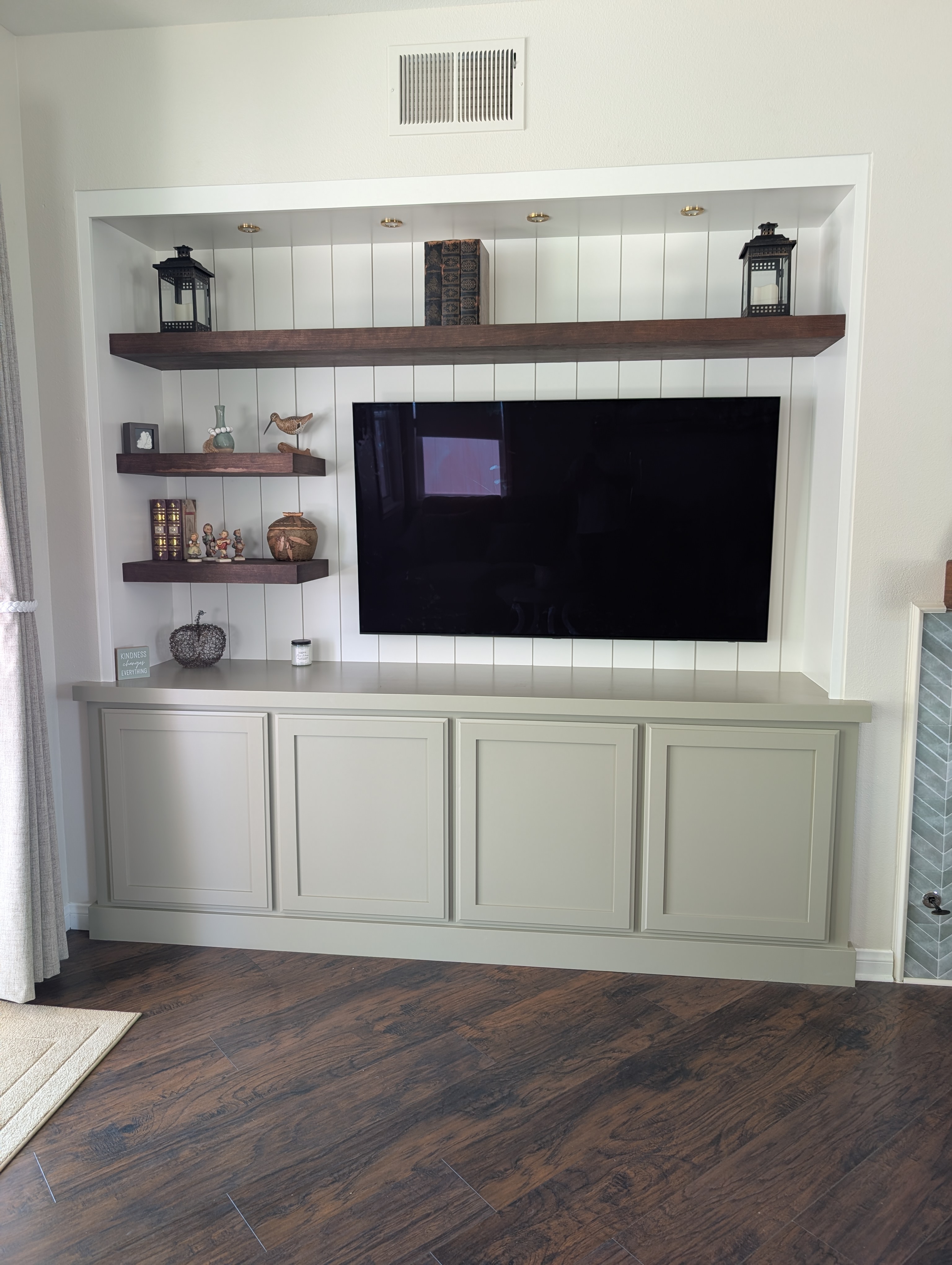
Before demo even began on the Brewster project, the crew carefully removed a section of the old unit’s crown molding just to get inside the niche and capture exact measurements — then reinstalled it so the homeowner didn’t live with an eyesore while her new unit was in production. That single step captures the difference between the two options in this post: a built-in demands that kind of precision because it becomes part of the house, and that permanence is exactly what furniture can’t offer and doesn’t require.
What we used on this project:
-
A built-in designed to the room — TV biased right to match the seating, not centered by default
-
Hand-built maple cabinet base providing real storage the previous furniture-era unit lacked
-
Crown molding removed for a precise pre-measure, then reinstalled — no eyesore during fabrication
-
A unit set within the niche so it reads as architecture, not a piece pushed against the wall
You’ll find the full story, the design sketch, and before-and-after photos here: the Brewster Built-In.
How Each Option Performs in the Inland Empire
Our dry inland climate and big day-to-night temperature swings are harder on furniture than people expect. Mass-produced particleboard consoles loosen at the joints and sag over a few seasons of expansion and contraction. A built-in made from quality plywood and properly finished hardwood handles those swings far better — dimensionally stable material, sealed surfaces, no wobble. On resale, the local picture matters too: a buyer who doesn’t want your furniture simply ignores it, while a well-built built-in that suits the room reads as a quality upgrade. The honest caveat — a built-in scaled wrong or finished in a trend color can read as a negative to some buyers, which is exactly why designing to the room, not the wall, matters.
The Holland & Sons Angle
The crown-molding step on the Brewster project tells you everything about why a built-in is a different animal than furniture. You don’t pre-measure a TV console — you set it down. But a unit that’s going to become part of the wall has to fit the niche to the sixteenth, so the crew pulled the old crown, measured inside, and put it back, all before demo. That’s a furniture buyer’s afternoon versus a finish carpenter’s discipline. Brian’s son handled the crown reinstall himself — learning that the careful, unglamorous steps nobody sees are what make the visible result look effortless.
Related Resources — Built-In Entertainment Wall Guide
This guide is part of a full cluster on planning, building, and getting a custom built-in entertainment wall right in the Inland Empire.
How Much Does a Custom Built-In Entertainment Wall Cost? — real line-item pricing, tiers, and what drives the investment.
What Goes Wrong With Built-In Entertainment Walls — the mistakes that derail a build, and how to avoid them.
Best Wood for Floating Shelves: Cherry vs. Walnut vs. White Oak vs. Maple — a carpenter’s take on choosing the right species.
How to Hire the Right Contractor for a Custom Built-In — the scorecard, the questions, and the red flags.
Built-In Entertainment Wall Materials Explained — the boxes, finishes, and hardware behind a built-to-last unit.
Frequently Asked Questions
What’s the difference between a built-in and a freestanding entertainment center?
A built-in is a custom-designed, permanent unit integrated into the room’s architecture — fabricated for one wall and installed in place. A freestanding entertainment center is movable furniture you buy and set down, and can take with you or rearrange. The built-in maximizes storage and proportion for the specific room; the freestanding piece offers flexibility and a lower upfront cost. The right one depends mostly on how long you plan to stay.
Is a custom built-in entertainment center worth it?
For homeowners staying several years, yes. A built-in delivers more usable storage, proportion suited to the room, and a finished look freestanding furniture can’t match — and it reads as a permanent upgrade to future buyers. For renters or short stays, the value tilts toward furniture, since you can’t take a built-in with you. The deciding factor is your timeline more than your budget.
Do built-ins add more home value than furniture?
A quality built-in that suits the room adds to buyer perception of quality and care, while freestanding furniture leaves with you and adds nothing to the home. Custom storage projects consistently rank well for buyer appeal. That said, a built-in scaled wrong or finished in a trend color can read as a negative — which is why design matters. The cost guide in this cluster covers local ROI in more detail.
Can you use kitchen cabinets to build an entertainment center?
You can, and it lowers cost by starting from stock boxes. The trade-off is fit: kitchen cabinets are built to standard depths and dimensions that rarely match what an entertainment wall needs, and they don’t give you the furniture-grade edges, proportion, or floating-shelf detail of purpose-built cabinetry. It’s a reasonable budget path if you accept the compromise in fit and finish.
Are built-in entertainment centers outdated?
Built-ins aren’t outdated — poorly designed ones are. The dated reputation comes from 1990s units built around trends: arched hutches, honey glazes, raised panels. A built-in designed to the room with timeless materials and proportion looks current for decades. The format isn’t the problem; the design choices are. The problems guide in this cluster covers how to keep a built-in from aging badly.
Will a built-in hurt resale if a buyer doesn’t want it?
A well-built, well-proportioned built-in in neutral, timeless materials generally helps resale — it reads as a quality upgrade, and a buyer who isn’t interested simply uses it differently rather than seeing a problem. The risk comes from built-ins scaled wrong for the room or finished in a strong trend color, which some buyers may want to change. Designing to the room with lasting materials is what protects resale value.
Which is cheaper, a built-in or freestanding furniture?
Freestanding furniture is cheaper upfront — a console or unit runs a few hundred to a few thousand dollars, versus $9,000–$15,000+ for a full custom built-in. Over time the gap narrows, because budget furniture often gets replaced every several years while a hand-built built-in lasts decades. If lowest upfront cost is the priority, furniture wins; if cost-per-year and permanence matter, the built-in is competitive.
Ready to Decide?
If you’re weighing a built-in against furniture for your home in Temecula, Murrieta, Menifee, Perris, Riverside, or anywhere in the greater Inland Empire, the best next step is a conversation. Visit hsconstruct.com/contact, fill out the form, describe your room, and upload a few inspiration photos. Brian will give you a straight answer about which option actually fits your situation — even when that answer is furniture.
Want to see this advice applied to a real project? Here’s the full breakdown: the Brewster Built-In.
You can also follow Holland & Sons on social media to watch projects come together from sketch to install.
951-338-8058 | brian@hsconstruct.com | hsconstruct.com | CSLB #1123738
More Than Just Entertainment Walls
A built-in is the right answer for a lot of Inland Empire living rooms — but it’s one of many ways we make a room feel finished. Brian and his sons have been finish carpenters since 1991, which means every room in your home is fair game.
If your space needs more than a built-in, here's what else we build:
-
Kitchen and bathroom remodels — full custom cabinetry, tile work, and finish carpentry from demo to done
-
Coffered ceilings — grid beam systems that add architectural depth to any room, sized and proportioned to the space
-
Wainscoting and wall paneling — classic raised panel, flat panel, board-and-batten, and shiplap applications
-
Reclaimed wood accents — feature walls, fireplace surrounds, and detail work using salvaged material with real character
-
Beam wraps — hollow wood wraps that give exposed beams the look of solid timber without the structural engineering
-
Crown molding, baseboards, and trim carpentry — the details that make a house feel finished, from a single room to a whole home
-
Cased openings and interior door replacements — clean transitions between spaces that most contractors overlook
-
Custom built-in entertainment walls and bookshelves — designed by hand, built in the shop, installed to last
Wood, proportion, and rooms that feel right — that’s what we do.
hsconstruct.com
About the Author
Brian Holland is the owner and lead carpenter of Holland & Sons Construction, a family-run finish carpentry and general contracting company serving Riverside County and the Inland Empire since 1991. He entered the trade at 17, learned on the job, and has spent 35 years building the kind of work that makes rooms feel right — often before a homeowner can articulate why. His sons now apprentice alongside him on every project. Holland & Sons is based in Perris, CA and licensed by the CSLB (#1123738).
Related project
This guide is part of our custom built-ins & cabinetry series.
Learn more about Custom Built-Ins & CabinetryHave a project in mind? Let's start a conversation.
Tell us what you are thinking about and we will give you a straight answer about scope, timeline, and investment.
Start a Conversation