Built-In Entertainment Wall Materials Explained: Plywood, MDF, Finishes & Hardware That Last
Quick Answer
A built-to-last custom built-in uses hardwood plywood for the cabinet box (where strength and screw-holding matter), MDF for paint-grade surfaces (where a dead-flat finish matters), a durable urethane enamel on painted cabinetry, a penetrating hardwax oil on stain-grade wood, and quality soft-close hardware. The material choice for each part follows its job — not a single “best” material for everything. On the Brewster project in Temecula, Holland & Sons combined all of these in one unit, matching each material to what that surface needed to do.
Key Takeaways
-
Plywood for the cabinet box (strength, screw-holding); MDF for paint-grade panels (dead-flat finish). Each does a different job.
-
A durable urethane trim enamel is the right spec for painted cabinetry; ordinary latex isn’t built for it.
-
A penetrating hardwax oil protects stain-grade wood from within and is easy to refresh — well suited to a dry climate.
-
Holland & Sons specifies each material by name and job — the Brewster unit used plywood, MDF, hardwax oil, urethane enamel, and Blum hardware together.
See this in action: the Brewster Built-In project (Paseo Del Sol, Temecula)
A custom built-in isn’t made of one material — it’s made of the right material in each place, and that’s the whole point of this guide. The cabinet box, the painted panels, the shelves, the finish, and the hardware each have a different job, and a contractor who knows the work picks each one for what that part has to do. Use plywood where you need strength and screw-holding. Use MDF where you need a dead-flat surface for paint. Use a urethane enamel where the finish takes abuse, and a hardwax oil where you want natural wood to look and feel like wood.
This is the construction-side companion to choosing a wood species. If you’re deciding between cherry, walnut, white oak, or maple for the visible shelves, that’s a separate question covered in the species guide linked below. Here we’re talking about what the box, the panels, the finish, and the hardware are made of — the parts that decide whether your built-in is built to last or built to a price.
The Cabinet Box: Plywood vs. MDF
This is the most-asked materials question, and the honest answer is that the best custom built-ins use both — each where it belongs. Here’s the breakdown:
| Material | Best Used For | Why |
| Hardwood plywood (e.g., 3/4” maple) | The cabinet box, face frame, structural parts | Dimensionally stable, holds screws and joints, machines cleanly, lasts decades |
| MDF | Paint-grade panels — upper-zone cladding, backers, smooth surfaces | Dead-flat, no grain telegraphing through paint, cuts cleanly for precise reveals |
| Particleboard / RTA | Budget builds only | Cheaper, but loosens at joints and fails sooner — the hallmark of built-to-a-price |
The takeaway: plywood where strength matters, MDF where a flawless painted surface matters, and particleboard avoided in anything meant to last. A box built from quality plywood is the difference between a unit that survives decades and one that loosens in a few years.
Why MDF for Painted Surfaces
It surprises people that the premium choice for a painted panel is often MDF, not wood. The reason is simple: MDF (medium-density fiberboard, an engineered panel with no grain) is dead flat and has no grain to telegraph through a high-sheen finish. Paint a high-sheen enamel over solid wood or textured drywall and you’ll see the grain or texture ghosting through under raking light. Paint it over properly prepped MDF and you get a factory-smooth result. That’s why the best painted cabinetry and upper-zone cladding uses MDF where it won’t take structural load — the surface is the product, and MDF gives the cleanest one. The trade-off: MDF is heavier than plywood and doesn’t tolerate moisture, so it stays on interior, painted, non-structural surfaces.
The Finish System
The finish is what most people see and judge, and it’s where corners get cut quietly. Two finish families do the heavy lifting on a built-in:
Durable Urethane Enamel — for Painted Cabinetry
For painted cabinet doors and trim, the right spec is a hybrid urethane-modified alkyd enamel — it applies like a water-based paint but cures to a hard, oil-like finish that resists chipping and cleaning. Sherwin-Williams Emerald Urethane Trim Enamel is one widely specified example; it self-levels so brush strokes flatten out and dries to a hard, non-yellowing surface. Ordinary interior latex is not built for cabinetry — it scuffs and dings under everyday use. This is the single finish upgrade that most affects how a built-in ages.
Penetrating Hardwax Oil — for Stain-Grade Wood
For visible stain-grade wood like floating shelves, a penetrating hardwax oil is the finish to know. Unlike a film-building stain-and-poly, Rubio Monocoat Oil Plus 2C soaks into the wood fiber in a single coat — 0% VOC, no plastic build on the surface, and the wood reads as richer and more natural. It’s easy to refresh later with the manufacturer’s product rather than fully refinishing, which suits a dry inland climate where you want the wood sealed but breathing. The species you put it on is a separate decision — see the floating-shelf species guide.
The Hardware
Hardware is the part nobody notices until it fails. Quality concealed soft-close hinges — Blum BLUMOTION is a standard example — close cabinet doors smoothly and quietly and keep doing it for the life of the unit, where bargain hinges loosen and sag. On a built-in you use every day, hardware is a small line item with an outsized effect on how the piece feels years on. It’s worth specifying by type or brand in the quote, not leaving as “hardware included.”
Backer Panels and Cladding
The surfaces behind and around the display zone matter more than people expect. A nickel-gap shiplap backer (tongue-and-groove boards installed with a consistent small gap — traditionally a nickel’s width — for a shadow-line detail) adds texture without competing with what sits on the shelves. For upper-zone cladding on the sides, back, and ceiling of a TV niche, MDF gives the dead-flat painted surface that drywall texture can’t. These choices read as small but they’re the difference between a niche that looks finished and one that looks framed-in.
Material-Performance Comparison
| Material | Role | Best For | Watch For |
| Hardwood plywood | Structure | Cabinet box, face frame | Costs more than RTA — worth it for longevity |
| MDF | Paint-grade surface | Upper-zone cladding, panels | Heavy; no moisture exposure |
| Urethane trim enamel | Painted finish | Cabinet doors, trim | Premium per gallon; longer cure than latex |
| Hardwax oil | Wood finish | Stain-grade shelves | Finish quality depends on prep & sanding |
| Soft-close hardware | Function | Doors, drawers | Specify by type — don’t accept “included” |
How These Choices Affect Your Investment
Materials are where the price spreads, so it helps to see the deltas. Compared with the budget alternative for each part, here’s roughly how much the built-to-last choice adds:
| Material Upgrade (vs. budget alternative) | Approx. Investment Impact |
| Hardwood plywood box vs. RTA / particleboard | +$1,200 – $1,800 |
| MDF upper-zone cladding vs. standard drywall finish | +$400 – $600 |
| Urethane trim enamel vs. standard interior latex | +$200 – $350 |
| Hardwax oil vs. standard stain and poly | +$300 – $500 |
| Quality soft-close hardware vs. standard hinges | +$150 – $250 |
These are the line items that explain why two quotes differ — see real pricing examples for each option in the cost guide for the full picture.
How to Choose Your Materials
A simple way to spend where it counts:
-
Box: always hardwood plywood if you’re staying in the home — this is the part that has to last.
-
Painted surfaces: MDF for visible flat panels, finished with a urethane enamel.
-
Visible wood: stain-grade with a hardwax oil — then choose the species for the room.
-
Hardware: quality soft-close throughout — it’s cheap insurance on daily feel.
See This In Action — The Brewster Built-In
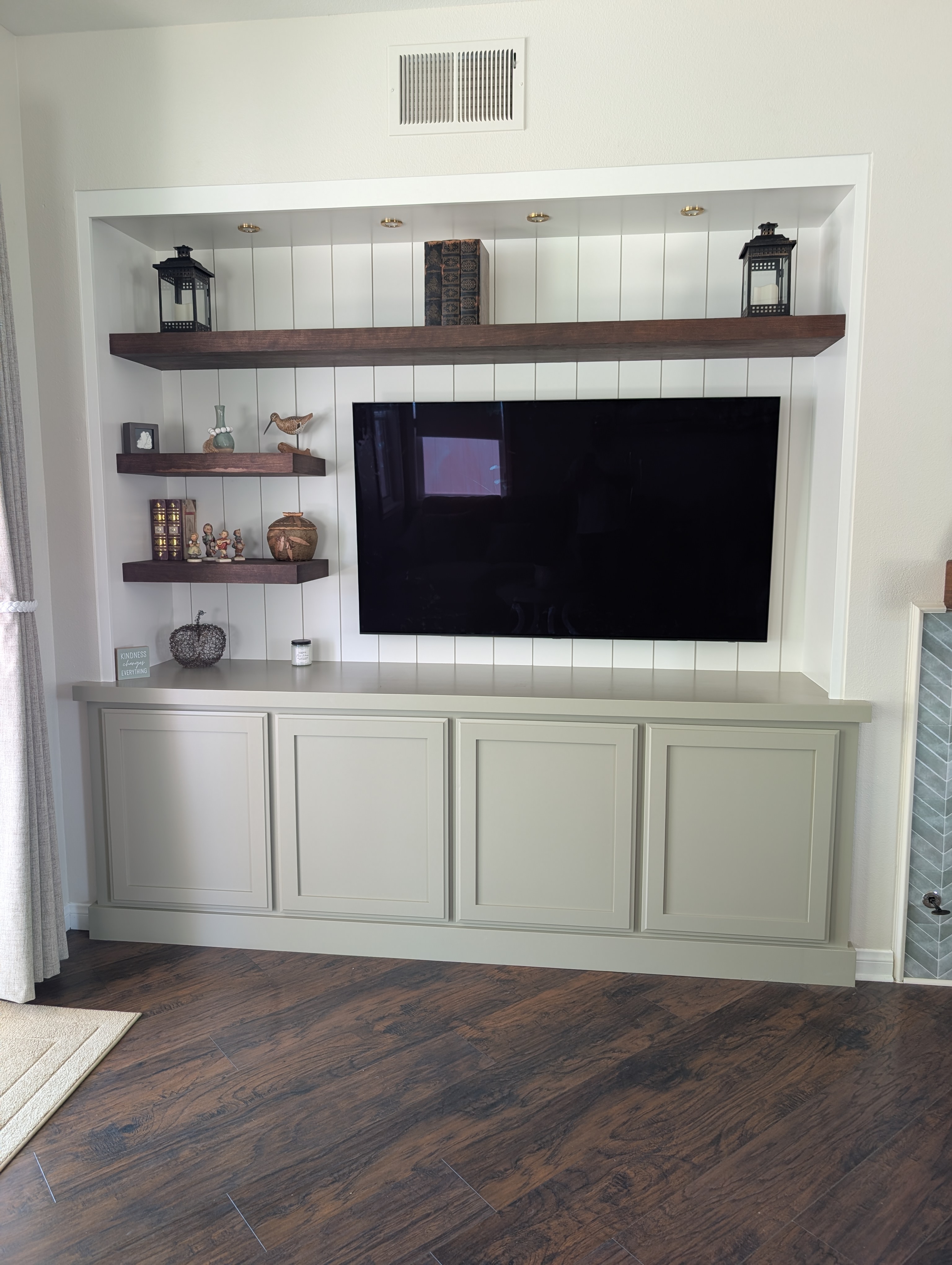
The Brewster floating shelves show the materials philosophy in one element. They’re built from ProCore cherry veneer plywood — a traditional ply core for dimensional stability, a 1/8” MDF layer for a perfectly smooth face, and a cherry veneer surface — then miter-folded and grain-wrapped so the grain runs continuously around every visible edge with no exposed end grain or seams. The ply core keeps the shelf from warping with seasonal humidity; the MDF layer gives the Rubio Monocoat a flawless surface to penetrate; the veneer gives the look. Three materials, one shelf, each doing its job.
What we used on this project:
-
3/4” domestic maple plywood cabinet box and face frame — structure
-
3/4” MDF upper-zone cladding — dead-flat painted surface
-
ProCore cherry veneer plywood shelves, miter-folded and grain-wrapped
-
Rubio Monocoat Oil Plus 2C (Chocolate) on the shelves; SW Emerald Urethane Trim Enamel on the cabinetry; Blum BLUMOTION soft-close hinges
You’ll find the full materials list, the design sketch, and before-and-after photos here: the Brewster Built-In.
The Holland & Sons Angle
The miter-fold on the Brewster shelves is the kind of detail that explains why materials and method can’t be separated. A shelf is just a board until you decide the grain should wrap around the corner with no seam showing — and then the material has to cooperate. The ProCore panel made that clean fold possible because its layered build holds an edge; a cheaper panel would have blown out at the miter. Picking the material and knowing what it can do are the same skill, learned by cutting a lot of them. On that shelf, Brian’s son ran the test miter on an offcut first — because you confirm the material will hold the detail before you commit the real piece, a habit you only build by ruining a few boards early in the trade.
Related Resources — Built-In Entertainment Wall Guide
This guide is part of a full cluster on planning, building, and getting a custom built-in entertainment wall right in the Inland Empire.
How Much Does a Custom Built-In Entertainment Wall Cost? — real line-item pricing, tiers, and what drives the investment.
What Goes Wrong With Built-In Entertainment Walls — the mistakes that derail a build, and how to avoid them.
Built-In Entertainment Wall vs. Freestanding Furniture — which one fits your home, and when furniture is the smarter call.
Best Wood for Floating Shelves: Cherry vs. Walnut vs. White Oak vs. Maple — choosing the species that goes on top of these materials.
How to Hire the Right Contractor for a Custom Built-In — the scorecard, the questions, and the red flags.
Frequently Asked Questions
What materials are used to build a custom built-in?
A built-to-last custom built-in combines several materials, each for its job: hardwood plywood for the cabinet box and structure, MDF for paint-grade flat surfaces, stain-grade wood with a hardwax-oil finish for visible shelves, a durable urethane enamel for painted cabinetry, and quality soft-close hardware. On the Brewster project, that meant maple plywood for the box, MDF for the upper-zone cladding, cherry veneer plywood for the shelves, Rubio Monocoat and Emerald Urethane for the finishes, and Blum hinges. The right material follows the part’s job.
Is MDF or plywood better for cabinets?
Neither is universally better — they’re used for different parts. Hardwood plywood is the choice for the cabinet box and structural elements because it’s dimensionally stable, holds screws and joints, and lasts decades. MDF is the choice for paint-grade flat surfaces — upper-zone cladding, panels — because it’s dead flat with no grain to telegraph through a high-sheen finish. The best custom built-ins use plywood where strength matters and MDF where a flawless painted surface matters.
What is the most durable paint for built-in cabinets?
A hybrid urethane-modified alkyd enamel is the durable standard for painted cabinetry. It applies like a water-based paint but cures to a hard, oil-like finish that resists chipping and stands up to cleaning — and it self-levels so brush strokes flatten out. Sherwin-Williams Emerald Urethane Trim Enamel is one widely specified example. Ordinary interior latex isn’t built for cabinet faces and scuffs under daily use. The paint spec is the single finish choice that most affects how a built-in ages.
What finish is best for wood shelves?
For stain-grade wood shelves, a penetrating hardwax oil is an excellent choice. Unlike a film-building stain-and-poly, it soaks into the wood fiber in a single coat, leaves no plastic build on the surface, and lets the wood read as richer and more natural. It’s also easy to refresh later with the manufacturer’s product rather than fully refinishing. Rubio Monocoat Oil Plus 2C is one common example. The finish suits a dry inland climate where you want the wood sealed but still breathing.
How do material choices affect the total investment?
Materials are where the price spreads. Compared with budget alternatives, a hardwood plywood box adds roughly $1,200–$1,800 over RTA, MDF cladding adds $400–$600 over a drywall finish, urethane enamel adds $200–$350 over latex, hardwax oil adds $300–$500 over stain-and-poly, and quality soft-close hardware adds $150–$250. These are the line items that explain why two quotes differ by thousands. The cost guide in this cluster breaks the full investment down.
What is nickel-gap shiplap and why use it as a backer?
Nickel-gap shiplap is a paneling system where tongue-and-groove boards are installed with a consistent small gap between each board — traditionally the width of a nickel. That gap creates a shadow-line that adds subtle texture to the wall. As a backer behind shelves and a TV, it adds visual interest without competing with what sits in front of it. Regular shiplap has a similar look but the gap is cut into the board edge rather than created by spacing.
Do soft-close hinges really matter on a built-in?
Yes — more than their small cost suggests. Quality concealed soft-close hinges close doors smoothly and quietly and keep doing it for the life of the unit, while bargain hinges loosen, sag, and rattle within a few years. On a built-in you open every day, the hardware is a small line item with an outsized effect on how the piece feels over time. It’s worth specifying by type or brand in the quote rather than accepting a vague “hardware included” line.
Ready to Spec a Built-In That Lasts?
If you’re planning a custom built-in in Temecula, Murrieta, Menifee, Perris, Riverside, or anywhere in the greater Inland Empire, Brian will spec every material by name and by job — so you know exactly what your unit is made of and why. Visit hsconstruct.com/contact, fill out the form, describe your space, and upload a few inspiration photos.
Want to see this advice applied to a real project? Here’s the full breakdown: the Brewster Built-In.
You can also follow Holland & Sons on social media to watch projects come together from sketch to install.
951-338-8058 | brian@hsconstruct.com | hsconstruct.com | CSLB #1123738
More Than Just a Built-In
Matching the right material to each job is the foundation of everything we build — not just entertainment walls. Brian and his sons have been finish carpenters since 1991, which means every room in your home is fair game.
If your space needs more than a built-in, here's what else we build:
-
Kitchen and bathroom remodels — full custom cabinetry, tile work, and finish carpentry from demo to done
-
Coffered ceilings — grid beam systems that add architectural depth to any room, sized and proportioned to the space
-
Wainscoting and wall paneling — classic raised panel, flat panel, board-and-batten, and shiplap applications
-
Reclaimed wood accents — feature walls, fireplace surrounds, and detail work using salvaged material with real character
-
Beam wraps — hollow wood wraps that give exposed beams the look of solid timber without the structural engineering
-
Crown molding, baseboards, and trim carpentry — the details that make a house feel finished, from a single room to a whole home
-
Cased openings and interior door replacements — clean transitions between spaces that most contractors overlook
-
Custom built-in entertainment walls and bookshelves — designed by hand, built in the shop, installed to last
Wood, proportion, and rooms that feel right — that’s what we do.
hsconstruct.com
About the Author
Brian Holland is the owner and lead carpenter of Holland & Sons Construction, a family-run finish carpentry and general contracting company serving Riverside County and the Inland Empire since 1991. He entered the trade at 17, learned on the job, and has spent 35 years building the kind of work that makes rooms feel right — often before a homeowner can articulate why. His sons now apprentice alongside him on every project. Holland & Sons is based in Perris, CA and licensed by the CSLB (#1123738).
Related project
This guide is part of our custom built-ins & cabinetry series.
Learn more about Custom Built-Ins & CabinetryHave a project in mind? Let's start a conversation.
Tell us what you are thinking about and we will give you a straight answer about scope, timeline, and investment.
Start a Conversation