Best Wood Options for Fireplace Mantels, Shelves & Built-In Tops: VG Fir vs. Oak, Maple, and MDF
By Brian Holland, Owner and Lead Carpenter, Holland & Sons Construction · Carpenter since 1991 · CSLB #1123738 · NARI Member · NAHB Member
Published
Quick Answer
For hand-milled fireplace mantels, floating shelves, and built-in countertops in Menifee's dry climate, vertical-grain (VG) fir is Brian Holland's top recommendation for a clear-finished, natural-wood look — it offers a straight, stable grain that resists warping. Oak and maple are strong alternatives for a harder, more traditional look, while paint-grade MDF is the budget-conscious choice when the millwork will be painted rather than clear-finished.
Key Takeaways
-
VG fir is Brian's top pick for clear-finished, exposed fireplace millwork in a dry inland climate
-
Oak and maple offer more hardness and a more traditional look, at a higher cost than fir
-
MDF is the right call only when the millwork will be painted, never for a clear or stained finish
-
Holland & Sons credential: hand-milled VG fir countertops, shelves, and a mantel from rough stock on a real $31,112 Menifee Ranch project
Vertical-grain fir is the right call for most hand-milled fireplace mantels, floating shelves, and built-in countertops in Menifee — assuming the design calls for a clear or lightly stained natural-wood finish. It has the straightest, most stable grain of any commonly available softwood, which matters more than most homeowners realize once that wood sits within a few feet of a heat source in a dry climate.
That's the recommendation. Here's the reasoning, the alternatives worth knowing about, and where each option actually fits — based on hand-milling VG fir from rough stock on a real Menifee Ranch fireplace wall.
The Direct Recommendation
For exposed, clear-finished fireplace millwork — a mantel, floating shelves, or a built-in countertop — vertical-grain (VG) fir is the strongest all-around choice for Inland Empire homes. It combines a straight, consistent grain pattern with genuine dimensional stability, which means less risk of the warping, cupping, or checking that can show up in lower grades of wood once they're installed near a heat source and living through California's dry seasonal swings.
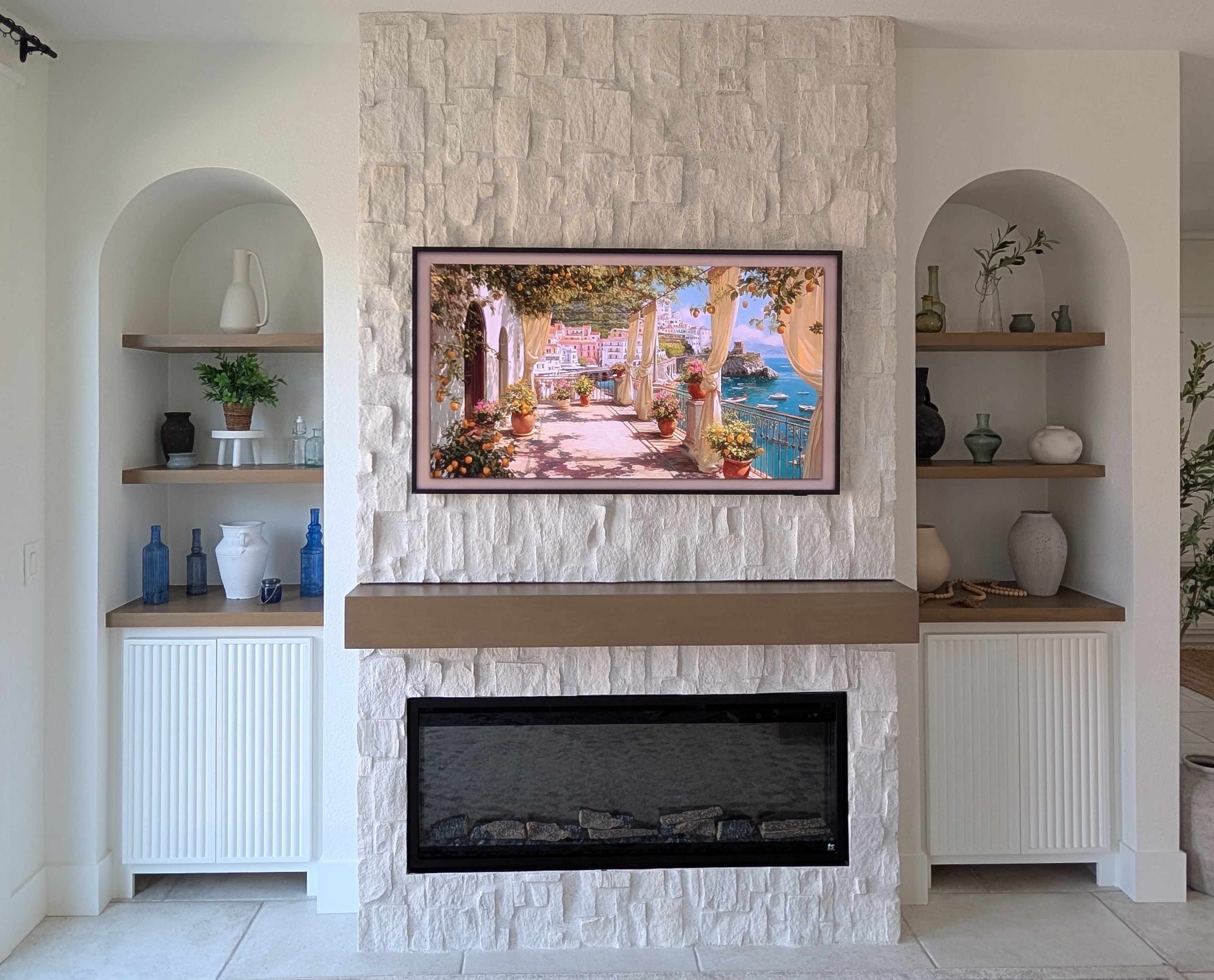
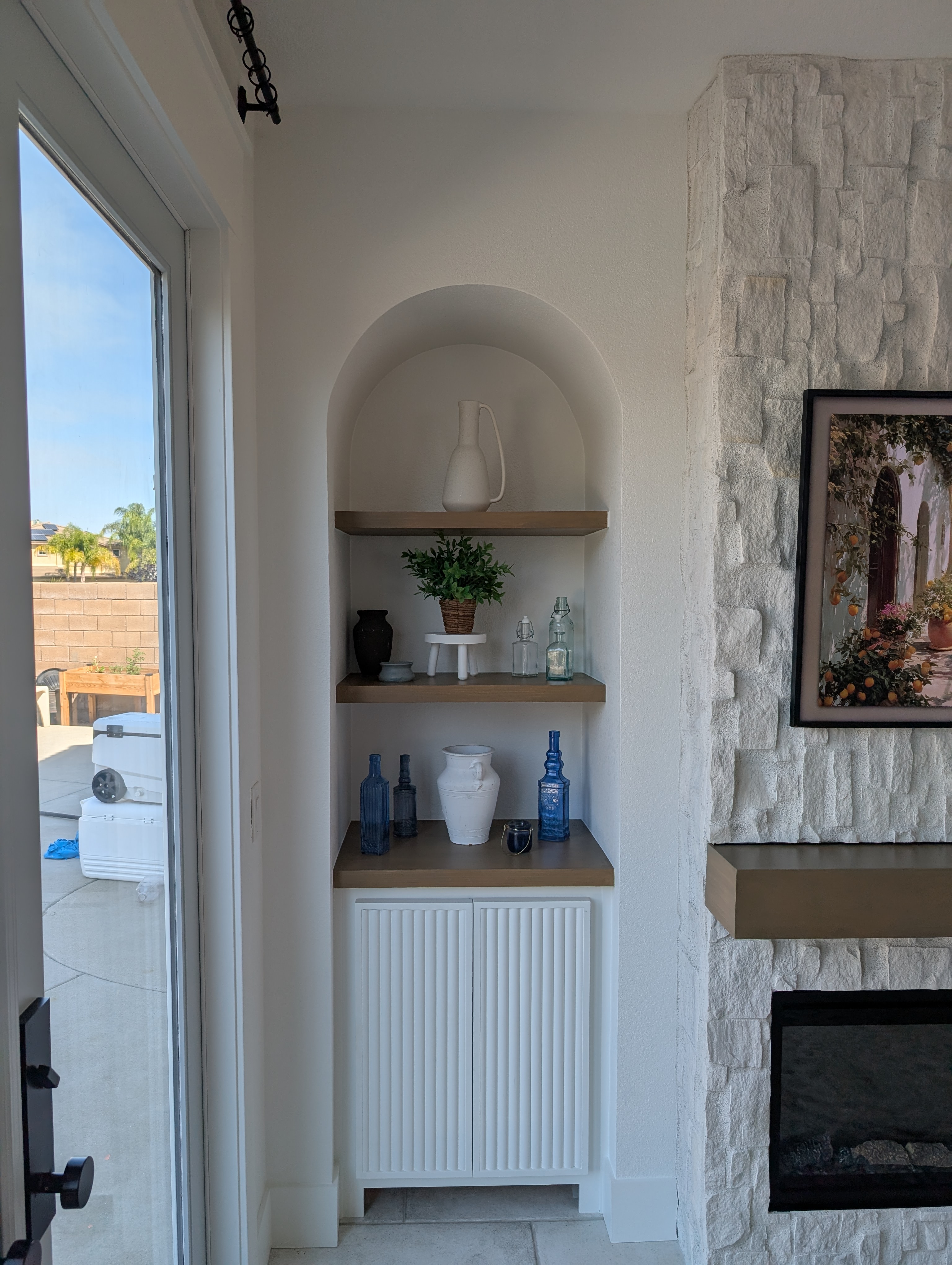
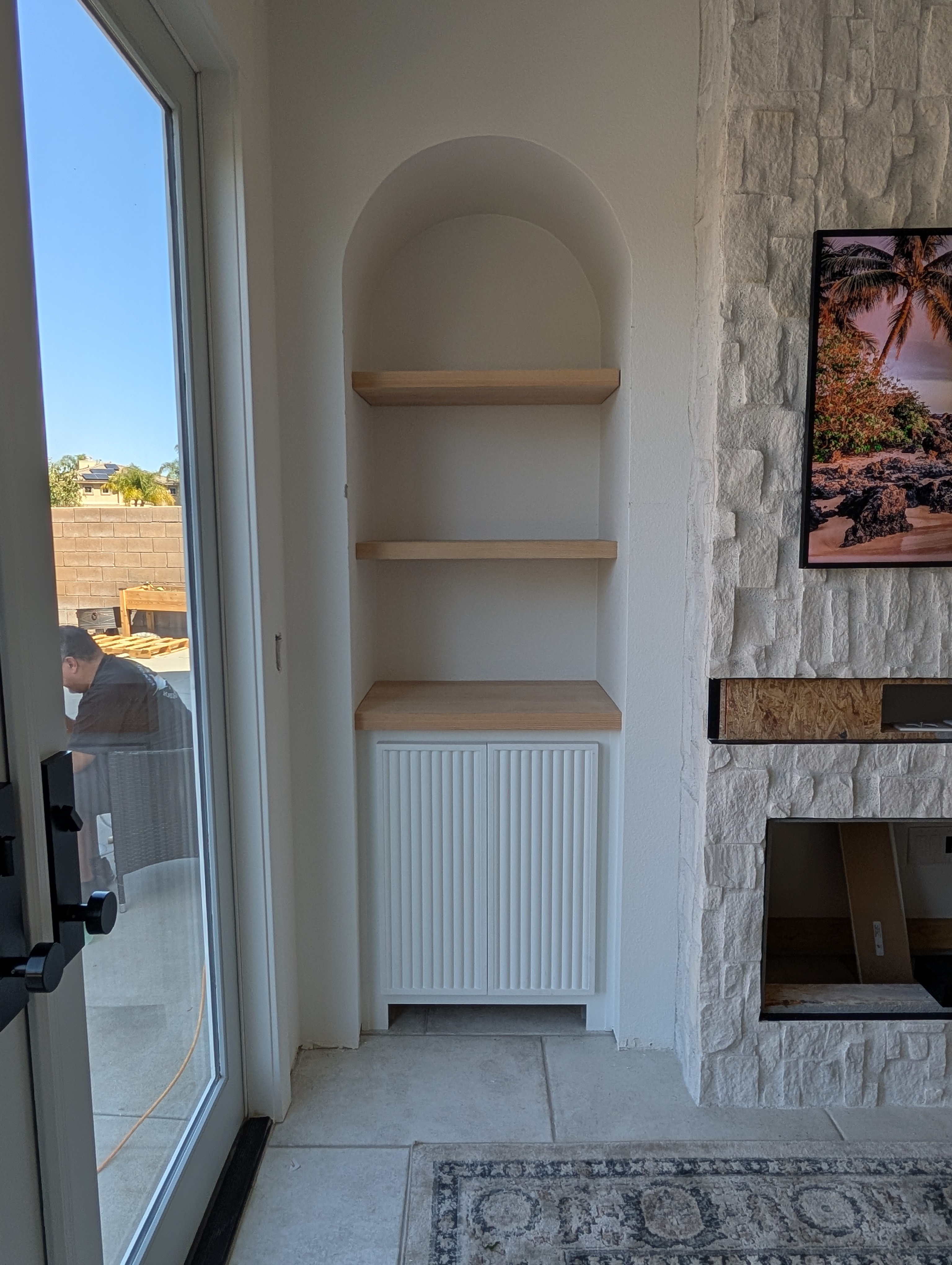
On a recent Rhapsody Ct. project in Menifee Ranch, Holland & Sons hand-milled VG fir for the countertops, floating shelves, and mantel — resawing and planing rough 2"x6" stock, then gluing it into 3/4-inch panels with a continuous, grain-matched face across the entire built-in.
The Full Evaluation
Vertical-Grain (VG) Fir
What it is: Douglas fir cut so the growth rings run nearly perpendicular to the board face, producing a tight, straight grain pattern.
Where it performs best: Exposed millwork that will be clear-finished or lightly stained — mantels, shelves, countertops, and cabinetry faces where the grain itself is part of the design.
Where it falls short: It's a premium-priced softwood, and hand-milling custom profiles from rough stock requires real shop skill — this isn't a material a crew can rush.
Who it's right for: Homeowners who want a warm, natural-wood look with real dimensional stability, and who are working with a contractor who can hand-mill it properly.
Brian's field assessment: "VG fir is the material I reach for when a design calls for wood that has to look good bare — no paint to hide anything. Thirty-five years in, it's the softwood I trust most in a dry climate."
Oak and Maple
What they are: Hardwoods, denser and harder than fir, commonly used for furniture-grade millwork and cabinetry.
Where they perform best: High-traffic surfaces that need extra durability, and homes leaning toward a more traditional or heavier design aesthetic.
Where they fall short: Both cost more than fir, and their heavier grain pattern can compete with a stone surround rather than complementing it.
Who they're right for: Homeowners who want a harder, more traditional wood surface and don't mind the added cost.
Paint-Grade MDF
What it is: Engineered wood panel product, smooth and consistent, but with no natural grain.
Where it performs best: Any millwork that will be fully painted rather than clear-finished — cabinet doors, trim, and panels where grain doesn't matter.
Where it falls short: It has no place in a clear-finished application, and it performs poorly with any direct moisture exposure.
Who it's right for: Budget-conscious painted millwork, not exposed wood surfaces near a heat source.
Comparison Table
| Material | Best For | Approx. Cost vs. Fir | Dry-Climate Stability |
| Vertical-grain fir | Clear-finished mantels, shelves, countertops | Baseline | Excellent — straight grain resists warping |
| White oak | Traditional, heavier-grain clear-finished millwork | +15–30% | Good — stable but heavier movement than fir |
| Hard maple | Clean, tight-grained clear or lightly stained millwork | +20–35% | Good — very stable, harder to work by hand |
| Paint-grade MDF | Painted cabinetry and trim only | -30–50% | Poor for exposed or heat-adjacent use |
The Questions Homeowners Actually Ask
What is vertical-grain fir used for?
VG fir is commonly used for doors, window casings, moldings, wainscoting, and exposed millwork like mantels, shelving, and countertops — anywhere its straight grain and dimensional stability can be shown off with a clear or lightly stained finish.
Does VG fir warp or crack over time?
Properly kiln-dried VG fir, hand-milled and finished correctly, is one of the more stable common softwoods available. Vertical-grain boards shrink and expand less than flat-sawn boards of the same species, which is part of why it's specified for exposed applications in the first place.
How does vertical-grain fir compare to oak or maple for millwork?
Fir is a softwood, so it's less hard and less scratch-resistant than oak or maple, but it's also less expensive, easier to hand-mill into custom profiles, and has a straighter, more consistent grain pattern than either hardwood. The choice comes down to whether the design calls for fir's clean, straight grain or a hardwood's heavier, more traditional character.
The Decision Framework
Choose VG fir when the millwork will be clear-finished or lightly stained, the design calls for a straight and consistent grain, and the piece sits near a heat source in a dry climate. Choose oak or maple when the design calls for a harder, more traditional hardwood look and the budget supports the upcharge. Choose paint-grade MDF only when the finished piece will be fully painted.
See This In Action — Rhapsody Ct. Fireplace Wall
On the Rhapsody Ct. project, the VG fir work started with rough 2"x6" stock — no shortcuts. Holland & Sons resawed and planed it, glued it into 3/4-inch solid panels, then miter-folded and grain-wrapped it so the countertops, floating shelves, and mantel all read as one continuous, unbroken piece of wood.
What we used on this project:
-
Rough 2"x6" vertical-grain fir stock, resawn and planed in-shop
-
3/4-inch glued-up solid panels, miter-folded for continuous grain match
-
A natural clear finish to let the grain carry the design
See the full photo story, including shop-fabrication photos of the milling process, at the link below.
Regional Performance Note: Dry Inland Climate
Menifee, Murrieta, and Temecula see real seasonal humidity swings — dry summers, occasional damp winters. Wood that isn't properly dried and milled will move with those swings, showing up as gaps, cupping, or cracked joints months after installation. VG fir's straight grain minimizes that movement more than flat-sawn lumber of the same species, which is part of why it holds up so well in exposed, heat-adjacent applications here.
The Holland & Sons Angle
The VG fir on Rhapsody Ct. didn't start as a countertop or a mantel — it started as rough 2"x6" stock that had to be resawn, planed, and glued into 3/4-inch panels before any of it looked like finished millwork. That's the part of the process a homeowner never sees in the after photos, but it's the difference between wood that just looks nice on install day and wood that still looks right five years later.
It's also where Brian's older son has spent real time this year — running the resaw and the planer himself, learning to read grain before a board ever goes through a blade, and understanding why a shortcut at this stage shows up as a problem much later.
Related Resources — Rhapsody Ct. Fireplace Wall Guide
This post is part of a full guide to planning a custom fireplace feature wall in Menifee. Here's the rest of the cluster:
Materials FAQ
What is vertical-grain fir used for?
VG fir is commonly used for doors, window casings, moldings, and exposed millwork like fireplace mantels, floating shelves, and countertops — applications where its straight grain and dimensional stability can be shown off with a clear or lightly stained finish.
Is Douglas fir a good wood for a fireplace mantel?
Yes, particularly vertical-grain (VG) Douglas fir, which is prized for millwork like mantels because of its straight, consistent grain and strong dimensional stability. It's a softwood, so it's not as hard as oak or maple, but it resists warping well and takes a clear finish evenly.
What's the best wood for a mantel near a fireplace?
Vertical-grain fir is a strong default for a clear-finished mantel near a fireplace, thanks to its stability in heat-adjacent, dry-climate applications. Oak and maple are solid alternatives for a harder, more traditional look at a higher cost. Always confirm mantel placement meets your fireplace manufacturer's clearance requirements.
How does vertical-grain fir compare to oak or maple for millwork?
Fir is softer and less scratch-resistant than oak or maple, but it costs less, is easier to hand-mill into custom profiles, and has a straighter, more consistent grain. Oak and maple offer more durability and a heavier, more traditional look at a higher price point.
Does VG fir warp or crack over time?
Properly kiln-dried and hand-milled VG fir is one of the more stable common softwoods available. Its vertical grain orientation means it shrinks and expands less than flat-sawn lumber of the same species, which is a major reason it's specified for exposed, heat-adjacent millwork.
Is VG fir overkill for a mantel? Why not pine, MDF, or plywood?
Pine and lower grades of softwood are more prone to knots and movement, and MDF and plywood have no place in a clear-finished application since they lack real wood grain and perform poorly with heat and humidity swings. VG fir costs more than these options, but for an exposed, heat-adjacent mantel meant to last, the stability difference is worth it.
How much more does VG fir cost than other wood options?
VG fir typically costs more than paint-grade MDF or basic pine, but less than premium hardwoods like white oak or hard maple, which can run 15% to 35% higher. The exact difference depends on grade, availability, and how much hand-milling the design requires.
Ready to Talk About Your Own Project?
If you're deciding between VG fir, oak, maple, or a painted alternative for your own fireplace millwork in Menifee, Murrieta, Temecula, Perris, or Riverside, we can walk you through what will actually hold up in your space.
Reach out through hsconstruct.com/contact to start the conversation — fill out the form, tell us about your project, and upload a few inspiration photos if you have them. We'll follow up to talk through scope, timeline, and investment.
You can also find Brian and his sons' latest work on Holland & Sons' social media channels.
Serving Menifee, Murrieta, Temecula, Perris, Riverside, and the greater Inland Empire.
951-338-8058 | brian@hsconstruct.com | hsconstruct.com | CSLB #1123738
More Than Just Fireplace Millwork
Hand-milling wood for a fireplace mantel or shelving is one of the more specialized parts of what Holland & Sons builds. Brian has been a finish carpenter since 1991, and his sons now build alongside him, which means every room in your home is fair game.
If your space needs more than that, here's what else we build:
-
Kitchen and bathroom remodels — full custom cabinetry, tile work, and finish carpentry from demo to done
-
Coffered ceilings — grid beam systems that add architectural depth to any room, sized and proportioned to the space
-
Wainscoting and wall paneling — classic raised panel, flat panel, board-and-batten, and shiplap applications
-
Reclaimed wood accents — feature walls, fireplace surrounds, and detail work using salvaged material with real character
-
Beam wraps — hollow wood wraps that give exposed beams the look of solid timber without the structural engineering
-
Crown molding, baseboards, and trim carpentry — the details that make a house feel finished, from a single room to a whole home
-
Cased openings and interior door replacements — clean transitions between spaces that most contractors overlook
-
Custom built-in entertainment walls and bookshelves — designed by hand, built in the shop, installed to last
Wood, proportion, and rooms that feel right — that's what we do. hsconstruct.com
This guide is part of our custom fireplace walls series.
Learn more about Custom Fireplace WallsHave a project in mind? Let's start a conversation.
Tell us what you are thinking about and we will give you a straight answer about scope, timeline, and investment.
Start a Conversation