Best Wood for Floating Shelves and Feature Walls: A Finish Carpenter's Picks for the Inland Empire
| Quick Answer: For floating shelves, Brian's pick is solid walnut for a statement shelf and white oak for high-use or moisture-prone spaces — both far better than softwoods that sag and dent. For a feature wall, authentic reclaimed barn wood wins on character, while milled shiplap or white oak gives a cleaner, more uniform look. Shelves are chosen for strength and presence; walls are chosen for appearance. Match the species to whether the piece is mostly seen or mostly used. |
Key Takeaways
-
Best floating-shelf woods: walnut for a statement, white oak for durability, maple for a bright clean look — always solid hardwood, never softwood.
-
Best feature-wall material: authentic reclaimed barn wood for character, milled shiplap or white oak for a cleaner uniform look.
-
Floating shelves perform and look best at 1.5–2.5 inches thick — thicker means stronger and more substantial.
-
Brian Holland's 35 years across Riverside County is the credential — these are field picks, not catalog rankings.
If you want the short version, here it is: for floating shelves, use solid walnut when you want the shelf to be a statement and white oak when it needs to take daily abuse. For a feature wall, use authentic reclaimed barn wood for genuine character or milled shiplap when you want something crisp and uniform. The reasoning behind those picks is what makes them useful, so this guide breaks down each one.
A quick note on what this isn't. This is not a catalog ranking pulled from product listings. It's what 35 years of building shelves and walls across the Inland Empire actually teaches you about how these species behave — which ones sag, which ones dent, which ones still look good in ten years, and which ones earn their premium. Brian works with all of them, so there's no house favorite to sell you.
The guide splits naturally into two parts, because shelves and walls ask different questions of the wood. Part 1 covers floating shelves, where strength and presence matter. Part 2 covers feature walls, where the decision is almost entirely about appearance and authenticity.
Part 1 — Best Wood for Floating Shelves
The direct recommendation
For most Inland Empire homeowners, Brian recommends solid walnut for a floating shelf that's meant to be seen and white oak for one that's meant to be used. Walnut's rich, dark grain makes it the centerpiece choice; white oak's hardness and moisture resistance make it the workhorse. The one rule that overrides everything: use solid hardwood, not softwood and not a hollow box, because the shelf is doing structural work even when it looks decorative.
The full evaluation
Here's how the top shelf species stack up after decades of building them:
| Species | Best For | Where It Falls Short | Brian's Field Take |
| Walnut | Statement shelves, design-forward rooms | Pricier; slightly softer than oak | The premium look — and it earns it |
| White Oak | Kitchens, baths, high-use shelves | Less bold than walnut | The durable all-rounder; closed grain resists moisture |
| Maple | Bright, clean, modern spaces | Less character; can look plain | Crisp and hard; great when you want simple |
| Cherry | Warm, classic interiors | Darkens over time; less common | Beautiful patina if you want warmth |
Walnut vs. White Oak — the real fork
This is the comparison homeowners ask about most. White oak is the harder wood, with a closed grain that resists dents, daily wear, and moisture — which is why it's the top pick for kitchens, bathrooms, and high-traffic shelves. Walnut is slightly softer but still plenty durable for shelving, and over time it develops small marks and a deepening patina that many homeowners prize as character. The visual difference is the deciding factor: walnut's dark tones make it a centerpiece, while white oak's lighter, neutral palette keeps it calm and versatile. For a design-focused statement, walnut. For a practical, high-use shelf, white oak.
Walnut vs. Maple — statement vs. clean
Where walnut and maple part ways is mood. Walnut is bold, dark, and dramatic — it wants to be noticed and pairs with warm neutrals and metallic accents. Maple is the opposite: bright, fine-grained, and understated, ideal when you want the shelf to feel simple and crisp rather than to dominate. Maple is also extremely hard, so it resists dents well, and it takes paint and light finishes cleanly. Choose walnut when the shelf is the feature; choose maple when the shelf should recede and let what's on it stand out.
How thick, and how it mounts
Thickness drives both looks and strength — aim for 1.5 to 2.5 inches, because thicker stock resists sagging over a span and reads as substantial rather than flimsy. The extra depth also has a practical purpose: it hides heavy-duty mounting hardware. A true floating shelf is bored to slide onto concealed steel, with no visible bracket. How that hardware anchors into the wall — and why a heavy solid slab needs real support, not just drywall — is its own subject. We cover how floating shelves actually hold weight in our guide to the hidden layer behind a reclaimed wood wall.
Part 2 — Best Wood for Feature Walls
The direct recommendation
For a feature wall, the decision flips: strength barely matters because the wall carries no load, so the choice is about appearance and authenticity. Brian recommends authentic reclaimed barn wood when you want genuine rustic character and a true story, and milled reclaimed shiplap or a selected new species like white oak or knotty alder when you want a cleaner, more uniform, more controlled look. The room's style decides it.
Reclaimed barn wood vs. shiplap
These get confused constantly, so let's separate them. 'Reclaimed' describes origin — salvaged from an older structure. 'Shiplap' describes the milling — boards with an overlapping rabbeted edge that fit flat together and self-align. The two can overlap (you can have reclaimed shiplap), but they usually represent two different looks. Raw reclaimed barn wood is irregular, rough, and full of character; it's more demanding to install well but delivers genuine age. Shiplap — reclaimed or new — goes up cleaner and more uniform thanks to those self-aligning edges, giving a crisp farmhouse look rather than a weathered one.
| Factor | Reclaimed Barn Wood | Shiplap (Milled) |
| Look | Irregular, weathered, genuine age | Crisp, uniform, controlled |
| Character | Maximum — real patina and story | Clean farmhouse; less rustic depth |
| Install | Demanding — layout & templating | Easier — edges self-align |
| Best room style | Rustic, Western, modern-rustic | Farmhouse, transitional, modern |
New species for walls, when you want them
If you'd rather use new wood on a wall — for budget, consistency, or a specific tone — white oak gives a warm, refined, grain-forward look that suits transitional and modern rooms, while knotty alder delivers a rustic feel at a more accessible price than authentic reclaimed stock. These are honest options when the reclaimed look isn't the goal. Just know what you're trading: new wood gives you control and consistency but not the genuine patina that makes a reclaimed wall feel like it has a history.
Comparison Table — Shelves and Walls at a Glance
| Use | Top Pick | Strong Alternative |
| Statement floating shelf | Solid walnut | White oak (more durable) |
| High-use / kitchen shelf | White oak | Maple (harder, brighter) |
| Rustic feature wall | Authentic reclaimed barn wood | Knotty alder (budget) |
| Clean / farmhouse wall | Milled shiplap | White oak (refined) |
The Decision Framework
Two questions settle almost every case:
-
For a shelf, ask: seen or used? If the shelf is mostly a design statement, choose walnut. If it earns its keep holding dishes, books, or kitchen items, choose white oak or maple for hardness and moisture resistance.
-
For a wall, ask: character or control? If you want genuine age and irregular character, choose authentic reclaimed barn wood. If you want crisp, uniform, and predictable, choose shiplap or a selected new species.
See This In Action — The Broken Twig Project, Norco
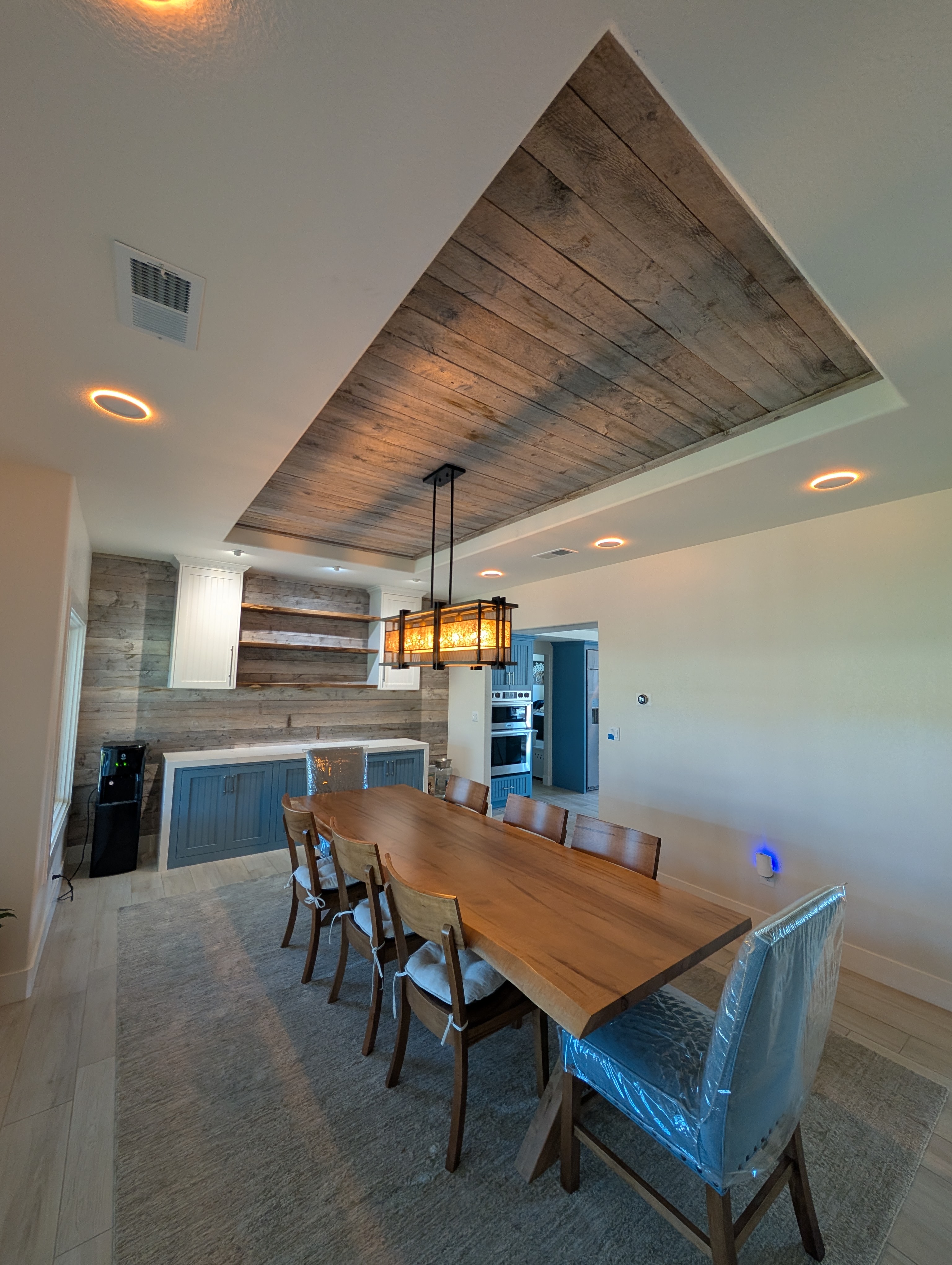
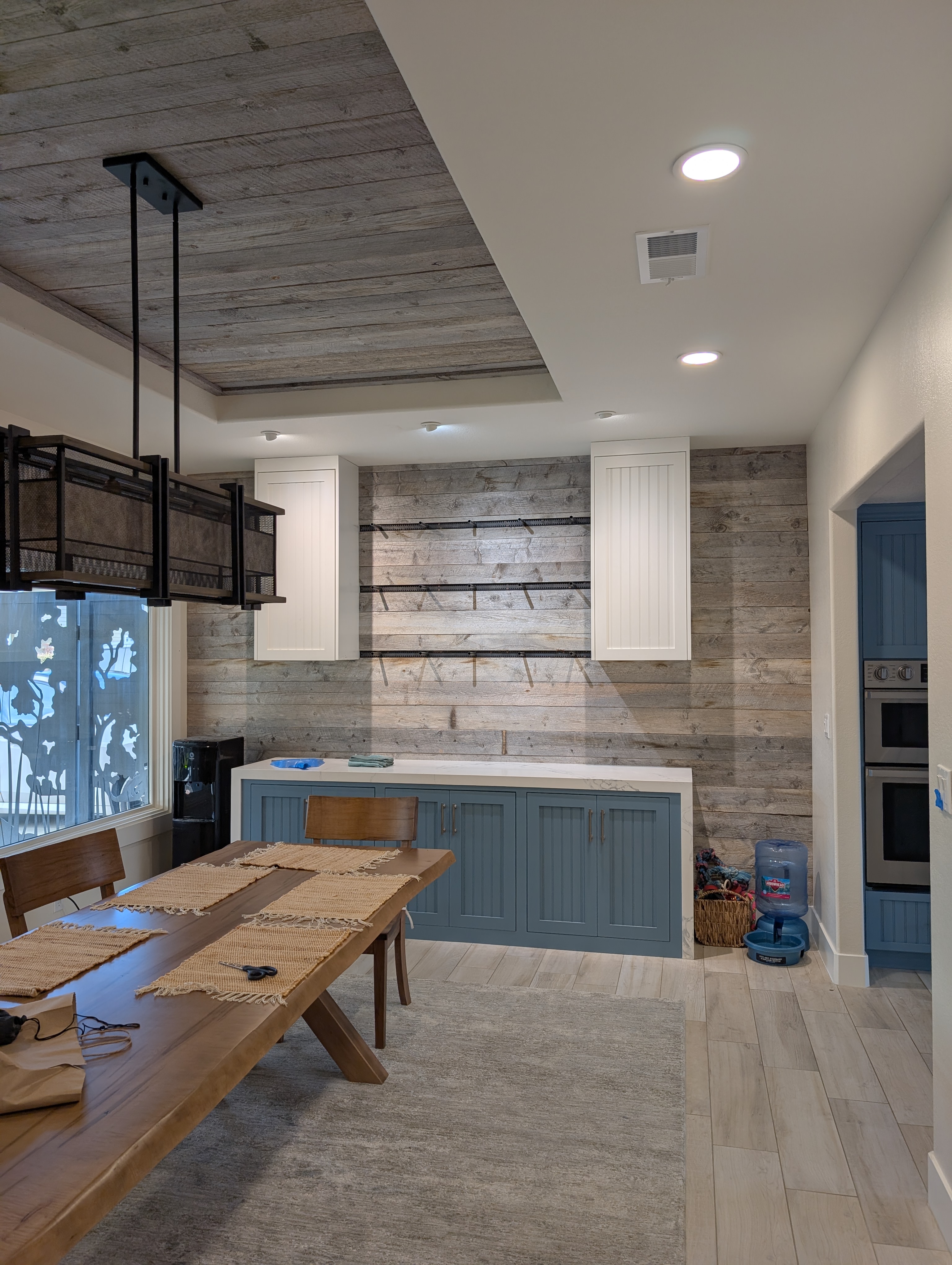
On the Broken Twig project, Brian used scribe gauges — the tools with sliding fingers that capture an exact profile — to make the solid live-edge walnut shelves die into the cabinet sides perfectly. A live edge is organic and irregular; the cabinet side is dead-straight and plumb. The gauge let him transfer the precise profile and cut to it, so the shelf met the cabinet tight with no caulk and no filler. That's the level of fit that separates a real solid-wood shelf from a hollow box stuck to a wall.
What we used on this project:
-
2-inch-thick solid live-edge walnut shelves — chosen to echo the family's commissioned live-edge dining table.
-
A multi-layer clear coat to protect the surfaces that get handled while keeping the grain rich.
-
Scribe-gauged cuts so each shelf met the cabinet side perfectly, no filler.
-
Walnut selected over stained pine or MDF because only solid walnut carried the visual weight against the barn wood.
Regional Performance Note
In the Inland Empire's dry climate, hardwood shelves perform well as long as they're solid and properly finished — there's little ambient moisture to swell them. Walnut and white oak both handle our conditions comfortably; white oak's closed grain gives it a slight edge in the few rooms with moisture, like a bath or a kitchen near the sink. For walls, our intense direct sunlight is the factor to plan around: it brings out the grain and irregularity of authentic reclaimed wood beautifully, while it can make flatter, more uniform materials look plain. In a sun-filled room — like a west-facing Norco dining room catching late-afternoon light — genuine wood with real grain variation earns its keep visually in a way a uniform product can't.
The Holland & Sons Angle
The scribe gauge is a perfect window into how Brian thinks about material. A lesser approach would set the walnut shelf close to the cabinet and run a bead of caulk to fill the gap where the live edge doesn't quite meet the straight cabinet side. Brian uses the gauge to capture the live edge's exact organic profile and cuts the shelf to it, so the two meet tight with nothing fudging the joint. The wood does the work; no filler covers for a sloppy fit. That respect for the material — letting good wood show what it can do rather than hiding compromises — is the whole reason to buy solid hardwood in the first place.
It's also how the next generation learns to trust the material. On a recent build, one of Brian's sons ran a scribe gauge for the first time on a dry-fit — pressing the sliding fingers against an irregular edge, transferring that profile to the workpiece, and cutting to the line so the two surfaces met clean. Watching a joint close up tight with no caulk, because the cut was right, teaches a young carpenter something a price sheet never will: that the best material deserves a fit good enough to show it off. Passed down one shelf at a time.
Related Resources — Reclaimed Wood Feature Guide
This species guide is part of a full series on planning a reclaimed wood feature in the Inland Empire. The companion guides cover the rest:
-
How Much a Reclaimed Wood Accent Wall Costs — real numbers, including what live-edge shelves add.
-
What Goes Wrong With Reclaimed Wood Walls — installation problems and wood movement.
-
Authentic vs. Aged & Faux Reclaimed Wood — choosing the wall material itself.
-
How to Hire a Finish Carpenter — making sure your contractor specifies species correctly.
-
The Hidden Layer Behind a Reclaimed Wood Wall — backing, substrate, and how floating shelves actually mount.
Frequently Asked Questions
What is the best wood for floating shelves?
The best wood for floating shelves is a solid hardwood — walnut, white oak, maple, or cherry — because these species have the density and stability to span a distance and carry weight without sagging or warping. For a statement shelf, walnut is the top pick: its deep, rich grain reads as high-end and pairs beautifully against lighter walls or rustic wood. For high-use or moisture-prone spots, white oak's hardness and tight grain give it an edge. Softwoods like pine dent easily and bow under load, so they're best left to purely decorative, lightweight shelves. On the Broken Twig project, Brian used 2-inch-thick solid live-edge walnut precisely because only solid walnut carried the visual weight needed against the barn wood and matched the family's live-edge table.
Walnut or white oak for floating shelves — which is better?
Walnut is the better choice for a bold, design-forward statement shelf, while white oak is better for durability and high-traffic or moisture-prone spaces. Walnut's darker chocolate-to-espresso tones create contrast and draw the eye, making it the centerpiece option that suits a feature wall or living-room display. White oak is a harder wood with a closed grain that resists dents and handles moisture better, so it's the stronger pick for kitchens, bathrooms, and shelves that get daily use. Both are premium hardwoods and both fit current warm-wood design trends. For a design statement, choose walnut. For a workhorse shelf in a busy room, choose white oak. Neither is a wrong answer — it comes down to whether the shelf is mostly to be seen or mostly to be used.
What is the best wood for an accent or feature wall?
For a rustic feature wall, authentic reclaimed barn wood is the best material because its genuine patina and old-growth character can't be replicated by new lumber. For a cleaner, more uniform look, milled reclaimed shiplap or a new species like white oak or knotty alder gives a warmer, more controlled appearance. The right pick depends on the look you're after: raw, irregular, and full of story points to reclaimed barn wood; crisp and orderly points to shiplap or a selected new species. Wall wood doesn't carry structural load the way a shelf does, so the decision is driven almost entirely by appearance and authenticity rather than strength. Brian matches the species to the room's style and the home's overall character.
How thick should a floating shelf be?
Floating shelves generally look and perform best at 1.5 to 2.5 inches thick, with thicker stock giving both more visual presence and more strength to resist sagging over a span. A thicker shelf reads as substantial and intentional rather than flimsy, and it has the depth to conceal heavy-duty mounting hardware. For a roughly 36-inch walnut shelf at about 1.75 inches thick, you can comfortably hold everyday display items and books when it's properly mounted into studs. Longer spans or heavier loads call for thicker stock or additional support. On the Broken Twig project, the shelves were 2-inch-thick solid live-edge walnut — substantial enough to carry visual weight against the barn wood and to mount on concealed steel rods. Thicker is almost always the better-looking and stronger choice.
What's the difference between reclaimed wood and shiplap?
Reclaimed wood describes where the wood came from — salvaged and reused from an older structure — while shiplap describes how the boards are milled, with an overlapping rabbeted edge that lets them fit flat together. The two overlap but aren't the same. Shiplap can be reclaimed, but it can also be brand-new boards milled with that profile. Reclaimed barn wood, by contrast, is often rough and irregular rather than uniformly milled. For a feature wall, the practical difference is the look and the install: shiplap goes up cleaner and more uniform with its self-aligning edges, while raw reclaimed barn wood is more irregular, more characterful, and more demanding to install well. Choose shiplap for a crisp farmhouse look, reclaimed barn wood for genuine rustic character.
Are live-edge shelves still in style?
Live-edge shelves are very much in style, and the trend has strengthened as design has moved toward warm, natural, organic materials and away from cool gray tones. A live edge — the natural, uncut contour of the tree preserved along the front of the shelf — brings organic character that pairs especially well with rustic and modern-rustic interiors. The look reads as intentional and high-end when the wood and finish are good, particularly in walnut or white oak. On the Broken Twig project, the live-edge walnut shelves were chosen specifically to echo the live edge of the family's commissioned dining table, tying the whole room together as one connected idea. Done with quality solid stock, live-edge shelving is a lasting choice rather than a passing fad.
Let's Talk About Your Project
Trying to pick the right wood for a shelf or a wall in your home? That's a conversation we love, because the right species depends on your room, your light, and how the piece will be used. Head to our contact page, fill out the form, describe your space, and upload any inspiration photos. We'll recommend the species that actually fits your situation — before anything is committed.
We serve Norco, Corona, Eastvale, Riverside, Temecula, Murrieta, Menifee, Perris, and the wider Inland Empire. Follow our latest work on social media, and reach out whenever you're ready.
951-338-8058 | brian@hsconstruct.com | hsconstruct.com | CSLB #1123738
More Than Just Shelves and Feature Walls
Choosing the right wood for a shelf or wall is one piece of a bigger vision for a room. Brian and his sons have been finish carpenters since 1991, which means every room in your home is fair game.
If your space needs more than that, here's what else we build:
-
Kitchen and bathroom remodels — full custom cabinetry, tile work, and finish carpentry from demo to done
-
Coffered ceilings — grid beam systems that add architectural depth to any room, sized and proportioned to the space
-
Wainscoting and wall paneling — classic raised panel, flat panel, board-and-batten, and shiplap applications
-
Reclaimed wood accents — feature walls, fireplace surrounds, and detail work using salvaged material with real character
-
Beam wraps — hollow wood wraps that give exposed beams the look of solid timber without the structural engineering
-
Crown molding, baseboards, and trim carpentry — the details that make a house feel finished, from a single room to a whole home
-
Cased openings and interior door replacements — clean transitions between spaces that most contractors overlook
-
Custom built-in entertainment walls and bookshelves — designed by hand, built in the shop, installed to last
Wood, proportion, and rooms that feel right — that's what we do.
hsconstruct.com
About the Author
Brian Holland is the owner and lead carpenter of Holland & Sons Construction, a family-run finish carpentry and general contracting company serving Riverside County and the Inland Empire since 1991. He entered the trade at 17, learned on the job, and has spent 35 years building the kind of work that makes rooms feel right — often before a homeowner can articulate why. His sons now apprentice alongside him on every project. Holland & Sons is based in Perris, CA and licensed by the CSLB (#1123738).
This guide is part of our accent walls series.
Learn more about Accent WallsHave a project in mind? Let's start a conversation.
Tell us what you are thinking about and we will give you a straight answer about scope, timeline, and investment.
Start a Conversation