Best Materials for a Custom Built-In Platform Bed with Storage: What Brian Recommends After 35 Years
Quick Answer
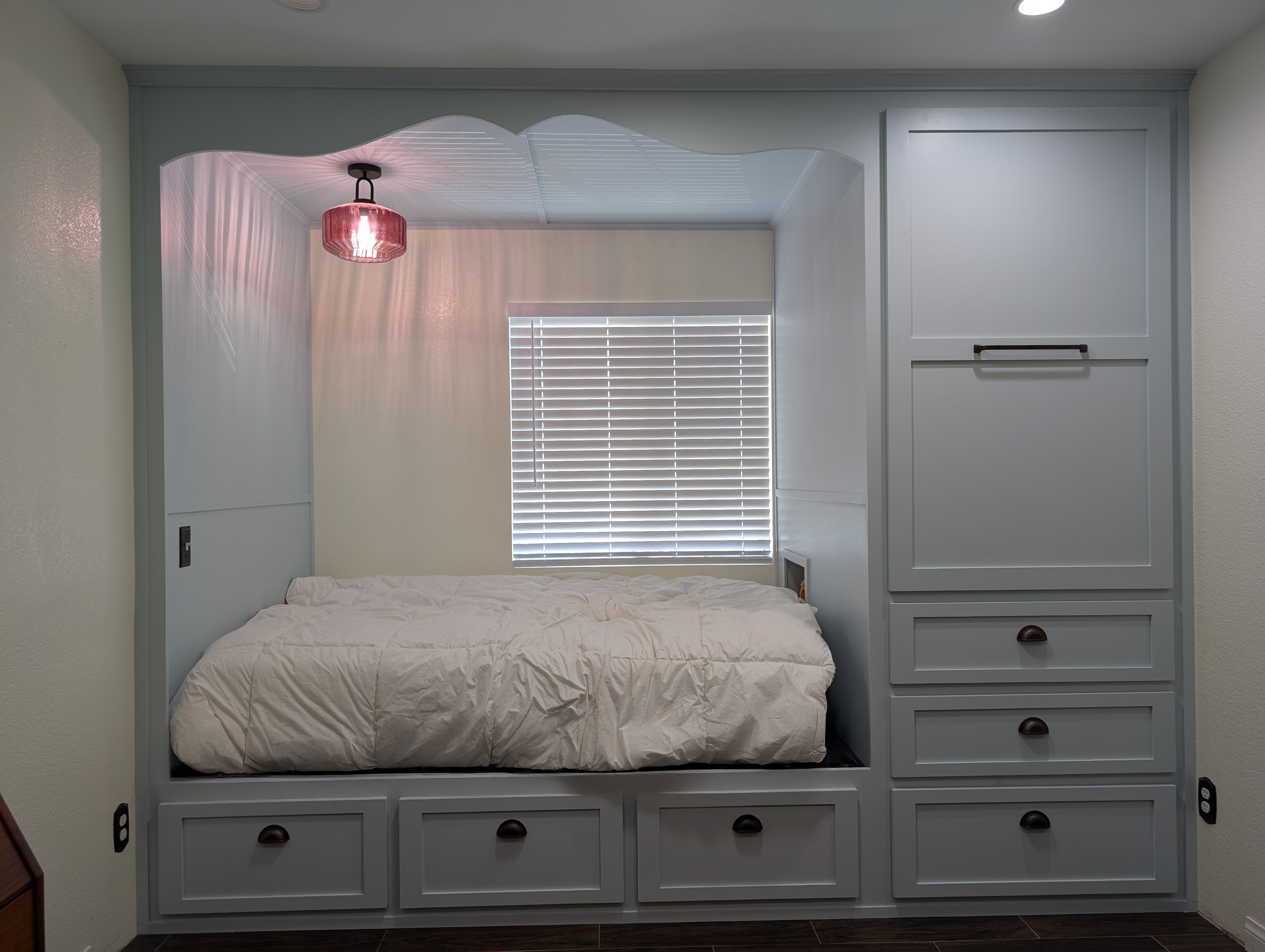
For a custom built-in platform bed with storage, the correct materials are: ¾-inch true Baltic birch plywood for all carcass and drawer box work, paint-grade poplar for face frames, hard maple rails and stiles with MDF center panels for painted door and drawer fronts, and Fulterer FR 5400 industrial slides for any drawer depth over 30 inches or any pull-out under real working loads. The paint system starts with Bondo, not primer — and that distinction makes everything else work. Here is the decision framework for each material choice, grounded in 35 years of field experience and a verified $18,446 project in Canyon Heights, Menifee.
Key Takeaways
-
Carcass and drawer boxes: ¾" true Baltic birch plywood — void-free core, superior screw holding, the only panel product built for load-rated deep drawer applications
-
Face frame: paint-grade poplar — tight grain, machines cleanly, accepts paint well, correct for this application
-
Door and drawer fronts: hard maple rails and stiles, MDF center panels — durable painted edges where they matter, dimensional stability where it matters
-
Heavy-duty slides: Fulterer FR 5400 (450–550 lb rated, up to 60") for deep drawers and pull-out wardrobes; Blum TANDEM Plus BLUMOTION for standard wardrobe drawers
-
Paint system: extensive Bondo fill and sand before any primer — this is the step most contractors skip and the step that determines the finished surface quality
Every material decision in a custom built-in bed is actually a load decision in disguise. The plywood grade is a screw-holding and deflection question. The drawer slide specification is a dynamic load question. The face frame material is a fastener-retention question. Even the paint system is a surface-preparation question — what substrate is under the topcoat, and how well was it filled and sanded before paint went on.
These are not aesthetic choices dressed up as technical ones. They are structural and performance choices that happen to also affect how the finished piece looks. Knowing why each material was selected — not just what was selected — is what separates a build that performs for 30 years from one that looks good at handoff and starts showing its compromises two years later.
What follows is the decision framework Brian uses for every built-in bed project. Not a generic "best materials" list. The specific rationale for each material in each position, grounded in 35 years of building and a specific $18,446 project where every choice was tested under real working conditions.
A. The Direct Recommendation — Start Here
Brian's specification for a full-scope custom built-in platform bed with storage:
-
Carcass and all drawer boxes: ¾" true Baltic birch plywood (including drawer bottoms)
-
Face frame: paint-grade poplar
-
Door and drawer fronts: hard maple shaker, 2" rails and stiles, MDF center panels
-
Deep drawers (36"+ depth) and pull-out wardrobes: Fulterer FR 5400 industrial slides
-
Standard wardrobe drawers (18"–24" depth): Blum TANDEM Plus BLUMOTION soft-close
-
Hardware: oil-rubbed bronze cup pulls for drawer faces; bar pulls for wardrobe door
-
Paint system: Bondo fill → sand → re-Bondo → re-sand → stain-blocking primer → topcoat (Dunn-Edwards)
That is the complete specification. Everything below explains why each choice was made and what the alternatives are when a different situation calls for a different call.
B. Plywood — Carcass and Drawer Box
Brian's Call: ¾" True Baltic Birch
Baltic birch plywood is not a brand name. It is a manufacturing standard from Finland and the Baltic states. True Baltic birch has 13 plies in a ¾-inch sheet, a void-free core, and a face veneer grade that accepts paint or finish evenly. That void-free core is the critical specification for load-bearing built-in work — internal voids are where screws pull through, where drawer box joints fail under sustained load, and where panels deflect when the carcass is carrying real weight.
Domestic "Baltic birch" substitutes and standard cabinet-grade plywood from China and Southeast Asian production have fewer plies (often 7 in ¾-inch) and internal voids. They are less expensive. They are also not appropriate for a project where 48-inch drawer boxes will carry hundreds of pounds on every pull.
| Plywood Type | Best For | Why Brian Uses or Avoids It |
| ¾" true Baltic birch (Finnish / Baltic) | Load-bearing carcass, all drawer boxes including bottoms | Void-free core, 13 plies, superior screw holding — specified for this project |
| Domestic "Baltic birch" substitutes | Lower-load cabinetry, painted shelving | Fewer plies, internal voids — not appropriate for deep-drawer load applications |
| Standard cabinet-grade plywood (imported) | Interior shelving, non-load-bearing panels | Voids compromise screw holding at joints under sustained load |
| MDF (medium-density fiberboard) | Flat panel inserts, door centers | Dimensionally stable and paints flat — correct for panel applications, wrong for structural work or anywhere screws need to hold |
| Particleboard | Budget furniture production | Not appropriate for any structural application in a load-rated built-in |
C. Face Frame Material
Brian's Call: Paint-Grade Poplar
The face frame is the visible front border of the cabinet — the wood that surrounds each drawer and door opening and gives the piece its finished, furniture-quality look. For painted built-ins, paint-grade poplar is the standard choice and has been for decades.
Poplar machines cleanly, takes paint well, and is stable enough for face frame applications where the wood is not in a high-contact zone. It is softer than maple — it will dent in high-traffic areas over time — but for a face frame that gets grabbed occasionally when opening drawers, it performs correctly. It is also significantly less expensive than hard maple, which makes it the right call when the goal is to allocate budget to the positions where material grade has the biggest performance impact (carcass and slides).
| Face Frame Material | Performance | Brian's Assessment |
| Paint-grade poplar | Correct for painted face frames — tight grain, machines cleanly, accepts paint well | Standard specification — right call for this application |
| Hard maple | Harder, more durable — correct for door fronts and high-contact applications | Better used for door and drawer fronts where edge durability matters; over-specified as face frame material |
| MDF | Paints well but holds fasteners poorly at joints | Not appropriate for face frame construction — joint fastener retention is inadequate under working stress |
| Paint-grade pine | Available and inexpensive | Grain telegraphs through paint in direct sun; knotty grades are inconsistent |
D. Door and Drawer Fronts
Brian's Call: Hard Maple Rails and Stiles, MDF Center Panels
The shaker profile — a flat center panel surrounded by a frame of rails (horizontal) and stiles (vertical) — is the standard for painted built-ins because it reads as architectural rather than furniture. The material combination is equally deliberate.
Hard maple for the rails and stiles (the frame elements): maple's hardness and density means the edges of the door hold paint cleanly and resist dings at the highest-contact points. Cup pulls, bar pulls, and daily hand contact happen at these edges. Maple is the right material where durability at the perimeter matters.
MDF for the center panel: MDF is dimensionally stable — it does not expand and contract with humidity the way solid wood does. A solid wood panel inside a shaker frame moves seasonally. In the Inland Empire's dry summer climate, that movement telegraphs through paint as cracks at the panel-to-frame joint over time. MDF eliminates that movement. It also paints completely flat, with no grain to telegraph through the topcoat.
The combination gives you durable edges where durability matters and a stable surface where flatness matters. Neither all-MDF nor all-solid-wood accomplishes both.
| Front Material | Pros | Cons / Brian's Note |
| Maple rails + MDF panels (Escalante spec) | Durable painted edges at perimeter; dimensionally stable panel; paints flat | More expensive than all-MDF — the right tradeoff for a permanent built-in |
| All-MDF construction | Less expensive; paints consistently flat | Holds fasteners less reliably at joints under working stress; not appropriate for screw-secured construction |
| All-solid-wood (maple or poplar) | Maximum durability | Panel movement in the Inland Empire's humidity range will show as paint cracks at panel edges over time |
| Thermofoil or laminate fronts | Inexpensive; no painting required | Not appropriate for permanent custom built-ins; edges peel in heat |
E. Drawer Slide Hardware
Brian's Call: Fulterer FR 5400 for Heavy Applications; Blum TANDEM Plus BLUMOTION for Standard
Slide hardware is the single most under-specified component in most built-in bed projects. Standard residential cabinetry uses soft-close undermount slides rated for 75 to 100 pounds per pair, in lengths up to 21 to 24 inches. That is an appropriate specification for kitchen and bath drawers carrying pots, plates, and folded clothing.
A 48-inch deep under-bed drawer carrying full daily-use contents — clothing, shoes, bins — is not that application. A 60-inch pull-out wardrobe carrying a full hanging load is not that application. Specifying standard residential slides for these loads is not economizing. It is engineering failure with a lag.
| Slide | Rating | Length Range | Brian's Application |
| Fulterer FR 5400 | 450–550 lb / pair | Up to 60" | Under-bed drawers 36"+ depth; pull-out wardrobe; any application over 200 lb expected load |
| Blum TANDEM Plus BLUMOTION 563H | 100 lb / pair | Up to 21" | Wardrobe tower drawers; standard-depth built-in drawers under normal residential loads |
| KV 8900 or equivalent | 500 lb / pair | Up to 28" | Heavy utility applications — not typically needed for bedroom built-ins |
| Standard soft-close undermount (generic) | 75–100 lb / pair | Up to 21" | Not specified by Brian for deep-drawer bed applications — correct for kitchen and bath cabinets at standard depths |
The Escalante project used $1,700 in Fulterer FR 5400 slides for the under-bed drawers and pull-out wardrobe, and $300 in Blum TANDEM Plus BLUMOTION for the wardrobe tower drawers. Hardware is not the place to find savings in a load-rated application.
F. The Paint System
Brian's Call: Bondo First, Every Time
Paint does not hide surface imperfections. It reveals them. A plywood substrate — even a high-quality Baltic birch surface — has texture, nail holes, screw heads, joint gaps, and grain. A face frame joint between two pieces of poplar has a seam. An arch built from layered plywood has exposed ply edges. All of it shows through paint if the surface is not properly prepared before any primer goes on.
The correct sequence for a painted built-in surface is: Bondo application at all joints, holes, and imperfections → sand smooth → re-Bondo where needed → re-sand → stain-blocking primer (to prevent poplar's tannins from bleeding through topcoat) → topcoat.
That is not a contractor upsell. It is the only sequence that produces a painted surface that looks like painted furniture rather than painted construction. The Escalante project required this process across the face frame, the door and drawer fronts, and the full plywood wall and ceiling cladding. It was the single most labor-intensive invisible step in the project.
| Paint System Step | Material / Product | Why It Matters |
| Surface fill | Bondo body filler or fine-grain wood filler | Fills nail holes, joint gaps, ply edges — paint cannot bridge these without fill |
| Sand | 100-grit then 150-grit progression | Level the filled surfaces before primer — sanding after primer reveals substrate again |
| Re-Bondo and re-sand | As needed — typically 1–2 passes | High-quality painted surfaces almost always require multiple fill-and-sand passes |
| Stain-blocking primer | Zinsser BIN or equivalent | Blocks poplar tannins from bleeding through topcoat — skipping this produces yellow bleed-through in UV-exposed areas |
| Topcoat | Dunn-Edwards satin or eggshell (Brian's preference) | Satin: cleanable, durable, correct sheen for built-ins — eggshell for a softer look in bedroom applications |
G. How These Materials Perform in the Inland Empire
The Inland Empire's climate is demanding for interior woodwork in one specific direction: humidity variation. Menifee and Murrieta summer interiors in unshaded rooms can run hot and dry. Winter interiors with heating run dry. That range — not extreme, but present — affects materials differently.
Baltic birch plywood is stable across this range. It is a cross-laminated product, which means the alternating grain directions of its plies cancel out the seasonal movement that solid wood panels experience. The Escalante carcass will not rack or shift with Menifee's seasonal humidity swings.
The maple-and-MDF door construction is directly responsive to this climate. A solid wood panel in a solid wood frame expands and contracts with humidity. In a dry inland climate with seasonal swings, that movement eventually shows as cracks at the panel-to-frame interface. The MDF panel eliminates that movement. Brian has been using this construction method in Inland Empire projects for years because the climate makes it the right call here in a way it might not be in a coastal humidity environment.
The Fulterer FR 5400 slides are zinc-plated cold rolled steel with stainless ball bearings. They are not affected by the Inland Empire's dry climate. Quality hardware does not care about the geography.
See This In Action — The Escalante Project, Canyon Heights, Menifee
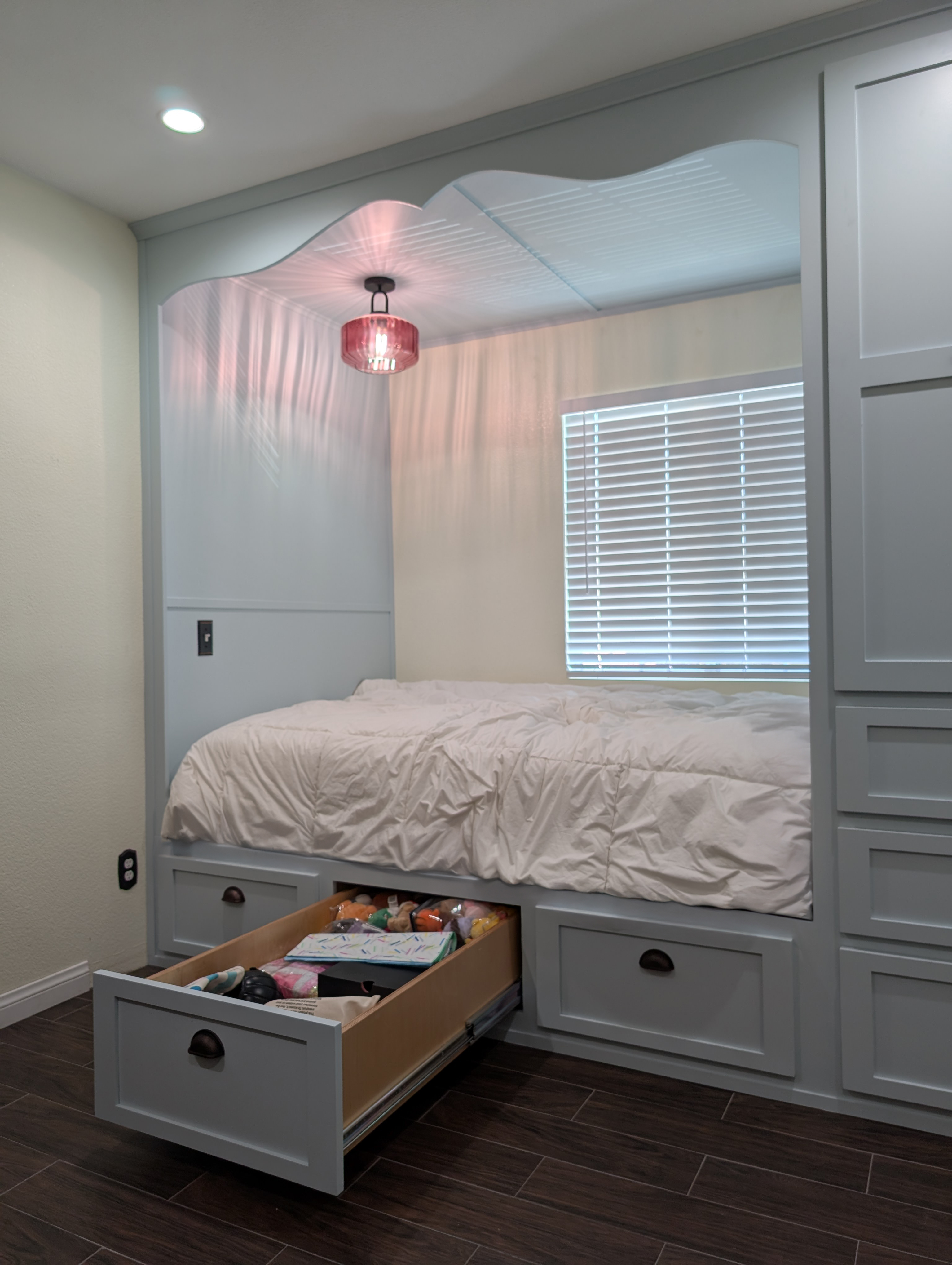
Every material in the Escalante project was verified under actual working conditions — not described in a spec sheet. Brian stood inside one of the extended drawer boxes to demonstrate the structural integrity of the ¾-inch Baltic birch construction and the FR 5400 slides. The drawer held him. That is the load test that matters.
What was used and why:
-
¾" true Baltic birch — carcass, drawer boxes including bottoms — specified for void-free core and screw-holding at load-rated depths
-
Paint-grade poplar — face frame — correct material, correctly priced for this position
-
Hard maple shaker fronts, 2" rails and stiles, MDF center panels — durable edges, stable panels, correct for Inland Empire climate
-
Fulterer FR 5400 — 48" under-bed drawers and 60" pull-out wardrobe — the only industrial slide available in 60" length for this application
-
Blum TANDEM Plus BLUMOTION — wardrobe tower drawers — soft-close, concealed, 100 lb rated, correct for standard wardrobe drawer loads
-
Bondo, sand, re-Bondo, re-sand — wall cladding, face frame, door and drawer fronts — the prep sequence that makes the finish look right
The Holland & Sons Angle
The Escalante project's pull-out wardrobe required a mid-build hardware switch. The original specification called for standard hardware. When the scope changed to a 60-inch pull-out wardrobe carrying a full hanging load, Brian researched the available slide options, found the FR 5400 series, and specified it correctly before fabricating the cabinet box that would carry it. That sequence — figure out what the application actually demands, then build to that specification — is the difference between engineering and guessing.
Brian's son Wyatt was on that project, handling the FR 5400 extensions that he later used as dip bars during a break. He learned what a 550-pound-rated slide looks and feels like in the hands, and more importantly, why it was there instead of the standard hardware. That knowledge transfers to every project after this one — not as a rule to follow, but as an engineering logic that he can apply when the application demands it.
Frequently Asked Questions
What is the best plywood for custom built-in bed drawer boxes?
¾-inch true Baltic birch plywood is the correct specification for load-bearing carcass work and deep drawer boxes. Void-free core, 13 plies in a ¾-inch sheet, superior screw-holding strength at joints. Standard cabinet-grade plywood with internal voids and fewer plies is not appropriate for drawer applications carrying hundreds of pounds at 48-inch depths.
What are the best drawer slides for heavy under-bed storage?
For drawer depths over 30 inches or working loads over 200 pounds per pair, the Fulterer FR 5400 series is the correct specification. Rated 450 to 550 pounds per pair depending on length, available to 60 inches, cold rolled steel with stainless ball bearings. For standard wardrobe drawers at 18 to 24 inches depth under normal residential loads, Blum TANDEM Plus BLUMOTION soft-close is the reliable choice at 100 pounds per pair.
Is MDF or solid wood better for drawer fronts on a painted built-in?
The best approach is a combination: hard maple rails and stiles with MDF center panels. Solid maple at the frame perimeter delivers durable, paint-holding edges at high-contact zones. MDF panels are dimensionally stable in the Inland Empire's humidity range and paint flat. All-MDF construction holds fasteners poorly at joints. All-solid-wood panel construction shows paint cracks at the panel-to-frame joint over time in dry climates.
What paint is best for a painted built-in in Southern California?
Dunn-Edwards is Brian's preferred brand for Inland Empire painted built-ins. The finish prep matters more than the brand: Bondo fill, sand, re-Bondo, re-sand before any primer. Stain-blocking primer (Zinsser BIN or equivalent) before topcoat on poplar surfaces. Satin or eggshell sheen on built-ins — cleanable, durable, correct for bedroom applications.
Is poplar or maple better for face frames on a painted built-in?
Paint-grade poplar is the correct specification for face frames on painted built-ins. It machines cleanly, accepts paint well, and is cost-effective relative to harder species. Maple is harder and more durable but is better allocated to door and drawer fronts where edge durability is the priority. Face frame material grade has less impact on the finished product than drawer slide specification — allocate budget accordingly.
What are the best drawer slides for a pull-out wardrobe?
A pull-out wardrobe in daily use requires industrial-grade side-mount slides rated for the actual working load of a fully loaded hanging wardrobe. The Fulterer FR 5400 in 60-inch length was specified for the Escalante pull-out wardrobe because no standard residential undermount slide is available in 60-inch length or rated for this dynamic load application. There is no residential alternative that does this job.
What is the difference between true Baltic birch and domestic substitutes?
True Baltic birch from Finland and the Baltic states has 13 plies in a ¾-inch sheet, a void-free core, and consistent face veneer quality. Domestic "Baltic birch" and lower-grade imports have 7 plies or fewer, internal voids, and inconsistent face veneer. The difference is visible in cross-section and measurable in screw-holding tests. For structural built-in work, only true Baltic birch is the correct specification.
Ready to Talk About Your Project?
If you're planning a custom built-in bed for a bedroom in Menifee, Murrieta, Temecula, Perris, or anywhere in the Inland Empire — fill out the form at hsconstruct.com/contact. Describe the room and what you're trying to build, and upload any photos or sketches. Brian reviews every submission personally.
Serving Menifee, Murrieta, Temecula, Perris, Riverside, and the greater Inland Empire since 1991.
951-338-8058 | brian@hsconstruct.com | hsconstruct.com | CSLB #1123738
More Than Just Custom Beds
Custom built-in platform beds are one part of what Brian and his sons have been building since 1991 — which means every room in your home is fair game.
If your space needs more than a built-in bed, here's what else we build:
-
Kitchen and bathroom remodels — full custom cabinetry, tile work, and finish carpentry from demo to done
-
Coffered ceilings — grid beam systems that add architectural depth to any room, sized and proportioned to the space
-
Wainscoting and wall paneling — classic raised panel, flat panel, board-and-batten, and shiplap applications
-
Reclaimed wood accents — feature walls, fireplace surrounds, and detail work using salvaged material with real character
-
Beam wraps — hollow wood wraps that give exposed beams the look of solid timber without the structural engineering
-
Crown molding, baseboards, and trim carpentry — the details that make a house feel finished, from a single room to a whole home
-
Cased openings and interior door replacements — clean transitions between spaces that most contractors overlook
-
Custom built-in entertainment walls and bookshelves — designed by hand, built in the shop, installed to last
Wood, proportion, and rooms that feel right — that's what we do.
About the Author
Brian Holland is the owner and lead carpenter of Holland & Sons Construction, a family-run finish carpentry and general contracting company serving Riverside County and the Inland Empire since 1991. He entered the trade at 17, learned on the job, and has spent 35 years building the kind of work that makes rooms feel right — often before a homeowner can articulate why. His sons now apprentice alongside him on every project. Holland & Sons is based in Perris, CA and licensed by the CSLB (#1123738).
Related project
This guide is part of our custom built-ins & cabinetry series.
Learn more about Custom Built-Ins & CabinetryHave a project in mind? Let's start a conversation.
Tell us what you are thinking about and we will give you a straight answer about scope, timeline, and investment.
Start a Conversation