Authentic Reclaimed Barn Wood vs. Aged & Faux Wood: Which Is Right for Your Inland Empire Home?
| Quick Answer: For an Inland Empire homeowner who wants the real thing, authentic reclaimed barn wood is the right call — genuine century-old patina, old-growth stability, and a true story, at a premium of roughly $6,000–$9,000 over aged lumber on a feature build. For a homeowner who simply wants the rustic look on a budget, quality 'aged' wood or DIY peel-and-stick panels deliver the appearance for far less. The deciding question isn't which is better — it's whether you're buying the material or the look. |
Key Takeaways
-
Authentic reclaimed wood is genuine old material; 'aged' wood is new lumber distressed to look old. Both are legitimate — the difference is real.
-
Authentic stock costs roughly $6,000–$9,000 more on a feature build but is more stable and carries true patina that can't be faked.
-
The deciding question is whether authenticity matters to you, or whether you just want the look — there's no universally right answer.
-
Brian Holland works with both and tells you exactly which you're getting — Holland & Sons never blurs the line.
If you're choosing between authentic reclaimed barn wood and a cheaper 'aged' or faux look-alike, here's the straight answer most articles dance around: for a homeowner who genuinely wants the real material, authentic wins, and the premium is worth it. For a homeowner who mostly wants the rustic appearance, aged or faux wood is the smarter spend. The choice isn't about which is objectively better — it's about what you're actually buying.
That sounds simple, and at the decision level it is. But the reasons behind it are worth understanding, because they affect cost, how the wall ages, how stable it stays in our dry Inland Empire climate, and how it reads to you and to a future buyer. Get those tradeoffs clear and the decision makes itself.
Brian Holland has installed both across Riverside County since 1991, and the comparison below is built on what each material actually does in a real home — not on a supplier's sales copy.
The Direct Answer
Brian's recommendation for the most common Inland Empire situation: if authenticity is any part of why you want wood, go authentic. The homeowners who choose authentic almost never regret it, while the ones who choose a cheaper look-alike to save money sometimes wish they'd spent up — because the wall is the centerpiece of the room and they look at it every day. That said, when a homeowner is honest that they just want the warm rustic look and the budget is the priority, quality aged wood is the right, no-regret call. The wrong move is paying for authentic when you don't care, or settling for faux when you do.
Authentic vs. Aged: The Side-by-Side
Here's the full evaluation across the factors that actually drive the decision:
| Factor | Authentic Reclaimed Wood | Aged / Faux Wood |
| Cost | Premium — adds ~$6,000–$9,000 on a feature build | Significantly lower; biggest budget lever |
| Character | Genuine century-old patina, true irregularity | Convincing at a distance; less depth up close |
| Stability | Old-growth, decades of drying — very stable | New wood; more prone to minor movement |
| Sustainability | Salvaged, reused material — carbon-friendly | New lumber milled and processed; less so |
| Availability | Finite supply; lead time to hand-select | Readily available, consistent stock |
| Maintenance | Raw, minimal — occasional dusting | Similar; some finishes need more care |
| Resale Appeal | Recognized premium feature; reads as 'real' | Adds warmth; less of a story for buyers |
Why This Comparison Matters in the Inland Empire
The reason this question comes up so often is that the look has gone mainstream — reclaimed wood walls are all over Pinterest and HGTV — and the market has filled with products at every price point claiming to deliver it. A homeowner searching for a feature wall finds peel-and-stick kits, distressed new planks, engineered look-alikes, and genuine salvaged stock all using the same buzzwords. The generic advice online treats them as interchangeable. They aren't.
Where Brian's field experience changes the answer is in two places specific to our region. First, our dry climate with big temperature swings rewards the dimensional stability of authentic old-growth stock — it has already done its moving. Second, Inland Empire homes in Norco, Menifee, and Temecula are largely builder-grade tract houses competing against each other, so a genuine, characterful feature does more to distinguish a home here than it would in a market full of unique older houses. Authenticity carries more weight where everything else looks the same.
The Other Options — Peel-and-Stick and Engineered
Beyond the authentic-versus-aged fork, two more alternatives come up. Rather than treat them as equals to the main comparison, here's the honest summary of where each fits:
| Option | What It Solves | What It Doesn't Solve | Right For |
| Peel-and-stick panels | Cheapest, fastest, DIY-friendly | Lacks depth; poor fit around obstacles | Rentals, quick refreshes, simple walls |
| Engineered / faux planking | Consistent color, lower cost, stable indoors | No genuine patina or old-growth character | Look-focused budgets, large areas |
| Reclaimed shiplap | Milled to fit, easier install than raw stock | Less irregular character than rough barn wood | Cleaner rustic look, faster installs |
For how these break down by actual dollars — and real pricing examples for each option — see our full guide to what a reclaimed wood accent wall costs.
The Bug Question — Where Authentic Wood Earns Trust
One real, practical difference between sources is treatment. Genuine salvaged wood has spent decades outdoors, so it can carry beetles or wood-boring insects if it isn't handled properly. This is not a reason to avoid authentic wood — it's a reason to source it through a specialist who treats it. On the Broken Twig project, the authentic Kentucky barn wood was fumigated against insects after resawing and before it ever entered the home. Faux and engineered products don't carry this risk because they're new material, but they also don't carry the patina. The point is simple: authentic wood requires a trustworthy source, and a trustworthy source eliminates the risk entirely.
The Decision Framework
When is each the right call? Be honest with yourself about one question and the rest follows.
-
Choose authentic when the real material is the point — when you'd feel the difference knowing it's genuine, when stability matters, or when the feature is the room's centerpiece and you'll live with it for years.
-
Choose aged when you want the rustic look, the budget is the priority, and you're candid that authenticity isn't what's driving the project. There's no shame in this — it's often the smart spend.
-
Choose peel-and-stick or engineered when it's a rental, a temporary refresh, a very large area, or a clean rectangular wall where fit around obstacles isn't a concern.
See This In Action — The Broken Twig Project, Norco
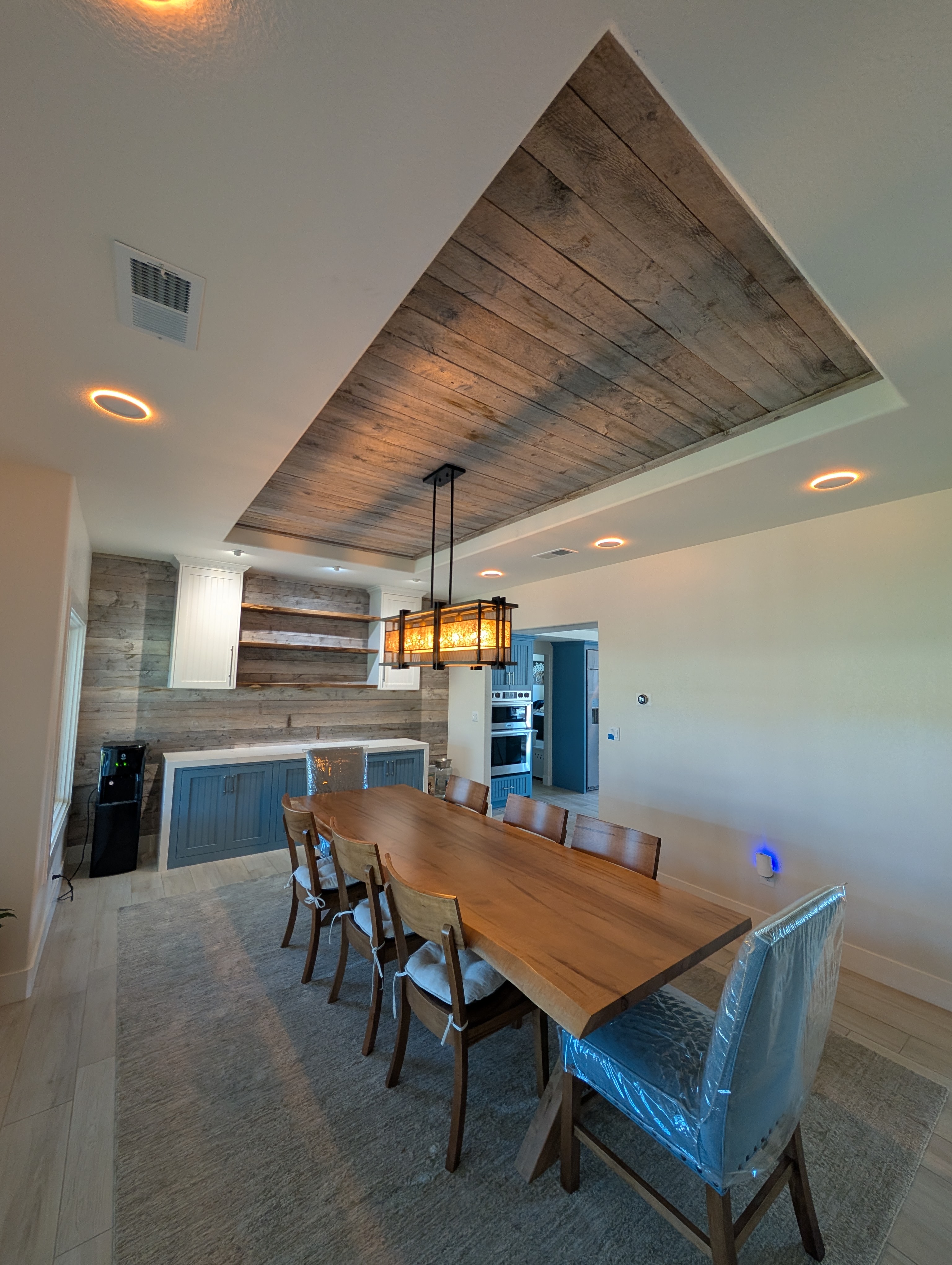
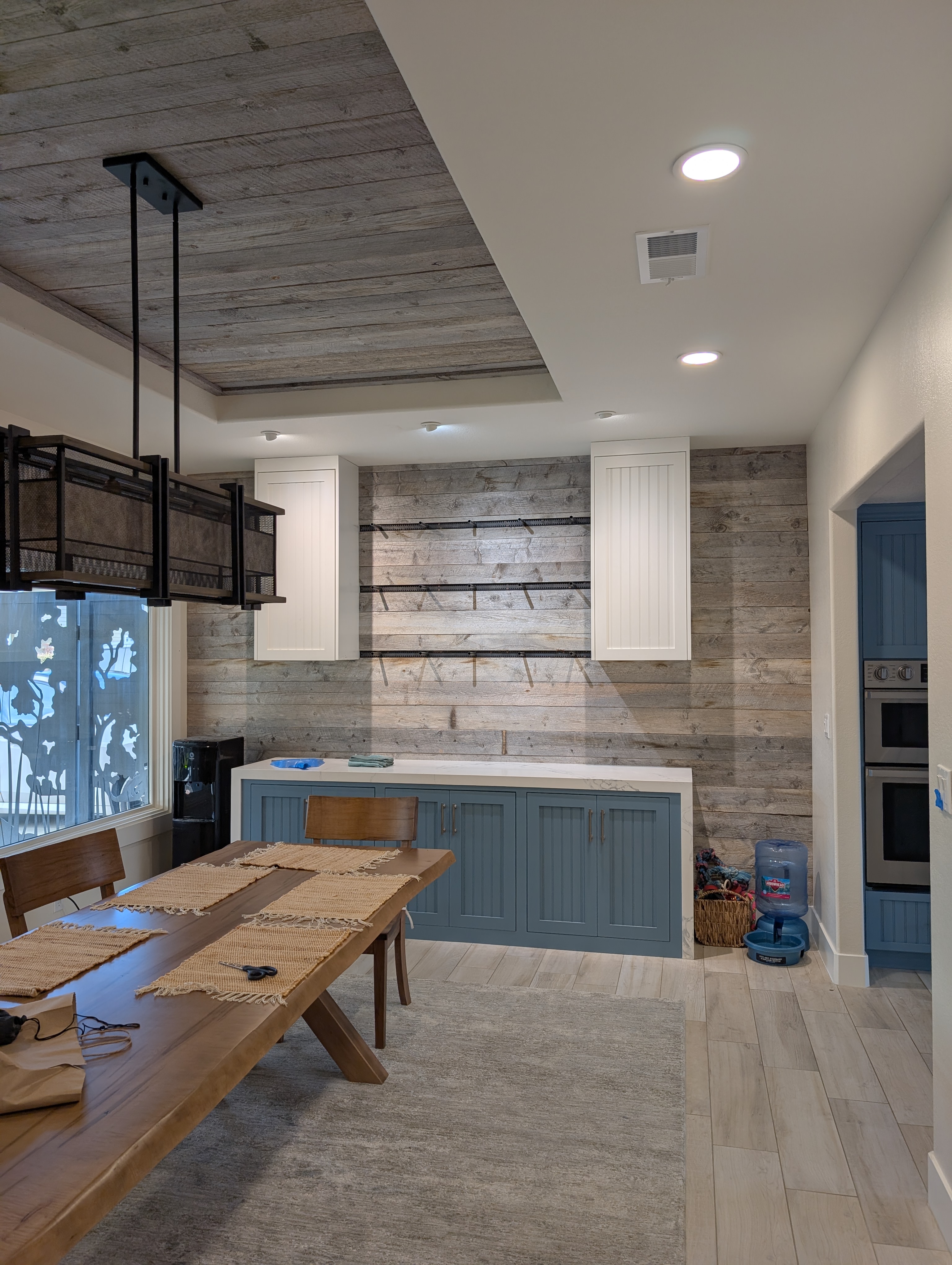
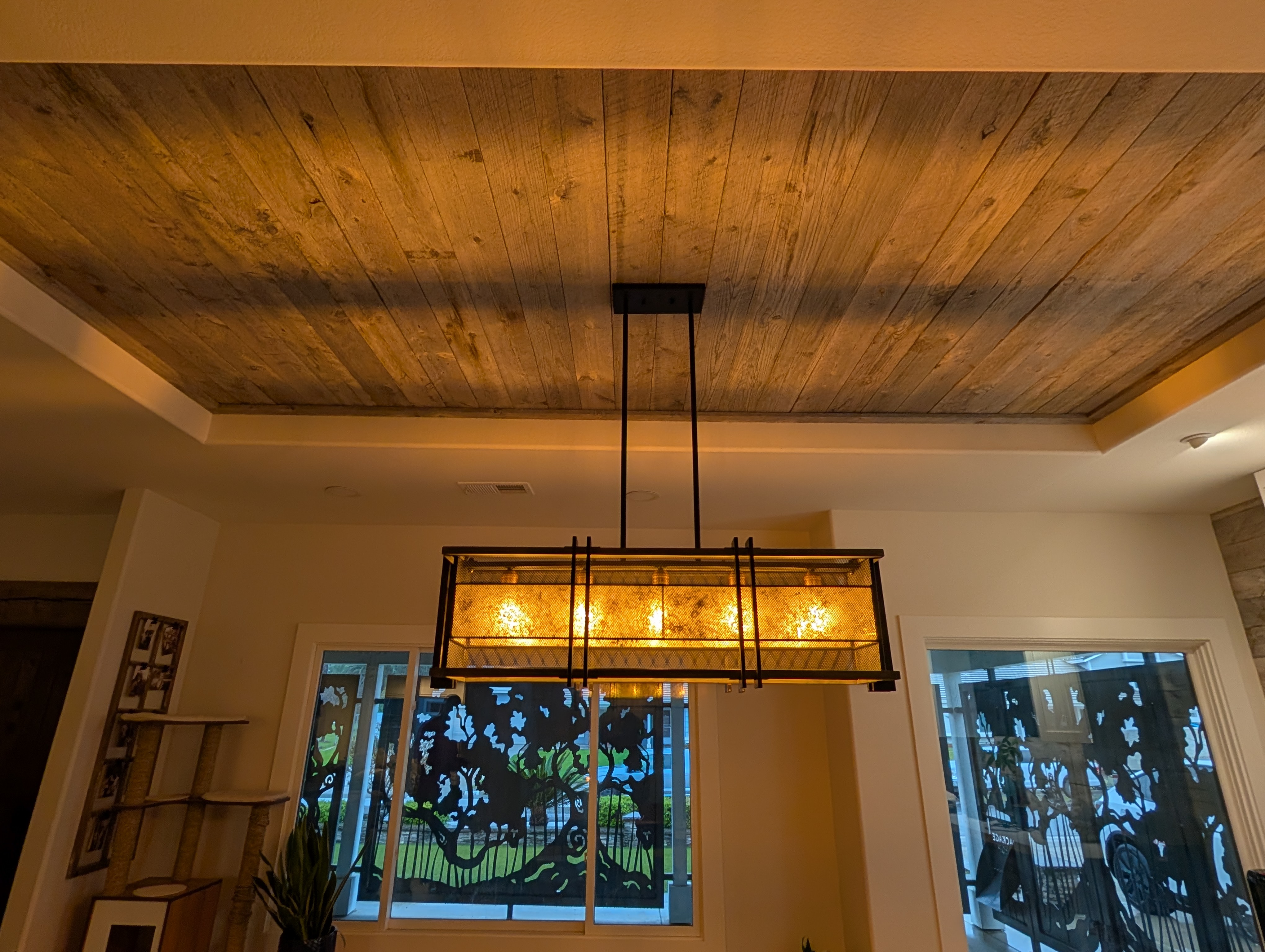
For the Broken Twig family, the authentic-versus-aged decision came up directly in the design phase — and they chose authentic 100+ year-old Kentucky barn wood without hesitation, because their whole life revolves around an authentic, horse-and-outdoors way of living and a faux version would have rung false. Brian laid out the honest tradeoff: real century-old stock meant more cost and far more careful handling of fragile, irreplaceable material, against a cheaper aged look-alike. For this family, authenticity was non-negotiable, so it was the right call. On a different project with a different priority, the answer might have been aged wood — and that would have been right too.
What we used on this project:
-
Authentic 100+ year-old Kentucky reclaimed barn wood, hand-selected and sourced through a reclaimed-wood specialist.
-
Originally full 2x6 tongue-and-groove barn walls, resawn to 1x6 and fumigated against insects.
-
Installed raw and aged-side-out to preserve the genuine patina.
-
Chosen over aged lumber at a premium of roughly $6,000–$9,000 — a deliberate, discussed decision.
Regional Performance Note
In the dry Inland Empire, both materials perform well indoors — there's no moisture exposure on an interior accent wall to punish either one. The meaningful difference is movement. Authentic old-growth stock has cycled through a century of seasons and barely moves, which suits our big day-to-night and seasonal temperature swings. Aged lumber is newer and will equalize and shift a bit more after install, which makes proper acclimation more important with aged wood than with authentic. Faux and engineered products are dimensionally stable but bring their own consideration — some can look flat under our intense direct sunlight, where the real grain and irregularity of authentic wood comes alive. In a sun-filled, west-facing room, authentic wood has a genuine visual edge.
The Holland & Sons Angle
The most important thing Brian does on this decision isn't installing the wood — it's refusing to blur the line about what it is. A lot of the industry sells distressed new lumber as 'reclaimed' and lets the customer assume it's century-old stock. Holland & Sons won't. If you're getting aged wood, you'll be told it's aged wood, and you'll pay an aged-wood price for it. If you're getting authentic, you'll know exactly which barn it came from. That honesty is the whole foundation of trust on a project like this, because the difference is something you're paying real money to get right.
This is also where Brian's sons learn to read wood — a skill that takes years. On a recent sort, one of them worked through a stack separating boards by their actual character: the deep, dimensional patina of genuine old stock versus the shallower, more uniform look of distressed new lumber. Learning to see that difference by eye and by hand — to know the real thing from the imitation at a glance — is exactly the judgment that lets Holland & Sons tell a customer the truth about what they're buying. It gets passed down one board at a time.
Related Resources — Reclaimed Wood Feature Guide
This comparison is part of a full series on planning a reclaimed wood feature in the Inland Empire. The companion guides cover the rest:
-
How Much a Reclaimed Wood Accent Wall Costs — real numbers for authentic, aged, and DIY options.
-
What Goes Wrong With Reclaimed Wood Walls — installation problems, bugs, and wood movement.
-
Best Wood for Floating Shelves & Feature Walls — species picks once you've chosen authentic or new.
-
How to Hire a Finish Carpenter — how to find a contractor who'll tell you the truth about materials.
-
The Hidden Layer Behind a Reclaimed Wood Wall — backing, substrate, and mounting behind the finish.
Frequently Asked Questions
What is the difference between authentic reclaimed wood and aged wood?
Authentic reclaimed wood is genuine old material — actual century-old boards salvaged from a structure like a barn — while 'aged' wood is new lumber that's been weathered, distressed, or stained to look old. The difference is real, not just a label. Authentic wood carries true patina, old-growth density, and decades of slow drying that make it exceptionally stable. Aged wood mimics the appearance at a lower cost but lacks the history and the dimensional stability. On the Broken Twig project in Norco, the family chose authentic 100+ year-old Kentucky barn wood specifically because authenticity was non-negotiable for them. Both are honest choices — a good contractor tells you exactly which one you're getting and never blurs the line between them.
Is faux reclaimed wood as good as real reclaimed wood?
Faux reclaimed wood is not as good as real reclaimed wood in authenticity, character, or long-term stability, but it can be a sensible choice depending on your priorities. Faux and engineered products replicate the weathered look at a fraction of the cost and with more consistency in color and dimension. What they can't replicate is genuine century-old patina, old-growth density, or the story of the material. If your goal is purely the look and you're working to a budget, faux can deliver. If authenticity, longevity, and the sense that the wood is the real thing matter to you, only authentic stock satisfies that. The right answer depends entirely on which of those you value more — there's no universally correct pick.
Is reclaimed barn wood worth it?
Authentic reclaimed barn wood is worth it when authenticity, stability, and lasting character are priorities — and less worth the premium when you simply want the rustic look on a budget. The premium is real: on a feature build the size of the Broken Twig project, choosing authentic Kentucky barn wood over aged lumber added roughly $6,000 to $9,000. What you get for that is genuine old-growth wood that's more dimensionally stable than new lumber, a patina that can't be faked, and a material with a true history. For a homeowner whose whole reason for the project is the real thing, it's clearly worth it. For someone who'd be just as happy with the appearance, aged or faux wood is the smarter spend. Decide what you're actually buying — the look, or the real material.
Is peel-and-stick barn wood any good?
Peel-and-stick barn wood can look surprisingly good on a simple, dry accent wall and is the most affordable, DIY-friendly option available. It's thin, adhesive-backed reclaimed or faux planking that a homeowner can install in a weekend with basic tools. The tradeoffs are depth and fit: thin panels lack the substance and shadow of solid stock, and they rarely wrap cleanly around cabinets, outlets, or trim without visible seams. Reviews consistently note that a darker wall color behind the planks helps hide any gaps that show through. For a rental, a quick refresh, or a clean rectangular wall on a tight budget, peel-and-stick is a reasonable pick. For a permanent feature you want to look custom, solid material installed by a finish carpenter is the better investment.
Will anyone be able to tell the difference between real and fake reclaimed wood?
Up close, yes — most people can feel the difference between authentic and faux reclaimed wood even if they can't name it, because genuine old wood has depth, irregularity, and a tactile patina that printed or distressed surfaces don't fully capture. From across a room, a well-chosen aged or faux product can read convincingly. The honest truth runs both ways: authentic wood rewards close inspection in a way fakes don't, but a cheap, obviously-uniform faux product also gives itself away quickly. If your wall will be seen and touched daily, authenticity holds up better over time. If it's a backdrop seen mostly at a distance, the gap narrows. We'll tell you candidly how each option will read in your specific room.
Does aged or faux wood last as long as authentic reclaimed wood?
Authentic reclaimed wood generally outlasts aged and faux alternatives because old-growth stock is denser and has already done most of its dimensional movement over a century of seasons. Aged lumber is new wood, so it hasn't cycled through decades of expansion and contraction and is more prone to minor movement after install. Faux and engineered products vary widely — some hold up well indoors, others are essentially decorative surfaces with a limited life. None of these is fragile on an interior accent wall, where there's no moisture or heavy wear, so all can last many years. But if longevity and stability are part of why you're choosing wood at all, authentic stock has a measurable edge. For most interior features, the practical difference is smaller than the appearance and authenticity difference.
Let's Talk About Your Project
Still deciding between authentic and aged wood for your room? That's exactly the kind of tradeoff we lay out honestly in the design phase. Head to our contact page, fill out the form, tell us about your space and your priorities, and upload any inspiration photos. We'll help you figure out whether you're buying the material or the look — and price it accordingly, before anything is committed.
We serve Norco, Corona, Eastvale, Riverside, Temecula, Murrieta, Menifee, Perris, and the wider Inland Empire. Follow our latest work on social media, and reach out whenever you're ready.
951-338-8058 | brian@hsconstruct.com | hsconstruct.com | CSLB #1123738
More Than Just Reclaimed Wood
Choosing the right wood is one decision inside a bigger vision for a room. Brian and his sons have been finish carpenters since 1991, which means every room in your home is fair game.
If your space needs more than that, here's what else we build:
-
Kitchen and bathroom remodels — full custom cabinetry, tile work, and finish carpentry from demo to done
-
Coffered ceilings — grid beam systems that add architectural depth to any room, sized and proportioned to the space
-
Wainscoting and wall paneling — classic raised panel, flat panel, board-and-batten, and shiplap applications
-
Reclaimed wood accents — feature walls, fireplace surrounds, and detail work using salvaged material with real character
-
Beam wraps — hollow wood wraps that give exposed beams the look of solid timber without the structural engineering
-
Crown molding, baseboards, and trim carpentry — the details that make a house feel finished, from a single room to a whole home
-
Cased openings and interior door replacements — clean transitions between spaces that most contractors overlook
-
Custom built-in entertainment walls and bookshelves — designed by hand, built in the shop, installed to last
Wood, proportion, and rooms that feel right — that's what we do.
hsconstruct.com
About the Author
Brian Holland is the owner and lead carpenter of Holland & Sons Construction, a family-run finish carpentry and general contracting company serving Riverside County and the Inland Empire since 1991. He entered the trade at 17, learned on the job, and has spent 35 years building the kind of work that makes rooms feel right — often before a homeowner can articulate why. His sons now apprentice alongside him on every project. Holland & Sons is based in Perris, CA and licensed by the CSLB (#1123738).
This guide is part of our accent walls series.
Learn more about Accent WallsHave a project in mind? Let's start a conversation.
Tell us what you are thinking about and we will give you a straight answer about scope, timeline, and investment.
Start a Conversation